









- bhavya gada
- No Comments
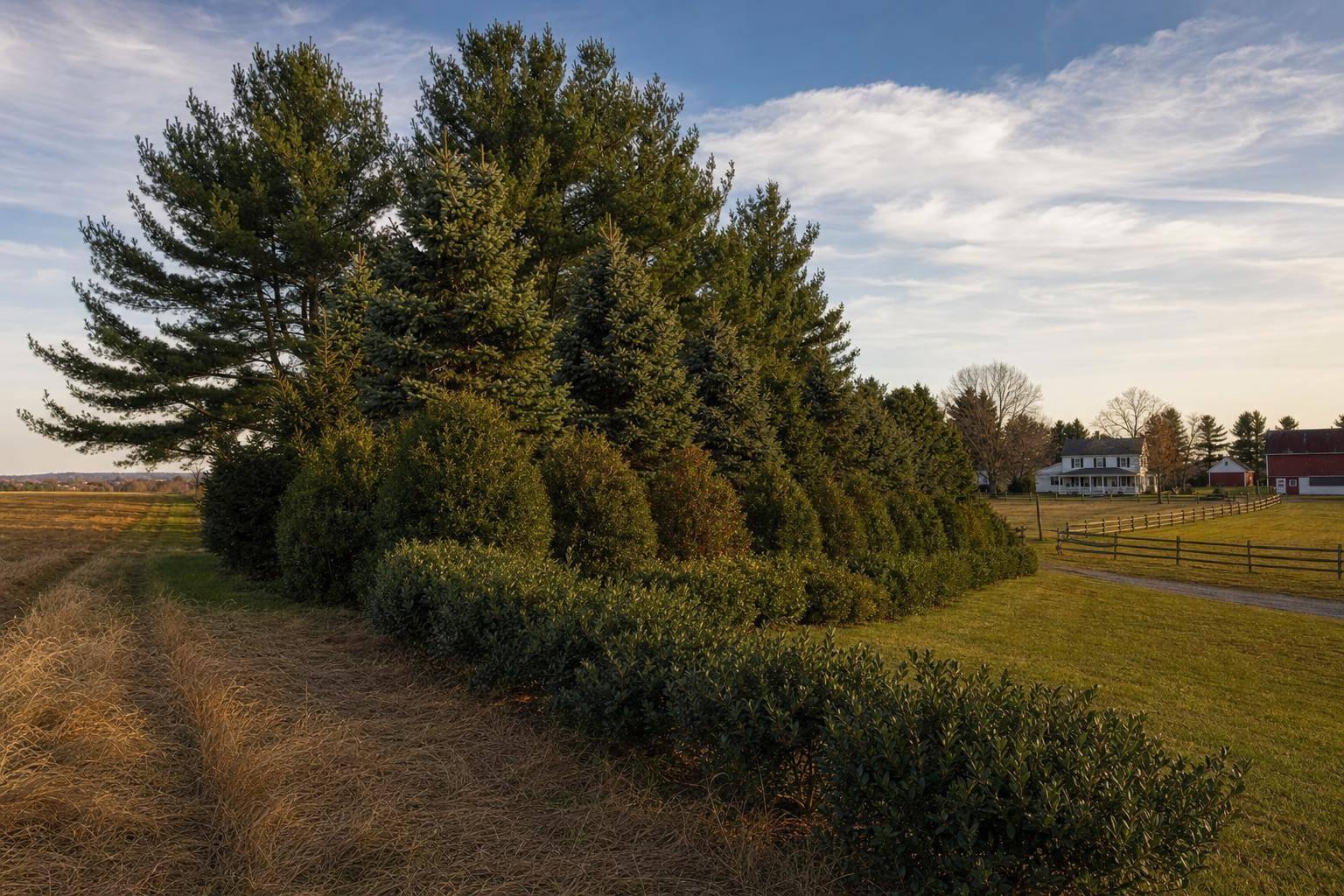
If I wanted a Maryland windbreak that works in winter, I’d start with evergreens, plant them on the north and west sides, and match each tree to the soil first. The top picks here are Eastern Redcedar, Green Giant Arborvitae, White Spruce, Eastern White Pine, American Holly, and Bald Cypress.
Here’s the short version:
- Eastern Redcedar: best all-around pick for dry, poor, or mixed soils
- Green Giant Arborvitae: best if I want a screen fast; often grows 3 to 5 feet per year
- White Spruce: good for exposed spots and mixed moisture
- Eastern White Pine: tall back-row tree for big lots; can reach 50 to 80 feet
- American Holly: fills the lower layer; often grows 15 to 30 feet
- Bald Cypress: best choice for wet ground, but it drops leaves in winter
A good windbreak is not just “plant some evergreens.” It needs dense growth near the ground, room for mature spread, and the right layout. On many larger Maryland lots, 2 to 3 staggered rows work better than one straight line because gaps matter less and coverage is thicker.
How to Choose Wind Break Trees
sbb-itb-843f8be
Quick Comparison
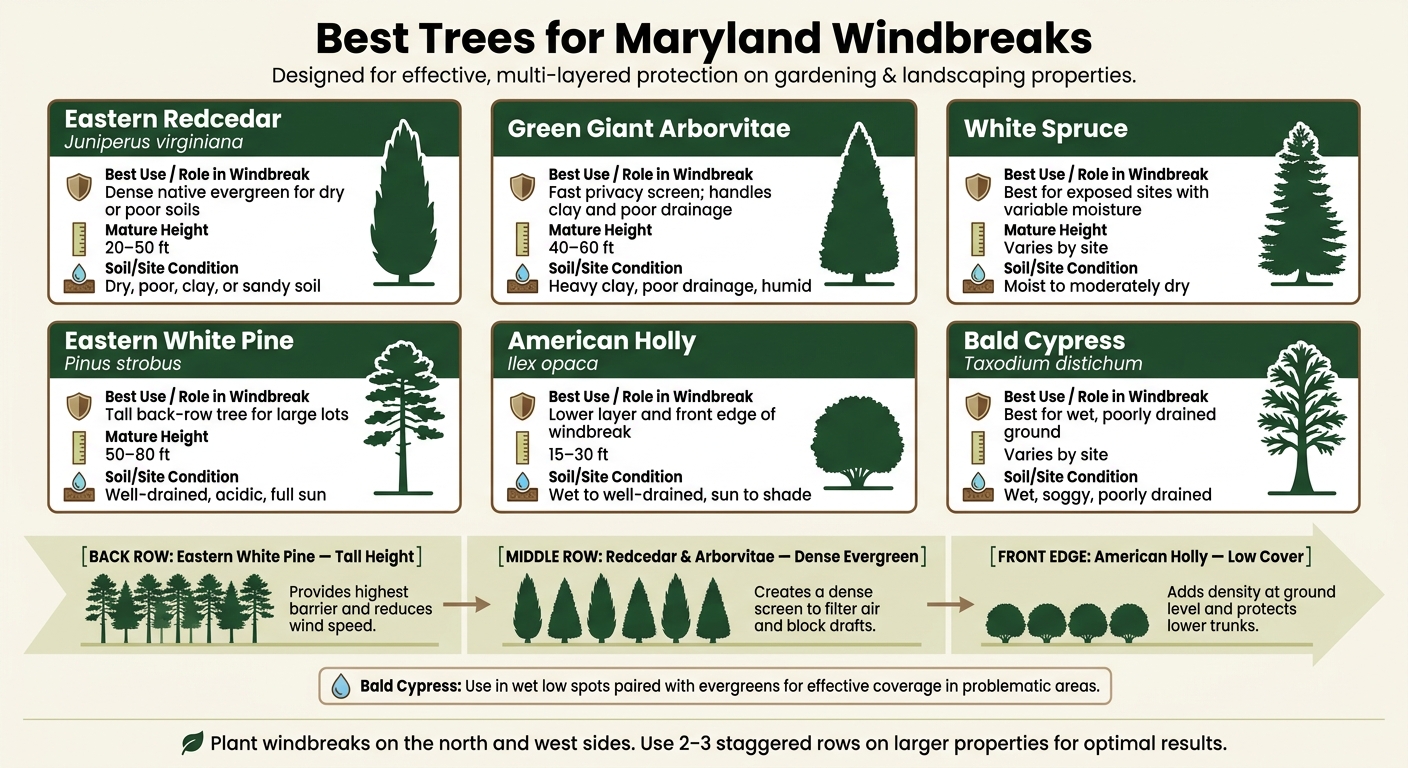
Best Trees for Maryland Windbreaks: Quick Comparison Guide
| Tree | Best Use | Height |
|---|---|---|
| Eastern Redcedar | Dense evergreen for dry or poor soil | 20 to 50 ft. |
| Green Giant Arborvitae | Fast privacy screen; handles clay | 40 to 60 ft. |
| White Spruce | Exposed sites; mixed moisture | Varies by site |
| Eastern White Pine | Tall back row on large properties | 50 to 80 ft. |
| American Holly | Lower layer and front edge | 15 to 30 ft. |
| Bald Cypress | Wet, poorly drained areas | Varies by site |
If I were planning one from scratch, I’d use height in back, dense evergreens in the middle, and lower cover in front. That simple setup does a much better job of slowing winter wind, a key part of our professional landscaping services.
What Makes a Good Windbreak Tree in Maryland?
Not every tree can do this job well. The best windbreak trees stay evergreen, handle Maryland weather, and stand up to wind, snow, and ice. That’s what separates a tree that just hangs on from one that actually blocks wind. And no, being evergreen by itself isn’t enough. A windbreak also needs density.
Evergreen foliage keeps the screen in place through winter. Deciduous trees drop their leaves right when cold winds start to hit, so the barrier weakens when you need it most.
Dense branching from the ground up matters just as much. If a tree has a tall canopy and a bare lower trunk, wind can slip right underneath it. That defeats the whole point. The best windbreak trees keep their branches low to the ground, forming a thick wall instead of a canopy on stilts.
Structural strength and pest resistance shape how long the planting will last. Native and well-suited trees often deal better with local pests and storm damage. Still, even a good species can struggle if you put it in the wrong spot.
Placement matters too. Plant windbreaks on the north and west sides of homes, barns, and outdoor living areas, since winter winds in Maryland usually come from those directions. Even the best tree needs proper exposure and spacing to work well.
One more thing: match the tree to your soil and drainage. A good species can fail fast in the wrong site. With those basics in place, the next six trees are the best options for Maryland.
Maryland Windbreak Layout Basics Before You Plant
Start by mapping the winter winds on your lot. Then place the windbreak perpendicular to that wind. After that, figure out whether your site needs a single row or several rows.
On larger properties, two or three staggered rows usually work better. That way, one opening or one dead tree doesn’t weaken the whole barrier. Once the rows are set, spacing becomes the next thing to sort out.
Space trees based on their mature spread. That usually means about 40 to 60 feet for large trees and 25 to 40 feet for medium trees like Eastern Redcedar. This helps preserve airflow and lowers canker risk in tight arborvitae or cypress plantings.[7][4]
Fill the base, too. Low evergreen shrubs can block gaps near ground level, which is often where wind slips through.
If your site has slopes, wet spots, heavy clay, or buried utilities, Pro Landscapes MD can review grading and drainage before planting. That layout work helps the trees below perform better.
1. Eastern Redcedar
Eastern Redcedar is the best place to start because it handles Maryland’s wind, soil, and winter exposure with very little fuss.
Eastern Redcedar (Juniperus virginiana) is a tough native windbreak tree for Maryland. It grows well across much of the state and does fine in poor, dry, or heavy soils. Its dense evergreen foliage stays full from the ground up, which gives you a screen in every season. At maturity, it reaches 20 to 50 feet tall [4], so it works well for cutting wind around homes, barns, and outbuildings. Its roots hold well in both clay and sandy soils, helping it stand up on exposed sites [6].
It is highly wind-tolerant, standing firm against strong winter winds and storm exposure across Maryland’s open rural corridors. [6]
For spacing, plant trees 6 to 10 feet apart in a staggered two-row zigzag pattern for the fastest, most solid barrier. [6]
It’s a strong first pick, especially if your soil is lean and the wind doesn’t let up.
2. Green Giant Arborvitae
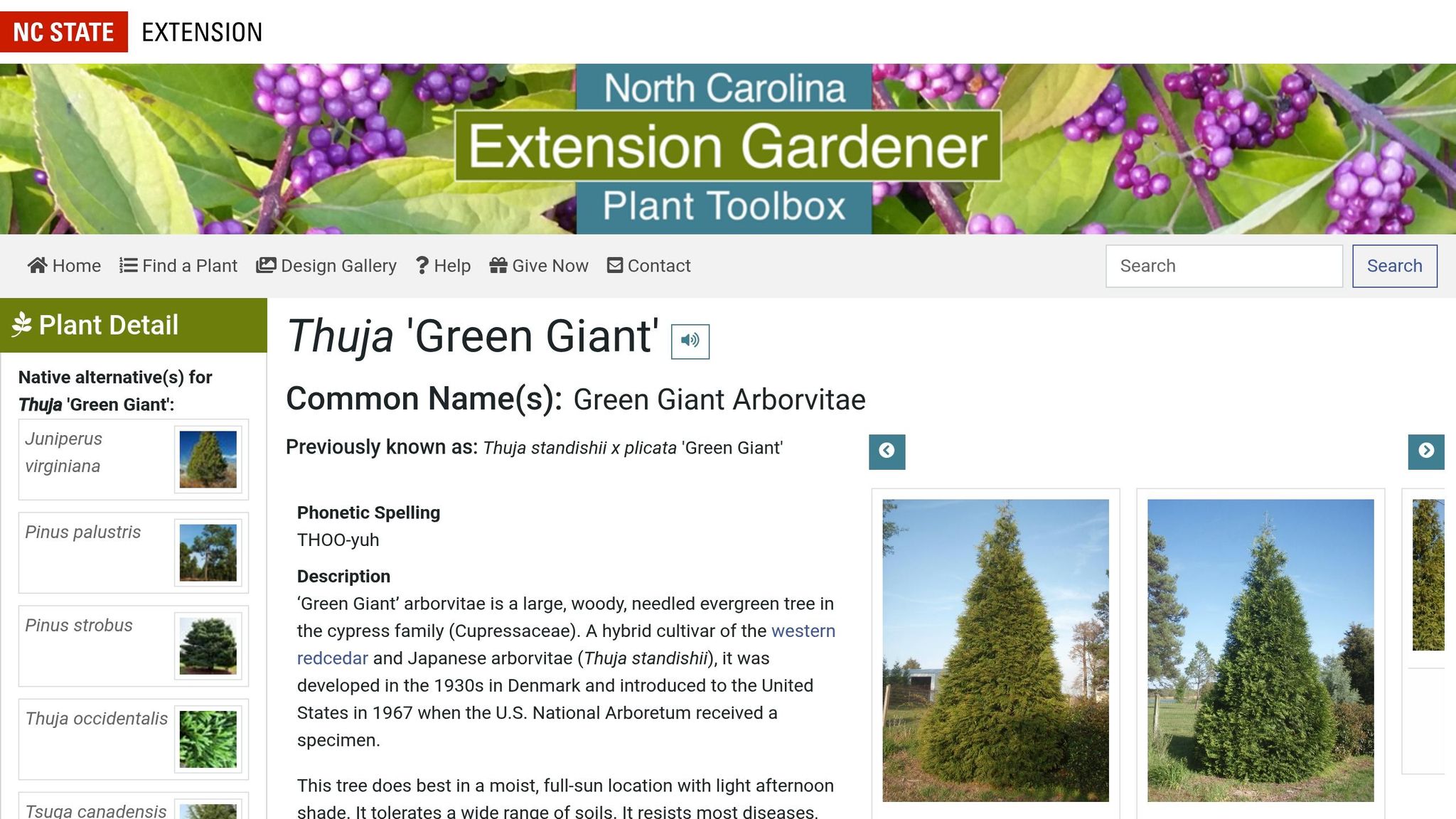
If you want privacy sooner than many native evergreens can give you, Green Giant arborvitae is a solid pick. In good conditions, it can grow 3 to 5 feet per year and reach 40 to 60 feet tall with a 12- to 18-foot spread.
That fast growth is the big draw. It’s also a good fit for tougher spots. Green Giant handles heavy clay and poor drainage well, and it puts up with humid summers and occasional summer drought [6]. If your main goal is fast screening, this one does the job.
3. White Spruce
For exposed spots that need solid winter cover, white spruce is a strong next pick. It provides year-round screening on exposed Maryland sites.
Plant white spruce 6 to 10 feet apart in a staggered two-row pattern if you want a thicker barrier.[6]
White spruce can handle both moist and moderately dry soils, which makes it a good fit for Maryland properties with uneven drainage.[3] That range gives you more room to work with, but young trees still need some care while they get settled.
Give each tree enough space so its mature spread doesn’t crowd structures or buried utilities.[3][6] Young trees may also need staking during establishment.[3]
4. Eastern White Pine
For taller sites that need overhead wind protection, Eastern White Pine (Pinus strobus) is a strong pick. It grows fast, and because it stays green all year, it keeps that wind screen in place through winter [4][1].
At full size, it can reach 50 to 80 feet tall with a spread of 20 to 40 feet. That makes it a good fit for the back row of a windbreak on large lots or acreage where height matters [4][2]. Give it plenty of room. Keep it well away from utility lines, foundations, and septic systems [3].
This tree is native to Maryland and is naturally suited to the state’s Mountain and Piedmont regions [2]. It grows best in deep, well-drained, acidic soil with full sun to partial sun [4]. Average moisture is fine, but standing water is not [3].
Young trees may need protection from deer browse, and it’s smart to watch for white pine blister rust [4][1].
5. American Holly
For the lower layer of a windbreak, American holly brings dense evergreen cover without eating up much room. American Holly (Ilex opaca) is a native evergreen that screens year-round, which makes it a smart pick for a Maryland windbreak.
It usually grows to 15 to 30 feet tall with a 10- to 20-foot spread, so it fits well as an understory tree or in a mixed-species buffer. Plant it 15 to 25 feet apart.
One reason people like it? It handles wetter soils and a broad range of moisture conditions. It also grows in full sun to full shade and is native across Maryland’s Coastal Plain, Piedmont, and Mountain regions. [5][2]
American holly also resists deer browse. In winter, its berries feed birds. [7]
6. Bald Cypress
For the wettest parts of a property, Bald Cypress (Taxodium distichum) fills a role many trees can’t. If your Maryland property has a low-lying spot that stays soggy after heavy rain, this tree is a smart pick. It does well in wet, poorly drained soil where other trees often fail, which is why it stands out here as the go-to choice for soggy ground [2][6]
One thing to note: bald cypress is deciduous, so it won’t give you a full winter screen by itself. That’s why it makes the most sense in a mixed windbreak on wet ground, paired with evergreens for year-round coverage. In a mixed row, it fits best in areas where drainage rules out many other options.
How to Combine These Trees for a Stronger Maryland Windbreak
These trees do their best work when you group them by height, density, and site conditions. A mixed-species windbreak is less risky than a single-species row. If a pest or disease outbreak hits, there’s less chance the whole screen will go down.
A simple way to set it up is to layer the planting from back to front:
- Put tall trees in the back
- Place dense evergreens in the middle
- Use low evergreens along the front edge
That means using Eastern White Pine for height, Redcedar and Arborvitae for density, Holly for the front edge, and Bald Cypress where the ground stays wet.
For wet low spots, pair Bald Cypress with evergreen rows for winter screening. Use Eastern Redcedar or American Holly to keep year-round coverage in place.[2][3][6]
The next table gives a quick side-by-side view of each tree’s best use.
Quick Comparison Table
Use this table to match each tree to the right windbreak layer and site condition. Planning these layers is a key part of successful landscape projects in Maryland.
| Tree | Main Windbreak Role |
|---|---|
| Eastern Redcedar | Dense native evergreen for poor or dry soils |
| Green Giant Arborvitae | Fast privacy screen; handles clay and poor drainage |
| White Spruce | Good for exposed sites with variable moisture |
| Eastern White Pine | Tall back-row tree for large lots |
| American Holly | Smallest of the group; best for the lower layer |
| Bald Cypress | Best for wet, poorly drained ground |
Eastern White Pine adds height. Eastern Redcedar and Green Giant Arborvitae add density. American Holly fits the front edge, and Bald Cypress is the go-to pick for wet ground.
Planting and Maintenance Tips for Long-Term Success
Once you’ve picked the right species, planting time and early care often decide if a Maryland windbreak makes it for the long haul. The best times to plant are early fall and early spring, with fall often giving trees a head start because roots can keep growing through winter before summer heat hits. [6]
Before you put anything in the ground, get a soil test and call Miss Utility. [2] The soil test helps you check drainage first, which matters more than many people think. If a site stays wet, plant trees that can handle wet soil. If it runs dry, use species that fit dry conditions. [6]
After planting, the main job is simple: keep roots healthy and protect young trees. Water on a regular basis during the first two growing seasons so roots can grow deep. That early root growth helps build a thicker windbreak later. [6] Add 2 to 3 inches of mulch, but keep it away from the trunk. [2]
New plants also need some defense while they fill in. Tree tubes or temporary fencing can help protect them from browsing until they’re settled in. [2] Prune once a year to help the screen stay dense. [6] And give each tree enough room from the start by planning for its full height and spread, so you don’t run into problems with utilities or nearby structures later. [6]
For drainage, grading, or planting support on windbreak sites, Pro Landscapes MD serves central Maryland.
Conclusion
A strong Maryland windbreak starts with three things: the right species, the right site, and the right layout. Tall, dense evergreens like Eastern Redcedar and Eastern White Pine form the main screen. Lower-growing picks like American Holly help cover the open space near the ground, where wind can slip through.
After you choose species, moisture is the next big filter.
Match species to moisture: Eastern Redcedar for dry, exposed sites, Bald Cypress for wet ground, and Eastern White Pine or American Holly for moist, well-drained soil.
On larger properties, back-row trees add the height and cover a windbreak needs. A staggered, multi-row planting also blocks wind at more levels and fills in faster than a single straight line. [6]
The main idea is simple: work with the site you have. Give trees enough space to reach mature size, and the windbreak gets stronger with time.
FAQs
How long does a windbreak take to fill in?
It depends on the tree species you pick and how fast they grow. Some fast-growing trees can start to provide usable wind protection within a few years. Others need more time before they make a big difference.
If you want a windbreak to fill in sooner, faster-growing trees like Green Giant Arborvitae and Eastern White Pine are often good options. Pro Landscapes MD can help you choose the right species and plant them the right way.
Which windbreak tree is best for clay soil?
For Maryland properties with clay soil, Eastern Red Cedar is a smart pick for a windbreak. This tough, native evergreen handles Maryland soil well and stands up nicely to wind.
A lot of evergreens have a hard time in heavy or poorly drained clay. Eastern Red Cedar is different. It can grow well even in poorer soils, which makes it a solid option for many yards in Maryland. Pro Landscapes MD can help with tree selection and planting for your property.
Can I mix evergreen and deciduous trees?
Yes – mixing evergreen and deciduous trees in a windbreak is a smart move. It creates a stronger barrier and helps the planting hold up better over time.
A mix of species also protects the windbreak’s main job. If a pest or disease hits one type of tree, the others can still keep the barrier working. That kind of mix adds a layer of backup you just don’t get with a single-species row.
Pro Landscapes MD can help design and plant a balanced, multi-species windbreak for your property.
Chat with Us