









- bhavya gada
- No Comments
Looking for the best waterproof materials for outdoor cabinets? Maryland hardscaping projects must withstand unpredictable weather – humidity, rain, snow, and temperature swings – can wreak havoc on outdoor cabinetry. Choosing the right material can save you from frequent repairs and replacements. Here’s a quick breakdown of the top options:
- HDPE (High-Density Polyethylene): Fully waterproof, resists rot, rust, and UV damage. Costs $40–$80 per linear foot, lasts 20+ years with minimal maintenance.
- 316 Stainless Steel: Corrosion-resistant, great for coastal areas, handles heat well. Costs $100–$150+ per linear foot, lasts 15–25 years.
- PVC and Resin: Budget-friendly, but lower durability. Premium options last 20+ years; cheaper ones degrade within 2–3 years.
- Masonry and Stone Veneer: Fireproof and durable, but heavy and expensive. Requires sealing to prevent moisture absorption.
Key takeaway: For durability and low maintenance, HDPE is ideal for most climates, while 316 stainless steel works best near saltwater. Avoid low-grade PVC for long-term use. Read on for detailed pros, cons, and cost insights.
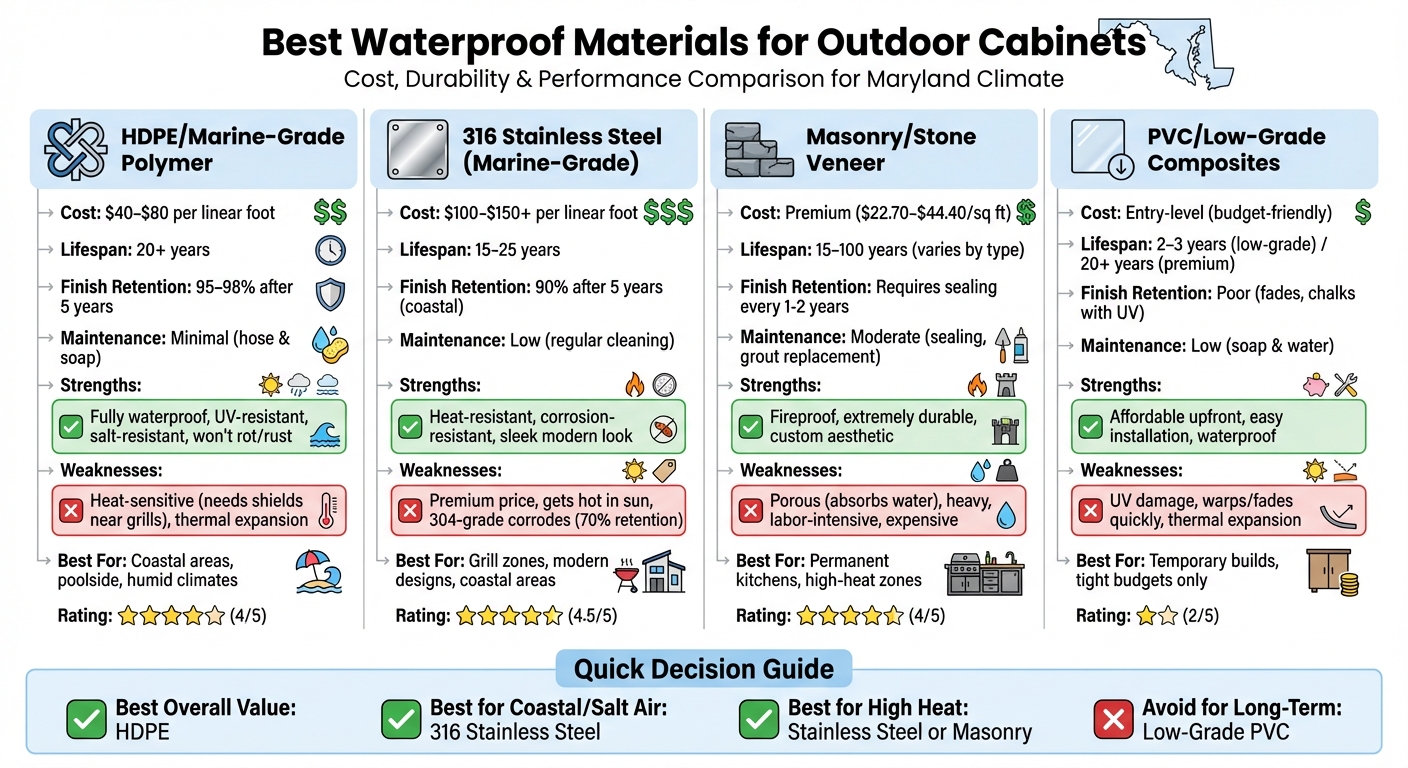
Waterproof Outdoor Cabinet Materials Comparison: Cost, Durability & Best Use Cases
What Everyone Gets Wrong with Outdoor Kitchens
sbb-itb-843f8be
1. High-Density Polyethylene (HDPE) and Marine-Grade Polymer
When dealing with Maryland’s unpredictable and often extreme weather, choosing materials that can handle those fluctuations is key. High-Density Polyethylene (HDPE) stands out for its ability to resist moisture and humidity. Being completely waterproof and non-porous, HDPE won’t swell, rot, or develop mold during Maryland’s humid summers. This durability, which has made it a go-to material for boat construction, also ensures it performs well against rain, snow, or high humidity [9].
Waterproofing and Weather Resistance
One of HDPE’s standout features is its through-body color. This means scratches or dings are barely noticeable since there’s no paint to chip or peel [8]. Marine-grade HDPE takes things further by incorporating UV inhibitors, protecting it from fading, chalking, or becoming brittle under harsh sunlight. Even after five years in freeze-thaw climates, HDPE retains 98% of its finish integrity, and in humid subtropical conditions, it holds up at 95% [9]. Plus, it’s completely corrosion-proof, making it a smart choice for coastal areas or places where road salt is common.
"HDPE’s waterproof design prevents moisture absorption." – Bradco Kitchens & Baths [9]
Durability in Maryland Climate
HDPE adapts well to Maryland’s temperature swings, though intense changes might cause slight bowing or misalignment [1][2][4]. However, since the material is heat-sensitive, it’s wise to install a stainless steel heat shield or insulated jacket if the cabinets are near a grill. This precaution ensures the long-term durability of outdoor kitchens in Maryland [9]. To further enhance functionality, many manufacturers add 1/4-inch weep holes at the bottom of HDPE cabinets, allowing any trapped moisture or melting ice to drain efficiently [9].
Maintenance and Lifespan
HDPE cabinets require very little upkeep. Cleaning is as simple as using a garden hose, mild soap, water, or even a power washer. Forget about painting, staining, or sealing – HDPE eliminates those chores entirely. The material also resists stains from food, drinks, and adhesives. With proper care, high-quality HDPE cabinets can last over 20 years, and many come with lifetime residential warranties. As David Whitmore shared:
"In 2013 we built an outdoor kitchen in our Vermont house. It came out perfectly and if you looked at it today you would think it was brand new. That’s the definition of quality." [6]
Cost and Installation Complexity
HDPE cabinets are a budget-friendly option, with installation costs ranging from $40 to $80 per linear foot. This is far more affordable than 316 stainless steel, which can exceed $100–$150 per linear foot [9]. The lighter weight of HDPE also makes installation easier and reduces labor costs. To prevent rust in Maryland’s humid environment, pair HDPE cabinets with 304 or 316 stainless steel hardware. On top of that, HDPE is an eco-conscious choice, often made from recycled materials, fully recyclable, and free of harmful chemicals like BPA and phthalates [7][9].
Next, we’ll explore other durable materials that can withstand Maryland’s challenging climate.
2. Stainless Steel
Stainless steel is a standout choice for outdoor kitchens, offering excellent waterproof properties. Unlike wood-based materials, it doesn’t rot, warp, or absorb moisture. However, gaps or cracks in the design can still allow water to seep in without proper weatherproof seals.
Waterproofing and Weather Resistance
The corrosion resistance of stainless steel depends on the grade you select. Grade 304, which contains about 18% chromium and 8–10% nickel [10], is the standard for most outdoor kitchens in Maryland. For homes near the Chesapeake Bay or Atlantic coast, Grade 316 (often called marine-grade) is a better choice. Its added molybdenum provides stronger protection against salt air, which can otherwise cause pitting and staining in lower-grade metals. Over five years in beachfront conditions, Grade 316 retains around 90% of its finish, compared to 70% for Grade 304.
"Stainless steel is an exceptionally hard-wearing material that does not age or deteriorate over time." – European Cabinets & Design Studios [10]
Durability in Maryland Climate
Maryland’s freeze–thaw cycles are no match for stainless steel. It stays stable through extreme temperature changes, making it a reliable option year-round. It also handles high heat well, so it’s ideal for areas near grills or pizza ovens. One drawback is that stainless steel can become very hot under direct sunlight due to its reflective surface. A powder-coated finish can help reduce heat buildup and glare.
Maintenance and Lifespan
Stainless steel is relatively low-maintenance. A microfiber cloth, mild soap, and warm water are usually enough to clean fingerprints and grease. Drying surfaces after cleaning or rain is recommended to avoid water spots and mineral buildup. Avoid using harsh chemicals like chlorine or bleach, as they can cause pitting or discoloration. In coastal areas, rinsing the surface more frequently can help prevent surface corrosion. With proper care, high-quality stainless steel cabinets typically last 15 to 25 years, and marine-grade options often come with warranties of 15–20 years [13].
Cost and Installation Complexity
Stainless steel is a premium material, with Grade 316 costing approximately $100–$150 per linear foot, compared to HDPE’s $40–$80. Individual cabinet units are priced between $700 and $2,000 [13]. Despite the higher cost, stainless steel’s lighter weight compared to masonry allows it to be installed on decks or rooftops without the need for concrete footings, potentially lowering project costs. Additionally, stainless steel is fully recyclable and retains its properties indefinitely [10].
Next, we’ll take a closer look at other materials that perform well in Maryland’s outdoor kitchens.
3. PVC and High-Density Resin
Waterproofing and Weather Resistance
PVC and resin cabinets stand out for their natural waterproofing, a feature that wood-based and masonry options don’t offer. This makes them a smart choice for Maryland’s wet climate. They resist rot, rust, and corrosion, even in the state’s rainiest conditions. As James Moylan from Design Builders, Inc. explains, "HDPE is impervious to water or moisture, so even if you live in a very wet climate, HDPE can handle the conditions" [2].
However, these materials aren’t without challenges. They tend to expand and contract with temperature fluctuations, which is a concern in Maryland’s hot summers and cold winters. Managing this thermal movement is essential to keep cabinets properly aligned. Lower-quality PVC is particularly vulnerable to UV damage, often fading or developing a chalky texture. On the other hand, premium resin options are treated with UV inhibitors, boosting their durability. This waterproofing advantage lays the groundwork for examining how these materials hold up against Maryland’s varying temperatures.
Durability in Maryland Climate
The durability of plastic cabinets depends heavily on their quality. High-end resin cabinets can last over 20 years with minimal upkeep, while cheaper PVC options may start to deteriorate within 2–3 years due to weather exposure [3]. Premium resin cabinets rival the performance of marine-grade polymers, offering exceptional resilience. However, because resin is petrochemical-based, it’s important to use stainless steel insulating sleeves near heat sources to prevent melting or safety risks.
Maintenance and Lifespan
Maintaining PVC and resin cabinets is straightforward. Routine cleaning with water or mild soap keeps them looking good, and their stain-resistant properties eliminate the need for sealing, staining, or painting. For areas with heavy sun exposure in Maryland, marine-grade resin is the best choice for lasting performance.
Cost and Installation Complexity
PVC and resin cabinets are typically more budget-friendly than materials like stainless steel or masonry, making them appealing for cost-conscious projects. However, the affordability of lower-quality PVC can be deceptive. While premium resin options offer a lifespan exceeding 20 years, cheaper PVC may require frequent replacements, potentially driving up long-term costs. Their lightweight design simplifies installation, but it’s crucial to account for thermal expansion when installing doors and hardware. This balance of cost-effectiveness and ease of installation highlights how PVC and resin compare to other materials, setting the stage for the next discussion on masonry-based cabinets.
4. Masonry, Concrete, and Stone-Veneer Cabinet Systems
Waterproofing and Weather Resistance
Masonry and stone-veneer cabinets are known for their durability and long lifespan, but they come with their own set of challenges, especially when compared to metal or polymer systems. These materials hold up well against Maryland’s unpredictable weather, yet their natural porosity can lead to water absorption during rainstorms [1]. While this moisture doesn’t compromise the structural integrity, it does mean these systems take longer to dry out after heavy rainfall [1][2][5].
To minimize water penetration, regular sealing and caulking are essential, though they can’t completely eliminate the issue [1]. The thick walls of masonry systems provide exceptional durability but can reduce interior storage space, making them bulkier than thinner-walled alternatives like polymer or metal cabinets [2].
Durability in Maryland Climate
Masonry systems thrive in Maryland’s climate, handling temperature swings without losing their structural stability [1]. High-performance concrete frames, for instance, can last up to 100 years, while more conventional concrete options typically offer a lifespan of 15 to 25 years [14]. Ultra-High-Performance Concrete (UHPC) takes durability even further, boasting up to 10 times the compressive strength of traditional concrete [14].
These systems are also non-combustible, making them a safer choice for outdoor kitchens with high-heat cooking appliances [14]. However, some maintenance is required – grout in stonework often needs replacing or adjustment after about 10 years due to dirt and weather exposure [1]. For natural stone surfaces near cooking zones, applying a sealant every 1 to 2 years helps protect against stains from oils and food [14].
While durability is a highlight, masonry systems also bring unique considerations in terms of cost and installation.
Cost and Installation Complexity
The durability and aesthetic appeal of masonry systems come with a hefty price tag and significant installation effort. In Maryland, high-end outdoor kitchens with masonry finishes can range from $30,000 to over $100,000 [15]. Stone veneer installations in Baltimore typically cost between $22.70 and $44.40 per square foot, including materials and labor [16]. Labor alone often accounts for 30% to 50% of the total project cost [17].
Installing masonry systems is labor-intensive, generating dust and requiring more time compared to modular stainless steel cabinets, which can often be installed in just one day [1]. Homeowners should plan for multiple components, including the structural skeleton (metal frame or concrete blocks), the exterior veneer (stone, brick, or stucco), and cabinetry inserts [2]. Due to the significant weight of masonry systems, the underlying deck or patio must be able to support the load, and some projects may even require engineering certification for structural safety [17].
For a polished and functional interior, many homeowners pair masonry exteriors with stainless steel cabinet inserts, combining the rugged look of stone with the practicality of modern storage solutions [1].
5. Engineered Wood and Specialty Composites
While materials like HDPE and stainless steel dominate the market for their durability, engineered wood and composites present a more affordable – though less reliable – alternative.
Waterproofing and Weather Resistance
Although engineered wood and composites are budget-friendly, their performance in Maryland’s challenging climate leaves much to be desired. Many PVC-based materials and lower-cost composites struggle with UV exposure, often warping and deteriorating after just a few seasons [3]. Prolonged exposure to sunlight and moisture can lead to fading or a chalky surface texture, unlike the consistent appearance maintained by HDPE or stainless steel [3]. Maryland’s temperature fluctuations also exacerbate the issue, causing misaligned cabinet doors or functional failures due to expansion and contraction [1][2].
Durability in Maryland Climate
Maryland’s humid summers, freezing winters, and constant moisture create a punishing environment for composite materials. Entry-level composite cabinets frequently break down within 2–3 years of installation under these conditions [3]. This is a stark contrast to HDPE or stainless steel, which can endure for two decades or more [3].
Wood-based composites are particularly vulnerable, often swelling during humid periods and cracking during the freeze-thaw cycles typical of the Mid-Atlantic [3]. While premium engineered wood products can last over 50 years with proper treatment [19], this longevity hinges on diligent maintenance – something many homeowners may overlook. Without consistent upkeep, these materials quickly fall short in performance and lifespan.
Maintenance and Lifespan
Compared to HDPE and stainless steel, engineered wood and lower-tier composites demand more frequent care. High-end composite materials require periodic cleaning with mild soap and water to fend off dirt and mold [18][20]. Unlike natural wood, they don’t need regular staining, sealing, or painting [18]. However, budget composites often crack and lose their structural integrity despite proper maintenance [3].
Another concern is that warranties for composite materials rarely cover weather-related damages [3], which poses a risk for Maryland homeowners. While manufacturers may claim lifespans of 25 to 50 years for premium composites [18], industry experts often regard budget composites as the weakest link in outdoor kitchen projects. These materials are frequently replaced with more durable options once they fail [3].
Cost and Installation Complexity
On the surface, specialty composites and PVC appear to be the most economical choices when compared to premium materials like stainless steel or marine-grade polymer [3]. However, the initial savings can be deceptive. Frequent replacements due to wear and tear often negate the lower upfront costs, making these materials less economical over time [2][3]. For projects in Maryland, experts typically advise against using low-end composites or PVC unless the goal is temporary or the budget is extremely limited [3].
Advantages and Disadvantages of Each Material
Maryland’s tough climate demands a careful balance between durability and cost when selecting materials. Here’s a closer look at how each option stacks up:
HDPE and Marine-Grade Polymers stand out for their waterproof properties, priced around $40 to $80 per linear foot. These materials are perfect for areas with high moisture or salt exposure, as they resist rot, rust, and saltwater, retaining 95% of their finish after five years [9]. However, they can expand with temperature changes, potentially misaligning doors. They’re also combustible, requiring stainless steel sleeves near grills [2]. As Steve Ward, an expert in outdoor kitchen design at Danver, explains:
"Initially fabricated for marine usage, this durable marine-grade polymer includes benefits such as UV inhibitors to protect against the sunlight’s harmful rays, while its ease of maintenance makes it a no-brainer for weekend warriors" [4].
For a more heat-resistant option, stainless steel offers unique advantages.
Stainless Steel – particularly the 316 marine-grade variety – provides excellent heat resistance and durability, maintaining 90% of its finish after five years in coastal areas [9]. It’s a premium choice, costing $100 to $150+ per linear foot, and is ideal for high-heat zones [9]. However, the 304-grade version fares worse in salty environments, with a 70% finish retention due to spot corrosion. Powder coatings may also need touch-ups every 7 to 10 years [9]. Additionally, stainless steel can become uncomfortably hot under direct sunlight [12].
For those seeking a permanent, high-end look, masonry systems are worth considering.
Masonry and Stone-Veneer Systems excel in fire resistance and offer a timeless, upscale appearance. These systems are non-combustible, making them ideal for extreme heat conditions [11][21]. However, they come with higher material costs and labor-intensive installation requirements [2].
For tighter budgets, PVC and composites offer an entry-level alternative.
PVC and Low-Grade Composites are the least expensive upfront but tend to degrade quickly under heavy UV exposure, making them less durable [3].
Here’s a quick comparison of these materials, highlighting their strengths, weaknesses, costs, and best applications:
| Material | Key Strengths | Key Weaknesses | Cost per Linear Foot | Best Use |
|---|---|---|---|---|
| HDPE/Polymer | Waterproof, salt-resistant, low maintenance, 25+ year lifespan [9] | Expands with heat, combustible, limited aesthetics | $40–$80 [9] | Coastal areas, poolside, humid climates |
| Stainless Steel (316) | Heat-resistant, sleek look, 20–25 year lifespan [9] | Expensive, requires polishing, heats up in sunlight [12] | $100–$150+ [9] | Grill zones, modern designs |
| Masonry/Stone | Fireproof, durable, custom aesthetic [11][21] | Labor-intensive, permanent | Premium | Permanent kitchens, hot climates |
| PVC/Composites | Budget-friendly, easy installation | Warps/fades quickly, poor UV resistance [3] | Entry-level | Temporary or budget builds only |
Conclusion
After considering how various materials hold up against Maryland’s tough weather conditions, the best options become evident. Selecting the right waterproof material for outdoor cabinets depends on Maryland’s climate challenges, upkeep requirements, and budget constraints.
For homeowners dealing with Maryland’s high humidity, heavy rain, and temperature swings, powder-coated stainless steel stands out. It holds up under extreme conditions and only requires occasional cleaning. As James Moylan from Design Builders MD puts it:
"Stainless steel maintains structural integrity in extreme weather without warping, bending, expanding, or contracting, making it ideal for Maryland and Virginia outdoor kitchens" [1].
If you’re located near the Chesapeake Bay, opting for 316-grade stainless steel offers extra protection against salt-air corrosion [3]. On the other hand, those looking for minimal maintenance might prefer HDPE. This material is completely waterproof and requires little effort to maintain, though it can expand and contract with temperature changes [1][2].
For a high-end, permanent outdoor kitchen, masonry and stone systems are worth considering. However, they tend to retain moisture longer than metal or plastic options [1]. Be cautious with lower-quality PVC composites, as they can deteriorate within a few years under prolonged UV exposure [3].
While stainless steel may cost more upfront, its durability reduces the need for costly repairs or replacements down the line. As ExtCabinets notes:
"In our experience, investing in weatherproof materials upfront saves thousands in repairs later" [3].
FAQs
What is the best cabinet material for salt air near the Chesapeake Bay?
Marine-grade stainless steel, particularly Grade 316, is widely regarded as the best option for outdoor cabinets in regions with salty air, such as areas near the Chesapeake Bay. Its superior resistance to corrosion from salt-laden environments ensures it remains durable and reliable over time.
How do I protect outdoor cabinets from grill heat?
To keep outdoor cabinets safe from grill heat, consider using heat shields or barriers crafted from reflective, heat-resistant materials like aluminized fiberglass or metal. These shields should be installed between the grill and the cabinets to help redirect radiant heat away. Another option is to use standalone barriers, such as ceramic briquette systems or metal deflectors, placed behind or beside the grill. This is especially important if your cabinets are made from materials like wood or polymers, which are more susceptible to heat damage.
Are PVC or composite outdoor cabinets worth it long term?
PVC and composite outdoor cabinets are a smart pick if you’re aiming for durability and minimal upkeep. These materials, including high-density polyethylene (HDPE) and marine-grade composites, are built to handle tough conditions. They resist moisture, mold, UV rays, and harsh weather, making them perfect for outdoor spaces. While they might cost more upfront, their lifespan – often stretching 20-30 years – and low maintenance needs make them a practical, long-term choice for a sturdy, weatherproof outdoor kitchen.
Chat with Us