









- bhavya gada
- No Comments
If your yard has compacted soil, poor drainage, or low organic matter, our landscaping services, biochar may help – but it works best when the soil is already the problem.
From what I see in this research, the clearest takeaways are simple:
- Biochar can keep carbon in soil for a long time
- It can improve water holding and infiltration
- It can lower compaction in disturbed soils
- It may help hold nitrogen, phosphorus, and potassium in place
- It works best in poor, sandy, or construction-damaged soils
- It can cause short-term nitrogen issues if used alone
- It should match the soil pH, especially around acid-loving plants
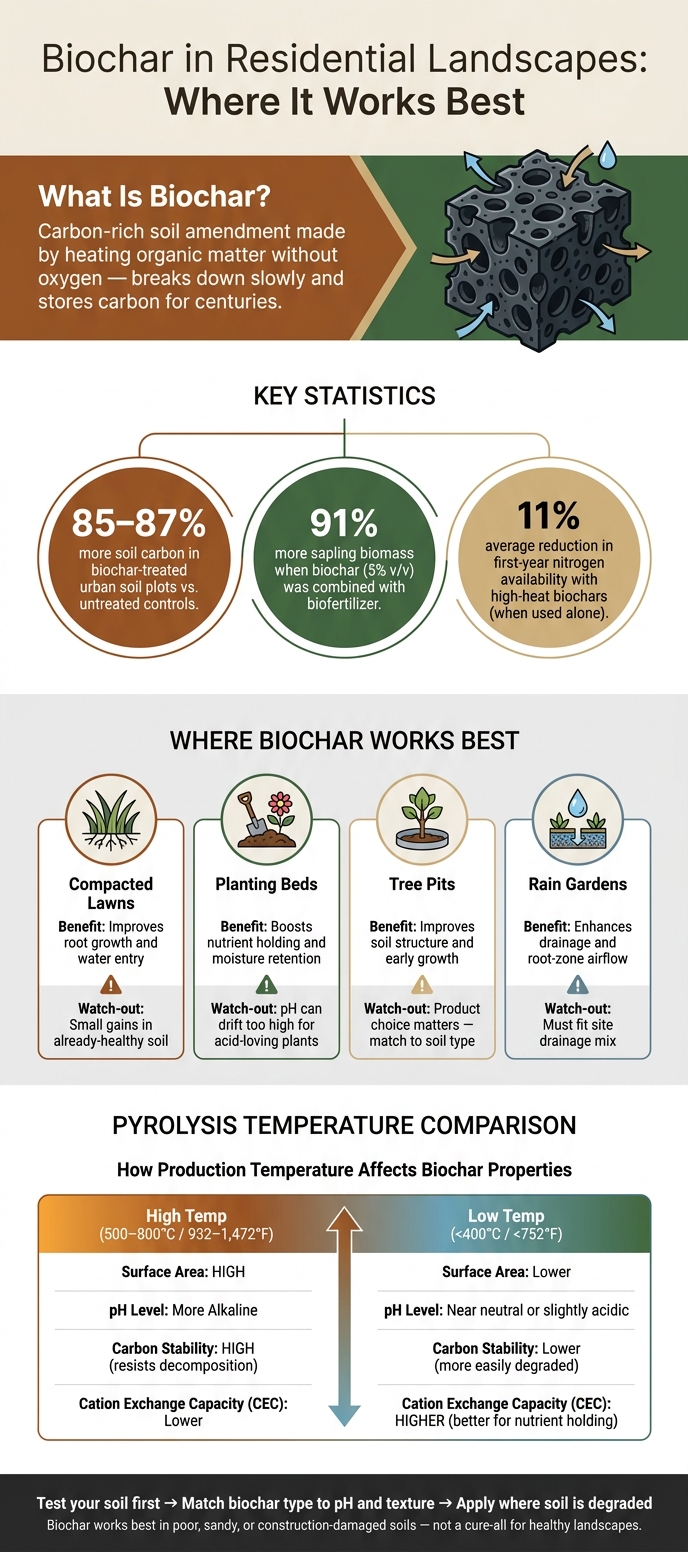
A few numbers stand out. One urban soil study reported 85%–87% more soil carbon in biochar-treated plots. A tree study using a 5% v/v rate with biofertilizer found 91% more sapling biomass. On the other hand, some high-heat biochars cut first-year nitrogen availability by about 11%.
If I boil the article down to one point, it’s this: biochar is not a cure-all. It tends to do the most in lawns with compaction, planting beds, tree pits, and rain gardens, especially when it is mixed into the root zone and paired with compost or fertilizer.
| Where it fits best | What it may improve | Main watch-out |
|---|---|---|
| Compacted lawns | Root growth, water entry | Small gains in healthy soil |
| Planting beds | Nutrient holding, moisture | pH can drift too high |
| Tree pits | Soil structure, early growth | Product choice matters |
| Rain gardens | Drainage, root-zone air flow | Must fit site mix and drainage |
So if you want the short answer: test the soil first, use the right biochar type, and apply it where the soil is degraded enough to need it.
Biochar in Residential Landscapes: Where It Works Best
What is Biochar? – How does it Improve Soil Fertility? – For Gardens, Lawns, Trees, and Shrubs
sbb-itb-843f8be
What Biochar Is and Why Researchers Study It in Landscape Soils
Biochar is a carbon-rich soil amendment made by heating organic matter without oxygen. Researchers pay close attention to it because it breaks down very slowly and can keep carbon in the soil for centuries. In Maryland yards, that matters most where soils are compacted and low in organic matter.
Physical and Chemical Traits That Affect Soil Performance
Biochar has a highly porous structure and a large surface area. Put simply, it works a bit like a sponge and a storage shelf at the same time. Those pores can help soil hold moisture and nutrients, while also improving aeration [1][2].
It also has a low bulk density. So when you mix it into dense or compacted soil, it can lower the soil’s overall density and make it easier for roots to push through [1].
On the chemical side, biochar can have a high cation exchange capacity, or CEC. That means it can hold onto positively charged nutrients like potassium, calcium, and magnesium instead of letting them wash away with rain [1][2]. Many wood-based biochars are also alkaline, which gives them a liming effect that can help lift or steady the pH of acidic soils [1][2].
The table below shows how pyrolysis temperature changes these key traits.
| Property | Higher temperatures (500–800°C / 932–1,472°F) | Lower temperatures (<400°C / <752°F) |
|---|---|---|
| Surface Area | Increases significantly [2] | Lower [2] |
| pH Level | More alkaline [2] | Closer to neutral or slightly acidic [1] |
| Carbon Stability | Higher (more resistant to decomposition) [2] | Lower (more easily degraded) [2] |
| Cation Exchange Capacity | Generally decreases [2] | Generally higher [2] |
There’s one practical tradeoff here. Higher-temperature biochars can sometimes hold nutrients too tightly, which may reduce how much is available to plants right away [2]. That’s why researchers often test biochar together with organic fertilizers or biofertilizers, especially when they want to avoid short-term nitrogen deficiency [1].
Residential Settings Where Biochar Is Most Relevant
In Maryland, this comes up often in developed residential landscapes. Construction-disturbed soils are common, and they’re often compacted, poor at holding water, and more likely to have nutrient imbalances [1].
That makes biochar most relevant in places like:
- Compacted lawns
- Planting beds
- Tree pits
- Rain gardens
Its nutrient-holding ability is especially useful in compacted planting beds, tree pits, and rain gardens [2].
Those traits lead to the next part of the discussion: how much biochar can actually improve carbon retention, moisture, and soil structure?
Research Findings: Carbon Retention, Moisture Holding, and Soil Structure
Soil Carbon Retention and Long-Term Sequestration
Study after study points to the same idea: biochar keeps carbon in the soil far longer than fresh organic matter does. It resists microbial breakdown, which means it can act as a stable form of long-term carbon storage [1][2].
The feedstock makes a big difference. Wood-based biochars, including those made from maple or conifer, tend to last longer than biochars made from crop residues. A big reason is their higher lignin content [2]. Pyrolysis temperature matters too. Biochar made at about 500–800°C (932–1,472°F) is usually more resistant to decomposition, which adds to its long-term carbon storage value [2].
One urban soil trial found that plots treated with sugar maple biochar had soil carbon levels 85–87% higher than unamended control soils [1]. For Maryland yards, that matters for more than carbon alone. Many disturbed soils also need better structure and better moisture control.
Water-Holding Capacity, Infiltration, and Runoff Reduction
Carbon storage is only part of the story. Biochar’s pore structure also changes how soil handles both heavy rain and dry stretches.
Research connects biochar with better infiltration during storms and better moisture retention during dry periods. Elkhlifi et al. describe biochar as a soil conditioner that can improve aeration, structure, water-holding capacity, and nutrient retention [2].
By lowering soil bulk density and adding more internal pore space, biochar helps water move into the soil instead of sitting on the surface or washing into storm drains [1][2]. For Maryland homeowners, that can mean less puddling in the yard. In rain gardens, better infiltration can help keep more stormwater on-site during heavy rain. Studies also report higher phosphorus and potassium availability in biochar-amended soils, which may help plants get through drought periods with less stress [2].
Compaction Relief, Soil Aggregation, and Nutrient Retention
These moisture benefits matter even more when biochar also changes how compacted soils hold roots and nutrients.
Biochar can lower bulk density in dense soils, and granulated or pelletized forms often work better than fine particles in residential settings [1]. Fine biochar can wash away in hard rain or blow around in dry weather. Granulated material is more likely to stay in the root zone, where it can do its job.
Studies have also linked biochar to higher nitrogen, phosphorus, and potassium availability [2]. There is one catch: high-temperature biochars can temporarily bind ammonium, which can reduce nitrogen availability to plants by an average of 11% in the first year [1]. That short-term dip can be offset by mixing biochar with compost, manure, or biofertilizers. That blend also helps soil aggregation, which supports the slow repair of disturbed soils over time [1][2].
Applying the Research to Maryland Residential Landscape Design
Best Uses in Lawns, Planting Beds, and Rain Gardens
These soil gains matter most when the design fits the site. The big question is simple: where does biochar earn its keep in a Maryland yard, and how should it be placed so it stays effective under normal residential conditions?
Tree planting sites have the strongest support from research. A 2023 PLOS One study found that combining sugar maple biochar with a biofertilizer increased silver maple sapling biomass by 91% in common Maryland residential soils, using a 5% v/v application rate as a practical reference point [1].
Rain gardens are also a strong match. In built rain-garden mixes, biochar can improve soil air flow and oxygen availability [3]. That matters because rain gardens need to drain, but they also need roots that can breathe. In new planting beds with degraded or nutrient-poor soils, biochar can improve nitrogen, phosphorus, and potassium availability in poor soils [2]. Lawns tend to benefit most in spots where compaction and low organic matter hold back root growth.
Site Conditions and Limits Homeowners Should Consider
Biochar works best when the product fits the soil’s pH, texture, and drainage. Soil pH is one of the first things to check. Many wood-based biochars are alkaline, which can push already-neutral soils too high for acid-loving plants [1]. That can be a problem in Maryland landscapes where azaleas and other acid-loving plants are common. If the biochar pushes pH up even more, those plants may struggle.
For slightly alkaline or erosion-prone sites, a near-neutral, granulated biochar is the better pick. More alkaline products make more sense in acidic soils [1]. In compacted clay and disturbed builder-grade soils, larger granules in the 2–4 mm range do a better job of reducing bulk density and improving aeration and moisture infiltration [1].
There’s also a plain limit here: biochar tends to show the clearest gains in degraded or nutrient-poor soils. If a yard already has healthy, well-structured soil, biochar alone will probably make only a modest difference.
When Professional Installation Leads to Better Results
When biochar is mixed into the planting zone, it is more likely to stay in place, hold water, and support long-term carbon storage [1]. So if a project already calls for grading, drainage work, or planting-bed prep, that’s usually the right time to add it.
For grading, drainage, and root-zone mixing, professional installation can help keep the biochar where it belongs and improve the odds of a better result.
Conclusion: What the Research Supports for Residential Projects
Research points to biochar as one of the best options for long-term carbon storage, moisture retention, soil structure, and nutrient holding when it’s used on poor or disturbed sites. It works because it breaks down slowly, helps hold nutrients, can moderate pH, and improves moisture storage. But there’s no magic here. The payoff depends on the site and the product you use.
The strongest results show up in degraded or sandy soils. In healthy soils, the gains are usually smaller [2]. Product choice also plays a big part. Wood-derived biochar is often more carbon-stable, while lower-temperature biochar tends to do more for nutrient availability [2].
For Maryland landscapes, that means biochar makes the most sense as part of a site-specific soil plan. For Maryland homeowners, the practical takeaway is simple: test the soil, match the product to pH and texture, and mix biochar into planting areas where the root zone needs lasting improvement.
FAQs
How do I know if my soil needs biochar?
Have your soil tested by a lab every 2 to 3 years, such as the University of Maryland Extension. A soil test shows your soil type, pH, nutrient levels, and organic matter.
That gives you a solid starting point. If your Maryland soil has poor drainage, dries out too fast, or has structure problems, biochar may help. Use the test results to make a clear plan for better soil health and stronger plants.
What type of biochar is best for my yard?
The best biochar for your yard depends on your soil. That’s because biochar can vary based on the feedstock used to make it and the pyrolysis temperature.
For general home use in Maryland, wood-based biochar is a common pick. It works well for improving nutrient and moisture retention in both sandy and clay soils.
To apply it, mix 1 to 2 inches into the top 6 inches of soil. Pick a high-quality product that fits your goal, whether that’s better soil structure or improved water-holding capacity.
Should biochar be mixed with compost or fertilizer?
Yes. Research suggests biochar and compost often work better together than either one on its own.
Here’s why: biochar has a highly porous structure, but it doesn’t bring many nutrients to the soil. Compost, on the other hand, releases nutrients as it breaks down. When you combine them, the biochar can hold onto those nutrients and help stop them from washing away.
That pairing can improve soil structure, boost water-holding capacity, and improve nutrient retention more than compost alone. In Maryland landscapes, that can support long-term soil health and better plant performance.
Chat with Us