









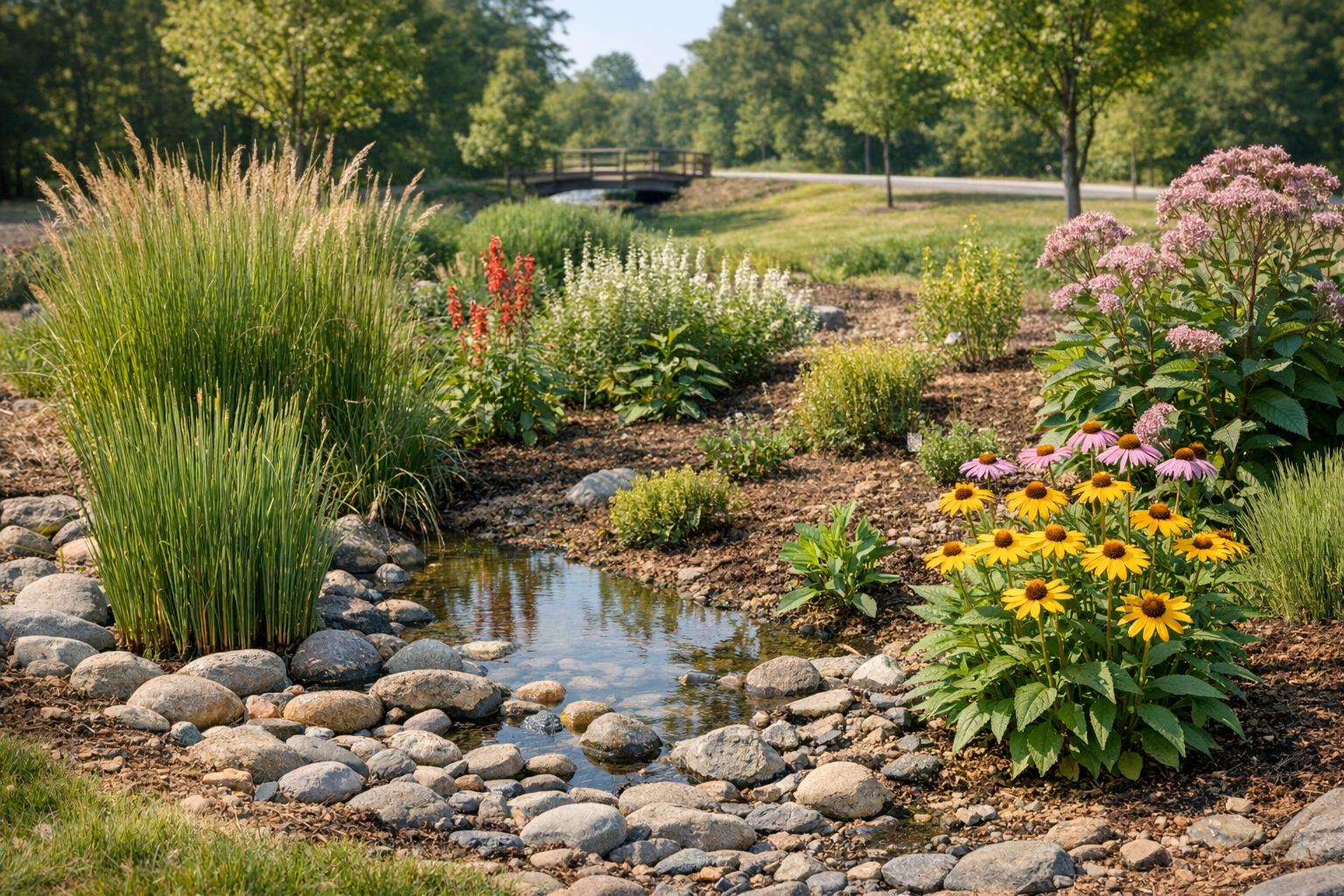
- bhavya gada
- No Comments
Bioretention landscaping helps manage stormwater by using soil and plants to filter runoff and improve water quality. Choosing the right plants is key to ensuring these systems work effectively while looking good. Here’s what you need to know:
- Understand Your Site: Assess soil, drainage, sunlight, and rainfall. Divide the area into moisture zones – low (wettest), middle (fluctuating), and high (driest).
- Choose Plants Wisely: Pick species that tolerate wet and dry conditions, have fibrous roots to maintain soil porosity, and are suited to their specific zone.
- Go Native: Native plants are better adapted to local conditions and support biodiversity.
- Avoid Problem Plants: Skip aggressive spreaders, species prone to clogging, or those unsuitable for local runoff conditions (e.g., low salt tolerance).
- Plan for Maintenance and Landscape Projects: Group plants for visual appeal and easy access. Ensure the system remains functional year-round.
Bioretention and Rain Gardens
sbb-itb-843f8be
Understanding Site Conditions for Plant Selection
Before choosing plants, take a close look at your site’s conditions. As the LID SWM Planning and Design Guide explains: "Plant selection for LID practices is predicated on the principle of ‘right plant for the right place’" [2]. In simple terms, this means selecting plants that are suited to the environment they’ll grow in – not the environment you hope for. Factors like soil, water, and sunlight play a key role in making the right choices.
Assessing Soil Type and Drainage
Break your site into three moisture zones to guide plant selection:
- Low Zone: Found at the bottom, this area collects water during storms and stays wet the longest.
- Middle Zone: Alternates between wet and dry conditions.
- High Zone: Located around the perimeter, this is the driest part of the site [2].
Each zone requires plants with specific traits to handle its moisture levels. For larger projects, soil testing is crucial. Geotechnical evaluations help determine the filter bed’s capacity and the runoff volume your system can handle [3]. Be mindful of soil compaction from construction, as it reduces infiltration and impacts plant health [2]. For trees and larger shrubs, ensure your soil media is at least 3 feet deep [2].
Bioretention systems are typically designed to drain fully within 24 hours [2]. This creates a tough environment where plants must endure brief flooding followed by extended dry spells. If your site collects runoff from roads, you’ll need salt-tolerant plants to cope with deicing chemicals. On the other hand, runoff from rooftops or courtyards allows for a broader range of plant options [2].
Evaluating Water Table and Rainfall Patterns
Local rainfall patterns heavily influence plant survival. Well-established plants are better equipped to handle extreme moisture swings compared to younger ones. As the LID SWM Planning and Design Guide notes: "A plant’s ability to tolerate flood conditions is further correlated to its age, adaptation to the site, and condition. A well-established plant has greater reserves to withstand flood events" [2].
Use a 1-3 moisture rating system to assess plant suitability:
- 1: Thrives in dry conditions (High Zone).
- 2: Tolerates fluctuating moisture (Middle Zone).
- 3: Prefers consistently wet soil (Low Zone) [2].
Some plants are versatile and may carry dual ratings like "1-2", meaning they can adapt to multiple zones. To protect young plants, stabilize the soil before introducing stormwater to the system [2].
Identifying Sunlight and Exposure Levels
Track how much direct sunlight your site gets each day:
- Full sun: 6 or more hours.
- Partial shade: 3 to 6 hours.
- Full shade: Less than 3 hours [2].
New bioretention systems often start with full sun exposure, but as trees grow, shade levels will increase. Consider current shade from nearby structures or trees and plan for the future. For areas transitioning from full sun to partial shade, pick species that can thrive with 3-6 hours of sunlight. Whenever possible, place bioretention systems in full sun to optimize plant growth and performance [2].
Key Plant Characteristics for Bioretention Systems
After completing your site assessment, the next step is choosing plants capable of thriving in bioretention systems. These systems create a tough environment – highly permeable soils combined with moisture that fluctuates dramatically. To succeed, plants must possess specific traits that allow them to endure these conditions while maintaining system functionality.
Water Tolerance and Flexibility
Bioretention plants face a constant cycle of extremes, from flooding during storms to prolonged dry spells. Alex MacLeod, P.E., from Contech Engineered Solutions, highlights this dual requirement:
"Plant species selected for use in biofiltration must be hardy; they should be drought tolerant but also able to withstand occasional flooding, adaptable to well-drained soils" [1].
This adaptability is critical. During heavy rain, plants may be submerged for hours. Yet, when the rain stops, the engineered media drains so efficiently that the same plants must withstand drought-like conditions. Selecting species with this dual water tolerance ensures survival and consistent performance. Beyond water tolerance, their root systems also play a vital role.
Root Structure and Erosion Control
Effective root systems are essential for keeping bioretention systems functional. Fibrous roots are particularly beneficial because they spread horizontally rather than growing straight down. MacLeod explains:
"Fibrous roots grow horizontally through the media and are an important mechanism for maintaining media porosity and hydraulic conductivity" [1].
This horizontal root growth prevents soil compaction, allowing water to infiltrate rather than run off, which helps reduce erosion. For quick establishment and soil stabilization, choose container-grown plants sized 1–15 gallons. These plants have intact root systems that anchor well and begin working immediately [1]. Avoid very small plants (under 1 gallon), as they are vulnerable to being dislodged by storm debris. Similarly, skip very large plants (over 15 gallons), as their dense root balls can clog the filtration media. Alongside strong root systems, incorporating native species can provide additional ecological benefits.
Native Species and Ecosystem Benefits
Native plants bring several advantages to bioretention systems. They are naturally suited to local climates, soil types, and pests, making them more resilient in challenging conditions. Dr. Catherine Neal, a Landscape and Nursery Horticulture Specialist at the University of New Hampshire, explains:
"The rugged, deep root systems of meadow plants allow them to survive drought and floods and enrich the soil" [4].
In addition to their resilience, native plants support local ecosystems by providing habitat and food sources like seeds and berries for birds and pollinators [4][3]. In many regions, using native species is also a requirement to meet stormwater Best Management Practices (BMP) and ensure compliance with performance standards [3]. For inspiration, look to natural areas such as floodplains, stream banks, and lakeshores to identify plants adapted to similar conditions [4]. For instance, Blue Flag Iris (Iris versicolor) thrives in wet zones where many plants struggle, while native big bluestem (Andropogon gerardii) is better suited to drier areas and contributes more to local ecosystems than non-native species [4].
Plant Selection by Bioretention Zone
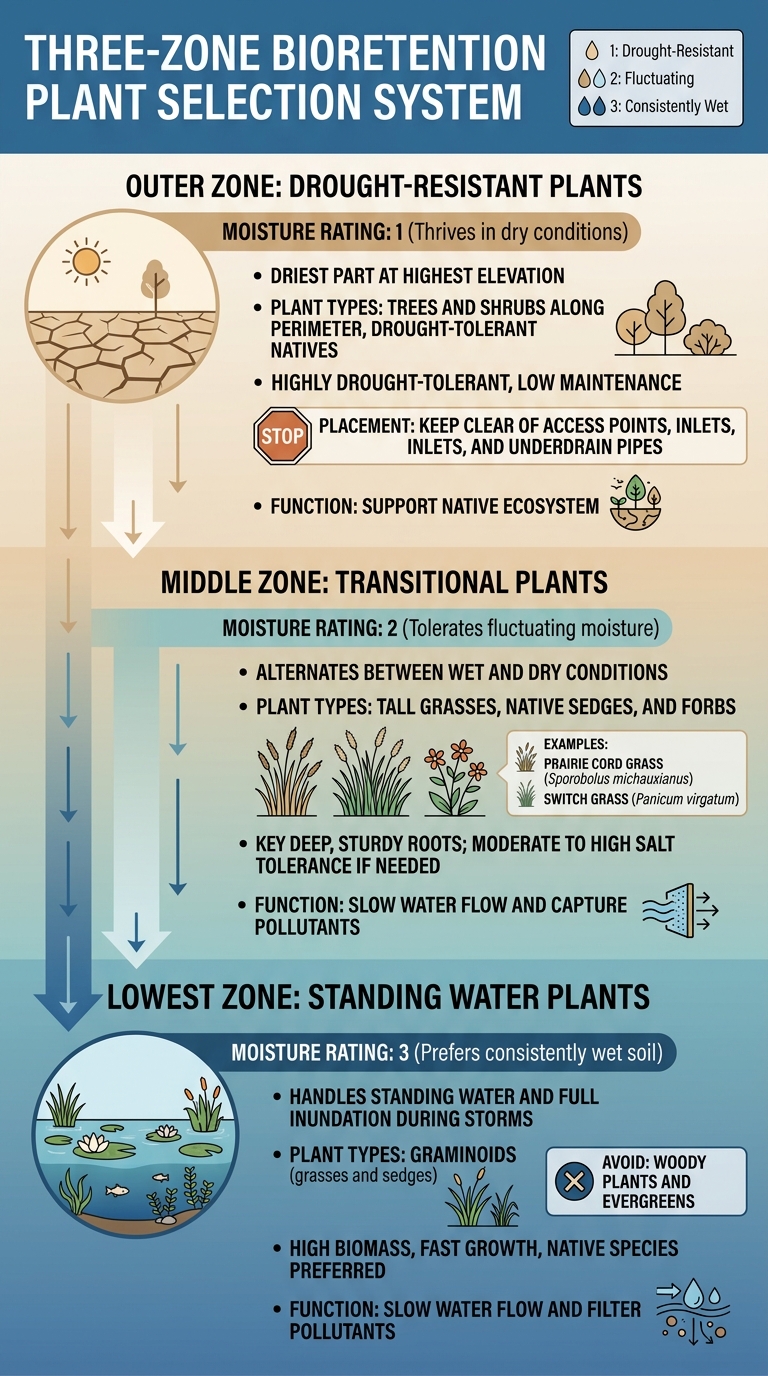
Bioretention Plant Selection Guide by Moisture Zone
Bioretention systems work best when plants are carefully matched to the moisture levels found at different elevations. Using your site evaluation as a guide, assign plants to zones based on their moisture needs. These zone assignments align with the moisture ratings outlined earlier [2].
Lowest Zone: Standing Water Plants
The lowest zone is designed to handle standing water and may experience full inundation during storms. Plant choices here should reflect the area’s ability to retain water and occasional dry periods. Graminoids, like grasses and sedges, are excellent because they slow water flow and help filter pollutants from runoff. Native species are especially encouraged since they thrive in local conditions and periodic flooding. Avoid woody plants and evergreens in this zone, as they can complicate inspections and sediment removal. Instead, prioritize plants with high biomass and fast growth to enhance nutrient absorption [2]. Moving outward, the middle zone requires plants suited to fluctuating moisture levels.
Middle Zone: Transitional Plants
The middle zone experiences a mix of wet and dry conditions, making it ideal for plants that thrive in moist soils. Tall grasses, native sedges, and forbs work well to slow water flow and capture pollutants before they reach the lower zone. If the area collects runoff from salted roads, opt for plants with moderate to high salt tolerance. Native grasses like Prairie cord grass (Sporobolus michauxianus) and Switch grass (Panicum virgatum) are excellent options for managing salt runoff [2]. Choose plants with deep, sturdy roots to promote drainage and improve nutrient uptake [2]. The outer zone, by contrast, requires plants that can handle drier conditions.
Outer Zone: Drought-Resistant Plants
The outer, or "high", zone is the driest part of the bioretention system, sitting at the highest elevation. Plants here should be highly drought-tolerant. Native species are preferred because they are better suited to local conditions and typically require less maintenance. This not only meets the needs of the dry zone but also supports the native ecosystem benefits highlighted earlier. Place trees and shrubs along the perimeter to keep access points, inlets, and underdrain pipes clear for maintenance. Use scientific names to ensure plant accuracy, and confirm salt tolerance if the area is exposed to road salt [2].
Avoiding Problematic Plants and Special Considerations
Plants to Avoid in Bioretention Systems
Choosing the wrong plants for a bioretention system can cause more harm than good, leading to poor performance and extra maintenance headaches. One major no-go? Invasive species. According to the Sustainable Technologies Evaluation Program, "Invasive species have not been included on the recommended plant list for LID practices and should not be planted in any situation" [2]. These plants tend to overpower native species, lack natural predators, and ultimately demand more upkeep.
Another group to avoid includes aggressive spreaders like certain grasses and vines. As Alex MacLeod, P.E., points out, these can overrun the biofiltration area, making maintenance a challenge [1]. Plant size matters too – steer clear of plants smaller than 1 gallon, as they’re vulnerable to storm damage, and avoid those over 15 gallons, which can have dense, clay-heavy root balls that may clog the filtration media [1].
Site conditions also play a big role in plant selection. For example, if your system deals with runoff from areas treated with road salt, avoid plants with low salt tolerance. Similarly, the Sustainable Technologies Evaluation Program advises against planting woody or evergreen species in parts of the system used for snow storage during winter [2]. Additionally, trees should be kept away from perforated underdrain pipes to prevent root interference, and rare native species should be avoided to protect the genetic integrity of nearby wild populations [2].
Design Considerations for Year-Round Appeal
Once you’ve ruled out problematic plants, it’s time to focus on landscape design and restoration that’s both functional and visually appealing throughout the year. Incorporate evergreens in suitable areas to maintain structure during the winter, and choose plants that offer seasonal interest – think colorful blooms, seeds, or berries. These not only enhance the system’s appearance but also support wildlife year-round [3].
Alex MacLeod, P.E., notes, "Vegetated systems full of ornamental grasses, shrubs, and trees can increase the visual appeal of a site. However, there is a fine line between long-term system function and aesthetics" [1].
To strike this balance, group plants thoughtfully to create visual impact while ensuring easy access for maintenance. Clear pathways are essential for tasks like removing degraded mulch or accumulated pollutants without disrupting established vegetation. You can also layer plants of varying heights – placing smaller shrubs beneath tree canopies helps create depth, mimics natural ecosystems, and maintains the system’s drainage efficiency [1].
Conclusion
Tailor plant choices to fit the specific conditions of your site. Divide your system into zones: place water-loving plants in the lowest areas, transitional species in the middle zones, and drought-tolerant plants along the edges. This zoning ensures that each plant thrives in its ideal environment while the system efficiently handles stormwater.
Focus on using native plants with strong root systems to support water movement and nutrient absorption. These plants naturally adapt to local conditions and help sustain biodiversity. Also, consider any stressors unique to your site. For example, if your bioretention area collects runoff from roads, opt for salt-tolerant species. In shaded urban areas, select plants that can thrive with less than three hours of daily sunlight.
Following the guidelines from the LID SWM Planning and Design Guide, always aim to choose the right plant for the right place [2]. Avoid invasive species, and ensure proper spacing to allow for maintenance access. Keep in mind that plants typically need one to several years to establish before being exposed to maximum water flow [2].
To create a successful bioretention landscape, start with a thorough site assessment, choose plants strategically, and commit to ongoing maintenance. These steps not only protect your investment but also improve the functionality and appearance of your landscape. For homeowners and property managers in central Maryland, working with seasoned professionals can ensure your system meets regulations while enhancing the natural beauty of your property.
Pro Landscapes MD specializes in expert drainage solutions, native planting, and sustainable design. With their help, you can achieve a bioretention system that’s both effective and visually appealing year-round.
FAQs
How do I map my site’s low, middle, and high moisture zones?
To plan bioretention landscaping effectively, start by mapping your site’s moisture zones. Pay attention to how water drains and soaks into the ground across the area. Typically, you’ll identify three main zones:
- High moisture zones: These areas stay saturated often. Consider plants that thrive in wet conditions here.
- Middle moisture zones: These spots have moderate water levels. Plants that prefer balanced moisture work well.
- Low moisture zones: These are well-drained areas. Opt for drought-tolerant plants in these spots.
You can determine these zones through careful observation or by using soil moisture sensors to get precise data. Matching plants to the right moisture levels ensures healthier growth and better landscaping results.
What’s the best plant size for a bioretention area?
The ideal plant size hinges on the depth of your planting zone and what you aim to achieve with the system. For shallow zones, smaller plants such as grasses and groundcovers are a better fit. On the other hand, deeper media beds – those around 3 feet or more – can handle shrubs and even trees. It’s often best to begin with smaller plants to establish growth, then introduce larger species as the system develops and conditions improve.
How long until bioretention plants are fully established?
Bioretention plants usually need about 2 to 3 years to become fully established. During this time, you may need to water them, particularly during prolonged dry periods. After they’ve settled in, regular watering isn’t typically required. However, keeping an eye on sediment buildup and the overall health of the plants remains important to ensure their long-term performance.
Chat with Us