









- bhavya gada
- No Comments
If your Maryland yard stays soft after rain, the fix may need to happen below the surface. I’d sum it up like this: chemical soil stabilization is used when weak soil needs more strength before a patio, driveway, slope repair, or drainage project can hold up.
Here’s the short version:
- It does not replace drainage work. If water is the cause, I’d fix that first.
- It does not do the same job as grading or compaction. Those shape and press soil. Stabilization changes the soil itself.
- The material depends on the problem.
- Lime is often used for wet, clay-heavy soil.
- Cement is often used where the base must carry more weight.
- Fly ash or blends may be used to cut plasticity and improve support.
- Repeated mud, ruts, and soft spots are warning signs. If the same area fails again and again, topsoil and seed usually won’t solve it.
- Testing matters. A poor material choice can leave the base weak even if the surface looks fine at first.
A few facts help put this in context: clay soils can swell when wet and shrink when dry, which is one reason Maryland yards often shift over time. And in load-bearing areas like driveways and patios, even a small weak spot in the subgrade can lead to cracks, settling, or surface movement.
What are different soil stabilization techniques?|Soil Stablization Methods|Techniques of soil stabl
sbb-itb-843f8be
Quick comparison
| Additive | Best fit | Main job | Common yard use |
|---|---|---|---|
| Lime | Wet, clay-rich soil | Reduce stickiness and plasticity | Prep before grading or hardscape work |
| Cement | Soil that needs more load support | Add compressive strength | Patios, walkways, driveways |
| Fly ash / blends | Mixed site conditions | Improve bearing and reduce plasticity | Sites needing a mix of workability and strength |
Bottom line: if your yard has wet soil, slope movement, rutting, or a base that must hold weight, I’d look at the soil condition first, then decide whether stabilization belongs in the plan.
How to Tell When Your Yard May Need Soil Stabilization
Common Warning Signs in Maryland Yards
Adding topsoil or reseeding can make a yard look better for a while. But it won’t fix a weak subgrade.
If the same spots keep turning soft, muddy, rutted, or uneven, the issue usually sits below the surface. That’s the big clue. You’re not dealing with a simple surface problem. You’re dealing with soil that isn’t holding up the way it should.
Basic Site Checks Before Choosing an Additive
Start with a simple check after rain or heavy foot traffic. Watch for areas that stay soft, form ruts, or drain slowly.
If the same patch keeps acting up, that pattern matters. It points to the soil condition underneath, and that diagnosis helps guide the choice of stabilizer. In plain English: the way the ground fails tells you a lot about what it may need.
When Soil Testing and a Professional Plan Are Needed
Chemical stabilization should match the actual site conditions. If the problem keeps coming back, soil testing and a site plan can help show whether lime, cement, fly ash, or a blend makes sense for the job.
Pro Landscapes MD can review grading, drainage, and hardscaping projects across central Maryland before work begins. From there, the focus shifts to pairing the additive with the soil and the type of project.
How Lime, Cement, Fly Ash, and Other Additives Work
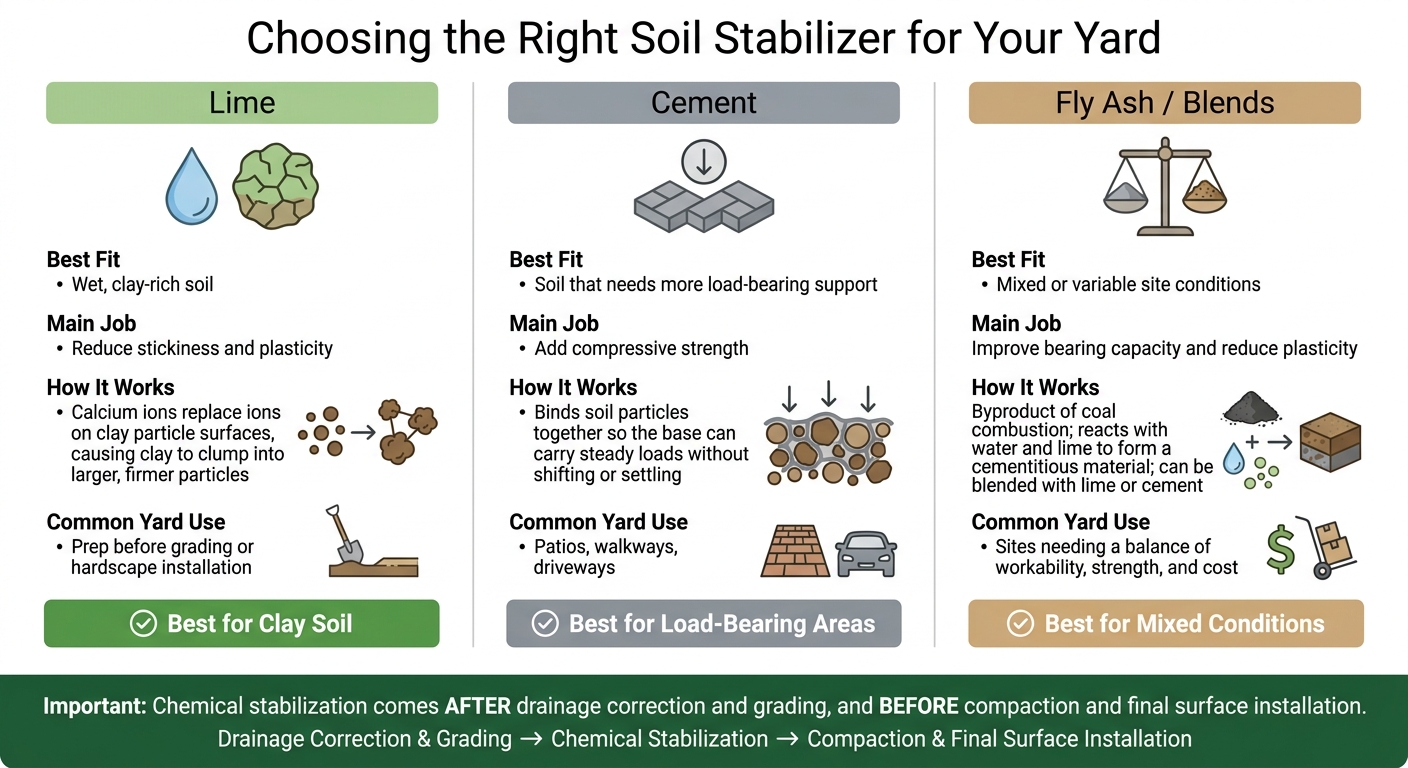
Lime vs. Cement vs. Fly Ash: Soil Stabilizer Comparison for Maryland Yards
Each additive changes soil in a different way. So the right pick depends on a few things: moisture, clay content, and how much weight the finished surface needs to handle.
Lime works best in clay-heavy soil. It reacts with moisture and changes how clay behaves, making the soil less sticky and much easier to grade. Inside the soil, lime starts an ion-exchange process. Calcium ions replace other ions on the surface of clay particles. That shift makes the clay group into larger particles, turning sticky soil into something firmer and easier to work with. That’s why lime is often used before grading or Baltimore hardscaping installation.
Cement comes into play when the subgrade needs more strength, especially under patios and driveways. It binds soil particles together and adds compressive strength, which helps the base carry steady loads without shifting or settling.
Fly ash and blended stabilizers fill a different role. Fly ash is a byproduct of coal combustion that reacts with water and lime to form a cementitious material. Used alone or mixed with lime or cement, it can improve bearing capacity and reduce plasticity. Blended stabilizers are often chosen when site conditions call for the right mix of strength, workability, and cost.
Cement and fly ash serve different subgrade needs, especially where hardscape must carry weight.
Lime for Wet, Clay-Rich Soils
Lime is the go-to additive when clay content is high and the soil stays wet. It cuts plasticity fast, which makes grading and compaction easier before any surface work starts.
Cement for Stronger Patio and Driveway Subgrades
Cement binds soil particles together and adds compressive strength. It works well under patios, driveways, and walkways where the subgrade needs to carry a steady load without shifting or settling.
Fly Ash and Other Blended Stabilizers
Fly ash is a byproduct of coal combustion that reacts with water and lime to form a cementitious material. On its own or blended with lime or cement, it can improve bearing capacity and reduce plasticity. Blended stabilizers are often used when site conditions call for a balance of strength, workability, and cost.
Where Soil Stabilization Fits in Slope, Patio, Driveway, and Wet Yard Projects
Chemical soil stabilization is a middle step in the job. It comes after drainage correction and grading, and before compaction and the final surface. Put simply, it strengthens a weak subgrade so the finished surface has a better base to sit on. It does not replace drainage correction or grading. That order matters most on slopes, paved areas, and wet low spots.
Slopes and Erosion-Prone Areas
On slopes, stabilization can help when the soil itself is weak and needs more strength. Use it after drainage is corrected and before the slope is finished. The same idea applies to hardscape bases that need to carry weight and stay stable over time.
Patios, Walkways, and Driveways
Patios, walkways, and driveways all depend on a stable base. If the subgrade is weak, chemical stabilization can strengthen it before compaction and before the final surface goes in. For larger patio, walkway, driveway, grading, or drainage projects, Pro Landscapes MD can coordinate the site work and final installation.
Wet Low Spots and Drainage Problem Areas
If a low spot stays wet because drainage is poor, fix the drainage issue first. Then chemical stabilization can strengthen the subgrade once the water problem is under control. After that, planting or surface work can move forward. Stabilization is only one part of the repair. It is not a substitute for fixing the source of the water issue.
Before starting, review the soil, drainage, and whether the finished area needs structural support. Next, look at safety, site conditions, and when a qualified contractor should take on the work.
Safety, Maryland Project Considerations, and Key Takeaways
In Maryland yards, the big issue is simple: does the soil need more strength before surface work starts? Chemical soil stabilization can help weak soils, but the product has to fit the soil type and the moisture at the site. If that match is off, the fix may not hold up.
When to Bring in a Qualified Contractor
The risk goes up when weak soil sits under a slope, patio, driveway, or retaining feature. At that point, this isn’t the kind of job to wing.
Bring in a qualified contractor if the yard has any of these conditions:
- Persistent wet soil
- A load-bearing hardscape
- Retaining features
- Visible slope movement or slumping
- Large erosion-prone areas
- Uncertainty about which additive fits the site
Using the wrong additive – or skipping the site fixes underneath – can leave the subgrade weak. That means the surface above it may still have problems, even if it looks fine at first.
Pro Landscapes MD handles grading, yard leveling, drainage installation, French drains, and patio and paver driveway installation across central Maryland.
Main Points to Review Before Starting a Yard Project
Use chemical stabilization only after the soil type, moisture level, and load demand are clear. It tends to work best under slopes, patios, driveways, and wet yard areas where the subgrade needs more strength.
FAQs
How long does soil stabilization last?
How long chemical soil stabilization lasts comes down to three things: the method used, the materials chosen, and the conditions on-site. When the work is done well, it can stay effective for 10 to 20 years or more and help the soil resist settling, erosion, and pavement damage.
Biopolymer-based stabilizers tend to have a shorter lifespan. In many cases, they last from several months to a year, though they can last longer in wet conditions. Routine inspections and maintenance, such as regrading or reapplying agents when needed, can help extend performance.
Can soil stabilization fix a muddy yard by itself?
No. Chemical soil stabilization is rarely a standalone fix for a muddy yard.
It can improve soil strength and load-bearing capacity. But it doesn’t solve the drainage issues that usually keep a yard wet in the first place.
In Maryland, persistent mud often comes from poor grading or soil with a lot of clay. A fix that lasts usually includes a mix of regrading, drainage work, and soil amendments.
Do I need soil testing before choosing lime or cement?
Yes. Soil testing should happen before using lime or cement.
Maryland soils can vary a lot in makeup, strength, and moisture. Because of that, testing helps crews pick the right stabilization method for your site.
That step can help avoid settling, erosion, and pavement failure. It also supports long-term performance.
Chat with Us