









- bhavya gada
- No Comments
The short answer: pick plants by site first, then by water needs, then by pollinator support. Successful landscape projects in Maryland start with a clear understanding of your yard’s conditions. If I want a Maryland pollinator garden that uses less water, I start with sun, soil, drainage, and slope. Then I choose mostly native plants, plan blooms from spring through fall, and give new plants deep watering in year one.
A few facts shape the whole plan:
- About 70% of native bees nest in the ground
- Full sun = 6+ hours of direct light per day
- New plants often need 1 to 2 inches of water per week while roots settle in
- A good target is at least 70% native plants
Here’s the simple framework I’d use:
- Read the site first: watch sun and shade, note hot spots near pavement, and check where water runs or sits
- Match plants to moisture: dry, medium, or wet spots
- Choose native plants that can handle dry periods after establishment
- Cover the whole season with spring, summer, and fall bloom times
- Plant in groups of 3 or more so pollinators can find flowers with less effort
- Leave small bare soil patches for ground-nesting bees
- Mulch 2 to 3 inches and water deeply, not lightly and often
A few strong Maryland picks include butterfly weed, false blue indigo, wild bergamot, little bluestem, moss phlox, and native asters. For dry slopes, I’d lean on deep-rooted grasses and shrubs. For hot beds near sidewalks or driveways, I’d use plants that can take reflected heat.
| What to check | What I’m looking for | Why it matters |
|---|---|---|
| Sun | Full sun, part shade, full shade | Tells me which plants can flower and hold up |
| Soil moisture | Dry, medium, wet | Keeps me from putting thirsty plants in dry spots |
| Drainage | Fast runoff or standing water | Helps stop plant loss |
| Slope | Flat ground or erosion-prone areas | Points to grasses, groundcovers, and shrubs |
| Bloom timing | Spring to fall | Keeps nectar and pollen available longer |
| Bee habitat | Small bare soil patches | Supports ground-nesting bees |
Bottom line: I don’t start with a plant list. I start with the yard. That one step makes it much easier to choose pollinator plants that can handle Maryland dry spells and still keep the garden active through the season.
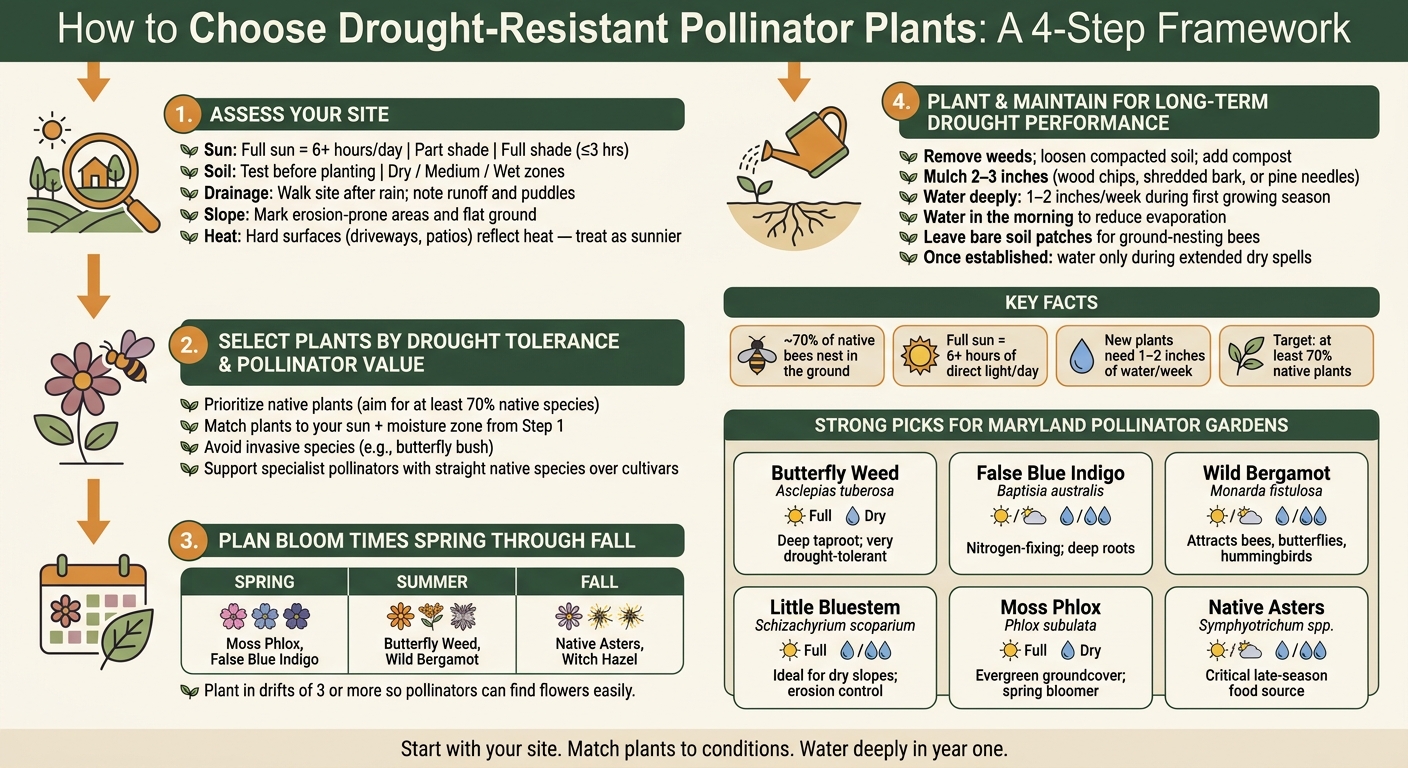
How to Choose Drought-Resistant Pollinator Plants: A 4-Step Framework
LESS WATERING! With Beautiful Drought Tolerant Native Plants
sbb-itb-843f8be
Step 1: Assess Your Site Before Picking Plants
Start by reading the site. Sun, shade, drainage, and slope shape what will grow well and what will struggle. It’s much easier to use those conditions to narrow your plant options first, then choose plants that fit. As you look around, you’ll start to see patterns. Some areas can take full sun. Others need plants that can handle shade.
Check Sun, Heat, and Shade Patterns
Watch how sunlight moves across the site during the day. Full sun means 6 or more hours of direct sunlight each day. Full shade means 3 or fewer hours. Anything between those falls into partial sun or partial shade, with partial sun getting more direct light than partial shade [4].
Hard surfaces can change the picture fast. The University of Maryland Extension puts it this way:
"Heat and light reflecting off of hard surfaces can increase the perceived amount of sun." [4]
That matters more than people think. Driveways, patios, and walls can bounce heat back onto nearby beds and make an area act sunnier than it looks. It also helps to notice where taller plants, fences, or buildings may cast shade later in the season and block plants that need more sun [2].
Test Soil, Drainage, and Moisture Levels
Before you plant, get a soil test [4]. That gives you a clear starting point. If the soil is compacted, aerate it and add organic matter so water can move through the soil more easily and stay there longer [1].
It also helps to group plants by moisture need:
- Dry
- Medium
- Wet
That way, the plants match the site instead of fighting it [4]. During establishment, keep a close eye on moisture and adjust watering as needed. Once you can see where the dry and damp zones are, map each planting area by both light and drainage.
Map Slopes, Bare Spots, and Existing Features
After a heavy rain, walk the property and pay attention to what the water is doing. Note where it runs off, where soil is washing away, and where puddles sit. Fast-draining slopes are often the driest parts of the yard. Low areas may stay wet much longer.
Mark existing features on your map, including mature trees, downspouts, and hard surfaces like walkways, patios, and driveways. These affect shade, root competition, and runoff. Also look for thin turf or bare spots under trees and on dry slopes. Those are often strong places to plant.
As you map the site, decide where to keep a few small bare patches and where exposed soil needs to be held in place. Leave some small, sunny bare-soil patches for ground-nesting bees [3]. In the rest of those areas, use groundcovers or mulch to hold the soil.
Step 2: Select Plants With the Right Drought Tolerance and Pollinator Value
Pick plants that fit Maryland soils and weather, need little water after they settle in, and give pollinators steady nectar or pollen. Your site map does the heavy lifting here. Match each plant to the sun and moisture zone where it will live best. Use the sun, slope, and moisture notes from Step 1 to trim your options.
Prioritize Maryland Native and Regionally Adapted Species
Start with native plants. Maryland natives already fit local weather, soils, and pest pressure, so they usually need less extra water and fertilizer once established [2].
"Aim to have at least 70% native plants to help support native beneficial insects and birds." [4]
That 70% target matters for another reason too. Some bees, butterflies, and moths are specialists. They rely on specific native plants for pollen or nectar [2]. Cultivars can still have a place, but straight species are usually the better pick if you want to support more local wildlife [3].
Skip butterfly bush (Buddleja). It is invasive. Better options include Liatris spicata (blazing star), Vernonia noveboracensis (New York ironweed), and Asclepias tuberosa (butterfly weed). Each one handles dry conditions well and gives pollinators a lot to work with [2].
Plan Bloom Times From Spring Through Fall
Try to keep something in bloom from spring through fall [2]. In plain English, don’t load the whole garden into one season and call it done.
A simple mix might look like this:
- Early bloomers such as Phlox subulata (moss phlox) and Baptisia australis (false blue indigo)
- Mid-summer plants such as Asclepias tuberosa and Monarda fistulosa (wild bergamot)
- Late bloomers such as native asters (Symphyotrichum spp.) and Hamamelis virginiana (witch hazel) [4]
It also helps to mix plant types. Different flowers pull in different pollinators. And instead of planting one here and one there, group each species in drifts of three or more. That makes the plants easier for pollinators to spot and lets them forage with less effort [3].
Maryland Plant Comparison Table
| Botanical Name | Common Name | Sun Needs | Soil Moisture | Bloom Season / Seasonal Interest | Pollinators Supported | Notes |
|---|---|---|---|---|---|---|
| Asclepias tuberosa | Butterfly Weed | Full Sun | Dry | Summer; Orange | Bees, Monarchs (host) | Deep taproot; very drought-tolerant |
| Baptisia australis | False Blue Indigo | Full Sun to Part Shade | Dry to Medium | Spring–Summer; Blue | Bees | Deep roots; nitrogen-fixing |
| Liatris spicata | Blazing Star | Full Sun | Dry to Moist | Summer; Purple | Bees, Butterflies | Vertical habit; replaces invasive species |
| Monarda fistulosa | Wild Bergamot | Full Sun to Part Shade | Dry to Medium | Summer; Lavender | Bees, Butterflies, Hummingbirds | Clumping habit; stabilizes soil |
| Coreopsis lanceolata | Lanceleaf Coreopsis | Full Sun | Dry to Medium | Spring–Summer; Yellow | Bees, Butterflies | Highly drought-tolerant; handles poor soil |
| Phlox subulata | Moss Phlox | Full Sun | Dry | Spring; Pink/Purple | Bees, Butterflies | Evergreen groundcover; prevents erosion |
| Symphyotrichum spp. | Native Asters | Full Sun to Part Shade | Dry to Medium | Fall; Blue/White/Purple | Late-season Bees, Butterflies | Critical late-season food source |
| Schizachyrium scoparium | Little Bluestem | Full Sun | Dry to Medium | Late Summer; warm-season foliage | Larval host for skippers | Deep-rooted bunchgrass; excellent for dry slopes |
| Hamamelis virginiana | Witch Hazel | Sun/Shade | Dry to Medium to Wet | Fall–Winter; Yellow | Moths, late-season insects | Large shrub; stabilizes slopes |
| Heuchera americana | Alumroot | Shade | Dry to Medium | Spring; Green-White | Small Bees | Semi-evergreen; good for dry shade |
Next, place these plants by form and root depth so the planting holds moisture better and helps keep soil in place.
Step 3: Match Plant Types to Your Maryland Landscape
Now that your plant list is shorter, the next move is simple: put each plant where it can deal with your yard’s heat, slope, and moisture. Use your sun, slope, and moisture map as a guide. The better the match, the better the plants will grow as part of your professional landscape services.
Perennials for Dry, Sunny Pollinator Beds
For hot, open beds, go with butterfly weed, lanceleaf coreopsis, false blue indigo, and blazing star. These plants do well in dry soil, help pollinators, and stand up to full sun.
If you have areas near driveways or sidewalks, start with the toughest picks there. Pavement throws off extra heat, so those spots can be rough on weaker plants.
Grasses, Groundcovers, Shrubs, and Small Trees for Slopes and Structure
Slopes and bigger planting areas need more than flowers. They need plants with strong root systems and enough presence to hold the space together over time.
Trees, shrubs, and deep-rooted grasses help keep soil in place and cut runoff. Use deep-rooted grasses on dry slopes, shrubs to give the planting shape, and part-shade plants near foundations.
Site-Based Plant Selection Table
| Site Type | Recommended Species | Height | Why It Fits |
|---|---|---|---|
| Dry Full-Sun Slope | Little Bluestem, Switchgrass, Northern Bayberry, Red Chokeberry, Fragrant Sumac | 2–10′ depending on species | Deep roots for erosion control; high drought tolerance |
| Sunny Garden Bed | Butterfly Weed, False Blue Indigo, Lanceleaf Coreopsis, Blazing Star | 1–4′ | High pollinator value; thrives in dry soil |
| Foundation (Part Shade) | Alumroot, Mapleleaf Viburnum, Foxglove Beardtongue, New Jersey Tea | 1–6′ | Structure; adapted to varying light |
| Narrow Street Strip | Moss Phlox, Adam’s Needle Yucca (Yucca filamentosa) | <1’–3′ | Handles reflected heat; evergreen coverage; structural interest |
Leave small patches of bare soil for ground-nesting bees. After the layout is in place, soil prep and watering have a big effect on how well everything gets established.
Step 4: Plant and Maintain for Long-Term Drought Performance
Once you’ve matched plants to the site, the next part is simple in theory but easy to get wrong in practice: plant them in a way that helps pollinators and gives the landscape a better shot at handling dry weather over time.
Use Planting Layouts That Support Pollinator Access and Soil Stability
Plant in groups, not one-off singles. Drifts of 3 or more are easier for pollinators to spot, and they make the planting feel more natural at the same time. The University of Maryland Extension says it plainly:
"Plant in drifts of 3+ to be noticed by pollinators." [3]
It also helps to leave a few small patches of bare, undisturbed soil for ground-nesting bees.
Dense planting does more than fill space. It works like living mulch, shading the soil, slowing evaporation, and helping keep weeds down. On slopes, native grasses like switchgrass and indiangrass pull extra weight. Their deep root systems handle dry conditions well and help keep soil from washing away.
Prepare Soil, Mulch Correctly, and Water Through Establishment
Even the right plant in the right place can struggle if the bed isn’t set up well. Start by removing weeds and loosening compacted soil so rain and irrigation can soak in instead of running off.
"Soils with more organic matter and less compaction allow rainwater and irrigation water to soak in more gradually rather than running off to drainage systems." [1]
If the soil is compacted, mix in compost to help with infiltration and root growth. After planting, add 2 to 3 inches of organic mulch, such as arborist wood chips, shredded bark, or pine needles. That layer helps moderate soil temperature and slows moisture loss.
Drought-tolerant plants still need regular watering during their first growing season. In many cases, new plants need 1 to 2 inches of water per week, depending on the soil and weather [1]. The goal is deep, occasional watering rather than light, frequent watering. That pushes roots farther down into the soil. Watering in the morning also cuts evaporation and can help lower the risk of leaf disease. Once plants are established, water only during long dry spells.
Monitor Results and Know When to Call a Professional
Keep a close eye on the planting through the first summer. Stress often shows up fast, and early action can make a big difference. Common warning signs include:
- Wilting that doesn’t recover overnight
- Leaf scorch
- Premature fall color
- Early leaf drop
- Yellowing leaves
Drought stress can also leave plants more open to pests and disease.
If you’re dealing with severe erosion or runoff that keeps coming back near slopes or foundations, Pro Landscapes MD can help with grading, drainage, and stormwater management across central Maryland.
Conclusion: Build a Maryland Pollinator Garden That Uses Less Water
Put these steps together and you get a garden that needs less water and gives pollinators a place to thrive. It starts with a close look at your site: sun exposure, soil type, soil moisture, drainage, and slope. Then match your plants to those conditions so they’re set up to do well from the start.
Start with Maryland natives and regionally adapted species that support pollinators and can handle dry spells once they’re established. It also helps to plan for blooms from spring through fall, so nectar and pollen are available all season instead of showing up in one short burst.
In the first season, focus on the basics: water deeply, mulch lightly, and plant densely enough to help shade the soil. That mix – good site match plus solid first-season care – can lead to lower water use over time.
Leave dead stalks and fallen leaves in place through winter to shelter pollinators. [2][3]
If the site itself is working against you, deal with that first. Poor drainage, bad grading, or erosion can stop plants from doing well no matter what you plant. Pro Landscapes MD can correct the site before you plant.
FAQs
How do I know if my yard is too dry for pollinator plants?
Start with a soil test so you know what you’re working with. Then sort your soil moisture into dry, medium, or wet to pick pollinator plants that fit your site.
It also helps to watch moisture levels during the first year after planting. That gives you a clear sense of how your landscape holds water over time.
If you want help checking your soil or planning a resilient landscape, Pro Landscapes MD can help across central Maryland.
Which drought-tolerant native plants bloom at different times?
Choose drought-tolerant native plants with bloom times that overlap, so pollinators can find food across the season.
- Early season: Lanceleaf coreopsis and Eastern redbud
- Mid-season: Smooth penstemon and Wild indigo
- Late summer through fall: New England aster and Seaside goldenrod
How long do new pollinator plants need regular watering?
Drought-resistant native plants usually need little to no extra water once they’re fully established.
That said, the first year is different. Check soil moisture on a regular basis so plants can stay healthy while their roots grow in and settle.
A 3-inch layer of mulch also helps during this setup period. It can hold moisture in the soil and protect roots at the same time.
Chat with Us