









- bhavya gada
- No Comments
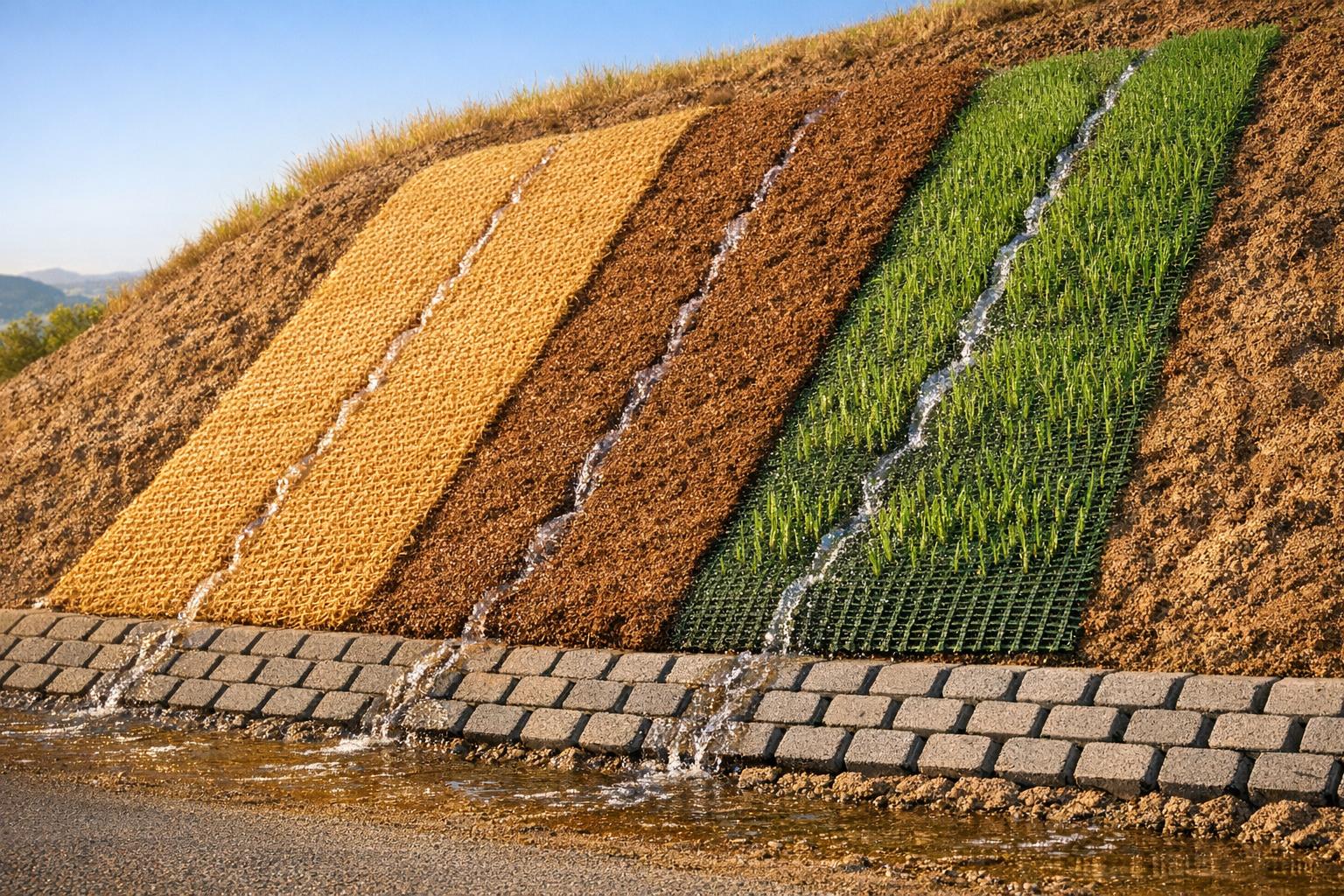
Erosion control mats are essential for stabilizing steep slopes and preventing soil erosion caused by heavy rain or runoff. Here’s a quick guide to choosing the right mat for your needs:
- Steepness matters: Slopes steeper than 3:1 (33%) require stronger mats to handle faster water flow and higher erosion risks.
- Know your soil: Clay soils resist water but are harder to anchor. Loamy soils are easier to stabilize but may need lighter mats.
- Water flow: Identify if water spreads evenly (sheet flow) or concentrates in channels (concentrated flow). High-flow areas need tougher mats.
- Mat types:
- Straw mats: Temporary, ideal for mild slopes (≤3:1).
- Coir mats: Longer-lasting, good for steeper slopes or shaded areas.
- Synthetic mats (TRMs): Permanent, suitable for steep slopes or areas with heavy runoff.
- Concrete-integrated mats: Best for extreme slopes or critical infrastructure.
In Maryland, heavy rains, freeze-thaw cycles, and clay-heavy soils make mat selection especially important. Proper installation – like anchoring, overlapping, and seeding – is key to success. Always evaluate slope, soil, and water conditions before making a choice.
Erosion Control Blankets and Turf Reinforcement Mats
sbb-itb-843f8be
Evaluating Your Slope and Site Conditions
Understanding your slope, soil, and water runoff is key to determining the right erosion control measures.
How to Measure Slope Steepness
To measure slope steepness, identify two points: the crest (top) and the toe (bottom) of the slope. Use a tape measure and level (or a smartphone app) to determine the horizontal distance (H) and the vertical rise (V). Divide the horizontal distance by the vertical rise to calculate the H:V ratio. For example, if the horizontal distance is 15 feet and the vertical rise is 5 feet, the ratio is 3H:1V, which translates to a slope of about 33%.
Slopes steeper than 3H:1V often require stronger reinforcement. For smaller areas, place a 10-foot 2×4 along the slope and measure the vertical gap at the downhill end – this gives you the rise over a 10-foot run.
How to Assess Soil Type and Stability
Soil type plays a big role in erosion control. Take a handful of moist soil and test its texture:
- Sticky soil: Indicates clay.
- Gritty soil: Suggests sand.
- Smooth soil: Points to silt.
- Crumbly soil: Likely loam.
You can also perform a ribbon test by pressing moist soil between your thumb and forefinger. If the ribbon is longer than 2 inches, the soil has a high clay content. Clay soils on steep slopes tend to slump instead of washing away, and their density makes anchoring stakes harder to drive. In these cases, use longer, closely spaced staples for better stability. For compacted fill slopes – common in newer Maryland developments – water runs off quickly, and roots struggle to grow. These slopes often need scarification and compost amendments before installing a mat.
Walk the slope to check for signs of instability. Look for:
- Rills: Small channels where water has concentrated and cut through the soil.
- Cracks: Polygonal cracks in clay indicate shrink-swell behavior.
- Slumps: Small soil slides suggest deeper instability.
If you notice any of these signs, a mat alone might not be enough to stabilize the area.
Identifying Water Flow and Drainage Risks
After assessing slope and soil, examine how water moves across the site. The best time to do this is during or just after heavy rainfall. Walk the property to identify water flow patterns, pooling areas, and runoff exit points. Trace all sources of runoff, such as downspouts, driveways, uphill paved surfaces, and neighboring properties.
Pay attention to the difference between sheet flow (water spreading evenly) and concentrated flow (water funneled into narrow, fast-moving channels). Concentrated flow creates more shear stress on mats and is often where erosion starts. Watch for red flags like ponding at the slope’s base, water seeping mid-slope, or runoff that repeatedly washes away temporary fixes. These issues might indicate a need for subsurface drainage solutions, like regrading or installing French drains, in addition to matting.
| Site Condition | Why It Matters | Likely Matting Implication |
|---|---|---|
| Steep, uniform slope (>3H:1V) | Higher erosion risk from sheet flow | Stronger reinforcement, closer anchoring |
| Compacted clay or fill soil | Low infiltration, poor root establishment | Longer stakes, soil prep before installation |
| Loam with good structure | Better infiltration and root growth | Lighter-duty mat may be sufficient |
| Concentrated runoff path | Higher shear stress and gully risk | Higher-performance mat or reinforced system |
| Swale or outfall area | Persistent flow and turbulence | Durable matting with robust anchoring |
If you’re in Maryland and unsure about your site’s conditions, consider reaching out to local professionals like Pro Landscapes MD. They can provide a detailed evaluation and recommend the best solutions for effective erosion control.
Types of Erosion Control Mats and Their Uses
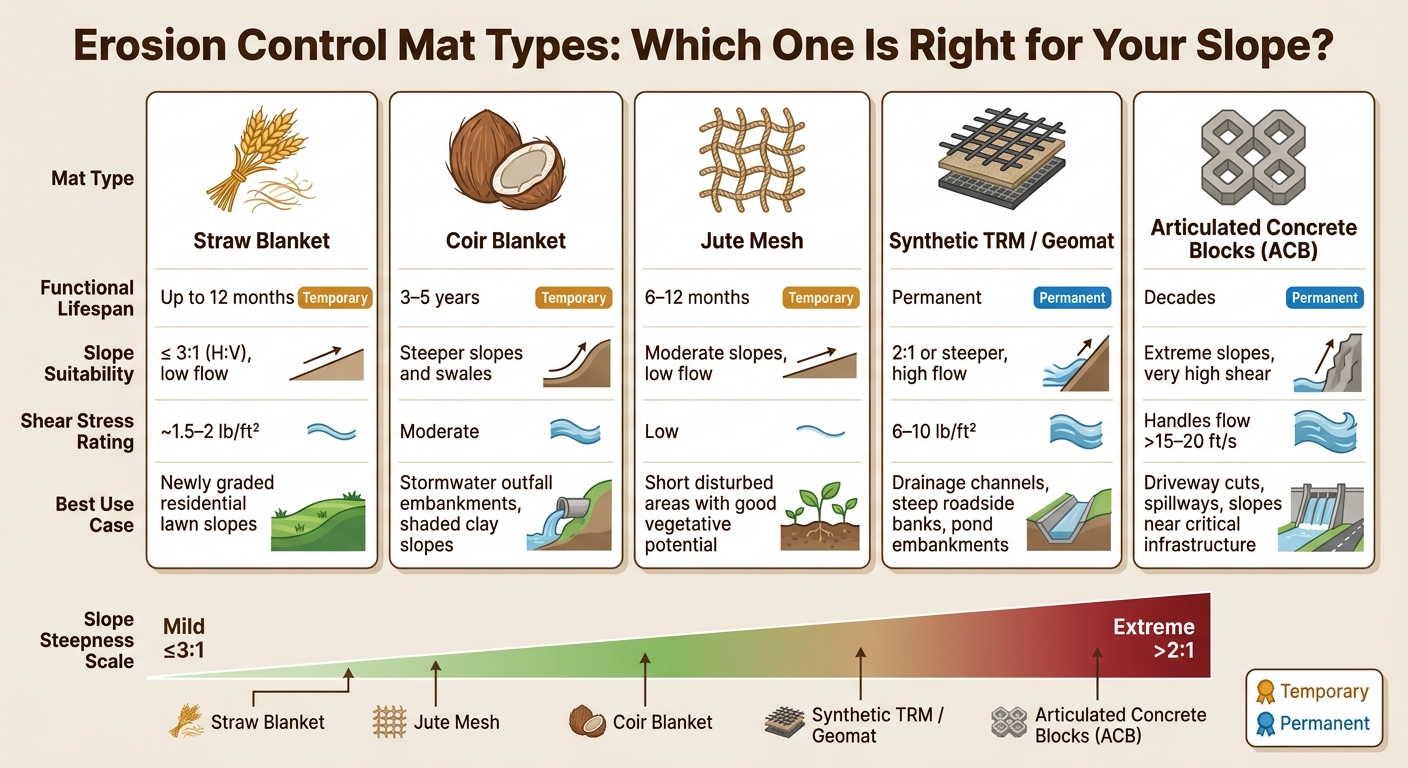
Erosion Control Mat Types: Which One Is Right for Your Slope?
When choosing an erosion control mat, factors like slope steepness, soil type, and water flow are key – especially in Maryland, where winters bring freeze-thaw cycles, and summers deliver intense storms. The three main mat types to consider are biodegradable blankets, synthetic turf reinforcement mats (TRMs) and geomats, and concrete-integrated systems.
Biodegradable Mats: Straw, Coir, and Jute
Biodegradable mats provide temporary protection, giving grass or native plants time to establish. These mats decompose over time, enriching the soil in the process. Their effectiveness depends on the type of fiber used and how long they last.
- Straw blankets are the most economical option, ideal for mild to moderate slopes (up to 3:1 (H:V)). These blankets typically last up to 12 months (FHWA Type 1 classification), making them suitable for areas where turf can establish within a single growing season.
- Coir (coconut fiber) blankets are more durable, lasting 3–5 years. They work well on steeper slopes or areas with higher water flow. Coir fibers can retain water up to five times their weight, which helps seeds germinate, especially on dry or sunny slopes.
- Jute mesh is lightweight and features an open weave that holds seeds in place and roughens the soil surface. However, it breaks down faster than coir and isn’t recommended for areas with concentrated water flow or high shear stress.
In Maryland, coir blankets often outperform straw and jute due to their resilience against the region’s harsh weather. They’re particularly effective on north-facing clay slopes or shaded areas where vegetation takes longer to grow.
For slopes with higher flow rates or requiring long-term stabilization, synthetic mats are a better fit.
Synthetic Turf Reinforcement Mats (TRMs) and Geomats
For steeper slopes (2:1 or greater) or areas with concentrated runoff, biodegradable options may fall short. TRMs and geomats offer a permanent solution, integrating with soil and root systems to stabilize slopes over the long term.
When installed correctly, TRMs can significantly boost a vegetated channel’s resistance to shear stress – from about 2–3 lb/ft² for unreinforced grass to 6–10 lb/ft² with TRM reinforcement [3]. Key performance factors include their ability to resist shear stress, handle water velocity, and withstand UV exposure.
In extreme hydraulic conditions where even reinforced vegetation cannot hold, concrete-based systems become essential.
Concrete-Integrated Mats for Extreme Slopes
For the steepest and most challenging scenarios, articulated concrete block (ACB) mats and concrete-filled geocells are the go-to solutions. These systems are built to handle flow velocities exceeding 15–20 ft/s, well beyond the limits of vegetated or synthetic mats.
ACBs aren’t strictly hardscape, though they are often used alongside retaining walls for comprehensive slope management. Many designs include open cells or geotextile layers that allow vegetation to grow through, blending structural integrity with a more natural appearance. This makes them a practical choice even in residential settings, such as steep cuts between driveways and property lines in areas like Howard County.
The table below summarizes each mat type’s features and ideal applications in Maryland.
| Mat Type | Functional Lifespan | Slope Suitability | Best Maryland Use Case |
|---|---|---|---|
| Straw blanket | Up to 12 months | ≤ 3:1 (H:V), low flow | Newly graded residential lawn slopes |
| Coir blanket | 3–5 years | Steeper slopes, swales | Stormwater outfall embankments, shaded clay slopes |
| Jute mesh | 6–12 months | Moderate slopes, low flow | Short disturbed areas with good vegetative potential |
| Synthetic TRM/Geomat | Permanent | 2:1 or steeper, high flow | Drainage channels, steep roadside banks, pond embankments |
| Articulated concrete blocks | Decades | Extreme slopes, very high shear | Driveway cuts, spillways, slopes near critical infrastructure |
Specifications to Check and Installation Tips
Key Product Specifications to Review
Start by examining the product datasheet for essential performance details. Pay close attention to the maximum slope rating, permissible shear stress (lb/ft²), maximum flow velocity (ft/s), design life, roll dimensions, and weight. These figures, derived from large-scale flume tests, will help you determine if the mat can withstand the runoff intensity typical of a Maryland summer storm. For example, a lightweight straw erosion control blanket (ECB) with a rating of 1.5–2 lb/ft² won’t suffice in areas requiring a synthetic turf reinforcement mat (TRM) rated above 8 lb/ft².
Also, match the design life of the product – temporary (up to 12 months), extended-term (up to 36 months), or permanent – to the time it will take for vegetation to establish. Look for products that meet ASTM standards or have state DOT approvals, as these indicate a baseline level of quality. Once the specifications align with your needs, focus on proper anchoring to ensure the mat stays securely in place.
Anchoring and Overlap Best Practices
After confirming the product specs, proper installation becomes essential. Begin by preparing the slope: grade and smooth the area, remove rocks, fill ruts, and compact soft spots to ensure the mat sits flat against the soil without gaps or "bridging."
At the top of the slope, dig an anchor trench about 6 inches deep and 6 inches wide. Tuck the end of the mat into the trench, then backfill and compact it. This "anchor slot" prevents the mat from peeling away during heavy rainfall. Next, unroll the mat downslope, following the natural flow of water. For overlaps, always place the upstream section on top of the downstream section, similar to roof shingles. Use a vertical overlap of 6–12 inches and a side overlap of 3–6 inches, securing each seam firmly with staples.
For steeper slopes (greater than 3:1), reduce staple spacing to 1.5–2 feet in staggered rows, compared to the standard 3–5 feet for flatter areas. On very long slopes, consider adding intermediate check slots – extra anchor trenches placed across the slope at intervals – to prevent the mat from gradually sliding downhill. Ensure all drainage systems are installed before placing the mat to avoid concentrated runoff that could undermine your efforts.
Seeding and Vegetation Establishment
In Maryland’s challenging conditions, proper seeding is critical for stabilizing the slope over time. Before laying the mat, prepare a firm, fine seedbed: lightly till the soil if needed, remove clumps, and smooth the surface. Spread seed and fertilizer evenly, then lightly incorporate them into the top ¼–½ inch of soil before placing the blanket over it.
For Maryland slopes, cool-season grasses like tall fescue work well as a base mix since they germinate effectively in the fall and spring when soil moisture levels are higher. In areas with more shade or moisture, supplement with native species that are better suited to local conditions. Native plants tend to develop deeper root systems and can better handle Maryland’s alternating wet and dry cycles. [2] Most state DOT guidelines require achieving 70–95% vegetative cover within one to two growing seasons before temporary erosion measures can be removed. Regular watering and inspections after significant rain events during the first season are crucial to achieving this goal.
"Native plants, grasses, and water-tolerant shrubs are ideal for swales. These plants absorb water, filter pollutants, and provide habitat for local wildlife." – Pro Landscapes MD [2]
For more complex slopes – such as those near retaining walls, drainage outfalls, or walkout basements – pairing an erosion mat with a professionally designed drainage system can make a big difference. Pro Landscapes MD specializes in combining erosion mats with grading, French drains, and stormwater management solutions across central Maryland. This approach addresses both surface protection and the underlying water flow challenges that mats alone can’t resolve.
Conclusion: Choosing the Right Erosion Control Mat for Maryland Slopes
Selecting the right erosion control mat for your Maryland slope boils down to understanding your site’s unique characteristics – slope angle, soil type, and water flow. For gentler slopes with stable soils, a biodegradable straw or coir blanket might do the job. However, steeper slopes or areas experiencing high water flow demand a turf reinforcement mat (TRM) designed to handle higher shear stress. In situations where failure could jeopardize nearby structures or drainage systems, a concrete-integrated solution may be necessary.
Here’s what to keep in mind:
- Slope angle and length: Make sure the mat you choose can handle the steepness and length of your slope.
- Soil and vegetation compatibility: Verify that the mat works well with your soil type and the seed mix you plan to use.
- Water runoff: Factor in runoff from impervious surfaces like roofs and driveways that can increase water flow.
- Performance ratings: Check that the mat’s specifications align with your slope, soil, and water conditions.
- Lifespan: Ensure the mat will last long enough for vegetation to fully establish and stabilize the slope.
Even with the best erosion control mat, proper drainage is non-negotiable. On steep slopes, incorporating surface swales, grading, or subsurface drainage systems is critical to success.
"Drainage problems are complex and require a custom approach for each project. These issues can cause long-term damage to your property if not handled correctly, which is why hiring an experienced team is critical." – Pro Landscapes MD [1]
For slopes near foundations, drainage outfalls, retaining walls, or shared property lines, professional expertise becomes even more important. Pro Landscapes MD serves central Maryland – including Howard County, Montgomery County, and Baltimore County – offering integrated solutions like erosion control mats, French drains, grading, and native planting. These systems are built to withstand Maryland’s challenging weather and protect your property for the long haul.
FAQs
Do I need a TRM or a biodegradable mat for my slope?
When deciding between Turf Reinforcement Mats (TRMs) and biodegradable erosion control mats, it all comes down to the specific requirements of your slope. TRMs are better suited for steep slopes or situations where long-term stabilization is needed. On the other hand, biodegradable mats are a great choice for temporary erosion control.
The key to making the right choice lies in evaluating your soil conditions and slope gradient. If you’re unsure, reaching out to professionals like Pro Landscapes MD can make all the difference. They specialize in erosion control, grading, and drainage, ensuring your landscape remains stable and healthy.
When is a mat not enough, and drainage is required?
Erosion control mats might not be enough when dealing with tough conditions such as clay-rich soils, steep inclines, or areas with significant water runoff. In these situations, installing a proper drainage system becomes crucial to avoid problems like soil erosion, water pooling, or even damage to foundations. Options like French drains, swales, or berms can efficiently redirect water, helping to maintain the stability and health of your landscape.
What’s the biggest installation mistake on steep slopes?
The most common mistake when tackling steep slopes is trying to handle the installation yourself. These areas often come with tricky challenges like steep gradients, heavy foot or vehicle traffic, and unstable soils – all of which demand professional know-how. Mismanaging water flow or failing to stabilize the soil can lead to serious problems like erosion, structural damage, or even complete landscape failure. Pro Landscapes MD specializes in expert solutions, including custom grading, to ensure your property stays durable and protected against water-related issues for years to come.
Chat with Us