









- bhavya gada
- No Comments
A pool safety cover is a must-have for protecting children, pets, and maintaining your pool. Unlike standard tarp covers, safety covers are durable, can support heavy loads, and meet strict safety standards like ASTM F1346-91. Here’s what you need to know:
- Safety First: Covers must support at least 485 lbs to prevent accidents.
- Cost vs. Longevity: Safety covers cost $1,200–$3,000 but last 8–20 years, saving on heating, chemicals, and water.
- Types: Mesh (lightweight, drains water), solid (blocks sunlight, prevents algae), and hybrid (combines both).
- Climate Considerations: Maryland’s rising precipitation makes drainage and UV resistance critical.
- Installation: Professional installation ensures proper fit, durability, and compliance with safety standards.
Key takeaway: Choose a safety cover that fits your pool, climate, and safety needs while ensuring proper installation for peace of mind.
For more details, keep reading!
An Introduction to Safety Pool Covers
sbb-itb-843f8be
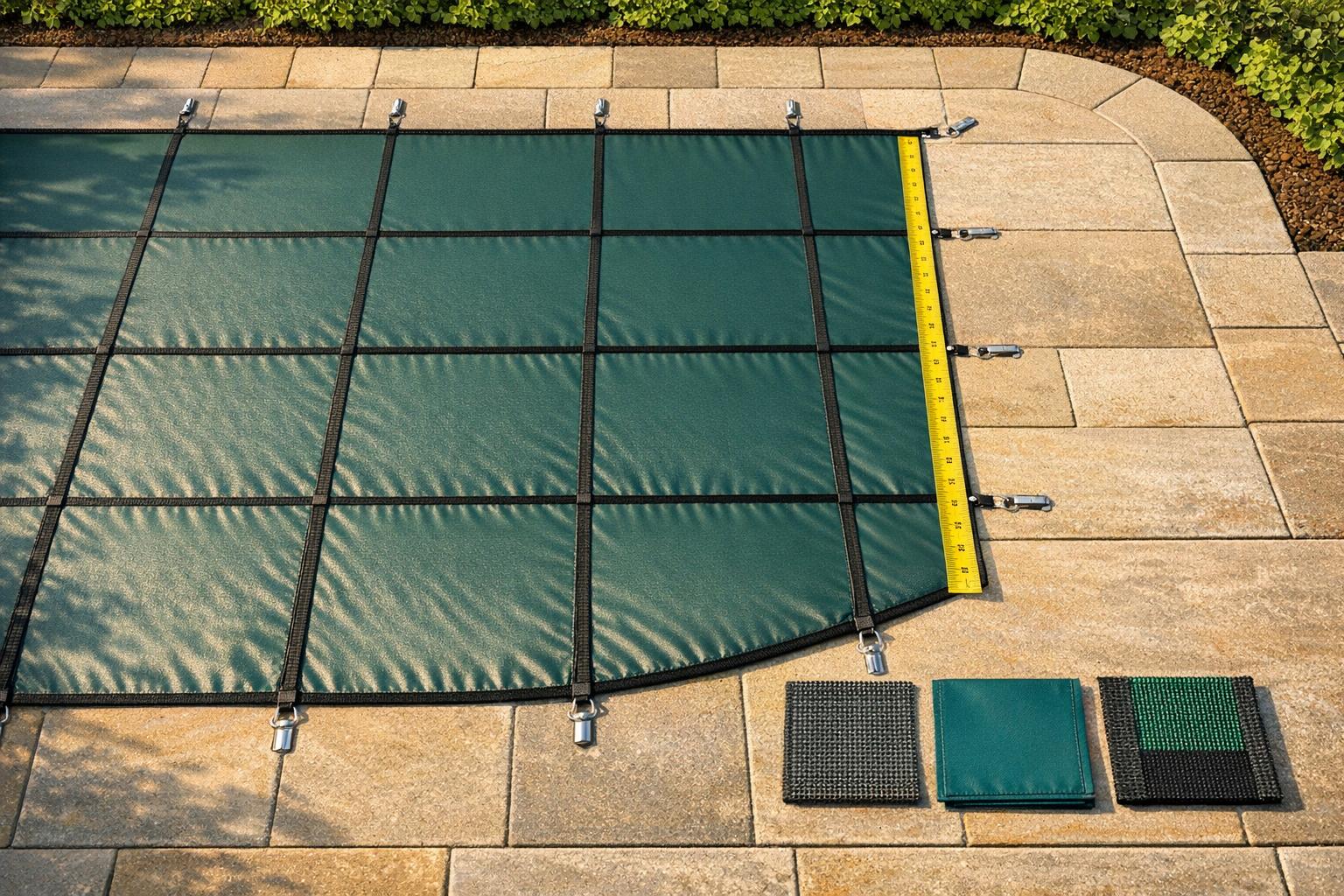
Step 1: Measure Your Pool’s Dimensions and Shape
Getting the right measurements is critical for ensuring your safety cover fits perfectly. Since manufacturers rely entirely on the numbers you provide, precision is non-negotiable. As Leslie’s Pool puts it, "Accuracy is of the utmost importance! Remember, the manufacturer producing your cover will only have the measurements you provide." [5]
For rectangular or oval pools, measure the length, width, and depth at their widest points. If your pool has a freeform or kidney shape, you’ll need to use the A-B triangulation method, which is the standard approach for irregular shapes. To begin, establish two fixed points (A and B) on a flat deck surface about 4–5 feet away from the pool’s edge. Point A should be on the left and Point B on the right when facing the pool. Make sure the distance between these points is roughly two-thirds of your pool’s total length. Next, mark the pool’s perimeter at intervals of 2–3 feet (or 1–2 feet for sharp curves) using chalk or painter’s tape. Always number these points clockwise – measuring counter-clockwise will result in a cover that’s a mirror image and won’t fit. From each numbered point, measure the distance to both Point A and Point B, and record all measurements carefully.
Don’t forget to account for fixed features like steps, ladders, handrails, diving board stands, and built-in spas. These need to be included to ensure the cover fits snugly, leaving no gaps larger than 4 inches. This is essential for meeting ASTM F1346-91 compliance standards [2]. To double-check your measurements, take 3–4 diagonal measurements across the pool from random numbered points. These cross-dimensions help the manufacturer verify the scale and identify any potential errors [6]. It’s also a good idea to take wide-angle and close-up photos of the marked pool to provide visual context along with your measurements [5][6].
If your pool is asymmetrical or freeform, the safety cover will require a 3’x3′ grid spacing to remain ASTM compliant. For symmetrical pools, a larger 5’x5′ grid can be used, unless the cover exceeds 1,500 square feet for mesh or 1,200 square feet for solid covers [7]. Taking the time to measure accurately now ensures a proper fit, avoids costly mistakes, and keeps your pool safe in line with regulatory standards.
Once you’ve documented all your measurements, you’ll be ready to move on to exploring the different types of safety covers in the next step.
Step 2: Learn About the Different Types of Pool Safety Covers
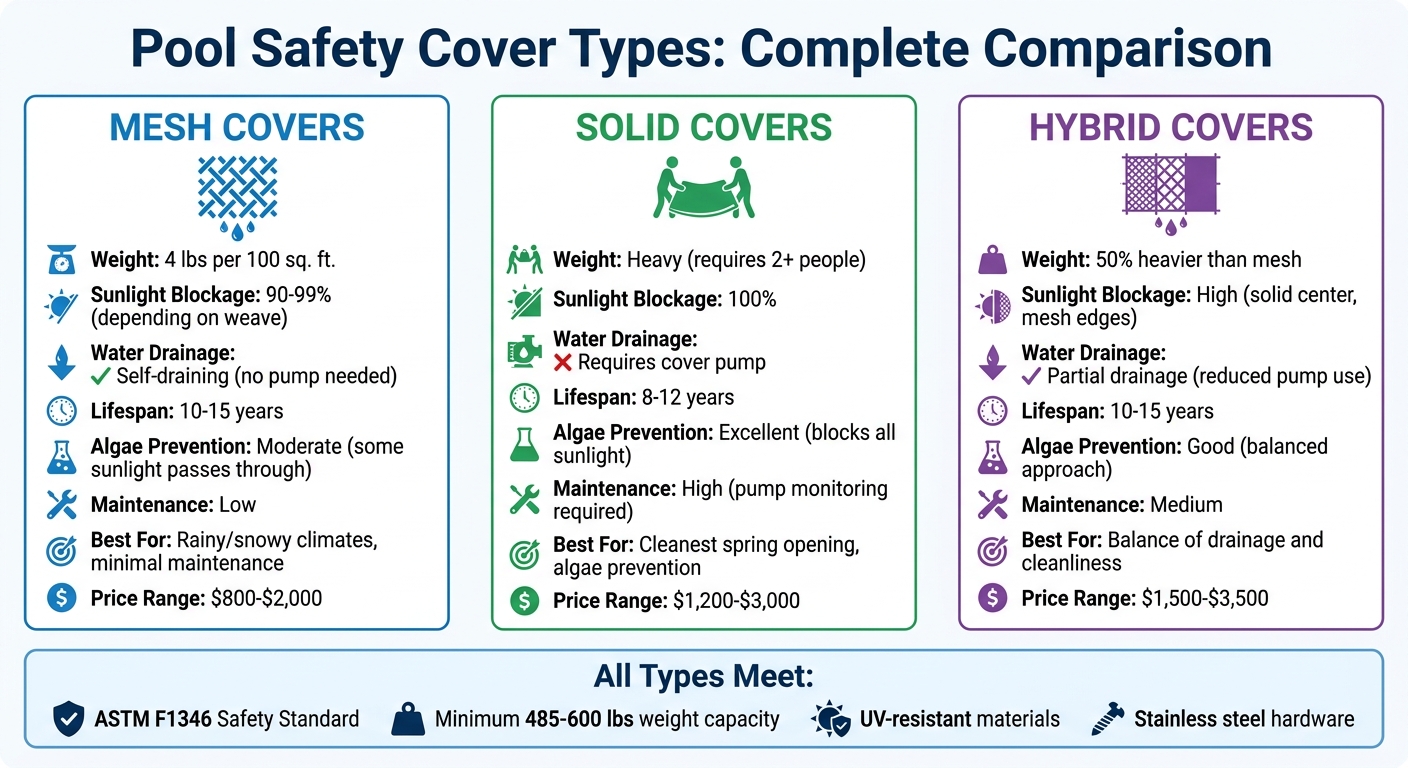
Pool Safety Cover Types Comparison: Mesh vs Solid vs Hybrid
Now that you’ve got your pool measurements ready, it’s time to dive into the three main types of pool safety covers. Each type has its own perks, depending on your local weather, how much maintenance you’re willing to do, and how clean you want your pool to be when you reopen it in the spring.
Mesh Safety Covers
Mesh covers are lightweight and designed to let rainwater and melted snow pass through while keeping out leaves and larger debris. Thanks to their porous material, water doesn’t pool on top, so you won’t need a cover pump to keep things dry.
Weighing about 4 lbs per 100 sq. ft. [8], mesh covers are much easier to handle than heavier options. They’re anchored securely to your pool deck and built to hold the weight of children, pets, and even adults in emergencies. High-quality versions are made with UV-resistant fabric, reinforced webbing, and stainless steel hardware, giving them a lifespan of 10–15 years when properly cared for [4].
Some advanced mesh covers, like RuggedMesh, block up to 99% of sunlight to help prevent algae growth while staying lighter than solid covers [9]. However, mesh covers do let some sunlight and fine silt through, which can encourage algae if the pool isn’t opened and maintained on time. Tim Golden, Owner of Pool Fits, emphasizes:
"The amount of shade or sunblock that your safety cover provides is critical to preventing or limiting algae growth, particularly for those who either close their pools early and/or open their pools late in the season" [7].
To keep algae at bay, consider opening your pool earlier in the spring before the water warms up [8]. Regular upkeep will also ensure your mesh cover performs at its best.
Solid Safety Covers
Solid covers, made from reinforced vinyl, offer complete protection by blocking 100% of sunlight and fine debris. This makes them the best choice for keeping algae at bay, so your pool water stays clear and requires minimal cleaning when spring rolls around [7].
However, solid covers come with their own challenges. Since they don’t let water pass through, you’ll need a pump or drainage panels to manage rain and snow, which can add a lot of weight. Regularly monitoring the pump during winter is essential to avoid damage from water buildup.
These covers usually last 8–12 years [7]. While they’re heavier and pricier than other options, they deliver the cleanest results when it’s time to reopen your pool. As In The Swim points out:
"Safety covers provide something standard tarp-style winter covers simply cannot: protection against accidental submersion & drowning" [8].
Hybrid Safety Covers
Hybrid covers combine the best of both worlds – solid panels to block sunlight and debris, and mesh sections to let water drain through without needing a pump. This design helps reduce algae growth while cutting down on maintenance.
Hybrids weigh about 50% more than mesh covers but are still easier to handle than fully solid options. Their more complex construction makes them pricier than standard mesh or solid covers, but they’re built to last. Features like a reinforced center strip add extra strength, making hybrids a reliable choice for homeowners who want safety and a hassle-free pool opening in the spring.
With these options laid out, you can now decide which cover fits your climate, safety needs, and maintenance preferences.
Step 3: Match the Cover to Your Climate, Safety Needs, and Pool Usage
After understanding the different types of pool covers, the next step is choosing one that fits your climate, safety priorities, and how you use your pool. These factors can help you narrow down the best option for your specific situation.
Climate Factors
If you live in an area with harsh winters, snow loads are a critical consideration. A cubic foot of snow weighs about 20 pounds, meaning your pool cover might need to handle between 15,000 and 30,000 pounds during a heavy storm [7]. To manage this, maintain the water level just below the skimmer to provide support for the weight of the snow. As Tim Golden, Owner of Pool Fits, explains:
"Any safety cover, either an automatic cover or traditional mesh or solid covers cannot sustain these types of snow loads unless that load is supported by the water/ice in the pool" [7].
Rainfall is another factor. Mesh covers allow rainwater to pass through into the pool, which can dilute water chemistry, particularly calcium hardness and cyanuric acid levels [10]. If you’re in a rainy area and choose a mesh cover, consider raising calcium levels to around 500 ppm before closing the pool to account for this dilution [10]. Solid covers, on the other hand, prevent water from entering the pool but require a working cover pump to remove accumulated rainwater. Without a pump, the water buildup can damage the cover and create safety risks [7].
Sun exposure also plays a role. In sunny climates, sunlight combined with warm water and phosphates can promote algae growth [7]. To combat this, opt for a high-shade mesh cover or a solid cover, especially if you plan to delay opening your pool in the spring [7]. UV-stabilized materials are essential for durability; while standard plastic may degrade after just one or two seasons, professional-grade covers made from polyethylene, polypropylene, or reinforced vinyl are designed to last [3].
Safety Standards
For families with children or pets, safety is non-negotiable. Look for covers that meet ASTM F1346 standards, which require the cover to support at least 600 pounds to prevent accidental drownings [4]. The most secure safety covers use a tensioned anchor system with stainless-steel springs to evenly distribute weight, ensuring the cover won’t collapse if someone steps on it [4].
Mesh covers are often preferred for safety because they eliminate the risk of standing water, which can be a drowning hazard for small children [4]. If you opt for a solid cover, make sure to use a cover pump to remove standing water immediately after rain or snowmelt [7]. Avoid relying on solar blankets, leaf nets, or winter tarps for safety – they aren’t weight-bearing and can actually increase the risk of entrapment. Instead, use a certified safety cover alongside other protective measures like self-latching fences and pool alarms [4][11].
How Often You Use Your Pool
Your swimming habits also influence the choice between an automatic or traditional cover. If you swim frequently or want to cover the pool nightly to save heat, an automatic cover is a convenient option. These covers open in just 30–60 seconds, reduce heating costs by 50–70%, and cut evaporation by up to 90%. However, they come with a price tag of $5,000–$15,000, including installation [2][1][4].
Traditional covers, on the other hand, are more labor-intensive. Secured with deck anchors, they take about 30–90 minutes to remove and reinstall manually [7]. These covers cost between $800 and $3,500, with mesh covers lasting 15–20 years and solid ones lasting 8–12 years [2][1][7]. As Tim Golden notes:
"Traditional mesh and solid covers are only used when the pool is not in operation or closed for the off-season" [7].
If you live in a snowy region and use an automatic cover, consider adding a secondary mesh or solid cover during the winter months. This extra layer can protect the automatic mechanism from damage caused by heavy snow loads [7][1].
Step 4: Check Material Quality and Anchoring Options
After deciding on the type of pool cover you need, it’s time to evaluate the material’s durability and choose the best anchoring method for your deck. Combining durable materials with a reliable anchoring system ensures your cover will last for many seasons.
Material weight and weave density are crucial for assessing quality. For mesh covers, look for weights between 5 oz and 7.9 oz, with weave densities offering 90%, 95%, or 99% shade. These provide varying levels of sunlight blockage, with higher percentages offering more protection. Solid vinyl covers, on the other hand, completely block sunlight, which helps prevent algae growth during the off-season. Choose covers with reinforced seams to boost durability and prevent algae buildup. Features like reinforced edges, double-layered construction, box stitching at tension points, and anti-rub strips are all signs of a well-made cover that can stand up to wear and tear [7].
Anchoring systems need to match your deck’s surface type. For concrete decks, brass threaded anchors or pop-up anchors that fit into 3/4-inch drilled holes are common. Paver decks require a different approach – an "anchor-in-pipe" system, which involves driving a 15-inch aluminum tube through the paver into the ground to prevent shifting. For wood decks, look for specialized anchors with wide top flanges to distribute pressure evenly and minimize the risk of rot. Also, ensure there’s at least 3 feet of decking around your pool to allow for secure hardware installation [7].
Hardware quality plays a big role in both safety and longevity. High-quality systems often include heavy-duty stainless steel springs and brass anchors, which are resistant to corrosion caused by winter weather and pool chemicals. These systems should meet ASTM F1346 standards for safety. As Mike Corkery of Pool Guard USA explains:
"A tarp that keeps out leaves is not the same thing as a tensioned, ASTM F1346–certified barrier that prevents accidents." [4]
Don’t forget to check the warranty before purchasing. Pro-rated warranties of 20–25 years for mesh covers and 15 years for solid covers often indicate better-quality materials [7]. Regular inspections are also essential – look for worn straps, springs, or loose anchors to ensure everything stays secure and compliant with safety standards. With proper maintenance, including balanced pool chemistry and dry storage, mesh covers can last 15–20 years, while solid covers generally last 8–12 years [7].
Once you’ve selected quality materials and a reliable anchoring system, you’re ready to move on to professional installation in the next step.
Step 5: Hire a Professional for Proper Installation
Even the best pool cover needs professional installation to function as a reliable safety barrier. Proper installation can be the difference between meeting ASTM F1346 standards and having a cover that falls short of protecting your loved ones.
Professionals bring precision to the process, relying on advanced tools to ensure accurate measurements. Many installers now use AI-powered drone systems to capture exact dimensions and account for obstacles like rocks, water features, or permanent ladders. For larger covers – mesh ones over 1,500 square feet or solid covers exceeding 1,200 square feet – professionals ensure that grid spacing meets ASTM requirements for safety and durability [7].
Anchoring methods also vary depending on the surface, and professional expertise ensures the right approach is used. For instance:
- Concrete decks: Brass anchors are set 1‑5/8 inches deep into at least 4 inches of concrete.
- Wood decks: Specialized anchors with wide top flanges are used to distribute pressure evenly.
- Paver or loose stone decks: Concrete footings at least 3 feet deep are installed to keep anchors stable [12].
Professionals use heavy-duty hammer drills and diamond-tipped bits tailored to your deck type, ensuring secure and lasting installation.
When it comes to automatic covers, expert installation is even more critical. Automatic systems involve complex electrical, hydraulic, and mechanical components that must be installed correctly to function properly. Tim Golden, Owner of Pool Fits, highlights this need:
"If you are installing an automatic pool safety cover… Pool Fits recommends you rely on professionals to install your automatic pool cover. This will ensure the cover and all its mechanical parts are installed correctly and that the cover will function to the manufacturer’s requirements and specifications" [7].
The cost for installing an automatic cover typically ranges between $8,000 and $15,000, reflecting the expertise required [2].
Local expertise can make all the difference. For example, Pro Landscapes MD provides professional pool safety cover installation services across central Maryland, including Howard County and Montgomery County. Their experience with paver patios, flagstone walkways, and deck installations ensures that anchoring systems are seamlessly integrated into your existing hardscape, combining safety with visual appeal.
Conclusion
Selecting the right pool safety cover involves five key steps: measuring your pool precisely with proper anchoring, understanding the pros and cons of mesh, solid, and automatic covers, considering Maryland’s specific climate and your family’s safety needs, ensuring ASTM F1346-91 certification, and opting for professional installation [2][14].
For Maryland homeowners, weather conditions play a big role. With climate models for 2026 forecasting an 18–22% rise in precipitation and snow loads in the mid-Atlantic region, it’s wise to choose a cover rated for a colder zone to withstand these changing conditions [2]. ASTM F1346-91 certification is particularly important, as it guarantees the cover meets essential safety standards – critical when you consider that children under five account for 75% of pool-related drownings [2].
Beyond safety, a high-quality pool cover offers practical benefits. It can lower energy costs by up to 70% by retaining heat and easing the workload on your pool’s filtration system [13]. Whether you prefer the convenience of a self-draining mesh cover or the algae-blocking properties of a solid cover, prioritizing certified safety features ensures your pool remains secure and efficient.
As mentioned earlier, professional installation is crucial to meet safety requirements. Pro Landscapes MD provides expert pool safety cover installation throughout central Maryland, ensuring proper anchoring and tension for a safe and reliable pool environment.
FAQs
Do I need a custom safety cover for my pool?
When deciding if you need a custom safety cover, consider factors like your pool’s safety requirements, local climate, and how often you use the pool. Custom covers are designed to fit your pool perfectly, meet ASTM safety standards, and provide strong protection – especially to prevent accidental drownings. If safety and a precise fit top your list of priorities, a custom cover is the way to go. On the other hand, if you’re focused on seasonal use or working within a tighter budget, a standard cover might meet your needs.
Which cover is best for heavy rain and snow?
A solid winter safety cover is a great choice for protecting your pool during heavy rain and snow. It shields the pool from debris and harsh weather, making it a reliable option for winter conditions. On the other hand, mesh covers allow rainwater and melted snow to drain directly into the pool. However, they might not be the best option for regions that experience heavy snow accumulation, as they can struggle to handle the weight.
Can I install a safety cover myself?
While it’s possible to install a safety pool cover on your own, having help – whether from a friend or a professional – can make a big difference. The installation process requires accurate measurements, securing anchors, and adjusting springs to ensure the cover fits snugly and provides the necessary level of safety. If you’re uncertain about any step, reaching out to a professional can ensure everything is done correctly and the cover performs as intended.
Chat with Us