









- bhavya gada
- No Comments
Want to size a cistern for your Maryland home? Here’s a quick guide to get started:
- Measure Your Roof Area: Calculate the horizontal footprint of your roof (not the slope) to estimate how much rainwater it can collect. Include only sections with gutters.
- Estimate Rainwater Collection: Use local rainfall data (40–45 inches/year) and the formula:
Roof Area (sq. ft.) × Rainfall (in.) × 0.623 = Gallons/year. - Match Storage to Water Needs: Consider your usage (e.g., irrigation or toilet flushing) and seasonal rainfall to pick the right tank size.
- Check Site Conditions: Ensure the soil can support the tank’s weight, and bury pipes below Maryland’s 24-inch frost line to prevent freezing.
- Understand Regulations: Confirm permits, setback rules, and stormwater management requirements with your county, especially if you’re in Montgomery County.
- Choose Tank Type: Compare above-ground (cheaper, visible) and below-ground (hidden, more durable) options based on your budget and space.
Proper planning ensures your cistern meets your needs without wasting water or money. Keep reading for detailed steps on calculations, installation, and compliance.
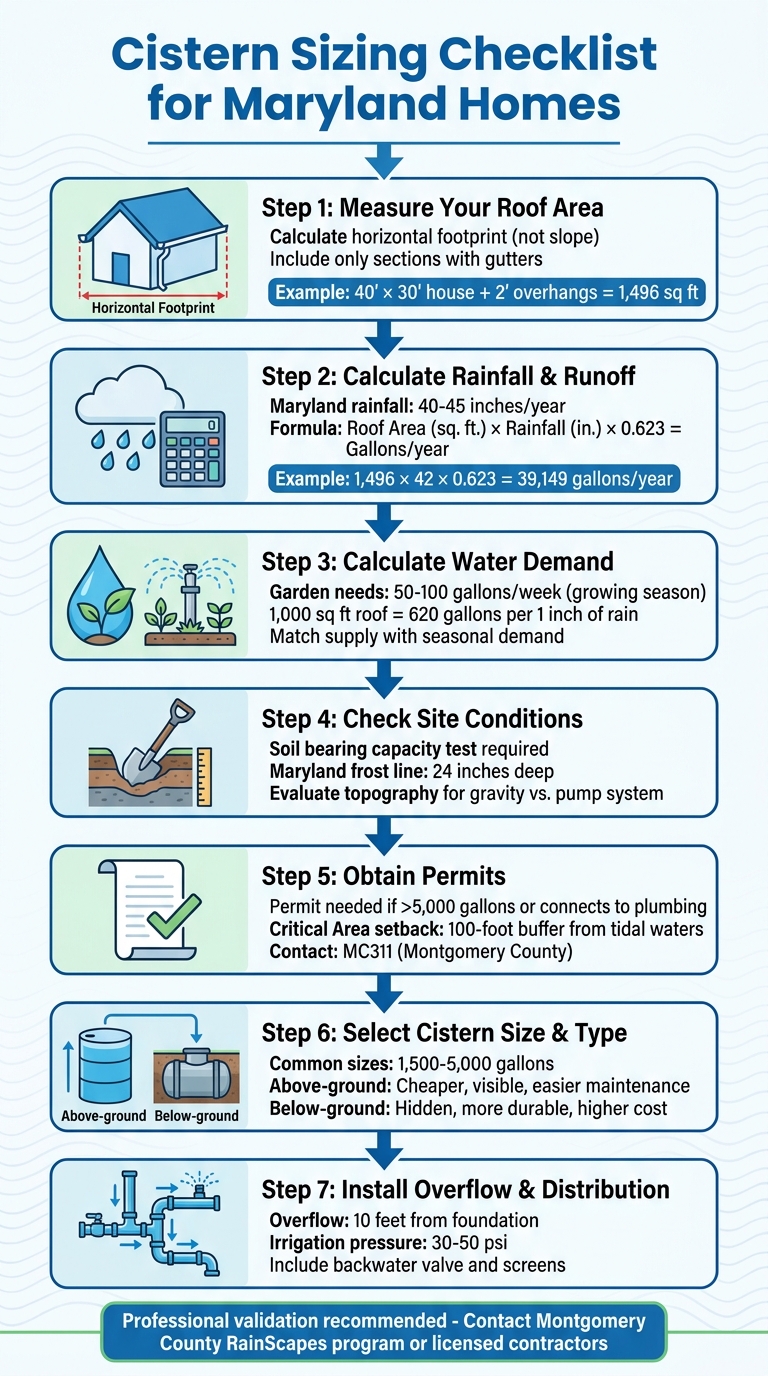
7-Step Cistern Sizing Process for Maryland Homes
How to Calculate Cistern and Elevated Tank Size, Pump Flow, and Pipe Diameter for Installations
sbb-itb-843f8be
Step 1: Measure Your Roof Area and Drainage Capacity
The first step in sizing your cistern is determining how much water your roof can collect. Instead of focusing on individual shingles, you’ll want to measure the horizontal roof footprint – the area you’d see if you were looking straight down at your house.
How to Measure Roof Area
Start by measuring your home’s footprint at ground level. For a simple rectangular house, measure the length and width, then account for the overhang (eaves) on each side. Multiply the adjusted length and width to find the square footage. For instance, a house that’s 40 feet by 30 feet with 2-foot overhangs on all sides would measure 44 feet by 34 feet, resulting in 1,496 square feet of roof area.
Keep in mind that roof pitch doesn’t affect the rainfall collection calculation. What matters is the horizontal "shadow" of the roof, not the sloped surface area of the shingles.
If your roof is L-shaped or multi-level, sketch it out, divide it into rectangular sections, and calculate the area of each. Only include sections that are impervious and connected to gutters. Skip any portions like un-guttered porches or additions.
Locate Your Drainage Points
Most homes have several downspouts, but your cistern will likely connect to just one or two. To figure out which parts of the roof drain to a specific downspout, observe how water flows during rainfall. Check the slope of the roof and how the gutters are connected. For example, if half the roof drains to the front downspout and the other half to the back, each downspout handles about 50% of the roof area.
If you’re in Montgomery County, the RainScapes program from the Department of Environmental Protection offers technical help for cistern installations. You can contact MC311 at 311 (within the county) or 240-777-0311 for assistance with local requirements [1].
Once you have your roof and drainage measurements, you’re ready to move on to calculating rainfall and runoff volumes in Step 2.
Step 2: Calculate Rainfall and Runoff Volume
To figure out how much water your roof can collect during Maryland’s rainy seasons, you’ll need to convert your measurements into gallons. This number will guide you in selecting the right cistern size. Using local rainfall data will help fine-tune your calculations.
Find Local Rainfall Data
Maryland typically sees between 40 and 45 inches of rainfall each year. However, the exact amount varies depending on your location. Some counties lean closer to 40 inches, while others may receive up to 45 inches. For precise details, check with your county’s Department of Environmental Protection. They maintain records of localized rainfall data and can help you adjust calculations for your specific drainage area. For those in Montgomery County, the RainScapes program provides environmental data tailored to individual neighborhoods. You can contact them by dialing 311 (or 240-777-0311 if you’re outside the county) to get property-specific information [1].
Apply the Runoff Volume Formula
Use this formula to calculate the total gallons of water your roof collects:
Roof Area (sq. ft.) × Rainfall (inches) × 0.623 = Total Gallons
The factor 0.623 converts rainfall in inches and roof area in square feet into gallons. For example, if your roof area measures 1,496 square feet and your location averages 42 inches of rainfall, the calculation would look like this:
1,496 × 42 × 0.623 = 39,149 gallons per year.
If you’re only connecting a cistern to a downspout that drains half the roof (748 square feet), the annual collection would be approximately 19,575 gallons from that single drainage point.
Keep in mind, this figure represents the maximum potential water capture under ideal conditions. You’ll compare this to your water needs in Step 3.
Step 3: Calculate Water Demand and Storage Requirements
Now that you’ve figured out how much water your roof can collect, it’s time to calculate your household’s water demand. This step ensures that your system’s capacity aligns with your actual water usage.
Estimate Your Household Water Demand
Start by identifying non-drinking water uses, such as watering your garden or washing your car. For example, a vegetable garden or flower bed typically requires around 50 to 100 gallons of water per week during the growing season. To get a more accurate estimate, track your outdoor water usage – like sprinklers, watering cans, or washing hardscapes – over several weeks. Once you have an average weekly usage, multiply it by the length of Maryland’s growing season, which runs from mid-May through September. This seasonal total will give you a clear picture of your outdoor water needs, which you can then compare to the potential annual runoff calculated earlier.
These numbers are essential for determining the right cistern size for your property, ensuring you manage water effectively.
Match Supply with Demand
To align your water supply with your seasonal demand, use the water balance method. Maryland’s rainfall patterns can be uneven, with less rain during the summer months when irrigation needs are at their peak. This means your cistern should be large enough to store water for drier periods.
As a guideline, a 1,000-square-foot roof can produce about 620 gallons of water from just one inch of rain [2]. Since modular storage units typically offer 90–95% usable capacity, a 1,000-gallon tank will provide approximately 900–950 gallons of usable water. Use these estimates to evaluate whether your cistern can sufficiently cover periods of low rainfall.
Step 4: Account for Maryland Site Conditions
When planning your cistern system, it’s not just about rainfall and water demand – site conditions play a huge role too. The physical characteristics of your property, including Maryland’s unique soil, climate, and terrain, all affect where and how you can set up your system.
Assess Soil Support and Frost Protection
Start by looking at the soil’s bearing capacity. A full cistern is heavy – a 500-gallon tank, for example, weighs roughly 4,170 pounds. If the soil underneath can’t handle that weight, the tank might sink, shift, or even crack over time. To avoid these issues, conduct a soil bearing capacity test. If your soil is unstable or prone to settling, you may need to install a reinforced concrete pad or consider a smaller tank to reduce the load.
Maryland’s frost line is 24 inches deep, which is another critical factor. Any underground pipes or non-insulated cistern components must be buried below this depth to prevent freezing in the winter. Pipes or connections installed above the frost line can freeze, leading to bursts and expensive repairs. Always ensure your system is installed below the frost line for proper protection.
Once you’ve addressed soil stability and frost concerns, think about how your property’s layout will impact the system’s operation.
Evaluate Space and Topography
Your property’s topography determines whether you can rely on gravity to move water or if you’ll need a pump. If you place your cistern on higher ground relative to your irrigation area, gravity can do the work of moving water downhill. On the other hand, if your land is flat or the cistern sits lower than your distribution points, a pump will be necessary to ensure water flows where you need it.
Space and placement are also key considerations. Position your cistern close to downspouts to minimize piping costs and reduce friction loss. Make sure there’s a clear downhill path for overflow water to flow safely away from your home’s foundation. This helps prevent basement flooding and soil erosion around your house. Additionally, check local setback requirements to ensure the cistern is positioned at a safe distance from your foundation, property lines, and any nearby septic or well systems. For specific guidelines and potential rebates, reach out to the Montgomery County Department of Environmental Protection (DEP) RainScapes program [1].
After evaluating your site’s conditions, you’ll be ready to move on to Step 5, which covers permits and local regulations.
Step 5: Obtain Permits and Meet Local Regulations
Before starting your cistern installation, it’s crucial to check if permits are required. Once you’ve assessed the site conditions, ensure the installation aligns with local regulations. Skipping this step could lead to fines or costly changes, as Maryland counties have varying rules.
County Permit Requirements
In Montgomery County, cistern installations fall under the Department of Environmental Protection (DEP) and its RainScapes program, which oversees residential stormwater management. If your cistern holds more than 5,000 gallons or connects to household plumbing (e.g., for toilet flushing), you’ll need a permit. To confirm the latest requirements, contact MC311 by dialing 311 within Montgomery County or 240-777-0311 from outside the area. Prince George’s County has similar permit guidelines, so it’s essential to check with your local authorities to avoid any surprises.
Critical Area Setback Rules
In addition to permits, you must follow setback rules designed to protect water quality. If your property is within 1,000 feet of tidal waters or wetlands, Maryland’s Critical Area Law applies. This law establishes a minimum 100-foot buffer where permanent structures, including large cisterns, are generally restricted or heavily regulated. Some areas may extend this buffer to 200 feet or more. To determine if your property is in the Critical Area or a buffer zone, use the Maryland Department of Natural Resources‘ online mapping tools. If your property falls within these zones, coordinate with your county’s DEP to ensure compliance.
Montgomery County’s DEP, through the RainScapes program, enforces these rules consistently. Maintain proper setbacks: infiltration components should be at least 10 feet from foundations, and drainage structures should be 5-10 feet from property lines. Municipalities often prohibit runoff discharge onto public areas, and connecting to municipal storm sewers typically requires specific approval.
Once you’ve addressed permits and setback requirements, you’re ready to move on to selecting the right cistern size and type (Step 6), keeping all local standards in mind.
Step 6: Select the Right Cistern Size and Type
In Maryland, cisterns commonly range from 1,500 to 5,000 gallons. Choosing the right size depends on your roof’s runoff capacity and your water needs. By using the calculations from Steps 2 and 3, you can pick a cistern that balances cost and efficiency. This decision will also prepare you for setting up your overflow and distribution systems in the next step.
Size Based on Runoff and Demand
Start by reviewing your runoff and water usage estimates. For example, if your roof generates 3,000 gallons of runoff per month and your irrigation needs are 2,500 gallons, a 3,000-gallon cistern would be a good fit. It minimizes overflow loss while meeting your demand. An undersized cistern wastes potential storage, while an oversized one adds unnecessary expense.
For outdoor irrigation, a cistern with a 2,000–3,000 gallon capacity is often sufficient. If you plan to use the water indoors for tasks like flushing toilets or doing laundry, a larger tank – closer to 4,000–5,000 gallons – might be a better choice to ensure a steady supply between rainfall events.
Once you’ve nailed down the size, the next step is deciding on the installation type.
Compare Above-Ground and Below-Ground Options
Above-ground cisterns are generally more affordable and easier to install. They sit on a level pad, are accessible for maintenance, and let you easily check water levels. However, they are visible, which may not suit every homeowner’s aesthetic preferences.
Below-ground cisterns, on the other hand, are great for saving yard space or keeping the system out of sight. While they require excavation and must be installed below the frost line (30–36 inches deep), they offer some advantages. They protect water from temperature changes and UV exposure, and they don’t take up visible space in your yard. Keep in mind, though, that installation and maintenance costs are higher since underground components are harder to access.
Regardless of the type you choose, make sure it complies with Montgomery County’s RainScapes program requirements. To find qualified contractors familiar with Maryland’s local codes, use the Montgomery County DEP’s "Find Licensed & Qualified Contractors" search tool. For further assistance or to confirm the latest requirements, contact MC311 by dialing 311 within Montgomery County or 240-777-0311 if you’re outside the area.
Step 7: Install Overflow and Distribution Systems
After determining your cistern’s size and ensuring compliance in previous steps, it’s time to focus on overflow and distribution systems. These components are essential for protecting your property from water damage during heavy rainfall and for effectively delivering stored water to where it’s needed. Both systems must work in harmony for a safe and efficient cistern setup.
Design Your Overflow System
Your overflow pipe needs to be at least as wide as your inlet pipes to handle peak stormwater flow. To determine the right capacity, use local roof runoff data as a reference.
Direct overflow to areas like dry riverbeds, swales, or infiltration zones to prevent erosion. Ensure the discharge point is at least 10 feet away from your home’s foundation to avoid issues like basement leaks or structural dampness. If you’re connecting to a municipal stormwater system, make sure your setup complies with Montgomery County’s stormwater regulations.
To keep your system functioning smoothly:
- Install a backwater valve on each overflow pipe to prevent backflow into the cistern.
- Use insect and vermin screens on all overflow outlets to block pests.
- Include a cleanout for easy debris removal.
- Avoid adding a shutoff valve to overflow pipes – these must stay open to handle stormwater effectively.
Once your overflow system is in place, you can move on to setting up the water distribution lines.
Select Pumps for Water Distribution
For gravity-fed systems, a slope of 1% (1 inch per 8 feet) is sufficient. This method is ideal for simple irrigation setups, especially if your cistern is positioned above your garden beds. Use solid, non-perforated pipes for water conveyance and reserve perforated pipes exclusively for drainage fields to avoid silt buildup.
When pressurized or uphill distribution is required, mechanical pumps are necessary. Choose pumps based on the pressure needed:
- Irrigation systems typically require 30–50 psi.
- Indoor systems need consistent pressure.
If your system’s pressure exceeds 80 psi, install a pressure-reducing valve to protect pipes and fixtures.
For high-traffic areas, use durable schedule 40 pipe to prevent damage. Lay all pipes on compacted granular material instead of clay to reduce shifting and sediment buildup. Add cleanout tees with threaded caps at high points and along long pipe runs to simplify maintenance.
If you’re using cistern water indoors (e.g., for toilet flushing), include a 100-micron filter with a pressure gauge so you’ll know when it needs servicing. Clearly mark all nonpotable water outlets with "CAUTION: NONPOTABLE WATER – DO NOT DRINK", and ensure a minimum 5-foot separation between nonpotable and potable water lines.
Test your system by filling the cistern and monitoring it for leaks and proper overflow drainage over a 24-hour period. For help with installation or to confirm compliance with local regulations, contact MC311 by dialing 311 within Montgomery County or 240-777-0311 if you’re outside the area.
Conclusion: Verify Your Cistern Sizing Plan
Test and Validate Your Calculations
Before moving forward with installation, take the time to double-check your roof area, runoff, and storage calculations using local Maryland data. Carefully review your roof measurements, runoff volume formulas, and storage estimates to ensure they match the region’s standards. Even small errors could result in a system that’s either too large or too small for your needs.
Montgomery County’s RainScapes program offers technical guidelines specifically for residential cisterns. Use their resources to confirm your plan meets local requirements. For further assistance, you can contact MC311 to get detailed information on local guidelines.
Once you’ve confirmed your calculations, it’s a good idea to have them reviewed by a professional.
Get Professional Help
After verifying your numbers, consulting with a professional ensures that your system is implemented correctly. Licensed contractors can help you meet safety and environmental standards while also addressing any site-specific challenges. You can use the "Find Licensed & Qualified Contractors" tool from Montgomery County’s Department of Environmental Protection to locate contractors experienced with local building codes. These professionals can review your calculations, spot potential issues with soil conditions or topography, and guide you through the permit process.
For example, Pro Landscapes MD specializes in drainage solutions and stormwater management across central Maryland. Their expertise in grading, land leveling, and drainage systems makes them a great resource for evaluating your property’s unique conditions. They serve areas like Howard County, Montgomery County, Carroll County, Frederick County, Prince George’s County, and Baltimore County, ensuring your cistern system integrates seamlessly with your landscape.
Professional assistance is especially important if you plan to qualify for programs like RainScapes or need to avoid conflicts with existing infrastructure, such as drainage systems or septic tanks. Before starting any work, reach out to local environmental agencies to make sure your installation plan aligns with broader property care and stormwater management objectives.
FAQs
How do I adjust cistern size for summer dry spells in Maryland?
To get ready for Maryland’s summer dry spells, think about expanding your cistern’s capacity to capture and store more water during times of low rainfall. Most residential cisterns hold between 250 and 500 gallons, but you may need a larger one depending on your water usage. Make sure to calculate how much runoff your roof can provide and place the cistern on a solid, level base. Also, ensure the overflow is directed to pervious surfaces to manage water efficiently.
What losses should I subtract from my roof runoff estimate?
To determine your cistern’s effective capacity, you need to account for water losses from overflow, evaporation, and infiltration. These losses reduce the actual amount of water stored, making it essential to include them when sizing your cistern to meet your requirements.
When do I need a pump instead of a gravity-fed setup?
When dealing with a large cistern or needing to move water to higher elevations or distant areas, a pump becomes essential. Gravity alone often can’t provide the necessary pressure for these situations. Pumps are commonly needed for cisterns holding more than 250 gallons or for systems used in irrigation or landscape watering – particularly when the water needs to travel farther or uphill from the cistern’s outlet.
Chat with Us