









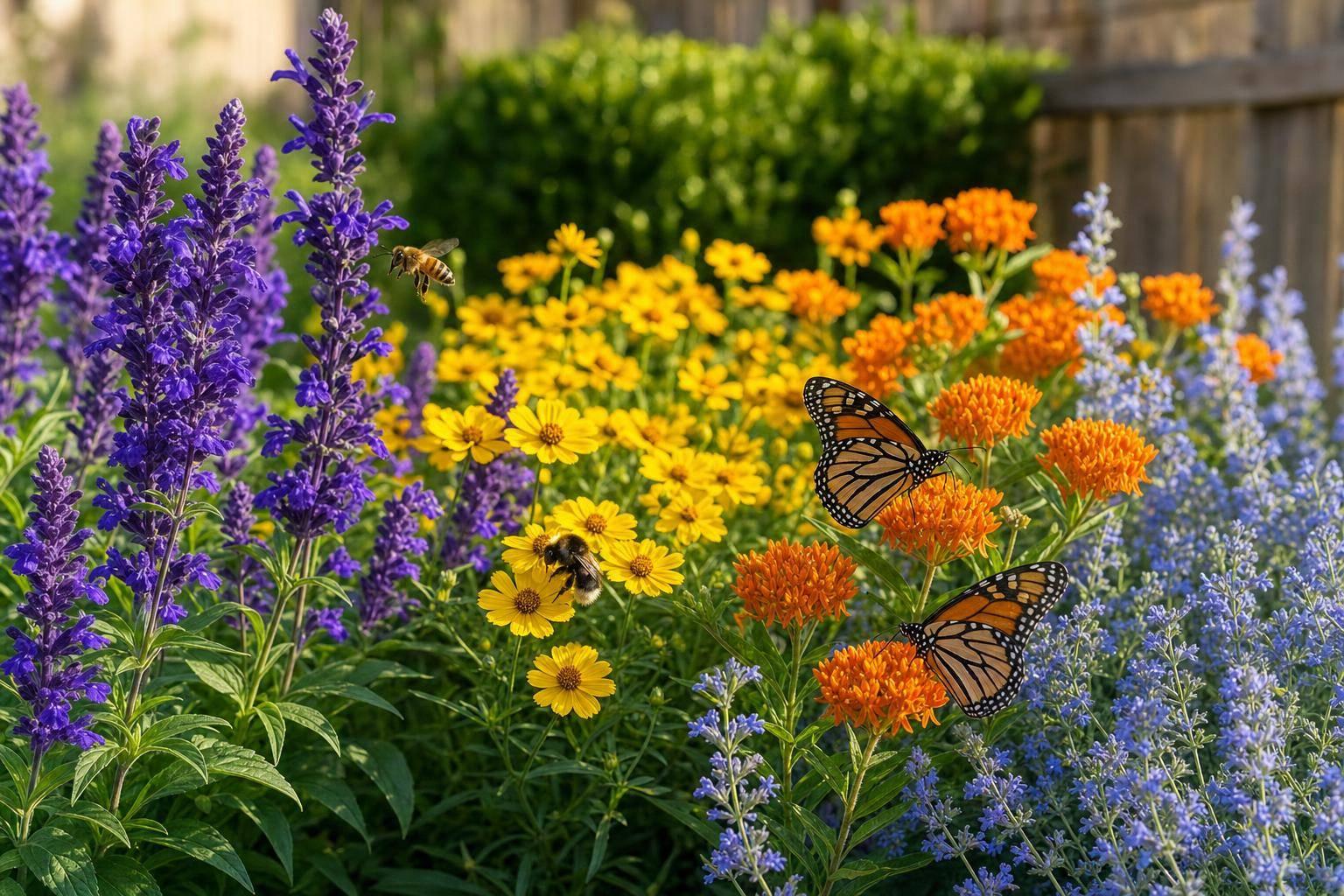
- bhavya gada
- No Comments
Flower color can help pollinators find blooms fast – but color alone does not decide what they visit. If I’m planning landscape projects in Maryland, the clearest takeaways are simple: use large groups of flowers, keep blooms from spring through fall, and match colors to the pollinators I want to draw.
Here’s the short version:
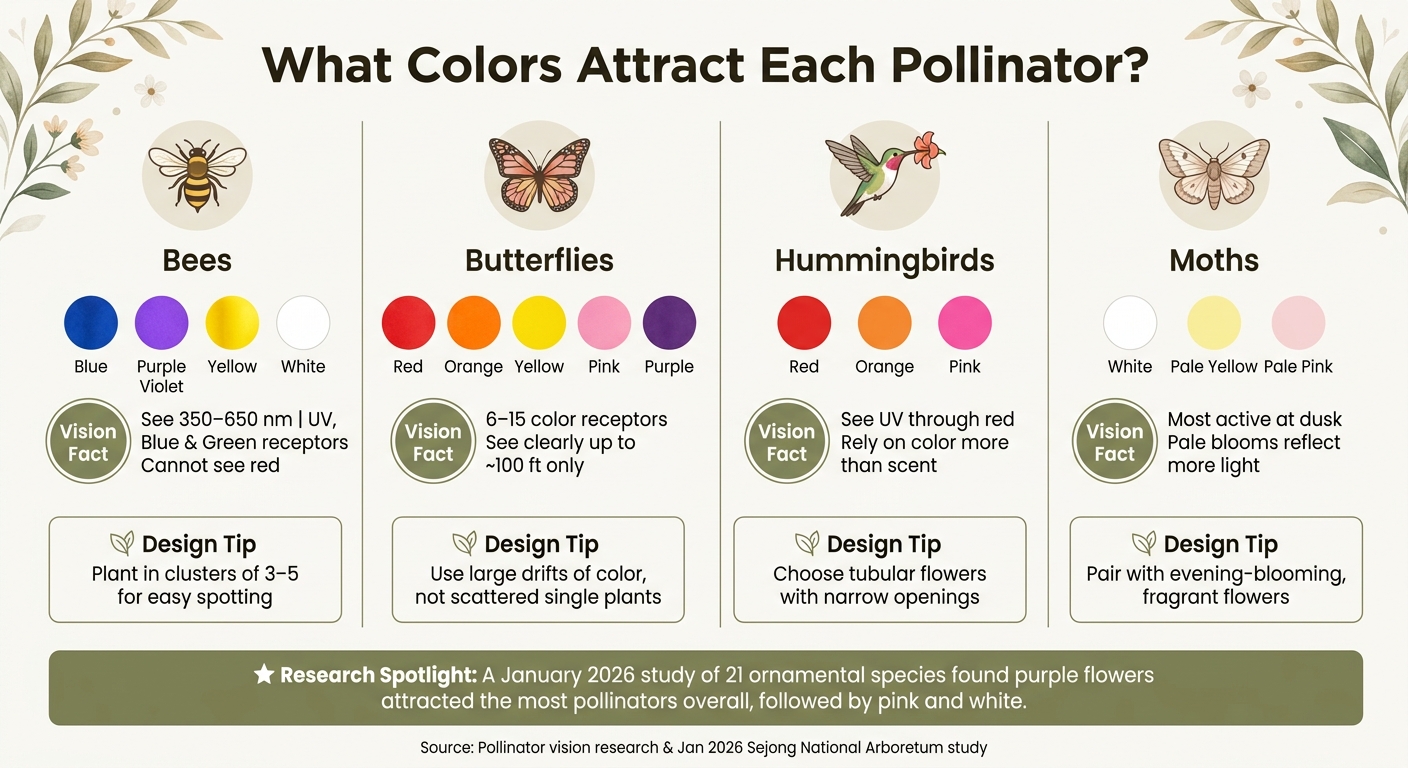
- Bees tend to go for blue, purple, yellow, and white
- Butterflies can see more colors, including red, and often do better with big patches of color
- Hummingbirds are often pulled to red, orange, and pink
- Moths tend to find white or pale flowers more easily at dusk
- Shape, nectar, scent, bloom time, and flower count matter too
- Single flowers are often easier for pollinators to use than double-flowered types
A few facts stand out from the research:
- Bees see light from about 350 to 650 nm, with vision tuned to UV, blue, and green
- Butterflies may have 6 to 15 color receptors, depending on the species
- One January 2026 study of 21 ornamental species found that purple flowers drew the most pollinators overall, followed by pink and white
- Butterflies may only see clearly up to about 100 feet, which helps explain why large drifts work better than scattered plants
If I want a yard that works for more than one pollinator group, I’d mix color ranges instead of using one color only. For example, I might pair red cardinal flower with blue or purple asters nearby. That gives bees, butterflies, and hummingbirds more to work with at the same time.
| Pollinator | Colors that often work best | Design note |
|---|---|---|
| Bees | Blue, purple, yellow, white | Group plants in easy-to-see clusters |
| Butterflies | Red, orange, yellow, pink, purple | Use broad sweeps, not single plants |
| Hummingbirds | Red, orange, pink | Tubular flowers help |
| Moths | White, pale shades | Evening bloom and scent help |
The bottom line: if I keep color blocks clear, bloom timing steady, and flower forms easy to use, I give pollinators a much better shot at finding and using the garden.
Pollinator Color Preferences: What Bees, Butterflies, Hummingbirds & Moths See
Discover how pollinators see flowers in your garden
sbb-itb-843f8be
How Pollinators See Flower Color
Pollinators don’t all see the same flower the same way. They pick up different parts of the light spectrum, which helps explain why one bloom can appeal to several pollinators for different reasons.
Color Vision in Bees, Butterflies, Hummingbirds, and Moths
Bees have three photoreceptor types tuned to ultraviolet (UV), blue, and green instead of red [4]. Their visual range runs from about 350 to 650 nm [5]. So red flowers are mostly outside what they detect well, while blue, purple, violet, yellow, and white flowers are much easier for them to notice [1][3].
Butterflies have a much broader spectral range, from UV through red [1]. They can detect more colors than bees, including red, and they tend to spot large, repeated plant groupings more easily [1].
Hummingbirds see from UV through red and are strongly drawn to bright red, pink, and orange flowers [1]. Moths, by contrast, usually find pale or white blooms more easily at dusk [1][6].
Nectar Guides, UV Patterns, and Distance Cues
Many flowers have UV patterns and markings – often called nectar guides – that humans can’t see. These marks help guide bees and butterflies toward nectar and pollen [1][2].
Bees also switch visual cues based on distance. From farther away, they rely more on green contrast. Up close, chromatic contrast matters more [4]. Research also suggests that bees are drawn in particular to flowers in the purple-violet and blue range, and many bee-pollinated flowers use blue-heavy patterns that stand out at close range [3].
These differences in vision help explain the color preferences covered next.
Color Preferences by Pollinator Type: What Studies Show
These patterns are tendencies, not hard rules. Color helps, but so do flower shape, bloom time, nectar, pollen, and scent. So the aim isn’t perfect prediction. It’s making smarter color choices when you plan a garden. With that in mind, studies still show some clear color trends by pollinator type.
How Bees and Butterflies Respond to Blue, Purple, Yellow, Orange, and Mixed Plantings
Bees respond strongly to blue, violet, purple, yellow, and orange flowers. In a January 2026 study from the Sejong National Arboretum, researchers looked at 21 native and cultivated ornamental species and found that purple flowers attracted the most pollinators overall, followed by pink and white [8]. That fits what we know about bee vision, which is especially tuned to the blue and violet range.
That said, bees aren’t one big group with one fixed taste. A 2018 study at the Universidade de São Paulo tested two Brazilian stingless bee species and found a split: Partamona helleri preferred bluish hues with higher spectral purity, while Melipona bicolor showed no clear color preference and relied more on chemical markings and food-source location [4]. In plain English, color helps, but it isn’t the whole story.
Butterflies work a bit differently. They have a broad color range, with between 6 and 15 color receptors depending on the species, and they can detect colors bees cannot, including red [1]. They’re also nearsighted and can only see clearly up to about 100 feet [1]. So if you’re planting for butterflies, big sweeps of color tend to work better than a few scattered blooms. A drift of flowers is easier for them to spot than single plants tucked here and there [1].
How Hummingbirds and Moths Respond to Red, Orange, Yellow, White, and Pale Blooms
Hummingbirds lean more on color than scent when they’re looking for nectar. They’re drawn to bright red, orange, and pink tubular flowers with narrow openings [1][2].
Moths are the opposite in some ways. Since many are active at dusk or after dark, pale flowers reflect more light and stand out better against dark foliage. Scent also matters more for moth pollinators than it does for hummingbirds. Pale, evening-blooming flowers give them a better target in low light.
Those color patterns start to pay off when you turn them into plant groupings and bloom timing across the season.
Applying Color Research to Pollinator Garden Design in Maryland
Use Color Blocks and Seasonal Bloom Sequences
Color research helps most when it shapes how you plant, not just what you plant. In a home garden, that means using color in blocks that pollinators can spot from a distance. Instead of scattering single plants here and there, plant in large drifts so bees and butterflies can find them fast.
Most perennials bloom for only a few weeks, so Maryland gardens need flowers in sequence from early spring through late fall to keep forage available[1][2]. Native columbine can handle early spring, butterfly weed and coneflowers can carry the garden through summer, and asters can take things into fall[1][3]. If you skip that sequence, the garden offers food for only a short window.
Match Color Palettes to Different Pollinator Groups
Once your bloom timing is mapped out, the next step is choosing colors for the pollinators you want to draw in. Think of these as starting points, not strict rules. Here’s a practical guide for central Maryland landscapes:
| Pollinator | Colors to Prioritize | Examples for Central Maryland |
|---|---|---|
| Bees | Blue, purple, violet, yellow, white | Wild bergamot, asters, sunflowers |
| Butterflies | Red, orange, yellow, pink, purple | Butterfly weed, coneflowers, columbine |
| Hummingbirds | Red, orange, pink | Cardinal flower, trumpet honeysuckle |
| Moths | White, pale colors | Pale evening-blooming flowers |
If you want a mixed-pollinator garden, it helps to combine color ranges. For example, pairing red cardinal flower with nearby blue or purple blooms gives you a better shot at drawing in more than one group instead of leaning on a single color scheme.
In partial shade, white flowers do extra work because they show up best in lower light for bees[6].
"Selecting colors specifically to entice pollinators to your garden need not adversely impact your garden design. There are many plants to choose from whose colors will work within your existing design." – Susan Marquesen, Master Gardener, Penn State Extension [1]
Fit Pollinator Planting Into Your Overall Landscape Design
Pollinator planting doesn’t mean you need to turn the whole yard into a meadow. These color drifts can slip into beds and borders you already have. What matters is scale: clusters of 3 to 5 plants of one species give pollinators a clear target[1].
It also helps to layer heights within each grouping. That gives the bed a fuller look people tend to like, while also supporting biodiversity[3]. In other words, this approach works just as well in mixed borders as it does in a dedicated pollinator bed.
Design Tradeoffs and Key Takeaways
Balancing Pollinator Goals With Site Conditions
Once you’ve picked your flower colors, the site itself decides whether those colors will do their job.
Deer are a big one. They can eat the very flowers meant to send that color signal, so it helps to protect new plantings until they’re established.
Another issue is easy to miss: double-flowered cultivars. They may look lush, but they can make nectar and pollen hard to reach. If you’re buying plants for patio pots or borders, go with single-flowered varieties when you can. That choice matters. Few cultivars were highly attractive to honeybees or bumblebees [7], which is a good reminder that some garden plants do far more than others.
Lot size matters too. In a small yard, scattered single plants tend to get lost. Larger blocks of color work better and are easier for pollinators to spot.
Treat these as shorthand rules, not strict commands.
| Pollinator | Color Strategy | Limitations |
|---|---|---|
| Bees | Blue, purple, yellow, white | Can clash with tidy, "weed-free" yard preferences when clover or dandelions are allowed to stay |
| Butterflies | Red, orange, yellow, pink, purple; use large drifts | Nearsighted; need large drifts or blocks to find flowers |
| Hummingbirds | Bright red, orange, and pink | High-nectar plants often need more water and richer soil |
Conclusion: The Most Useful Color Principles for Maryland Gardens
A few points from the research are hard to ignore. Pollinators do not see color the way people do. Bees can’t see red at all, and they rely a lot on UV patterns that we can’t see [1]. So a flower that seems plain to you might stand out like a neon sign to a bee, while a bright red rose may barely register.
Color works best when it comes with the right flower shape and an actual nectar reward. Color saturation matters. Vivid, saturated colors do better than muted ones for drawing bees and butterflies [4]. It also helps to have at least three species blooming in each part of the growing season – spring, summer, and fall – so pollinators have food through their active cycles [1].
For Maryland gardens, the strongest color plan is pretty simple: group plants by color, keep blooms coming from spring through fall, and favor single-flowered varieties.
FAQs
Why do bees avoid red flowers?
Bees don’t skip red flowers because they “hate” them. The main issue is simpler: they usually can’t see red well. Their vision is tuned more to ultraviolet, blue, and green light.
That means red flowers can be harder for bees to spot or read as a source of nectar. By contrast, bees are drawn more strongly to violet, purple, blue, and yellow flowers, especially flowers with ultraviolet patterns.
How large should flower groups be?
Plant large, dense groups of the same flower species instead of scattering single plants around your garden. This works especially well for butterflies.
Butterflies are nearsighted, so they may have trouble seeing objects more than 100 feet away. Big patches of the same color are easier for them to notice and use as food sources.
What if I want to attract all pollinators?
Plant a mix of flowers with different shapes, colors, and bloom times across the season. Pollinators don’t all look for the same thing, so blending blue, purple, yellow, and white flowers can bring in more types of insects and birds.
Skip double-flowered varieties. They often don’t provide the nectar and pollen pollinators need. Pro Landscapes MD can help design and plant diverse, eco-friendly garden spaces across Maryland and DC.
Chat with Us