









- bhavya gada
- No Comments
If you’re deciding between a concrete or paver patio for your Maryland home, here’s what you need to know:
- Cost: Concrete patios are cheaper upfront, ranging from $5–$15 per sq. ft., while pavers start at $10–$30 per sq. ft.. However, pavers last longer, potentially saving money over time.
- Durability: Pavers are more resistant to Maryland’s freeze-thaw cycles and can handle up to 8,000 psi, compared to concrete’s 2,500 psi. Pavers also flex with soil movement, reducing cracking.
- Maintenance: Concrete requires sealing and crack repairs, while pavers are easier to fix since individual units can be replaced. Pavers also resist pooling water better.
- Lifespan: Concrete lasts 15–25 years, while pavers can last 50–100 years with proper care.
- Design: Concrete offers sleek, continuous surfaces with options like stamping and staining. Pavers provide more variety in patterns, colors, and textures and can be easily adjusted after installation.
Quick Comparison
| Feature | Concrete Patios | Paver Patios |
|---|---|---|
| Cost (per sq. ft.) | $5–$15 | $10–$30 |
| Lifespan | 15–25 years | 50–100 years |
| Durability | Prone to cracking | Handles soil shifts |
| Maintenance | Cracks require patching | Easy to replace units |
| Design Options | Sleek, modern look | Endless patterns/colors |
For Maryland’s climate, pavers are generally a better long-term investment, offering flexibility, durability, and greater design options. But if you’re on a budget, concrete provides a cost-effective solution with quicker installation.
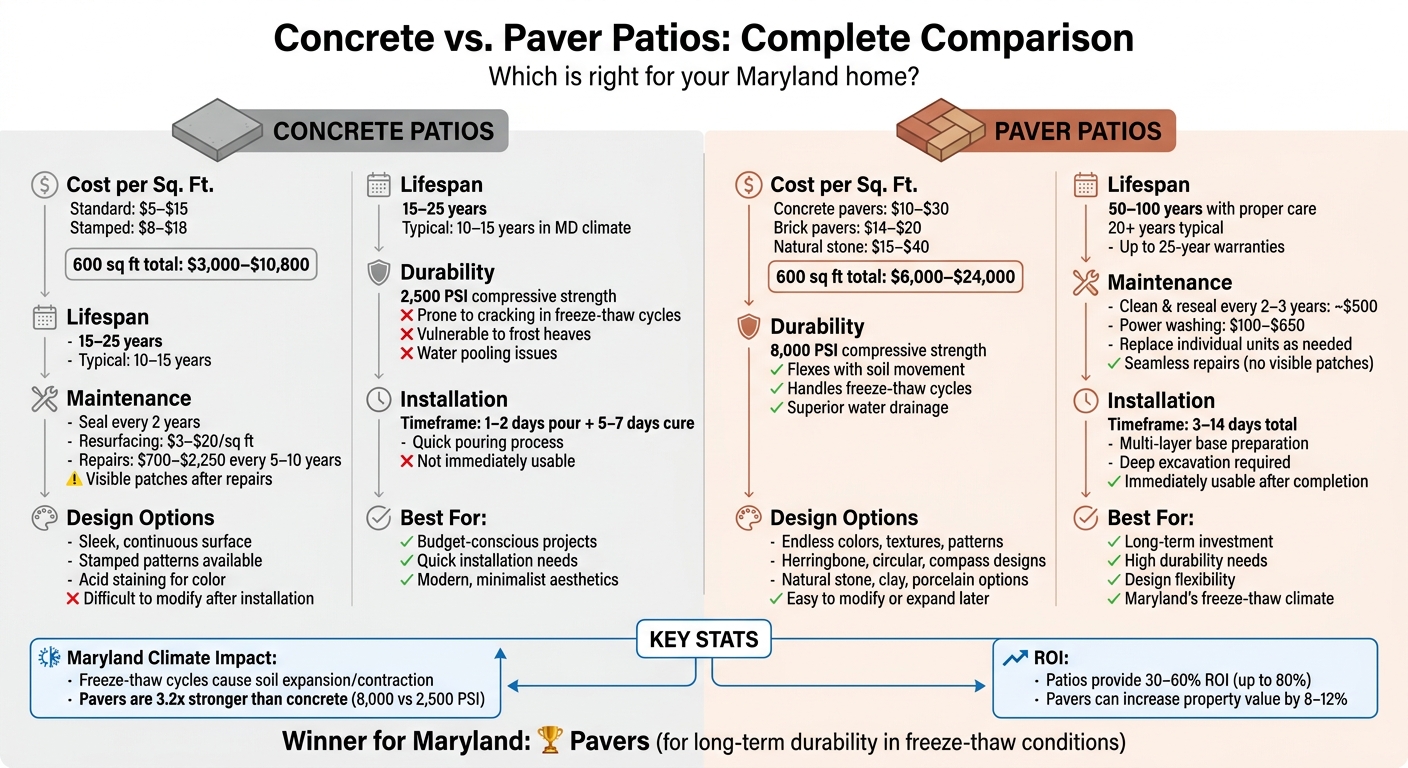
Concrete vs Paver Patios Comparison Chart for Maryland Homes
Cost Comparison
Initial Costs
When it comes to upfront expenses, concrete patios are typically the most affordable option. In Maryland, the cost for standard concrete ranges from $5 to $15 per square foot [3][4]. If you’re considering stamped or decorative concrete, expect to pay between $8 and $18 per square foot [3][4]. On the other hand, concrete pavers cost $10 to $30 per square foot, while natural stone pavers like flagstone or bluestone can set you back $15 to $40 per square foot. Brick pavers fall somewhere in the middle at $14 to $20 per square foot [4].
Labor costs in Maryland account for 40% to 50% of the total project, with installation fees running between $5 and $20 per square foot [3][4]. Maryland’s clay-heavy soil, especially in areas like Prince George’s County, often requires additional grading or stabilization, which can add $500 to $1,000 to the bill. Urban locations such as Bethesda and Rockville may present access challenges, leading to extra costs for manual excavation ($200 to $500) or the use of a concrete pump truck ($125 to $200 per hour) [3][4]. Permit fees vary, ranging from $50 in Howard County to $300 in Baltimore County [3]. If you’re replacing an old patio, removal costs can add $2 to $6 per square foot [4].
| Material Type | Estimated Cost per Sq. Ft. | Total Estimated Cost (600 sq. ft.) |
|---|---|---|
| Standard Concrete | $5 – $15 | $3,000 – $9,000 |
| Stamped Concrete | $8 – $18 | $4,800 – $10,800 |
| Concrete Pavers | $10 – $30 | $6,000 – $18,000 |
| Natural Stone | $15 – $40 | $9,000 – $24,000 |
While these initial costs are important, it’s also essential to weigh the long-term durability and maintenance expenses of each option.
Long-Term Value
Looking beyond the upfront price tag, the lifespan and maintenance of your patio material play a major role in its overall value. Concrete patios typically last 15 to 20 years before requiring significant repairs or replacement, especially in Maryland’s freeze-thaw climate [5]. In contrast, pavers are built to endure. With a strength of up to 8,000 PSI, pavers are nearly twice as strong as concrete, which measures 2,500 to 4,000 PSI [5][1]. This durability often comes with warranties of up to 25 years for professionally installed systems [5].
Maintenance costs also vary significantly. Fixing cracks in concrete often involves cutting out large sections, and the patches rarely match the original surface [5][1]. Pavers, on the other hand, allow for easy repairs – individual stones can be removed, the base adjusted, and the same stones reinstalled without issue [5]. Routine maintenance like power washing costs between $100 and $650, while cleaning and resealing pavers every 2 to 3 years runs about $500 [4]. For concrete, resurfacing costs range from $3 to $20 per square foot, and general repairs can add $700 to $2,250 every 5 to 10 years [4].
"Should a paving stone driveway ever need repairs, the process is relatively simple and inexpensive as you’ll only need to replace individual paving stones." – Aaron Brundage, Outdoor Remodeling Expert, System Pavers [5]
Example Cost Breakdown
For a 600 sq. ft. patio, costs vary widely depending on the material:
- Standard concrete: $3,000 to $9,000
- Stamped concrete: $4,800 to $10,800
- Concrete pavers: $6,000 to $18,000
- Natural stone: $9,000 to $24,000
Additional expenses like grading and excavation can add $1,000 to $3,000, depending on the site conditions [4]. Features like built-in seating, fire pits, or lighting can increase the total by $1,500 to $6,000 or more [6].
Homeowners in Maryland should note that concrete slab patios are considered permanent improvements, which may lead to higher property taxes [4]. However, the investment often pays off. Patios typically provide a 30% to 60% ROI, with some estimates going as high as 80% [3][4]. A well-installed paver patio can even increase property value by 8% to 12% [6].
sbb-itb-843f8be
Installation Process
Concrete Installation
Installing a concrete patio is relatively straightforward and affordable. The process starts with clearing, excavating, and grading the site to ensure proper drainage. In Maryland, contractors often recommend a slope of at least 1% to direct water away from your home and prevent pooling [9]. Once the subgrade is compacted, workers install formwork to outline the patio’s edges.
The actual concrete pour is quick, usually completed within a few hours. Workers spread the concrete evenly, level it, and then apply a finish. This finish could be a broom texture for better traction or a stamped pattern for a more decorative look. To handle Maryland’s freeze-thaw cycles, crews cut expansion joints into the slab. Without these joints, the concrete is more likely to crack unpredictably.
"In Maryland, the winter freeze and thaw cycles introduce natural shifting, sinking, and expansion in the soil beneath a patio’s subgrade. For concrete patios, expansion joints are a necessary measure to reduce cracking." – All Your Landcare [2]
One downside of concrete patios is the curing time. While the pouring process is fast, the slab needs 5 to 7 days to reach sufficient strength for use [8]. During this period, it’s crucial to keep the concrete moist and protect it from extreme temperatures.
Next, let’s dive into the more intricate process of paver installation.
Paver Installation
Installing pavers involves a more detailed and labor-intensive process compared to concrete. It starts with deep excavation below the patio’s intended surface. In Maryland, where soil conditions vary, additional excavation may be necessary. Preparing the site can take up to 90% of the total installation time, as it involves clearing, leveling, and ensuring proper drainage [9].
Once the site is ready, workers lay a multi-layered gravel base, compacting it in stages to prevent settling over time. This step alone can take about one day for every 150 square feet of patio space. A layer of bedding sand is then spread over the compacted base to create a smooth, level surface for the pavers. The pavers are placed by hand in patterns like herringbone, running bond, or circular designs. With a professional four-person crew, around 400 square feet can be laid in a single day [9].
After the pavers are in place, edge restraints are installed to keep them secure. Workers then sweep sand into the joints and compact the entire surface using a plate compactor. Unlike concrete, paver patios are ready for immediate use once the joints are stabilized. Depending on the size and complexity of the project, the installation process typically takes 3 to 14 days [9].
"A properly compacted base is not optional – it’s the foundation that determines whether your patio lasts 5 years or 25+ years." – Carolina Paver & Turf [6]
Installation Comparison Table
| Feature | Concrete Installation | Paver Installation |
|---|---|---|
| Primary Steps | Pouring and finishing | Excavation, base compaction, sand bedding, laying units, joint filling |
| Timeframe | 1–2 days to pour; 5–7 days to cure [8] | 3–14 days [9] |
| Labor Intensity | Low to Moderate | High |
| Maryland Climate Suitability | Prone to cracking/frost heaves | Flexible; accommodates freeze-thaw cycles |
| Immediate Use | No (requires curing time) | Yes, once joints are filled and stabilized |
Maryland’s climate plays a big role in determining the best installation method. Concrete patios, while rigid and durable, are more susceptible to cracking during the state’s frequent freeze-thaw cycles. On the other hand, the interlocking design of paver patios allows them to adjust to soil shifts without cracking. For areas with challenging terrain, such as rocky or clay-heavy soil, contractors may spend additional time – sometimes up to a week – preparing the foundation for a 500-square-foot patio [9].
Durability and Maintenance
Durability in Maryland Climate
Maryland’s freeze-thaw cycles can be tough on outdoor materials, and both concrete and pavers handle this challenge differently. Concrete has a compressive strength of around 2,500 psi, while pavers can handle up to 8,000 psi [1]. However, the real issue isn’t just strength – it’s how these materials respond to ground movement.
Concrete’s rigidity and porous nature make it vulnerable. It absorbs water, and when that water freezes, it expands, leading to surface damage and frost heaves [1]. Winter soil shifts often cause concrete to crack. On the other hand, pavers are designed to adapt. Their sand-filled joints and independent structure allow them to flex with soil movement, making them far less likely to crack [1]. Plus, pavers naturally direct water into the ground, reducing surface pooling [1].
"When they are installed properly, pavers create a strong, interlocking pattern that is far less vulnerable to breaking and cracking." – Dan Weingart, GreenImage Landscape & Design [1]
Maintenance Requirements
Keeping a concrete patio in good shape involves sealing it every two years to prevent moisture absorption and minimize freeze-thaw damage [7]. Cracks should be filled as soon as they appear to stop weeds from growing and to avoid further damage [2]. Cleaning is relatively simple with a pressure washer, but repairs can be tricky – patches and fixes are often very noticeable.
Paver patios, on the other hand, require a different type of care. Regularly removing weeds and moss from the joints is key, as is replenishing the joint sand that can wash away over time. Occasionally, individual pavers may need to be reset if they shift or sink [7]. Many pavers come pre-sealed, offering better stain resistance compared to concrete [2]. A smart tip is to keep extra pavers from the original installation. This makes replacing damaged units easier and avoids mismatched colors [1]. If a paver gets damaged, it can be removed, the base adjusted, and the same or a new paver reinstalled without disturbing the rest of the patio [1]. These maintenance factors directly impact the longevity and repairability of each material.
Lifespan and Repair Ease
The durability of each option becomes even more apparent when considering lifespan and repairs. Concrete patios in Maryland typically last about 10–15 years, while paver patios can exceed 20 years with consistent care [1]. Repairs are where the differences really stand out. Fixing concrete often leaves visible marks or requires replacing entire slabs [1].
"Concrete tends to show its scars, so to speak. Repairs are usually very visible." – Dan Weingart, GreenImage Landscape & Design [1]
For issues like tree roots causing lifting, pavers offer a clear advantage. Individual units can be lifted, the base adjusted, and the same pavers reset. In contrast, tree roots under concrete slabs usually lead to permanent cracks that are much harder to address. This flexibility makes pavers a particularly appealing choice for Maryland homeowners dealing with mature trees or shifting soil conditions.
Pavers vs Concrete: 6 DIFFERENCES You Need to Know BEFORE Your Next Project!
Appearance and Design Options
When planning your patio, its look is just as important as its durability and upkeep. Picking the right material means finding the perfect balance between functionality and style.
Concrete Design Options
Concrete patios are known for their sleek, continuous appearance, offering a polished, modern vibe [2][7]. What’s exciting is how customizable concrete has become. You can choose broom finishes for a textured, slip-resistant surface, add decorative borders, or opt for stamped patterns that mimic materials like Ashlar slate, flagstone, river rock, brick, or even wood planks. For a pop of color, acid staining can create stunning variations [10].
"Concrete isn’t just plain gray anymore. Modern concrete options include broom-finished concrete for traction, decorative borders, stamped concrete designs, and color enhancements." – John Crockett, Owner, Crockett & Sons Concrete [7]
However, once concrete is poured and cured, making changes is tough. Its seamless nature, while visually appealing, limits design flexibility after installation [10].
Paver Design Options
Pavers, on the other hand, provide endless combinations of colors, textures, and patterns [2]. From intricate circular layouts to compass rose designs and star-shaped formations, the possibilities are endless. Their textures range from smooth and sleek to rugged and weathered, with finishes like slate-top or sandblasted surfaces [10].
What makes pavers truly stand out is their adaptability. They’re easy to match with existing architectural elements and landscaping [2]. Planning to add a fire pit, outdoor kitchen, or walkway later? No problem – pavers can be removed and reinstalled without leaving unsightly patches [1][2]. This same feature makes repairs simple, as damaged pieces can be swapped out without disrupting the overall look. For homes surrounded by mature trees or those with plans for future outdoor upgrades, this flexibility is a game-changer.
Design Comparison Table
| Feature | Concrete Patios | Paver Patios |
|---|---|---|
| Surface Style | Seamless and continuous | Patterned and modular |
| Design Variety | Moderate (stamped/stained) | High (endless colors/textures) |
| Material Options | Poured aggregate mix | Natural stone, clay, porcelain, concrete units |
| Curb Appeal | Clean and modern | High-end |
| Integration with Features | Challenging to match with existing elements [2] | Easily coordinates with landscaping and architecture [2] |
| Post-Installation Changes | Repairs often show patches or mismatched areas | Individual units replaced seamlessly [1] |
Both materials bring something unique to the table, but their design possibilities and flexibility make each more suited to different needs and preferences.
Which Option is Best for Your Maryland Patio?
Factors to Consider
When choosing between materials for your Maryland patio, it’s essential to weigh factors like cost, climate, intended use, and maintenance needs.
Concrete typically costs between $3 and $7 per square foot, while pavers range from $8 to $25 per square foot[1]. However, pavers offer a much longer lifespan – lasting 50 to 100 years with proper care, compared to concrete’s 25-year lifespan[2].
Maryland’s climate, with frequent freeze-thaw cycles, poses a unique challenge. These cycles cause soil to expand and contract, leading to frost heaves that can crack concrete permanently[7]. In contrast, pavers are designed to flex independently, significantly reducing the risk of structural damage[2].
Concrete’s porous nature can result in water pooling, which may deteriorate the material over time[1]. Pavers, on the other hand, feature an interlocking design that promotes water dispersion, helping to protect both the patio and your home’s foundation. Additionally, pavers are far stronger, handling up to 8,000 psi, compared to concrete’s 2,500 psi[1][2]. This makes pavers ideal for patios that need to support heavy furniture, high foot traffic, or even future access to underground utilities. Plus, if damage does occur, individual pavers can be replaced without leaving unsightly patches.
These considerations underscore the importance of selecting a skilled contractor to ensure your patio is built to last in Maryland’s challenging conditions.
Pro Landscapes MD Services

For homeowners in Maryland, Pro Landscapes MD offers expert guidance and patio installation tailored to the state’s specific needs. They provide custom paver and flagstone solutions across Howard, Montgomery, Carroll, Frederick, Prince George’s, and Baltimore Counties. Their team is well-versed in handling Maryland’s soil conditions and drainage challenges, offering services like French drains, grading, and stormwater management to enhance patio longevity.
Before hiring any contractor, make sure they hold a valid Maryland Home Improvement Commission (MHIC) license to ensure quality and compliance with local regulations[7].
Final Recommendations
Here’s how to decide:
- Choose concrete if you’re looking for a more affordable upfront option with quick installation. Concrete patios can often be completed in just one day and offer a sleek, modern look that complements minimalist designs[7][2].
- Choose pavers if durability, flexibility, and aesthetic variety are priorities. Their ability to withstand heavy loads and the option to replace individual units without visible repairs make pavers an excellent long-term investment, especially for homeowners planning to stay in their property for years to come[2].
No matter which material you go with, proper site preparation, drainage solutions, and a strong foundation are critical to creating a patio that stands the test of time.
FAQs
Do I need a permit for a patio in my Maryland county?
In many Maryland counties, you usually won’t need a permit for ground-level concrete or paver patios without a roof. However, if your patio is covered or exceeds 200 square feet, a permit is often required. It’s always a good idea to confirm with your county’s Department of Permitting Services before beginning your project.
How do I prevent patio drainage and pooling water issues?
Proper grading is key to avoiding water drainage and pooling problems on your patio. By ensuring the surface slopes away from your patio, you can direct water flow effectively. Adding drainage solutions, like patio drains, can further improve how water runs off and prevent it from collecting. A well-thought-out drainage system not only safeguards your patio but also helps maintain a functional and attractive outdoor area by minimizing water-related issues.
Which patio type is easier to repair after cracking or settling?
A paver patio offers a practical advantage when it comes to repairs compared to a concrete patio. If cracks or settling occur, you can replace individual pavers without much hassle, keeping the patio looking cohesive with minimal effort. On the other hand, fixing concrete often requires patching or repouring sections, which can be both more expensive and harder to blend in seamlessly. This makes pavers a more convenient choice for straightforward and less disruptive repairs.
Chat with Us