









- bhavya gada
- No Comments
If I want to keep stormwater compliance costs down in Maryland, I need to stay ahead of maintenance. The big pattern is simple: routine care usually costs far less than delayed repairs, especially for ponds, bioretention areas, and permeable pavement.
Here’s the short version:
- Maryland stormwater duties do not stop after construction
- Most owners must follow a recorded maintenance agreement for the life of the system
- Local inspections happen at least once every 3 years
- Annual maintenance often runs about 3% to 7% of installation cost
- Bioretention can cost about $0.13 to $2.30 per sq. ft. per year
- Permeable pavement routine care is often about $0.25 to $0.28 per sq. ft. per year
- Neglected ponds can trigger dredging and repairs in the $50,000 to $200,000+ range
- County credits, fee reductions, and rebates can cut total out-of-pocket cost
What lowers cost most?
- Regular inspections
- Early sediment removal
- Vegetation care
- Clearing clogged inlets
- Fixing small erosion spots before they spread
I also see a clear planning lesson here: budget for routine work, set aside money for repairs, and track county credit renewal dates. That’s often the lowest-cost path for homeowners, HOAs, and property managers trying to avoid bigger bills later.
| BMP type | Main cost pattern | What usually drives bigger bills |
|---|---|---|
| Ponds | Steady routine work with occasional spikes | Sediment removal, dredging, bank repair |
| Bioretention / rain gardens | Recurring labor and plant care | Media work, replanting, clogging |
| Permeable pavement | Lower routine cost if cleaned on time | Deep clogging, surface restoration |
Bottom line: if I wait, costs tend to jump. If I inspect, clean, and fix small issues early, compliance is usually cheaper and easier to plan for.
How Much is My Stormwater Project Going to Cost?
sbb-itb-843f8be
Maryland Stormwater Rules That Shape Maintenance Costs
In Maryland, property owners are still on the hook for stormwater facility maintenance after construction wraps up. The Maryland Department of the Environment (MDE) says these systems must be maintained under the standards in the 2000 Maryland Stormwater Design Manual and its 2009 revisions. That applies to ponds, bioretention areas, rain gardens, swales, and permeable pavement.
Those rules set the minimum upkeep needed to keep systems working the way they were designed to work. They also help owners avoid repair bills that could have been prevented with routine care.
Post-Construction Responsibilities Under Maryland and County Requirements
The legal core of post-construction compliance is the Maintenance Agreement (MA). This is a binding document recorded in local land records, and it creates repeat upkeep obligations for the life of the facility.
For HOAs and property owners, the MA spells out who handles maintenance and gives local agencies the right to inspect the system. Local governments enforce that duty through routine inspections. MDE also requires BMPs to keep performing at their design level so they continue to remove nutrients and sediment as intended.
Inspection Frequency and Performance Expectations
Maryland requires local jurisdictions to inspect stormwater practices at least once every three years. That inspection schedule sets the baseline for many of the maintenance cost drivers discussed next.
What Research Shows About Long-Term Stormwater Costs
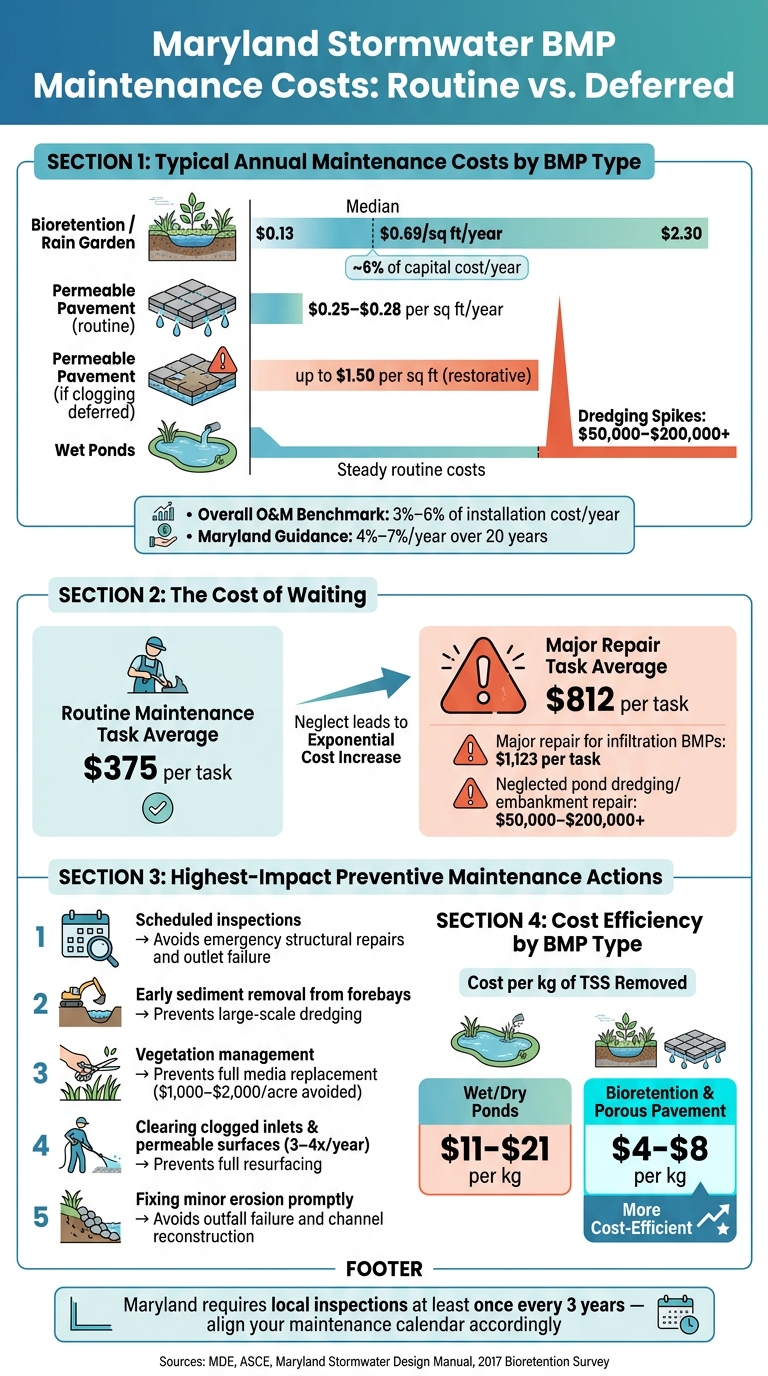
Maryland Stormwater BMP Maintenance Costs: Routine vs. Deferred
Research usually puts long-term stormwater expenses into four buckets: upfront installation, annual operation and maintenance (O&M), periodic rehab, and repairs or full replacement after failure.[8][9] That framework matters because a stormwater budget only works if it reflects how costs show up over time, not just on day one.
Studies estimate annual O&M at about 3%–6% of installation cost. Maryland-focused guidance puts that a bit higher, at 4%–7% per year over 20 years when you include routine care and periodic dredging.[1][13][12] For Maryland property owners, those costs also have to line up with the inspection and performance duties described above.
Typical Cost Drivers for Ponds, Bioretention, and Permeable Pavement
Each BMP comes with its own cost pattern.
Ponds tend to have steady, recurring costs for mowing, clearing inlets and outlets, fixing small erosion areas, and inspections. But the big budget hit usually comes from sediment removal and dredging, which can create sharp cost spikes instead of smooth yearly spending.[4]
Bioretention systems and rain gardens are more hands-on. A 2017 survey of bioretention facilities found median annual maintenance costs of $0.69 per square foot, with a range of $0.13 to $2.30 per square foot per year.[12][5] On average, that equals about 6% of capital cost per year.[12]
Permeable pavement works differently. Its routine cost is mostly tied to vacuum sweeping, which is estimated at $0.25–$0.28 per square foot per year.[5] That may sound manageable. But if clogging is ignored, restorative maintenance can jump to $1.50 per square foot.[5] That’s the kind of cost curve that punishes delay.
| BMP Type | Primary Maintenance Tasks | Typical Annual Cost | Cost Timing |
|---|---|---|---|
| Wet Pond / Basin BMPs | Mowing, inlet/outlet clearing, erosion repair, inspections | Routine costs are steady; dredging creates larger spikes | Routine costs are steady, but dredging creates larger spikes |
| Bioretention / Rain Garden | Weeding, mulching, plant replacement, trash/sediment removal | $0.13–$2.30/sq ft/year [12] | Recurring labor costs, with periodic rehabilitation over the system life |
| Permeable Pavement | Vacuum sweeping, joint inspection, surface condition checks | $0.25–$0.28/sq ft/year for routine maintenance [5] | Low annual cost, but expensive if clogging is deferred |
Why Deferred Maintenance Gets Expensive
The gap between routine upkeep and major rehab is not small. One ASCE analysis found that routine maintenance tasks averaged $375 per task, while major repairs averaged $812 per task.[6][11] For infiltration BMPs such as bioretention and permeable pavement, major repairs were higher still, averaging $1,123 per task.[6][11]
For ponds, the jump can be even more painful. Neglected ponds may need dredging and embankment stabilization projects in the $50,000–$200,000+ range.[7] That can blow past what steady routine care would have cost over the same stretch of time.
Across BMP types, the pattern is pretty clear: routine maintenance costs less than deferred repair. And that gap helps show which maintenance actions save the most money.
Evidence-Based Ways to Lower Compliance Costs
Preventive Maintenance Actions With the Best Cost Impact
Deferred maintenance is the most expensive route. If you want to cut compliance costs, the biggest wins usually come from stopping sediment buildup, clogging, and erosion before they snowball into bigger repairs.
The required inspection cycle does more than check a box. It helps spot small defects early, when they’re still cheap to fix. Routine inspections and early sediment removal tend to save the most because they can stop minor issues from turning into dredging, erosion repair, or structural damage. In studies that compared cost per kilogram of TSS removed, wet and dry ponds came in at $11–$21 per kilogram, while bioretention and porous pavement were lower at $4–$8 per kilogram.[10] One big reason is simple: ponds often keep collecting sediment until expensive dredging can’t be avoided.
Vegetation work in bioretention areas and swales also matters. It helps keep infiltration rates in good shape and can prevent full soil media replacement, which may cost $1,000–$2,000 per acre of drainage area.[18] Clearing clogged inlets is another small task with a big payoff. For permeable surfaces, regular sweeping or vacuuming – about 3 to 4 times a year – helps stop the kind of deep clogging that can end in resurfacing or reconstruction.[15] The same logic applies to erosion. Fixing a small washout early is a lot cheaper than waiting until a pipe or outfall starts to fail.
| Preventive Action | Main Cost It Helps Avoid | Long-Term Savings Category |
|---|---|---|
| Scheduled inspections | Emergency structural repairs, outlet failure | Capital repair avoidance; reduced enforcement risk |
| Early sediment removal from forebays | Large-scale dredging; loss of storage volume | Reduced non-routine maintenance; extended BMP life |
| Vegetation management | Full media replacement; swale regrading | Lower periodic rehabilitation costs |
| Clearing clogged inlets and permeable surfaces | System bypass, flooding, full resurfacing | Flood damage reduction; preserved fee credits |
| Fixing minor erosion promptly | Outfall failure, pipe undermining, channel reconstruction | Avoided major infrastructure repair |
These are the plain, routine jobs that help avoid the larger repairs driving most compliance costs.
Design Choices That Make Stormwater Features Cheaper to Maintain
Some design choices make maintenance easier from day one. The pattern is pretty straightforward: fewer access problems, less sediment buildup, and less erosion usually mean lower long-term costs.
Vehicle access to a forebay or pond edge lets crews bring in small equipment for routine sediment removal instead of paying to mobilize specialized machinery.[17] That can change the math quite a bit over time. Pretreatment areas – like grass swales, filter strips, or small forebays placed upstream of the main BMP – also help by trapping coarse sediment before it gets into more complex systems. That reduces how often bioretention cells or permeable pavement beds need deep cleaning.[20][21]
Plant choice plays a role too. Simple native plantings can cut recurring costs tied to fertilizers, irrigation, pesticide use, and replanting. Chesapeake Bay Trust guidance says native plants reduce fertilizer, pesticide, water, and overall maintenance needs in rain gardens.[22] Stable grading and properly armored outfalls help for the same reason: they reduce repeat erosion repairs. And for permeable pavement, details matter. Correctly sized aggregates and interlocking concrete pavers rated for the real traffic load can reduce surface deformation and patching over time.[2][13]
Better access and simpler pretreatment lower maintenance demands right from the start.
Where Permeable Pavers, Rain Gardens, and Drainage Improvements Fit
For residential properties, driveways, walkways, and shared community spaces, three low-impact options often strike a good balance between compliance value and upkeep costs.
Permeable interlocking concrete pavers, or PICP, cost more upfront – about $7–$14 per square foot to build. But a life-cycle comparison of traditional and permeable concrete sidewalks found total costs of about $15 per square foot for traditional pavement versus $8 per square foot for permeable pavement once stormwater management was included.[2] Annual maintenance is about $0.07–$0.37 per square foot per year, mostly for sweeping and vacuuming.[13] They may also reduce impervious area that’s subject to county stormwater fees.
Rain gardens tend to work best when they handle modest impervious areas, such as part of a roof or a strip of driveway, and where soils can support decent infiltration. Installation costs range from $4 to $35 per square foot, depending on site conditions and design complexity. Residential projects may also qualify for rebates of up to $6,000 through programs like the Chesapeake Bay Trust.[22] Vegetated filter systems like bioretention also have a lower annualized cost per kilogram of TSS removed than wet ponds, which can make them a practical fit for HOAs and residential communities trying to manage runoff without building large systems.[10][18]
Grading and drainage improvements fit a different part of the puzzle. Regrading yards to move water into vegetated swales, adding level spreaders, or redirecting downspouts to pervious areas can cost two to three times less per linear foot than curb-and-gutter systems with underground pipes.[18] They also cut pollutant loads reaching downstream BMPs, which can reduce maintenance frequency across the whole setup.
That cost profile matters most when a site needs both compliance and upkeep that owners can plan for. These design and maintenance choices shape the baseline before local fees and credits enter the picture.
Maryland Incentives, Local Planning, and Key Takeaways
County Fees, Credits, and Rebates That Can Offset Costs
Once you know what drives maintenance costs, the next move is simple: look for local programs that can trim the bill. In Maryland, stormwater fees are a standard cost for many property owners. But some counties also give you ways to cut those costs back. Fee credits lower what you pay each year, while rebates help with installation costs up front. And in year one, a rebate can be worth more than a small annual credit.[14][19]
Here’s how some central Maryland counties set these programs up:
| County / Jurisdiction | Fee Type | Credit or Rebate Available | Qualifying Practices |
|---|---|---|---|
| Howard County | Watershed Protection Fee, about $115/year for single-family detached homes on lots ≤0.25 acre [3] | One-time reimbursement of 75% of documented BMP installation costs, plus annual fee credits based on impervious area treated [14] | Rain gardens, permeable pavement, bioretention, drainage improvements |
| Montgomery County | Water Quality Protection Charge | Up to 50% off for residential properties and up to 60% for multifamily and non-residential properties; credits are valid for 3 years and applications are due by Oct. 31 [26] | Rain gardens, water harvesting, and other approved green infrastructure [25] |
| Prince George’s County | Stormwater utility fee | Rain Check rebates up to $6,000 per residential property and $20,000 per commercial, industrial, institutional, HOA, and similar properties; rebates include about $10/sq ft for rain gardens and about $12/sq ft for permeable pavement [16][19] | Rain gardens, permeable pavement, green roofs, rain barrels, cisterns, pavement removal, conservation landscaping, urban tree canopy [16][19][23] |
| Anne Arundel County | Watershed Protection and Restoration Fee | Credits can reduce the assessed fee by up to 50% and are renewed in 3-year intervals as long as BMPs are maintained and functioning [27] | Qualified on-site stormwater controls [27] |
| Baltimore City | Stormwater fee | Credits tied to approved BMPs; Baltimore City also offers credit for public participation volunteer hours [24] | Rain gardens, rainwater harvesting, tree planting, and approved clean-water volunteer events [24] |
Applying Research to a Multi-Year Maintenance Plan
Those savings don’t last on their own. They depend on keeping maintenance up to date.
A simple way to plan is to split your budget into three buckets:
- routine upkeep for inspections, debris removal, and small vegetation tasks
- Corrective repairs for sediment excavation or drain repair when a system starts slipping
- Upgrades for bigger fixes, like turning a chronic drainage issue into a rain garden or replacing a failing surface with permeable pavers
This matters for another reason too. In several Maryland programs, credits have to be renewed every three years, so your maintenance calendar should match your renewal cycle.[26][27] Howard County is a good example. It requires credit applications by April 1 for the current billing year.[14] If you track renewal dates alongside inspections and seasonal checkups, it’s a lot easier to stay on top of both.
Conclusion: Early, Consistent Maintenance Is Usually the Lowest-Cost Path
When maintenance is planned over several years, staying in compliance usually costs less. Waiting is what drives the biggest compliance bills in Maryland. Once stormwater features clog, erode, or stop working, owners can lose performance and money at the same time. Annual credits may shrink, rebates may not apply to failed installations, and repair costs can end up far above the original maintenance budget.[14][24]
The lower-cost path is usually the boring one – and that’s the point. Clear inlets. Manage vegetation. Remove sediment early. Grading corrections, drainage improvements, environmental pavers, and stormwater-focused landscape work are the practical fixes that help restore function before a small issue turns into an expensive one.
FAQs
What does a Maryland stormwater maintenance agreement require me to do?
A Maryland stormwater maintenance agreement usually means you need to keep your stormwater best management practices in good working order and in compliance.
In plain English, that includes regular inspections, timely repairs, and routine maintenance so the system keeps doing its job and doesn’t wear down over time.
Pro Landscapes MD helps property owners stay on top of these requirements with drainage inspections, repairs, and maintenance.
How can I tell if routine stormwater maintenance is being deferred too long?
Routine stormwater maintenance is being put off too long when you start seeing standing water, structural damage, or drainage that no longer works the way it should.
That matters more than many property owners think. Stormwater systems can be expensive to maintain, and in some cases they wear out sooner than expected. Spotting trouble early gives you a better shot at protecting the system before small issues turn into costly repairs.
Pro Landscapes MD offers drainage repair and yard leveling to fix these problems and help reduce the risk of financial and regulatory consequences.
Which Maryland counties offer stormwater credits or rebates for BMPs?
The documents reviewed do not name any Maryland counties that currently offer direct stormwater credits or rebates for individual best management practices (BMPs).
They do discuss stormwater costs, affordability, and rules across several counties. But they don’t point to county-level incentive programs for specific BMP installations.
If you’re a property owner dealing with runoff or drainage problems, Pro Landscapes MD offers drainage solutions and environmental pavers that can help manage water on your property.
Chat with Us