









- bhavya gada
- No Comments
When dealing with steep slopes, controlling erosion and maintaining soil health can be challenging. Native, drought-tolerant plants offer a practical solution. These plants stabilize soil with their deep roots, reduce water runoff, and require minimal maintenance once established. Here’s a quick look at 10 options that thrive on slopes:
- Creeping Phlox: Low-growing groundcover with vibrant colors; prevents soil erosion year-round.
- Butterfly Milkweed: Deep taproots anchor soil; great for sunny, dry slopes.
- Little Bluestem: Fibrous roots extend 3–6 feet deep; ideal for poor, well-drained soils.
- Prickly Pear: Spreading cactus that holds soil in place and resists deer.
- Broomsedge: Warm-season grass that performs well in nutrient-poor soils.
- Pussytoes: Dense mat-like groundcover that shields soil from rain and wind.
- Purpletop: Salt-tolerant grass for roadside slopes; slows water runoff.
- Pasture Rose: Shrub with spreading roots; thrives in rocky, dry soils.
- Hairy Beardtongue: Perennial suited for rocky, sunny slopes; resists erosion.
- Winged Sumac: Shrub forming dense thickets; anchors soil with deep roots.
These plants not only protect your property but also support local ecosystems. To get started, ensure the slope is stable, redirect water runoff, and plant native species suited to your site’s sun and soil conditions. Once established, these plants require little upkeep, offering a long-term, low-maintenance solution for erosion control.
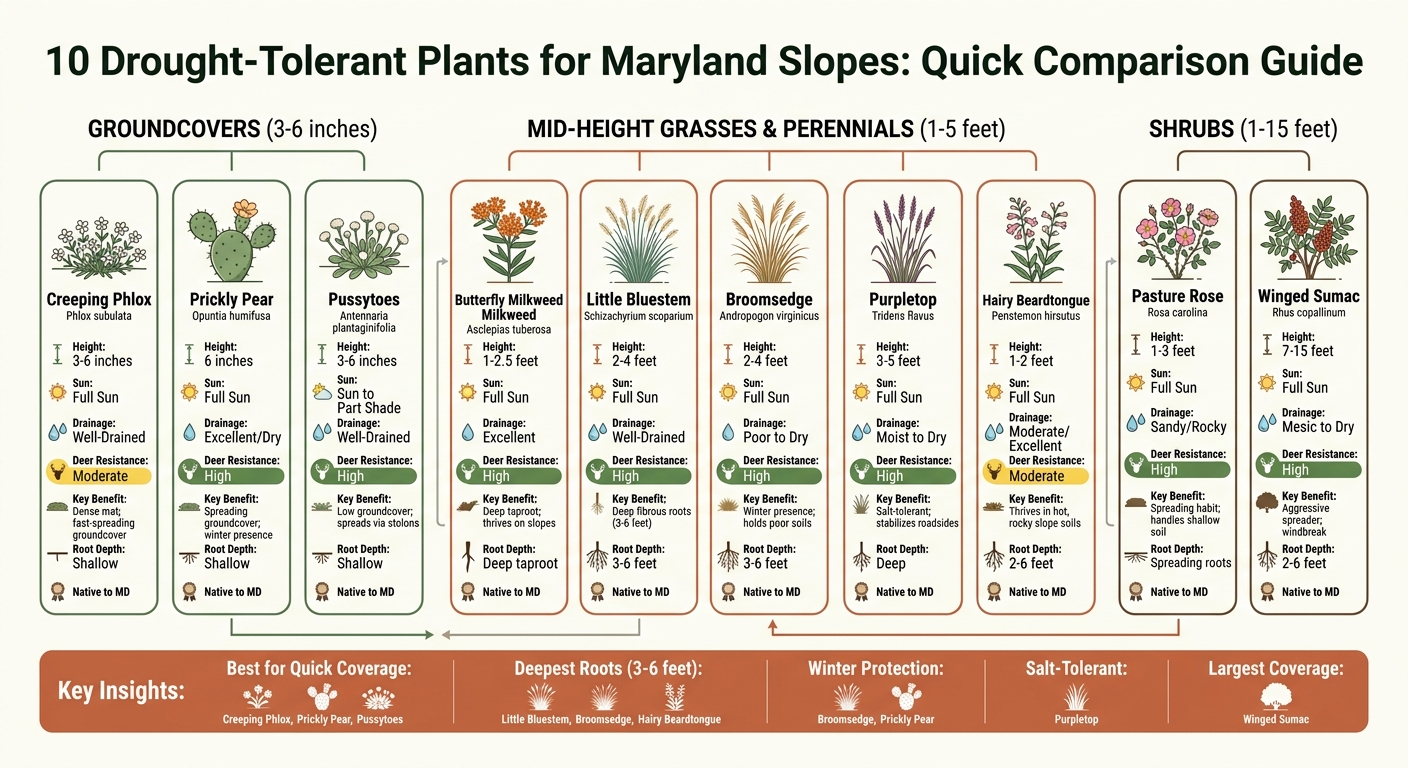
Comparison of 10 Drought-Tolerant Plants for Slope Erosion Control in Maryland
The 25 Best Plants for Preventing Slope Damage
sbb-itb-843f8be
1. Creeping Phlox (Phlox subulata)
Creeping Phlox brings slopes to life with its vibrant colors while also providing essential soil stability. This groundcover quickly establishes itself – typically within a single growing season – and forms a dense carpet of needle-like evergreen foliage. Its deep roots anchor the soil, making it an effective solution for controlling erosion during heavy rainfall[4][3].
Erosion Control Capabilities
Creeping Phlox offers more than just beauty; it’s a natural protector for slopes. Acting as a living mulch, it helps retain soil moisture, reduces evaporation by shading the ground, and minimizes wind erosion[4]. Its evergreen foliage ensures that slopes remain shielded even in winter, providing year-round soil protection[2].
Drought Tolerance
Once established, Creeping Phlox thrives in tough conditions. It’s well-suited for hot, sunny slopes where water drains quickly, making it ideal for rocky outcrops, sandy areas, and thin soils. Its dense foliage reduces water loss, helping it endure dry spells with ease.
Soil and Sun Preferences
This resilient groundcover is a great alternative to grass, especially in places where traditional turf struggles to grow[4]. It thrives in USDA zones 3 through 9, making it perfect for Maryland’s climate. While it adapts to various soil types, Creeping Phlox performs best in well-drained soils with full sun exposure. Its low-maintenance nature and adaptability make it an excellent choice for stabilizing slopes in the region.
2. Butterfly Milkweed (Asclepias tuberosa)
Butterfly Milkweed is a plant that brings long-term benefits for slope stabilization. While it may not grow as quickly as some other groundcovers, its deep taproot system provides a strong anchor for soil over time. According to the University of Maryland Extension, this native plant is "slow growing but deep tap root may provide long-term slope stabilization value" [2]. Its drought tolerance and ability to thrive in challenging conditions make it a reliable choice for erosion-prone areas.
Erosion Control Capabilities
The deep taproot of Butterfly Milkweed does more than just help the plant survive – it plays a critical role in stabilizing soil. During storms and heavy rainfall, this root system helps hold the soil in place, making it a dependable option for long-term erosion control.
Drought Tolerance
Butterfly Milkweed is built to handle dry conditions. Its taproot extends deep into the ground to access water reserves, allowing it to survive even during extended dry spells. Interestingly, this plant thrives on slopes because of the excellent drainage they provide. The University of Maryland Extension highlights that "the rapid water runoff on steep slopes actually benefits this plant, preventing the overly moist conditions that can cause root problems while mimicking its preferred dry habitat" [2].
Deer Resistance
Another benefit of Butterfly Milkweed is its natural resistance to deer. This ensures the plant remains intact, maintaining its role as a protective groundcover and reducing the risk of soil erosion.
Soil and Sun Preferences
Butterfly Milkweed excels in tough environments, particularly on sunny slopes where heat and quick drainage dominate. It prefers full sun and does best in areas where water doesn’t linger for long. As noted by the University of Maryland Extension, "Sunny sites are brutal during hot, dry summer weather. Dryness is amplified by the quick drainage found on steep slopes. Any rain that falls doesn’t stay for long. Some native plants perform well in these environments" [2]. Butterfly Milkweed is one of those plants, and it’s especially suited for steep slopes rather than flat, moisture-retaining areas.
3. Little Bluestem (Schizachyrium scoparium)
Little Bluestem is a native bunch grass that plays a key role in stabilizing slopes with its extensive fibrous root system. These roots can reach depths of 3–6 feet, creating a strong underground network that holds soil together and reduces erosion during heavy rains [4]. Beyond its soil-stabilizing abilities, this grass provides year-round slope protection, making it a reliable choice for erosion control.
Erosion Control Capabilities
The dense foliage of Little Bluestem slows down water runoff by reducing its speed, giving the soil more time to absorb moisture rather than being washed away. One standout feature of this grass is its winter resilience. Unlike plants that completely die back in colder months, Little Bluestem maintains its structure, continuing to shield the soil from wind and water erosion when other vegetation has faded.
Drought Tolerance
This grass thrives in tough conditions, particularly on steep slopes where its deep roots tap into water reserves beneath the surface. The University of Maryland Extension highlights the challenges of such environments:
"Sunny sites are brutal during hot, dry summer weather. Dryness is amplified by the quick drainage found on steep slopes. Any rain that falls doesn’t stay for long" [2].
Little Bluestem is well-adapted to these conditions, making it a dependable choice for areas prone to drought.
Soil and Sun Preferences
To grow successfully, Little Bluestem needs full sun and performs best in poor, well-drained soils where other plants may struggle. The natural drainage of slopes complements its growth, preventing issues caused by excessive moisture. Its enduring presence through winter ensures continuous soil protection, providing stability throughout the year.
4. Prickly Pear (Opuntia humifusa)
Prickly Pear is a resilient groundcover that thrives on Maryland’s challenging slopes. As a native species, it not only stabilizes soil but also flourishes in harsh slope conditions. This cactus spreads across the surface, acting like a living mulch that holds the ground in place and slows water runoff. By doing so, it helps the soil absorb moisture instead of losing valuable topsoil to erosion [4].
Erosion Control Capabilities
Its growth pattern creates a natural shield over steep areas, keeping soil intact even during heavy rainfall [4]. Unlike many plants that die back in winter, Prickly Pear continues to stabilize slopes year-round [2]. This is particularly important considering that about 36 billion tons of fertile topsoil are lost globally to erosion each year [4].
Drought Tolerance
Prickly Pear is built for dry, tough environments like sandy or rocky outcrops where water drains quickly [2]. The University of Maryland Extension highlights its ability to thrive in brutally hot sites with poor moisture retention [2]. Not only does it survive these harsh conditions, but it also helps mitigate common slope issues, such as deer browsing.
Deer Resistance
Thanks to its spiny structure, Prickly Pear naturally deters deer. Steep slopes further discourage deer activity. Dr. Sara Tangren, formerly of the University of Maryland Extension, explains:
"Deer are browsing and grazing many of our native plant species into oblivion, but they cannot risk a twisted or broken ankle, so they avoid slopes" [2].
Soil and Sun Preferences
This cactus thrives in full sun with dry, well-drained soil. It easily adapts to poor soil types, including sandy, gravelly, or rocky substrates, where flatter areas might retain too much moisture for its liking.
5. Broomsedge (Andropogon virginicus)
Broomsedge is a standout native bunch grass, particularly suited to Maryland’s steep, erosion-prone slopes. Known for its resilience, this warm-season grass remains visible even in winter, providing year-round erosion control when other plants have withered away[2].
Erosion Control Capabilities
The secret to Broomsedge’s effectiveness lies in its deep, fibrous root system. These roots can extend 3 to 6 feet underground, forming a dense network that secures soil particles and prevents erosion during heavy rains, much like retaining garden walls[4]. Above ground, its foliage plays a key role by slowing down rainwater as it flows over slopes, giving the soil time to soak up moisture[4].
Drought Tolerance
Broomsedge thrives in conditions that challenge most plants. According to the University of Maryland Extension:
"Sunny sites are brutal during hot, dry summer weather. Dryness is amplified by the quick drainage found on steep slopes. Any rain that falls doesn’t stay for long. Some native plants [like Broomsedge] perform well in these environments."[2]
This grass is particularly well-suited to poor, nutrient-depleted soils and areas with fast-draining, steep terrain. It’s a reliable option for locations where topsoil has been stripped away by erosion[2][4].
Deer Resistance
Another advantage of Broomsedge is its natural resistance to deer. This makes it a dependable choice for open areas where deer browsing is a concern[2].
Soil and Sun Preferences
Broomsedge thrives in full sun, requiring at least six hours of direct sunlight daily. It’s highly adaptable, flourishing in acidic soils with a pH range of 4.5 to 6.0. Whether the substrate is sandy, clay-based, or rocky, this grass performs best in dry, nutrient-poor conditions, showcasing its impressive drought tolerance[2].
6. Pussytoes (Antennaria plantaginifolia)
Pussytoes is a native groundcover that not only thrives in tough conditions but also helps stabilize slopes. Thanks to its dense, mat-like growth, it’s an excellent choice for areas prone to erosion.
Erosion Control Capabilities
This plant works as a natural mulch, offering multiple benefits. Its thick foliage shields the soil from the impact of heavy rain and strong winds, reducing erosion. Meanwhile, its root system firmly anchors soil particles, helping to maintain the essential topsoil layer of 5 to 10 inches[4]. These qualities make Pussytoes a reliable option for Maryland’s sunny slopes and challenging terrains.
Drought Tolerance
Pussytoes is perfectly suited for sunny, sloped areas where water drains quickly. Its dense growth slows down water runoff, allowing the soil to absorb more moisture[2][4]. On steep slopes, where gravity speeds up drainage and rainfall doesn’t linger, this plant’s ability to retain moisture is especially useful[2].
Soil and Sun Preferences
For the best results, plant Pussytoes in full sun with well-drained soil[3]. While it can adapt to different soil types, it thrives in conditions where drainage is optimal[3].
7. Purpletop (Tridens flavus)
Purpletop is a native grass that thrives on steep, dry slopes with poor soil. Its upright growth and extensive root system make it a natural choice for controlling erosion.
Erosion Control Capabilities
Purpletop’s deep roots anchor soil effectively, while its sturdy stems help trap soil particles and reduce the speed of water runoff. Its layered leaves also play a role by catching raindrops before they hit the ground, minimizing the "rain splash" effect that can erode bare soil[1].
Drought Tolerance
This grass is well-suited for sunny areas with hot summers and dry conditions. It performs reliably on steep slopes with fast-draining soil, handling a wide range of moisture levels. Purpletop also stands up to soil compaction and road salt, making it a practical option for dry roadside areas[2].
Deer Resistance
Purpletop is considered deer-resistant, meaning it’s less likely to be grazed. This quality makes it even more effective for stabilizing slopes, as it remains undisturbed and continues to perform its soil-stabilizing role[2].
Soil and Sun Preferences
For the best results, plant Purpletop in full sun. It adapts to a variety of soils and moisture levels, which is especially useful for slopes near roads or driveways where salt runoff and compacted soil are common[2]. Its ability to endure harsh conditions makes it a reliable choice for slope stabilization.
8. Pasture Rose (Rosa carolina)
The Pasture Rose, also known as rock rose, is a native shrub perfectly suited for slopes thanks to its spreading growth habit and its ability to thrive in shallow, rocky soils [2].
Erosion Control Capabilities
With its spreading growth, this plant effectively anchors soil on slopes, making it an excellent choice for erosion control. It performs well in sandy or rocky soils and is naturally resistant to deer, which helps preserve its growth and soil-stabilizing properties.
Drought Tolerance
This shrub thrives in hot, dry, and sunny locations. It’s well-adapted to mesic to dry soils, particularly those that are sandy or rocky with fast drainage. Its ability to handle low moisture levels makes it a reliable option for areas where other plants might struggle.
Deer Resistance
Pasture Rose has a natural resistance to deer, which is even more effective when grown on steep slopes. Since deer tend to avoid these areas to prevent injury, the plant enjoys an added layer of protection, allowing it to maintain its dense growth and continue stabilizing the soil.
Soil and Sun Preferences
For the best results, plant Pasture Rose in full sun. While it can adapt to sandy, loamy, or clay soils, it truly thrives in poor, rocky, and well-drained conditions. Although it can handle occasional moisture, it performs best in dry, well-drained environments, making it an excellent choice for challenging sites like rock outcrops or slopes with shallow topsoil.
This hardy shrub not only stabilizes slopes but also adds a touch of beauty to rugged landscapes with its resilience and charm.
9. Hairy Beardtongue (Penstemon hirsutus)
Hairy Beardtongue is a perennial plant native to Maryland’s Piedmont and Mountain regions, perfectly suited for hot, rocky slopes as part of our landscaping services. Its tough root system and durable foliage make it an excellent choice for stabilizing slopes.
Erosion Control Capabilities
This plant features a fibrous root system that extends 2–6 feet deep, anchoring soil effectively[4]. During heavy rains, these roots create a sturdy underground network that helps prevent soil erosion and washouts. Meanwhile, its foliage provides an added layer of protection by catching rainfall before it impacts the soil, minimizing rain splash and wind erosion[4][1].
Drought Tolerance
Hairy Beardtongue is well-adapted to rocky, dry environments, thriving on steep slopes with excellent drainage. This drainage prevents root rot and allows the plant to withstand extreme heat and dry summers with ease.
Soil and Sun Preferences
For best results, plant Hairy Beardtongue in dry, rocky soil with excellent drainage on sunny slopes. It performs best in Maryland’s Piedmont and Mountain regions but is not suited for the Coastal Plain. Planting on steep inclines also helps deter deer and prevents water from pooling around the roots.
10. Winged Sumac (Rhus copallinum)
Winged Sumac earns its spot as a top choice for slope stabilization thanks to its vigorous growth and deep-root system. This native shrub is recognized for its ability to spread quickly and form dense thickets, with roots that can anchor soil as deep as 2–6 feet, even during intense storms [2][4]. Its name comes from the distinctive "wings" along its leaf stalks, making it easy to identify. It’s particularly effective at colonizing bare slopes, providing excellent erosion control [2].
Erosion Control Capabilities
Winged Sumac offers a powerful defense against erosion. Its deep roots stabilize the soil, while its dense foliage slows down water runoff, allowing more moisture to soak into the ground rather than washing away precious topsoil [1][4]. Acting as both a soil stabilizer and a natural windbreak, it protects against erosion caused by both water and wind. Compared to shallow-rooted plants like turf grass, Winged Sumac provides far better soil retention [1].
Drought Tolerance
This shrub thrives in hot, dry conditions, thanks to its glossy, leathery leaves that minimize water loss. Its underground rhizomes help it spread into dense colonies, capturing surface moisture even in less-than-ideal soil. This makes it an excellent choice for steep slopes where water drains quickly and other plants may struggle.
Deer Resistance
Winged Sumac is highly resistant to deer browsing [2], making it a practical option for areas where deer activity is a concern.
Soil and Sun Preferences
For best results, plant Winged Sumac on dry or mesic slopes with full sun exposure. It does particularly well on south-facing hillsides, where heat and rapid drainage can challenge other plants [2]. On steeper slopes (greater than a 33% grade), pairing it with physical supports like retaining walls can further enhance stability [4]. As a native species, it delivers quick coverage and establishes itself aggressively [2].
Check out the upcoming plant comparison table for a detailed side-by-side analysis of these options.
Plant Comparison Table
The table below highlights key erosion control features of 10 drought-tolerant plants that thrive on slopes, providing a quick reference for their characteristics and benefits.
| Plant Name | Height | Sun Requirements | Soil Drainage | Deer Resistance | Native to MD | Erosion Control Benefit |
|---|---|---|---|---|---|---|
| Creeping Phlox | 3–6 inches | Full Sun | Well-Drained | Moderate | Yes | Dense mat; fast-spreading groundcover [4][1] |
| Butterfly Milkweed | 1–2.5 feet | Full Sun | Excellent | High | Yes | Deep taproot; thrives on slopes [2] |
| Little Bluestem | 2–4 feet | Full Sun | Well-Drained | High | Yes | Deep fibrous roots (3–6 feet) [4][1] |
| Prickly Pear | 6 inches | Full Sun | Excellent/Dry | High | Yes | Spreading groundcover; winter presence [2] |
| Broomsedge | 2–4 feet | Full Sun | Poor to Dry | High | Yes | Winter presence; holds poor soils [2] |
| Pussytoes | 3–6 inches | Sun to Part Shade | Well-Drained | High | Yes | Low groundcover; spreads via stolons [1] |
| Purpletop | 3–5 feet | Full Sun | Moist to Dry | High | Yes | Salt-tolerant; stabilizes roadsides [2] |
| Pasture Rose | 1–3 feet | Full Sun | Sandy/Rocky | High | Yes | Spreading habit; handles shallow soil [2] |
| Hairy Beardtongue | 1–2 feet | Full Sun | Moderate/Excellent | Moderate | Yes (Piedmont) | Thrives in hot, rocky slope soils [2] |
| Winged Sumac | 7–15 feet | Full Sun | Mesic to Dry | High | Yes | Aggressive spreader; windbreak [4][2] |
Groundcovers like Creeping Phlox, Prickly Pear, and Pussytoes act as living mulch, effectively covering the soil and reducing erosion. Mid-height grasses such as Little Bluestem and Broomsedge provide better soil anchoring than traditional turf grass, thanks to their deep, fibrous roots. Taller plants, including Winged Sumac, form dense thickets that double as windbreaks, while Purpletop stabilizes roadsides with its salt tolerance.
For Maryland slopes, understanding the specific ecoregion is key. For instance, Hairy Beardtongue thrives in rocky soils found in Piedmont and mountainous areas, whereas the other species adapt well across the state. Most of these native plants resist deer browsing, though Creeping Phlox and Hairy Beardtongue offer only moderate resistance [2].
Winter presence is another critical factor for erosion control. Plants like Broomsedge and Prickly Pear retain their root systems and basal structures during dormant months, ensuring protection against snowmelt and winter rains. This year-round defense is essential for slopes, where erosion risks persist throughout the year.
These comparisons provide a solid foundation for selecting the right plants for Maryland slopes. Up next: practical tips for planting and maintaining these drought-tolerant options.
How to Plant and Maintain Slopes in Maryland
Before you start planting, take a close look at your slope for any signs of instability. Cracks along the top ridge are a red flag, indicating the slope might fail. As Bosky Dell Natives explains:
"If the slope is already destabilized, check for cracks along the top. These are signs that the slope is going to fail. If you find those, you should call a professional" [5].
If you spot these issues, it’s time to call in experts for solutions like grading, retaining walls, or stormwater management. Companies like Pro Landscapes MD provide drainage and land leveling services throughout central Maryland.
Once you’re sure the slope is stable, the next step is managing water runoff. Redirect water from gutters or driveways that drain directly onto the slope. On steeper inclines, consider using biologs – fiber rolls designed to slow water flow and create terraced planting areas [1]. When removing weeds, only clear the spots you plan to plant, as large bare areas can lead to erosion [1].
With water management and weed control in check, focus on planting. Proper spacing is key. For instance, groundcovers like Creeping Phlox can spread up to 5–6 feet [3], so plan accordingly to allow plants to overlap naturally. This overlapping creates a canopy that softens the impact of rainfall. Layering plants with different root depths – such as shallow groundcovers, mid-depth grasses, and deep-rooted shrubs – further stabilizes the soil by forming an interconnected root network [5].
After planting, apply mulch right away to protect the soil from rain splash and suppress weeds. For areas where you’ve seeded, use straw or biodegradable erosion control blankets to keep seeds in place. Water your new plants weekly to help them establish roots, but avoid overwatering, as it can lead to erosion. Once they’re established, native plants generally require very little upkeep.
Interestingly, Maryland’s steep slopes naturally deter deer, making them perfect for native plants that might otherwise be vulnerable to browsing [2]. For larger-scale projects, such as installing retaining walls or extensive grading, reach out to professionals like Pro Landscapes MD or consult your local Soil and Water Conservation District for expert guidance.
Conclusion
When it comes to slope stabilization in Maryland, drought-tolerant plants play a key role in controlling erosion and maintaining the health of the landscape. Their deep root systems provide better soil anchoring than turf grass, while their broad foliage helps shield the ground from weeds and erosion [3]. As garden designer Orchid Black explains:
"These great groundcovers can turn a dry, steep problem area into a beautiful garden setting for you to enjoy year-round and a sunny habitat for birds and butterflies" [3].
Once these plants are established, they require very little water or maintenance, making them perfect for steep, hard-to-reach areas.
The choice of plants should be tailored to the specific conditions of the slope, such as sunlight exposure, soil type, and drainage. For instance, south-facing slopes, which get more sunlight and wind, may need different plant species than shaded, north-facing slopes. In rocky, dry areas, Hairy Beardtongue thrives, while Broomsedge is better suited to soils that are low in nutrients [2].
For complex and challenging slopes, professional landscaping services can ensure long-lasting results. From site analysis and plant selection to installation and drainage solutions, experts can handle the technical aspects of slope stabilization. Pro Landscapes MD offers a full range of services across central Maryland, including grading, planting, and stormwater management, to meet the unique needs of your property.
FAQs
How do I pick the best plants for my slope?
Select native plants that align with your slope’s specific conditions, such as how much sunlight it gets, the type of soil, and moisture levels. For slopes that are sunny and dry, consider options like Broomsedge and Common Milkweed. These plants not only tolerate drought well but also help control erosion effectively. Prioritize species that germinate quickly, provide coverage throughout the year, and grow without becoming invasive. This approach ensures the slope remains stable and protected from erosion.
How long until new plants stop erosion?
Newly planted vegetation starts working to stabilize slopes and minimize erosion almost right away. While seeding and mulching offer solid initial protection, achieving complete erosion control can take anywhere from several months to years. This timeline depends on how successfully the plants take root and the specific conditions of the surrounding environment.
Do I need a retaining wall too?
Retaining walls can be a smart solution when dealing with steep slopes or areas prone to erosion. They play a crucial role in stabilizing soil and reducing the risk of landslides. When combined with other erosion control techniques, retaining walls become even more effective in preserving the slope’s structure and preventing long-term damage to the surrounding area.
Chat with Us