









- bhavya gada
- No Comments
Eco-friendly soil stabilizers are changing how we approach construction and landscaping. Unlike cement and lime, which contribute to 8% of global CO2 emissions, these alternatives use biopolymers, plant-based materials, and microorganisms to strengthen soil while reducing environmental harm. Key benefits include:
- Lower emissions: Production processes are less energy-intensive.
- Improved soil health: Biodegradable materials enrich the soil over time.
- Efficiency: Require smaller quantities to achieve results similar to traditional stabilizers.
Examples include xanthan gum and guar gum, which can boost soil strength by up to 300%, and geopolymers made from industrial by-products like fly ash. These solutions are particularly useful in regions like Maryland, where diverse soil types and wet climates pose unique challenges. By choosing eco-friendly stabilizers, you can create durable, erosion-resistant foundations while supporting sustainable practices.
Stabilization of Expansive Soils by Using Eco Friendly Enzyme Based Material
sbb-itb-843f8be
What Are Eco-Friendly Soil Stabilizers?
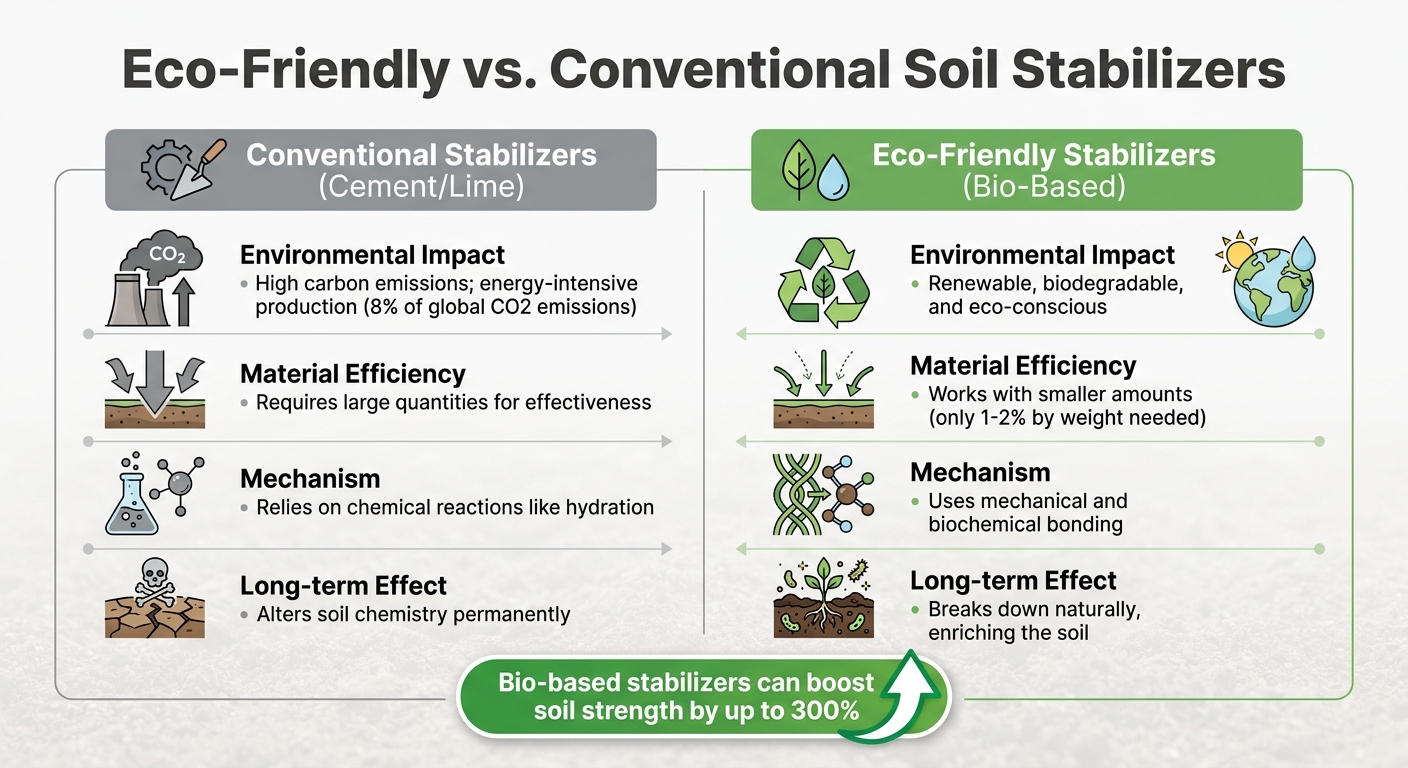
Eco-Friendly vs Conventional Soil Stabilizers Comparison
Soil Stabilizers Explained
Soil stabilizers are materials added to soil to improve its strength and performance for construction and landscaping. They help increase the soil’s ability to bear weight, improve particle cohesion, and prevent problems like erosion, shifting, or structural failure. This method plays a crucial role in creating erosion-resistant construction sites and more resilient landscapes.
These stabilizers function in a few different ways. Mechanical reinforcement involves adding physical elements like plant roots or fibers to create a supportive framework within the soil. Biochemical interaction uses additives to chemically bond soil particles at the molecular level through processes like bio-cementing and bio-encapsulation. Lastly, hydrological control focuses on managing water movement, reducing runoff, and enhancing water absorption into the soil [1][2]. Together, these mechanisms provide a foundation for environmentally friendly options that not only stabilize soil but also support its long-term health.
How Eco-Friendly Stabilizers Protect the Environment
Eco-friendly soil stabilizers are made from renewable, biodegradable materials like biopolymers, plant-based substances, and microorganisms. Unlike chemical stabilizers, these options break down naturally, leaving no harmful residues behind. This makes them a safer choice for the environment [4].
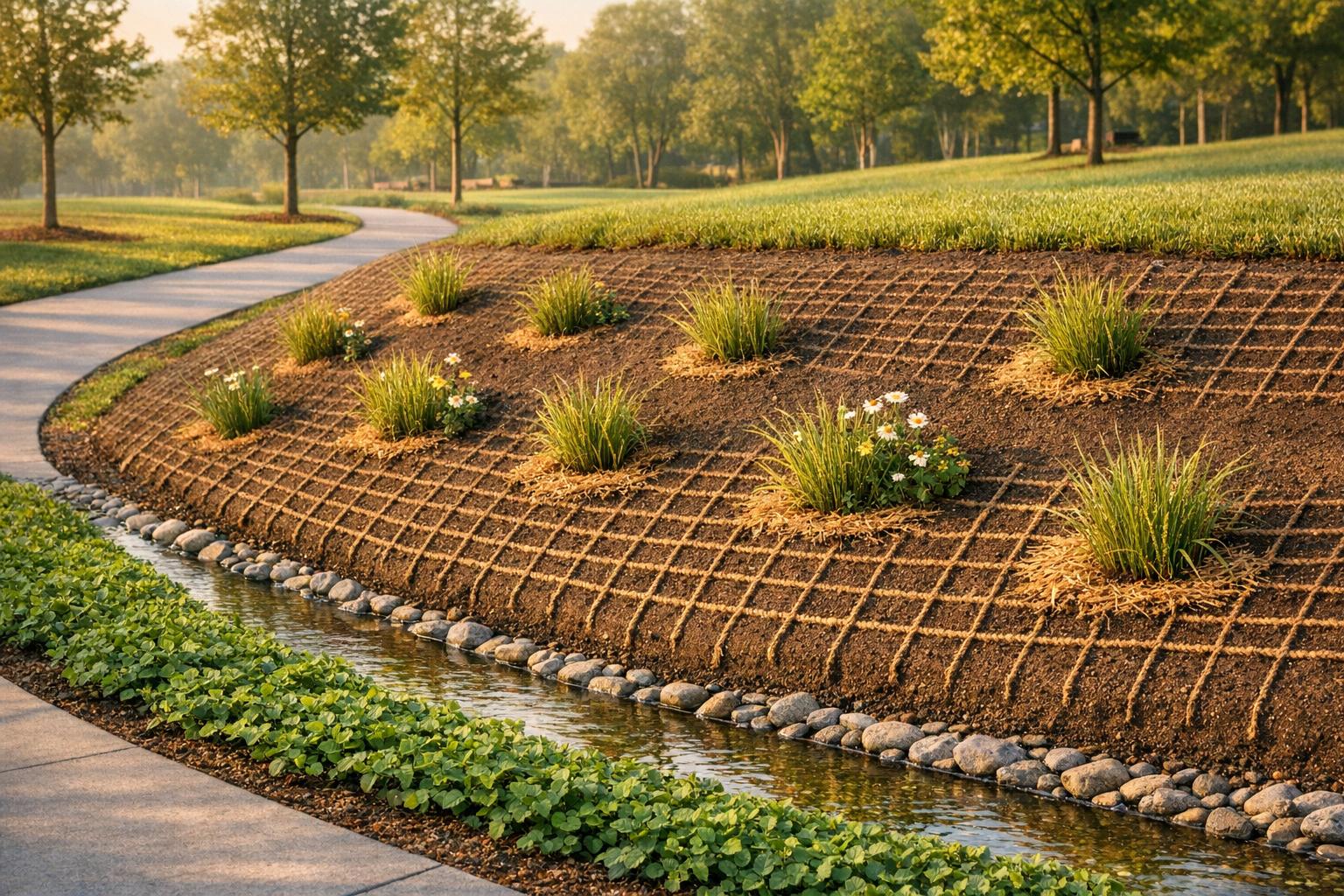
These stabilizers help the planet in a few key ways. For one, they avoid the energy-heavy production processes typical of chemical alternatives, reducing pollution and conserving resources. Additionally, as many bio-based stabilizers decompose, they enrich the soil with nutrients, promoting plant growth and improving the soil’s ability to retain water [7][4]. For example, materials like straw or coconut coir mats not only provide physical erosion protection but also encourage vegetation to take root, creating a long-term, natural stabilization system [7].
Eco-Friendly vs. Conventional Stabilizers
When comparing eco-friendly stabilizers to traditional ones, the differences in environmental impact and efficiency are striking. Conventional options like cement and lime require large amounts of material to achieve the desired results, while bio-based alternatives often accomplish the same goals with smaller quantities [3].
| Feature | Conventional Stabilizers (Cement/Lime) | Eco-Friendly Stabilizers (Bio-Based) |
|---|---|---|
| Environmental Impact | High carbon emissions; energy-intensive production | Renewable, biodegradable, and eco-conscious |
| Material Efficiency | Requires large quantities for effectiveness | Works with smaller amounts |
| Mechanism | Relies on chemical reactions like hydration | Uses mechanical and biochemical bonding |
| Long-term Effect | Alters soil chemistry permanently | Breaks down naturally, enriching the soil |
Eco-friendly stabilizers take advantage of natural processes, working with the soil’s existing properties rather than forcing chemical changes that could harm it over time. This approach not only stabilizes the soil but also supports its ecological health.
Types of Eco-Friendly Soil Stabilizers
Eco-friendly soil stabilizers come in various forms, each designed for specific needs like erosion control or construction. Here’s a closer look at the main types, their strengths, and where they work best.
Biopolymer-Based Stabilizers
Derived from plants, microbes, or animals, biopolymers like xanthan gum, guar gum, gellan gum, and chitosan act as natural binders. They form hydrogels that hold soil particles together, improving cohesion and shear strength across different soil types.
One of their standout features is efficiency: only 1-2% by weight is needed to achieve the same strength as traditional stabilizers [3]. However, they have a drawback – prolonged exposure to water can weaken their effectiveness. This makes them ideal for areas with good drainage but less suitable for constantly wet environments [3]. By using biopolymers, you can stabilize soil while reducing environmental harm.
Geopolymer Stabilizers
Geopolymers are made by combining industrial by-products like fly ash and ground granulated blast-furnace slag (GGBFS) with an alkaline activator. This combination triggers pozzolanic reactions, where silica and alumina interact with water and soil minerals to form strong, cement-like bonds.
Unlike traditional cement, which is responsible for about 8% of global CO2 emissions, geopolymers offer a greener alternative [6]. They perform exceptionally well in challenging conditions, such as organic soils and peat, where lime or cement often fail due to interference from humic acids. Their durability and strength make them a great choice for road bases and heavy-load embankments, even in tough environments like Maryland’s coastal wetlands [6].
Non-Toxic Chemical Stabilizers
This category includes bioenzymes like TerraZyme and recycled materials such as biochar, shredded rubber, and recycled concrete. Bioenzymes act as organic catalysts, improving soil density and reducing permeability. They are particularly effective for road subgrades and expansive clay soils [2].
Recycled materials, on the other hand, provide physical reinforcement. For example, shredded tire rubber enhances soil flexibility and prevents cracking under heavy loads or temperature changes. In the U.S., shredded tires have been successfully used in road base projects, boosting soil toughness while reducing waste [5]. These methods not only stabilize soil but also support recycling efforts, creating a win-win for infrastructure and the environment.
Using Eco-Friendly Stabilizers in Maryland Projects
Maryland’s diverse landscape calls for specialized soil stabilization techniques that align with the state’s unique environmental conditions. Whether you’re tackling a residential patio or managing a large-scale construction site, understanding local soil and climate factors is key to achieving long-lasting results. Below, we explore strategies for erosion control, hardscaping, and adapting to Maryland’s specific terrain and weather challenges.
Controlling Erosion in Construction Zones
Maryland’s rainy seasons can wreak havoc on construction sites, accelerating erosion. The Maryland Department of the Environment updated its stormwater Best Management Practices guidance in November 2023, focusing on protecting active construction zones [8]. For areas prone to gully erosion, especially in clay-heavy soils, start by filling depressions with high-clay soil. Cover this with topsoil and install temporary runoff diversions until vegetation can establish itself [10].
Biopolymers are a game-changer for local soil stabilization, increasing shear strength by up to 300% with minimal usage [2][3]. To further protect against erosion, use mats made from natural materials like coconut coir, jute, or straw. These mats should be placed immediately after seeding, ideally before the rainy season begins [9]. Even modest vegetation growth – around 30% cover – can reduce soil erosion by as much as 50% [9].
For steep slopes with grades steeper than 3:1, opt for low-maintenance native vegetation that doesn’t require mowing and provides better stability [10]. To manage surface runoff, install check dams using stone or coir fiber biologs in narrow flow paths [10]. Costs for these erosion control measures range from $55–$250 per acre for mats and $30–$200 per acre for vegetative cover [9].
Eco-friendly stabilizers aren’t just for construction zones – they also play a vital role in hardscaping projects.
Supporting Hardscaping and Landscape Features
Eco-friendly stabilizers offer a sustainable way to create sturdy bases for patios, retaining walls, and walkways. Biopolymers, for instance, strengthen the soil beneath these features, minimizing the risk of settling that can lead to cracks. For pathways like stepping stones or gravel trails, first loosen the compacted soil, then add a layer of sand or small gravel to prevent shifting [10]. To ensure long-term stability, place landscape fabric beneath gravel or mulch to stop stabilizers from sinking into the soil over time [10].
Maryland’s organic-rich and coastal soils can be challenging for traditional materials like lime and cement, as humic acids interfere with the chemical reactions needed for these stabilizers to work effectively [6]. This makes biopolymers and geopolymers particularly useful in areas like Annapolis, Severna Park, or Edgewater, where high organic matter content is common.
Given Maryland’s humid climate, proper drainage is essential. For example, French drains installed behind retaining walls or dry riverbeds can help manage water exposure and maintain structural integrity.
Maryland Soil and Climate Factors
Local soil and climate conditions play a crucial role in determining the performance of eco-friendly stabilizers. Maryland’s soil composition varies significantly across the state. Central areas like Howard County and Montgomery County often have clay-heavy soils with moderate acidity, while coastal regions near the Chesapeake Bay are rich in organic matter and peat. These variations directly influence the choice of stabilizers.
Factors like temperature, curing time, and soil pH also affect the bonding process of bio-stabilizers [2]. For Maryland’s acidic organic soils, adjusting the pH with sodium bicarbonate or calcium oxide may be necessary before applying microbial stabilizers to create optimal conditions for bacterial activity [6]. In wetland-adjacent areas, where peat and organic soils dominate, shear strength can be as low as 5 to 20 kPa, requiring specialized approaches [6].
Timing is another critical factor. For example, fall seeding of legumes should be completed by September 1, while spring planting must wrap up before May 1 to take advantage of Maryland’s growing season [11]. Regulations also require at least 90% vegetative ground cover for pasture or hay land during the final two years of the responsibility period [11]. To promote seed germination, control erosion, and retain moisture, apply hay or straw mulch at a rate of 2–3 tons per acre [11].
These tailored techniques ensure sustainable and effective solutions for Maryland’s unique landscaping challenges, paving the way for Pro Landscapes MD to deliver exceptional results.
Pro Landscapes MD‘s Eco-Friendly Approach

Pro Landscapes MD is redefining soil stabilization across central Maryland, serving areas like Annapolis and Germantown with a focus on sustainability. Whether it’s a residential patio in Ellicott City or a commercial project in Silver Spring, their dedication to eco-conscious practices is evident. They use plant-based bioengineering, recycled materials, and natural biopolymers to create outdoor spaces that are both durable and environmentally friendly. Their services cover landscaping, hardscaping, and drainage solutions, all designed with sustainability in mind.
Landscaping Services
Pro Landscapes MD takes a vegetation-focused approach to landscaping, using plants to naturally reinforce soil. Their horticulturists prioritize native species with deep root systems, which improve soil cohesion and reduce runoff – an important consideration in Maryland’s wet climate [1]. On erosion-prone slopes in areas like Columbia or Clarksville, they combine strategic planting with materials like coconut coir. This method not only stabilizes the soil but also retains moisture, offering a balance between ecological restoration and practical infrastructure needs. By avoiding high-carbon cement treatments, they create landscapes that are both functional and environmentally responsible.
Eco-Conscious Hardscaping
Hardscaping projects like patios, walkways, and retaining walls are designed with sustainability at the forefront. Pro Landscapes MD uses eco-friendly pavers and recycled materials, such as crushed concrete and bricks, to minimize the depletion of natural resources [5]. In coastal areas like Severna Park and Edgewater, where soil conditions can be challenging, they use biopolymers like xanthan gum and guar gum to increase soil strength by up to 300%, all while using minimal materials [2]. Additionally, reclaimed rubber particles from old tires are incorporated to improve elasticity beneath hardscaping, ensuring these features withstand temperature changes and heavy loads [5].
Drainage and Erosion Control Expertise
Addressing Maryland’s water management challenges, Pro Landscapes MD offers innovative drainage solutions. Their grading and leveling services include the use of industrial by-products like fly ash, which provide a low-carbon alternative to traditional cement [5]. In areas like Bethesda and Potomac, they install systems such as French drains and dry riverbeds, combining physical stabilizers with chemical bio-additives. This approach ensures both strength and flexibility, delivering long-lasting solutions for stormwater management [1][5]. Their erosion control techniques consistently prove that environmental responsibility and structural durability can coexist seamlessly.
Conclusion
Eco-friendly soil stabilizers present a non-toxic, sustainable alternative to traditional options like cement and lime, which are responsible for about 8% of global CO2 emissions. These stabilizers not only improve soil health but can also boost shear strength by as much as 300% [2][6]. Their combination of environmental and engineering benefits makes them an excellent choice for Maryland’s diverse soils and climates.
Beyond their structural advantages, these stabilizers offer ecological benefits. They improve water retention, minimize erosion, and promote long-term soil cohesion – all without causing the chemical degradation linked to conventional methods. For property owners facing challenges like sloped terrain, construction zones, or drainage issues, bio-based stabilizers can transform unstable soil into a strong, reliable foundation while preserving the surrounding ecosystem. In fact, some bio-based additives achieve impressive strength gains with only minimal application [2].
However, proper application is key to success. Factors such as soil pH, temperature, curing time, and geotechnical properties all play a role in determining the best product and method for a specific site [2]. Using the wrong approach can undermine both the structural and environmental benefits these products offer.
Pro Landscapes MD specializes in applying bio-based solutions tailored to central Maryland’s unique conditions, serving areas from Annapolis to Germantown and beyond. Their expertise ensures the right additives are matched to the soil type, curing conditions are optimized, and plant-based reinforcements are seamlessly integrated with modern hardscaping and drainage systems. Whether you’re planning a patio in Ellicott City, addressing stormwater issues in Bethesda, or stabilizing slopes in Columbia, their eco-conscious methods deliver projects that balance durability with environmental care.
Ready to build sustainably? Visit Pro Landscapes MD at https://prolandscapesmd.com to explore how eco-friendly soil stabilizers can enhance your next project.
FAQs
Which eco-friendly stabilizer is best for my soil type?
The most suitable eco-friendly stabilizer for your project depends on your soil’s characteristics and specific requirements. Some effective options include:
- Bio-based stabilizers: These include bio-cementing agents that enhance soil strength naturally.
- Plant-based methods: Using plant roots to reinforce soil and prevent erosion.
- Biopolymers: Materials like xanthan gum or guar gum that improve soil cohesion sustainably.
Each method offers environmentally friendly solutions for improving soil stability and controlling erosion. To ensure the best results, consult a geotechnical specialist who can recommend the right choice based on your soil type and project conditions.
How long do biopolymer soil stabilizers last in wet conditions?
Biopolymer soil stabilizers generally remain effective for several months to a few years in wet conditions. The specific lifespan depends on the type of biopolymer used and environmental factors. Research indicates that under the right conditions, they can last for 12 months or longer.
Do I need a soil test before using a bio-based stabilizer?
Conducting a soil test is an important step when working with bio-based stabilizers. These stabilizers perform best when they are adjusted to match the specific properties of the soil. By evaluating factors like soil composition, texture, and moisture levels, a soil test ensures compatibility and maximizes the stabilizer’s effectiveness. Skipping this step could lead to subpar results, as the stabilizer might not interact optimally with the soil’s unique characteristics.
Chat with Us