









- bhavya gada
- No Comments
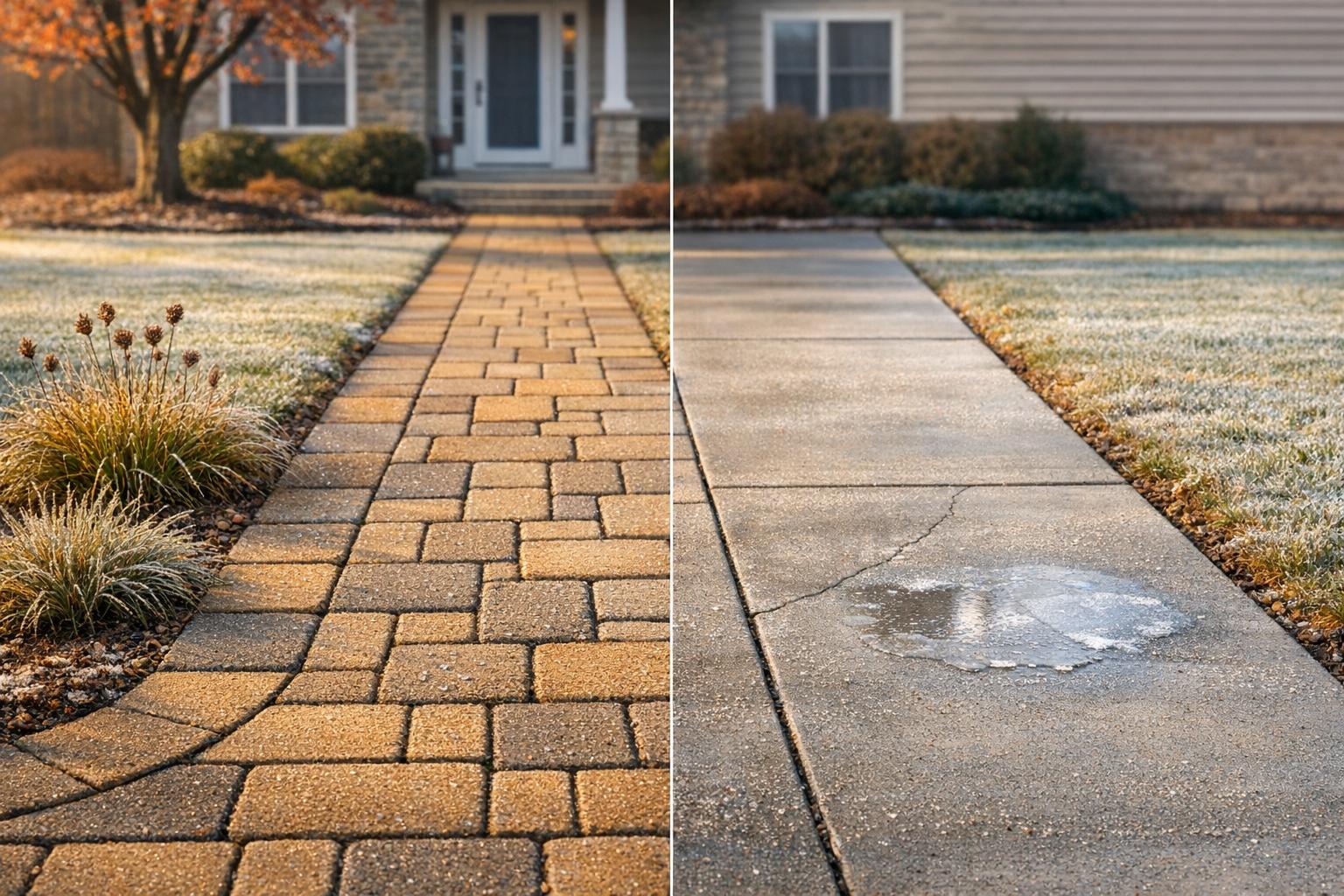
Eco-friendly walkways, such as permeable pavers and natural stone, often outlast concrete in Maryland’s challenging climate. While concrete can last 20–30 years, eco-friendly options can exceed 30–50 years with proper care. Here’s why:
- Durability: Concrete cracks and spalls under freeze-thaw cycles and heavy rainfall, while eco-friendly systems handle these stresses better due to their flexibility and drainage capabilities.
- Maintenance: Concrete repairs are costly and often visible. Eco-friendly walkways allow easy, localized fixes, saving time and money.
- Weather Performance: Eco-friendly systems manage water effectively, reducing runoff and ice formation, unlike impervious concrete slabs.
Quick Comparison:
| Feature | Concrete Walkways | Eco-Friendly Walkways |
|---|---|---|
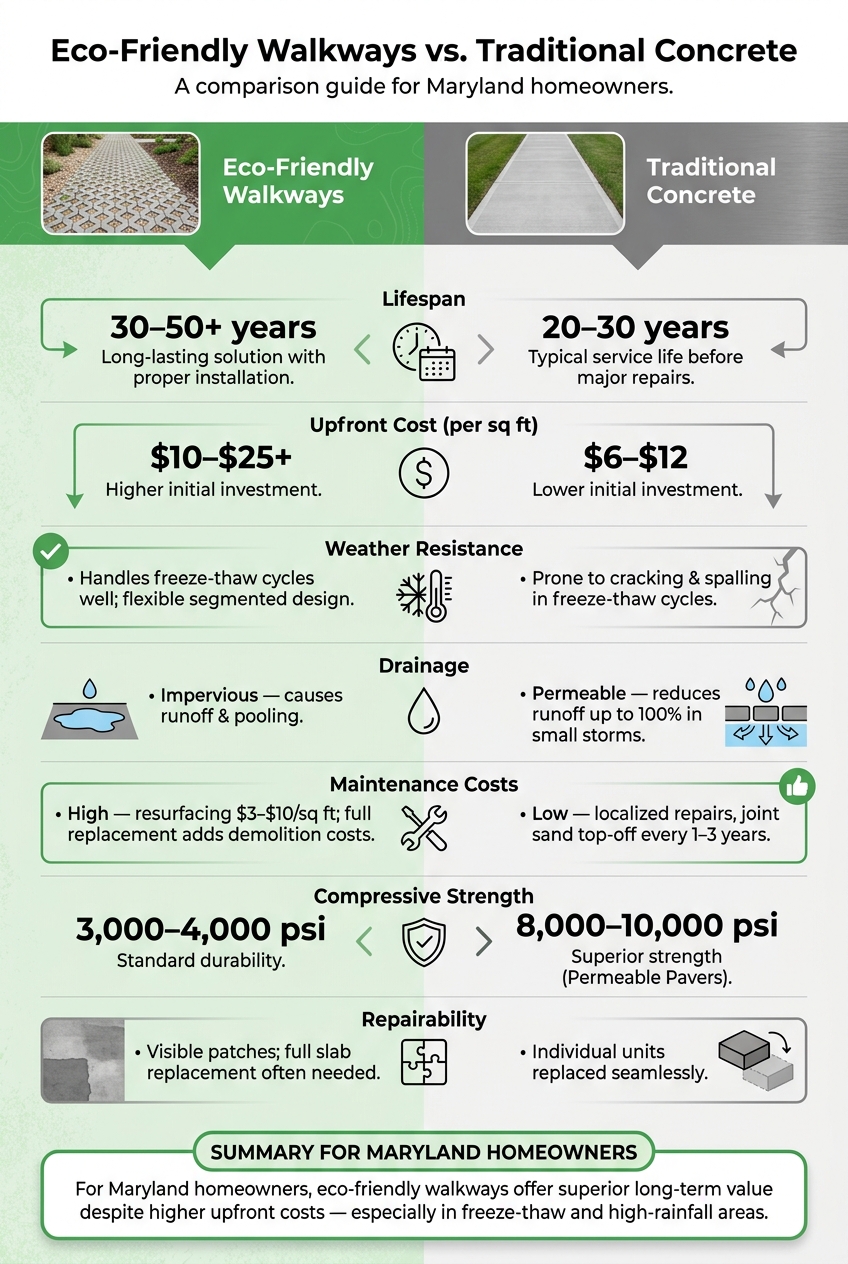
| Lifespan | 20–30 years | 30–50+ years |
| Weather Resistance | Prone to cracks/spalling | Handles freeze-thaw cycles well |
| Maintenance Costs | High (repairs/replacement) | Low (localized repairs) |
| Drainage | Impervious (runoff) | Permeable (better drainage) |
| Upfront Cost (per sq ft) | $6–$12 | $10–$25+ |
For Maryland homeowners, eco-friendly walkways are a smart long-term investment, especially in areas prone to heavy rain, freeze-thaw cycles, and clay-heavy soils. Proper installation and regular maintenance are key to maximizing lifespan.
Eco-Friendly Walkways vs. Concrete: Lifespan, Cost & Performance Compared
Key Factors That Affect Walkway Durability
How Walkways Fail Over Time
Over time, all walkways experience wear and tear, influenced by their material and construction. In Maryland, the shifting seasons and fluctuating climate make these aging processes even more noticeable. Concrete slabs, for instance, are prone to developing shrinkage cracks early in their lifespan. These cracks widen with repeated stress, and the use of de-icing salts hastens surface deterioration, leading to spalling – where the top layer flakes off. This is particularly common in Maryland due to the frequent use of de-icing products during winter, often resulting in the need for significant hardscaping repairs.
On the other hand, paver and natural stone walkways tend to fail in more localized ways. Instead of widespread cracking, you might notice a sunken section, a loose or rocking stone, or joint sand washing away after a heavy rainstorm. These issues, while frustrating, are typically easier to address since they affect only specific areas rather than the entire walkway. The U.S. Federal Highway Administration highlights freeze–thaw cycles combined with de-icing chemicals as a leading cause of scaling and spalling in cold climates – a pattern Maryland homeowners are all too familiar with during winter months.
Aside from structural concerns, the appearance of a walkway also plays a big role in how long it’s perceived to last.
Structural Lifespan vs. Appearance Over Time
The functional safety and the visual appeal of a walkway often age at different rates, particularly with concrete. According to the Portland Cement Association, well-designed, air-entrained concrete pavements can remain structurally sound for 30–40 years or more. However, their aesthetic lifespan is often much shorter. Staining, surface cracking, and spalling can make a concrete walkway look worn out after just 10–15 years, even if it’s still safe to use.
Paver systems offer a distinct advantage here. Thanks to their modular design, damaged or discolored units can be replaced individually without disturbing the rest of the surface. With proper care, a paver or flagstone path can maintain its fresh appearance long after a comparable concrete slab would require a full replacement.
Still, no material is immune to the effects of time and weather. Regular maintenance is key to preserving both the structure and appearance of any walkway.
How Maintenance Affects Longevity
Regular upkeep can significantly extend the life of a walkway. For concrete, applying a high-quality penetrating sealer every few years helps prevent water and salt from seeping in – two major culprits behind surface damage in Maryland’s climate. Switching from traditional rock salt to a concrete-friendly deicer, such as calcium magnesium acetate, can also reduce scaling and other types of surface breakdown.
For paver and eco-friendly systems, joint maintenance is crucial. When joint sand erodes, pavers can shift and become unstable, which speeds up wear on the base. To prevent this, re-sand joints with polymeric sand and use pressure washing to keep the surface clean and free of weeds. Proper joint maintenance also helps permeable systems retain their drainage capacity. Research on Mid-Atlantic permeable pavements shows that well-maintained systems can maintain full drainage efficiency for 5–10 years, while neglected ones lose much of their effectiveness due to clogging.
"With proper care and maintenance, hardscaping materials such as stone and concrete can last decades." – Pro Landscapes MD [1]
Annual inspections, particularly after winter, are a smart investment for both concrete and paver walkways. Check for signs of heaving, settling, or standing water – early indicators of base issues that are far easier (and cheaper) to fix now than after a full failure occurs.
sbb-itb-843f8be
Eco-Friendly Walkways: Lifespan and Advantages
Types of Eco-Friendly Walkway Materials
When it comes to eco-friendly walkways, materials like permeable pavers, natural stone (flagstone, bluestone, granite), and gravel paths on open-graded bases stand out. Unlike traditional concrete, these materials allow water to flow through or around them, preventing water from becoming trapped underneath. This design not only benefits the environment but also contributes significantly to the durability of these systems.
Permeable pavers are particularly impressive, with a compressive strength of 8,000–10,000 psi, far surpassing the 3,000–4,000 psi typical of residential concrete. When installed following Interlocking Concrete Pavement Institute (ICPI) standards, these pavers can last 20–40+ years. Natural stone, such as flagstone or bluestone, offers even greater longevity, often lasting several decades or 50+ years. The durability of natural stone depends more on the base and joints beneath it rather than the stone itself, as the material rarely fails.
What Makes Eco-Friendly Walkways Last
The durability of eco-friendly walkways lies in their open-graded base and modular assembly. The open-graded base consists of a layer of uniformly sized, clean angular stone (typically 3/4-inch gravel) that allows water to drain efficiently. This feature is particularly useful in areas like Maryland, where winters bring frequent freeze–thaw cycles. Proper drainage reduces the amount of water trapped under the surface, minimizing expansion pressure during freezing and preventing cracking or heaving.
Additionally, modular systems offer a key advantage over poured concrete slabs. Individual pavers or stones in a jointed system can move slightly without concentrating stress in one area. ICPI testing has shown that pavers endure over 300 freeze–thaw cycles with de-icing salts while showing minimal scaling. In contrast, older concrete often spalls and cracks under similar conditions. Combined with their high compressive strength and proper edge restraints, these features give eco-friendly walkways exceptional durability.
Repairs and Upkeep for Eco-Friendly Walkways
One of the standout benefits of eco-friendly walkways is how easy they are to repair. If a section shifts due to tree roots or utility work, the affected area can be lifted, the base corrected, and the paver or stone replaced. The result is a seamless repair with minimal disruption, leaving the rest of the walkway untouched. Professionals like Pro Landscapes MD design these walkways with modular repairability in mind, making long-term maintenance far less stressful and more cost-effective.
Routine upkeep is straightforward and manageable. In most residential settings, joint sand or aggregate may need a light top-off every 1–3 years, especially after heavy rains. Regular sweeping or light power washing can remove organic buildup. Research from the University of New Hampshire Stormwater Center has shown that well-maintained permeable pavements can retain high infiltration capacity for over 10 years, even in cold climates where de-icing salts are used. This demonstrates that a little routine care can go a long way in preserving the functionality and appearance of these walkways.
Concrete Walkways: Lifespan and Drawbacks
How Long Concrete Walkways Last
Concrete walkways, while durable, face specific challenges, especially in areas like Maryland where weather conditions can be tough. A properly installed concrete walkway can last around 20–30 years before major repairs or replacement become necessary. To achieve this lifespan, several factors come into play: the slab should be at least 4 inches thick, rest on a compacted gravel base, and include control joints every 4–6 feet. Additionally, the concrete mix should have a strength of 3,500–4,000 psi.
For regions prone to freeze–thaw cycles, like Maryland, the American Concrete Institute (ACI) suggests using air-entrained concrete, which contains 4–7% entrained air. This feature helps the concrete handle the pressure caused by freezing water. A continuous poured slab is particularly effective at evenly distributing weight, handling foot traffic, and resisting movement over time. On the cost side, broom-finished concrete runs about $6–$12 per square foot, making it a relatively affordable choice upfront. However, Maryland’s weather and soil conditions can still take a toll, as we’ll explore next.
Common Ways Concrete Walkways Deteriorate
Water is the biggest enemy of concrete walkways in Maryland. When moisture seeps in and freezes, it creates internal pressure that leads to cracking, spalling, and surface scaling. According to the Portland Cement Association (PCA), the use of de-icing salts like calcium chloride or rock salt during winter worsens this problem, speeding up surface scaling.
Another frequent issue is tree roots, which can grow beneath slabs and lift sections of the walkway, creating uneven surfaces and potential trip hazards. Maryland’s clay-heavy soils add another layer of complexity. These soils expand and contract with seasonal moisture changes, putting extra stress on the concrete from below. These combined factors often lead to damage that can be difficult – and sometimes costly – to repair.
Repairing and Replacing Concrete Walkways
Repairing concrete walkways comes with its own set of challenges. Unlike modular pavers, repairs on poured concrete are often visible. For example, using repair mortar or epoxy to fill a crack can improve safety and slow further deterioration, but the patched area will usually stand out, especially on older concrete where the color and texture have changed over time.
For surface scaling, a resurfacing overlay can restore the walkway’s appearance and usability. This option typically costs $3–$10 per square foot, depending on the materials and finish. However, overlays may not last as long if the concrete continues to face freeze–thaw cycles. When damage becomes extensive – such as alligator cracking, heaved sections, or deep spalling – completely removing and replacing the slab is often the best long-term solution. While this approach is effective, the added costs of demolition and disposal make it more expensive than the original installation.
| Damage Type | Typical Cause in Maryland | Repair Option | Realistic Outcome |
|---|---|---|---|
| Hairline surface cracks | Shrinkage, minor settling | Crack filler or sealant | Functional but visibly patched |
| Wide or deep cracks | Poor base, freeze–thaw stress | Epoxy mortar repair | Extends life; color match unlikely |
| Surface spalling/scaling | De-icing salts + freeze–thaw | Resurfacing overlay | Improves appearance; limited lifespan |
| Heaved or uneven slabs | Tree roots, clay soil movement | Slabjacking or replacement | Slabjacking works if slab is otherwise sound |
| Widespread structural damage | Multiple compounding issues | Full slab removal and replacement | Most reliable long-term solution |
Eco-Friendly Walkways vs. Concrete: A Side-by-Side Look
Lifespan: Which Lasts Longer?
Concrete walkways typically last between 20 and 30 years before significant damage calls for replacement. On the other hand, well-designed paver systems – according to the Interlocking Concrete Pavement Institute (ICPI) – can last 30 to 50 years or more with proper installation. Natural stone, when set on a carefully engineered base, can outlast both, as the stone itself rarely fails. Instead, issues usually arise in the base or jointing material over time.
The way these materials age is also quite different. Concrete tends to hold up well for many years but then deteriorates rapidly once damage sets in. Paver systems, however, age more gradually. Small sections may settle or shift, but their modular design allows for quick, localized repairs. This difference in how they wear over time becomes especially relevant when dealing with Maryland’s challenging weather.
How Each Material Handles Maryland Weather
Maryland’s climate throws a lot at walkways – freeze-thaw cycles in winter, humid summers, and frequent heavy rain. While properly installed, air-entrained concrete can handle these conditions, its rigid structure makes it vulnerable to moisture freezing in microcracks, which can lead to scaling and cracking.
Eco-friendly paver systems, thanks to their segmented design, adapt better to freeze-thaw stresses. Individual units can shift slightly without transmitting stress across the entire surface. Many permeable paver systems also allow water to drain through the joints into a stone base, preventing water from pooling on the surface. ICPI research shows that permeable interlocking concrete pavements (PICP) can reduce runoff volume by up to 100% during small to moderate storms. This drainage feature minimizes standing water, which in turn reduces ice formation and surface damage – a big plus for areas like Columbia, Ellicott City, and Gaithersburg, where heavy rain and winter ice are common.
| Weather Challenge | Traditional Concrete | Eco-Friendly Paver System |
|---|---|---|
| Freeze–thaw cycles | Rigid slab prone to cracking and scaling | Segmented units flex with movement; lower crack risk |
| Heavy rain/runoff | Impervious; water pools or runs off edges | Permeable joints allow infiltration; reduces ponding |
| Snow and ice removal | Works with de-icers, but salts can speed up spalling | Paver-safe de-icers recommended; drains meltwater, reducing black ice |
| Summer heat and humidity | Stable but surface can get hot | Some permeable surfaces may stay cooler |
Upkeep and Long-Term Costs
Beyond lifespan and weather performance, long-term maintenance and costs are essential considerations. Concrete walkways often have a lower upfront cost, typically about $6–$12 per square foot for broom-finished residential work. In contrast, quality paver systems range from $10–$25+ per square foot. However, this initial savings with concrete may be offset by higher maintenance and repair expenses down the line.
For the first 10 years, concrete maintenance usually involves cleaning, monitoring, and occasional sealing. But once major damage like deep cracks, heaving, or spalling occurs, repairs are both costly and difficult to blend seamlessly. Resurfacing can cost $3–$10 per square foot, while full slab replacement adds demolition and disposal costs.
Paver systems, on the other hand, require routine upkeep like topping up joint sand and occasional cleaning. Their big advantage lies in repairs: damaged sections can be replaced individually, making fixes almost invisible. Over a 20–30 year period, many homeowners find that the higher upfront cost of pavers is balanced out by avoiding the need for one or two major concrete repair or replacement cycles.
Conclusion: Picking the Right Walkway for Your Property
Key Takeaways
Choosing the best walkway material depends heavily on the specific conditions of your property. Eco-friendly options, like permeable and modular paver systems, often provide excellent long-term value when factors such as drainage, freeze-thaw durability, and ease of repair are taken into account. On the other hand, concrete offers a sleek, durable surface that can last for decades – provided it’s installed on a solid, compacted base with proper control joints and regular maintenance.
A well-prepared base is crucial for any walkway material. Without it, even the highest-quality materials, like premium flagstone, will fail prematurely. However, eco-friendly paver systems have an advantage: they allow for easy replacement of individual sections, which can significantly extend the walkway’s lifespan when paired with good drainage and a stable sub-base.
In Maryland, the combination of clay-heavy soils, frequent freeze-thaw cycles, and heavy rainfall makes it essential to choose materials that can flex and drain effectively. While concrete may seem like the more affordable option initially, the cost of resurfacing or replacing it down the line can make premium paver systems more cost-effective in the long run.
"Permeable pavers… are perfect for areas like Columbia, MD." – Pro Landscapes MD [2]
These considerations highlight the value of professional installation and routine upkeep to ensure your walkway stands the test of time.
Pro Landscapes MD: Walkway Design and Installation

For homeowners in Maryland, Pro Landscapes MD offers custom walkway solutions, including paver, flagstone, and eco-friendly designs tailored to the region’s unique weather and drainage challenges. Serving communities across Howard County, Montgomery County, Baltimore County, and beyond – including Columbia, Ellicott City, Gaithersburg, and Bethesda – they also specialize in drainage planning, grading, and stormwater management to ensure your walkway remains functional and durable for years to come.
Pavers vs Concrete: Which One Should YOU Choose? | Pros & Cons
FAQs
Is my yard a good fit for permeable pavers?
Permeable pavers are a great choice if your yard deals with issues like water pooling, erosion, or runoff. These pavers let rainwater seep into the ground, which works especially well with Maryland’s clay-heavy soils. While smaller installations can be tackled as DIY projects, Pro Landscapes MD advises hiring professionals for more complicated setups – like steep slopes or areas with heavy foot or vehicle traffic – to ensure they last and perform effectively.
How do I prevent pavers from sinking or shifting?
To keep pavers from sinking or shifting, start with a solid, well-compacted foundation. Place a layer of geotextile fabric between the soil and the gravel base to prevent the materials from mixing over time. Opt for angular stone for the base since its sharp edges lock together, providing better stability. Use a plate compactor or a hand tamper to compact the base thoroughly. Once the pavers are laid, fill the joints with angular stone to ensure they stay interlocked and supported.
Which de-icers are safest for concrete and pavers?
Pro Landscapes MD focuses on installing long-lasting hardscaping materials, including Techo-Bloc pavers, natural stone, and environmentally conscious permeable paving options. While the safest de-icers for concrete and pavers aren’t specified here, maintaining these surfaces during winter is essential to protect your investment. Seeking advice from a professional can help keep your walkways, patios, and driveways in great shape, ensuring they stay both practical and attractive through the colder months.
Chat with Us