









- bhavya gada
- No Comments
Erosion control blankets protect soil after grading, construction, or heavy rainfall. But to get the most out of them, you need the right material, proper installation, and regular maintenance. Here’s what you need to know:
- Material Matters: Lifespan varies by material – straw lasts 3–12 months, while coconut coir can last up to 5 years. Choose based on slope steepness, climate, and project duration.
- Maryland Challenges: Frequent rain, clay-heavy soils, and freeze-thaw cycles can degrade blankets faster. Opt for durable materials like coir for longer-term projects.
- Installation Tips: Grade the slope, anchor the blanket in trenches, and secure it with staples. Overlap edges and seams to prevent water from lifting the blanket.
- Maintenance: Inspect after storms, fix lifted edges, and reseed bare patches. Protect blankets from foot traffic, pets, and concentrated water flow.
- Long-Term Solutions: Once vegetation establishes (70–90% coverage), consider adding drainage systems or retaining walls for lasting stability.
For Maryland homeowners, durable materials and proper drainage are key to avoiding costly repairs. If persistent erosion issues arise, consult professionals for tailored solutions.
Stormwater Quick Dip 5: Installing Erosion Control Blankets
sbb-itb-843f8be
Factors That Affect Erosion Blanket Lifespan
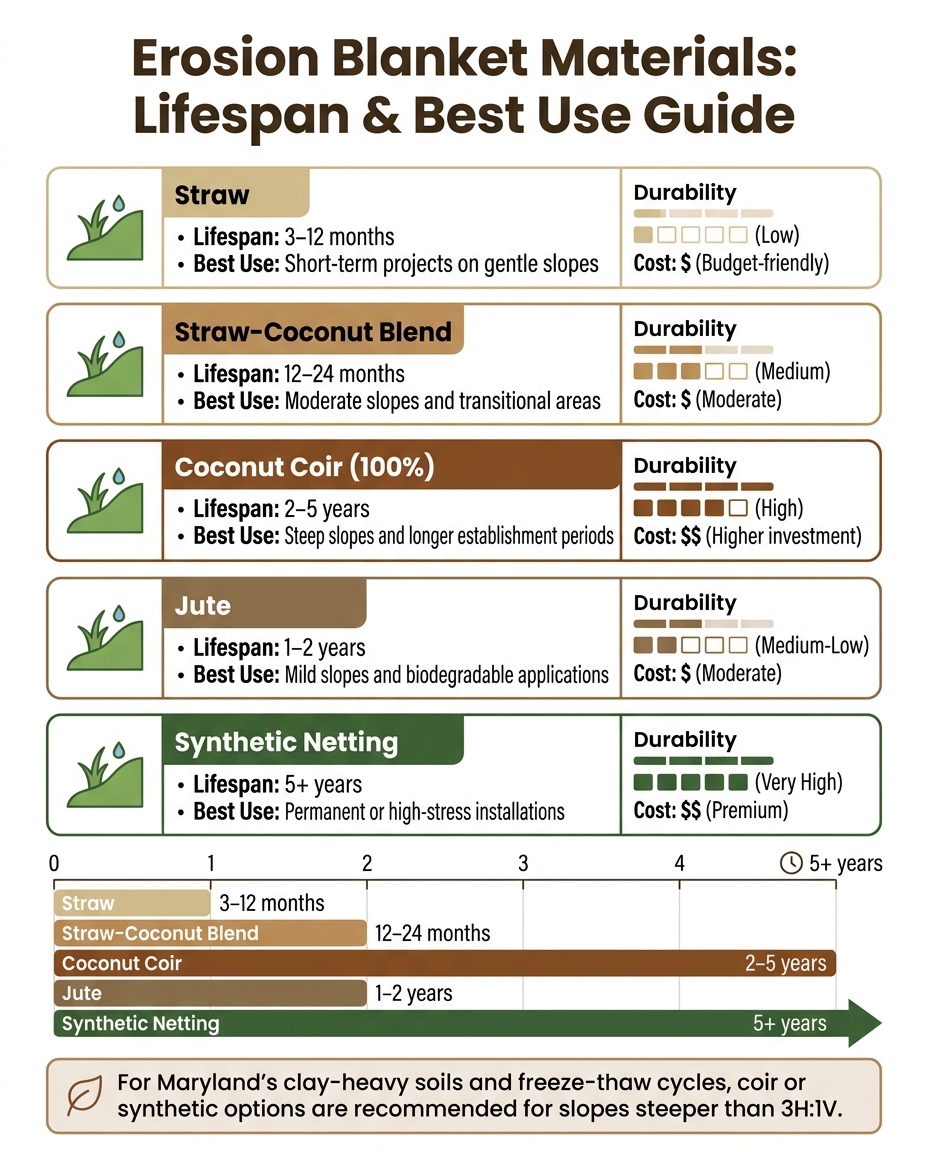
Erosion Blanket Materials: Lifespan & Best Use Guide
Material Types and Durability
The type of material used in an erosion blanket plays a major role in its lifespan. Each material decomposes at a different rate, which directly impacts how long it can effectively perform until vegetation takes hold.
| Material | Effective Lifespan | Best Use Case |
|---|---|---|
| Straw | 3–12 months | Short-term projects on gentle slopes |
| Straw-coconut blend | 12–24 months | Moderate slopes and transitional areas |
| Coconut coir (100%) | 2–5 years | Steep slopes and longer establishment periods |
| Jute | 1–2 years | Mild slopes and biodegradable applications |
| Synthetic netting | 5+ years | Permanent or high-stress installations |
Straw blankets tend to be the most budget-friendly option, but they degrade quickly, especially when exposed to continuous moisture. On the other hand, coconut coir lasts much longer, as its fibers naturally resist rot. If your project site needs more than a single growing season for vegetation to fully establish, investing in coir or a straw-coconut blend is usually the better choice. For Maryland’s challenging weather, selecting a material built to endure these conditions can save time and money in the long run.
Beyond material choice, local climate and soil conditions also play a role in how long erosion blankets remain effective.
How Maryland’s Climate and Soil Affect Performance
Maryland’s weather presents unique challenges for erosion control. The combination of high temperatures, humidity, and frequent heavy rainfall speeds up the decomposition of organic materials. For example, areas like Gaithersburg often experience intense downpours, increasing runoff and testing the durability of erosion blankets.
Winter brings its own issues, as freeze-thaw cycles shift the soil, loosening blanket edges and creating gaps that allow erosion to occur. Central Maryland’s clay-heavy soils add to the difficulty – they drain poorly, leading to water pooling that accelerates material breakdown. Compacted soils further complicate matters by making it harder for seeds to germinate, extending the time the blanket needs to stay intact.
In these conditions, opting for a material that can withstand Maryland’s unpredictable weather – rather than just going for the cheapest option – can make all the difference in achieving long-term erosion control success.
Choosing the Right Erosion Blanket
Selecting the right erosion blanket means aligning the material’s durability with the specific conditions of your site and the timeline of your project. Let’s break it down.
Matching Blanket Type to Project Duration
The key is to match the blanket’s lifespan to how long it takes vegetation to establish. For cool-season grasses in Maryland, such as tall fescue or Kentucky bluegrass, seeds typically germinate in 7–21 days, and full coverage develops within 6–12 weeks with proper watering. In these cases, a short-term erosion blanket is usually enough, especially for gentle slopes.
However, if your project involves slower-growing vegetation – like native meadow mixes, shaded areas, or late-season seeding – an extended-term option is a better fit. Materials like straw–coconut blends (lasting 24–36 months) or coir blankets (lasting 36+ months) are more durable and can handle these longer timelines.
A good rule of thumb: for late-season seeding, choose a blanket that can last through at least one winter. If it degrades too quickly, you might have to start over.
Site-Specific Factors to Consider
After determining the blanket’s required duration, consider the specific conditions of your site, as these can significantly impact the blanket’s performance.
- Slope Steepness: For slopes no steeper than 3H:1V (around 18–20 degrees), straw blankets work well. On steeper slopes – closer to 2H:1V or beyond – water moves faster and can wash out lighter materials. In these cases, heavier options like coir blankets or turf reinforcement mats are better suited for high-shear conditions. Even moderate slopes that are long can build runoff momentum, requiring sturdier materials.
- Runoff Intensity: Areas with concentrated water flow, such as beneath downspouts or along driveway edges, need blankets rated for channel applications. Basic straw blankets can’t handle shear stresses above 2 lb/ft² and may fail in these situations.
- Sun Exposure: Maryland’s hot, humid summers can cause straw blankets to degrade faster in full-sun areas. On the other hand, shaded or north-facing slopes slow vegetation growth, meaning the blanket needs to last longer. In both cases, it’s wise to invest in an extended-term material rather than opting for the cheapest solution.
When to Get Professional Advice
Sometimes, even the right erosion blanket won’t solve persistent issues. If you’re dealing with repeated washouts, visible gully formation, standing water after rain, or slopes steeper than 3H:1V, it might be time to call in a professional. The wrong blanket choice could even make the problem worse.
A professional evaluation can uncover underlying issues like poor drainage, improper grading, or problematic soil conditions that an erosion blanket alone can’t fix. For Maryland homeowners, especially those with clay-heavy soils or runoff near patios and walkways, Pro Landscapes MD offers site assessments and customized solutions. They can help integrate the right erosion blanket with drainage improvements, grading adjustments, or hardscaping features like retaining walls or French drains. Plus, they provide free estimates, making it easier to plan your project with confidence.
Installation and Maintenance Best Practices
How to Install Erosion Blankets Correctly
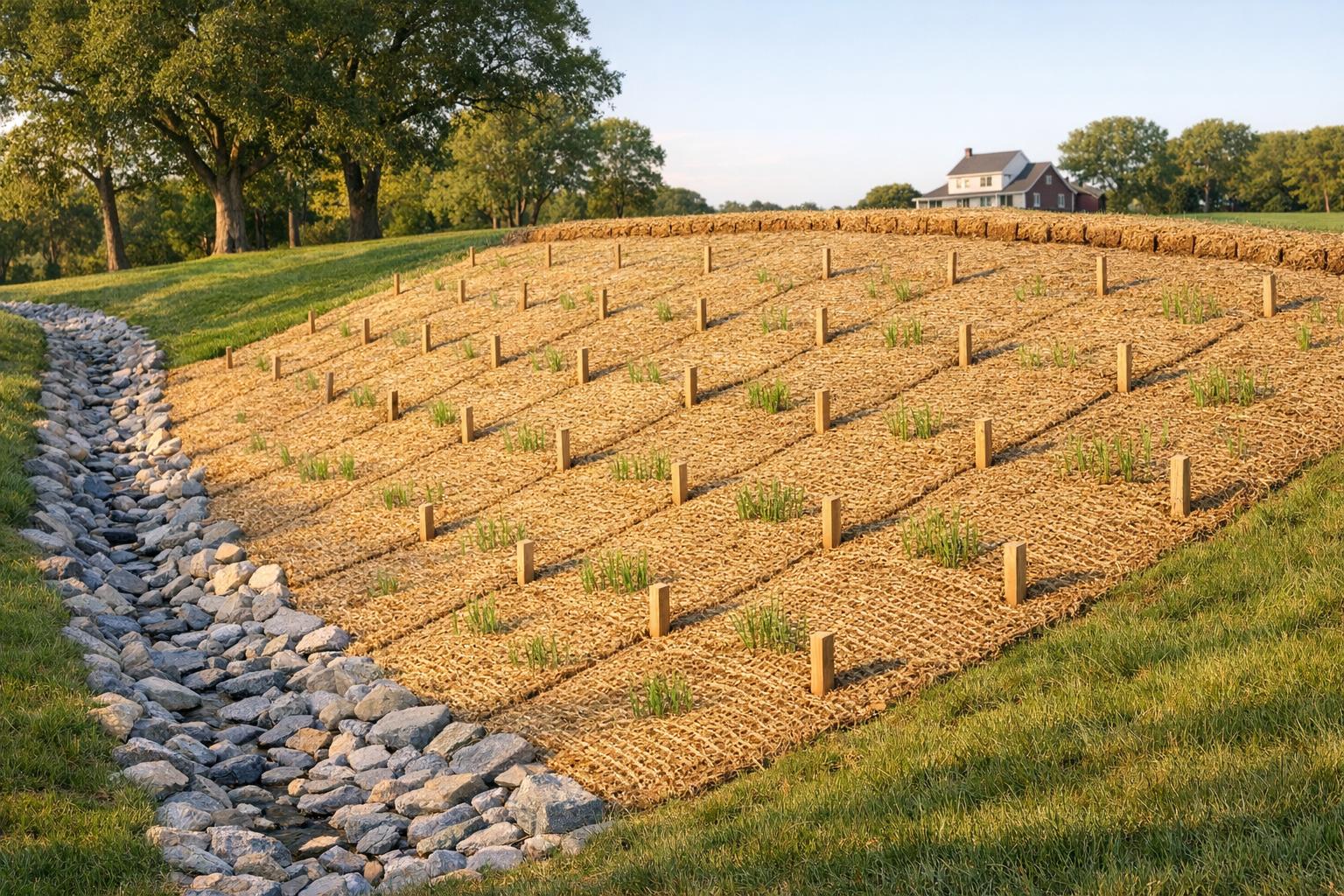
Proper installation begins before you even unroll the blanket. Start by grading the slope to create a smooth, firm surface. Fill in any low spots or rills, and clear away rocks, roots, or debris that could prevent the blanket from sitting flush against the soil. Once the surface is prepped, apply topsoil amendments, seed, and fertilizer. Lightly rake the area so the seed settles into the top ¼ inch of soil before laying the blanket. To avoid seed loss from unexpected storms, aim to seed and install the blanket on the same day.
At the top of the slope, dig an anchor trench about 6 inches deep and 6 inches wide. Tuck the leading edge of the blanket into this trench, stapling it across the bottom every 6–12 inches. Then, backfill and compact the trench firmly. This "check trench" is critical for preventing water from sneaking underneath and lifting the blanket – a common failure point when water undermines the mat rather than flowing over it.
Next, unroll the blanket downslope in the direction of water flow, ensuring it stays flat against the soil with no air gaps or bridging. Overlap the side edges by 2–4 inches and the end-to-end seams by at least 6 inches, positioning the upslope piece on top, similar to roof shingles. Use U-shaped metal staples (typically 8–12 inches long) to secure the blanket. Place staples every 12 inches along edges and seams and every 24–36 inches across the interior on gentle slopes. For steeper slopes or high-flow areas, increase the staple density – sometimes up to 2–3 times more staples – to prevent the blanket from lifting or "ballooning" during heavy rain.
Routine Maintenance Steps
Begin inspections immediately after installation, followed by a check after the first rainfall of 0.5 inches or more. In fact, many state stormwater permits require this post-storm inspection within 24 hours because it’s the best time to spot damage. Continue inspecting the blanket at least once a month during the first growing season.
During inspections, watch for lifted edges, missing staples, bubbles where water has seeped underneath, open seams, and bare soil patches where seed failed to germinate. For lifted edges, re-stretch the blanket flat and add staples every 4–6 inches along the affected area. Re-overlap and re-staple open seams with a denser pattern. For bare patches, loosen the soil through the blanket openings, reseed with the original grass mix, and secure the area with additional staples. Addressing these issues early – especially after Maryland’s intense summer storms – can prevent small problems from escalating into larger washouts.
Once grass begins to grow through the blanket, adjust your mower blade to a higher setting to avoid catching the material. Also, avoid sharp turns or sudden movements on slopes covered by the blanket.
Protecting Blankets from Common Damage
Foot traffic and pets are often overlooked but can seriously damage a newly installed blanket. Walking on a wet slope can tear the material, dislodge staples, and create ruts that channel water incorrectly. If you need access to the area, use flat boards or stepping stones to distribute weight evenly. To keep pets off the slope, install temporary fencing until the vegetation is well established – digging or repeated running can shred even the most securely anchored blanket.
Another major threat is concentrated water flow. Downspouts, driveways, and uphill runoff can overwhelm a standard erosion blanket. Before installation, redirect downspouts away from the slope and consider adding a diversion berm or swale uphill to spread out water flow. If your property struggles with persistent runoff – common in Maryland’s clay-heavy soils and areas with nearby impervious surfaces – combining the blanket with drainage solutions like French drains or regrading may be necessary. For a more comprehensive approach, Pro Landscapes MD can evaluate drainage conditions and design solutions that reduce water pressure on the blanket entirely.
Moving to a Stable, Long-Term Landscape
Erosion blankets are an effective first step in stabilizing soil, but they’re not the endgame. The ultimate goal is a landscape that can withstand rain, freeze-thaw cycles, and seasonal storms without relying on temporary measures. A well-engineered, self-sustaining landscape ensures long-term stability.
Signs the Blanket Has Achieved Its Purpose
The best indicator of success is the presence of dense, even vegetation. According to field standards, 70% ground cover significantly reduces erosion, while 90% coverage signals it’s time to retire temporary erosion control measures. After a heavy rain, inspect the slope for clear runoff and check for the absence of new rills, gullies, or sediment buildup at the base. If the surface holds steady through repeated storms, the roots are now doing what the blanket initially handled.
For biodegradable blankets like straw, coir, or straw-coir blends, you may notice the material breaking down into loose fibers. That’s normal and expected. Removing a biodegradable blanket after vegetation has taken hold can disturb the root system and re-expose the soil, so it’s usually best to let it decompose naturally. However, plastic netting should always be removed to prevent harm to wildlife.
Once vegetation demonstrates its stability, it’s time to consider hardscaping and drainage solutions to ensure the site’s long-term durability.
Adding Hardscaping or Drainage Features for Long-Term Stability
Even when vegetation is established, underlying slope and drainage issues may still need to be addressed. Persistent low spots that stay saturated or areas where water consistently collects (like near driveways or rooflines) indicate that plants alone won’t solve the problem.
In these cases, reshaping steep slopes to create a gentler pitch or adding retaining walls can provide a more permanent solution. Retaining walls physically secure the soil, reduce runoff velocity, and offer decades of stability – far more reliable than repeatedly repairing erosion and reinstalling blankets.
Drainage systems are equally critical. A French drain can intercept subsurface water before it saturates the slope, while a dry riverbed channels surface runoff along a defined, erosion-resistant path. Both options tackle the root cause of erosion – water movement – rather than merely protecting the soil from its effects. Plus, a dry riverbed can double as a visually appealing feature in the yard.
How Professional Services Can Support the Transition
After monitoring and maintaining erosion control blankets, the next step is planning for the slope’s long-term stability. Adding hardscaping without addressing drainage can often shift erosion problems to another area, so careful planning is essential. A professional contractor can evaluate your property’s grade, soil type, and water flow patterns to identify any hidden drainage issues that might not be obvious in dry weather.
For example, Pro Landscapes MD offers integrated services across central Maryland, including grading, French drain and dry riverbed installation, retaining walls, and landscape restoration. These comprehensive solutions ensure that new hardscaping doesn’t inadvertently create fresh erosion challenges. In areas like Howard, Montgomery, Frederick, Baltimore, and Prince George’s counties – where clay-heavy soils and intense summer storms are common – this level of coordination can mean the difference between a slope that stays stable and one that continues to fail.
Conclusion
Maximizing the lifespan of an erosion control blanket comes down to three key factors: choosing the right material, installing it correctly, and maintaining it after storms. Skipping any of these steps can lead to problems like lifted edges, exposed soil, or full-blown washouts, undoing all your hard work. Getting it right from the start ensures better long-term results for your landscape.
In Maryland, where heavy rains are common, proper anchoring and drainage are non-negotiable. Without these, even the best blankets won’t hold up. Pairing the right blanket with smart grading practices is what keeps slopes stable, rather than facing repeated failures.
But here’s the ultimate goal: a landscape that no longer needs a blanket at all. Once dense vegetation takes hold, you can transition to permanent solutions like improved grading, French drains, or retaining walls to maintain stability over the long haul.
For situations where erosion persists – like steep slopes, wet areas, or trouble spots near foundations or driveways – getting professional advice is a smart move. Pro Landscapes MD helps homeowners across central Maryland, from Ellicott City and Columbia to Silver Spring and Towson, by creating customized plans that integrate erosion control, drainage, grading, and hardscaping. Their team evaluates your site’s unique conditions – soil type, slope, and water flow – to recommend solutions designed to withstand Maryland’s challenging weather.
Stay proactive by inspecting your slope after heavy rains. Address small issues before they grow, keep vegetation healthy, and clear debris from drainage areas. Tackling problems early is always more affordable than fixing major erosion down the line.
FAQs
Do I need a permit for an erosion blanket in Maryland?
In Maryland, the need for permits for erosion control blankets varies based on the project’s size and local regulations, which often focus on managing runoff effectively. These projects can involve intricate drainage and grading work, so consulting with a professional is highly recommended to ensure everything meets the requirements. Pro Landscapes MD has expertise in navigating these complexities and can assist you through the regulatory process for your property.
How can I tell if my slope is too steep for a straw blanket?
If you’re wondering whether your slope is too steep for a straw blanket, take a closer look at your property’s terrain. Uneven ground or areas with severe erosion may indicate that the slope requires additional attention. In many cases, steep slopes benefit from a professional evaluation to ensure they are stabilized correctly. If you’re uncertain or dealing with more complex erosion issues, reaching out to experts like Pro Landscapes MD can provide tailored solutions to meet your needs and ensure long-term stability for your property.
What drainage solution works best with an erosion blanket?
The best drainage methods to complement erosion control blankets are berms and swales. Berms work by redirecting water flow with raised soil mounds, while swales are shallow, plant-lined channels designed to slow down and guide runoff. Both approaches help reduce water speed, minimize erosion, and encourage water to soak into the ground naturally. For more severe runoff challenges, Pro Landscapes MD provides tailored drainage assessments and professional installations, including options like French drains or pipe systems, to safeguard your landscape.
Chat with Us