









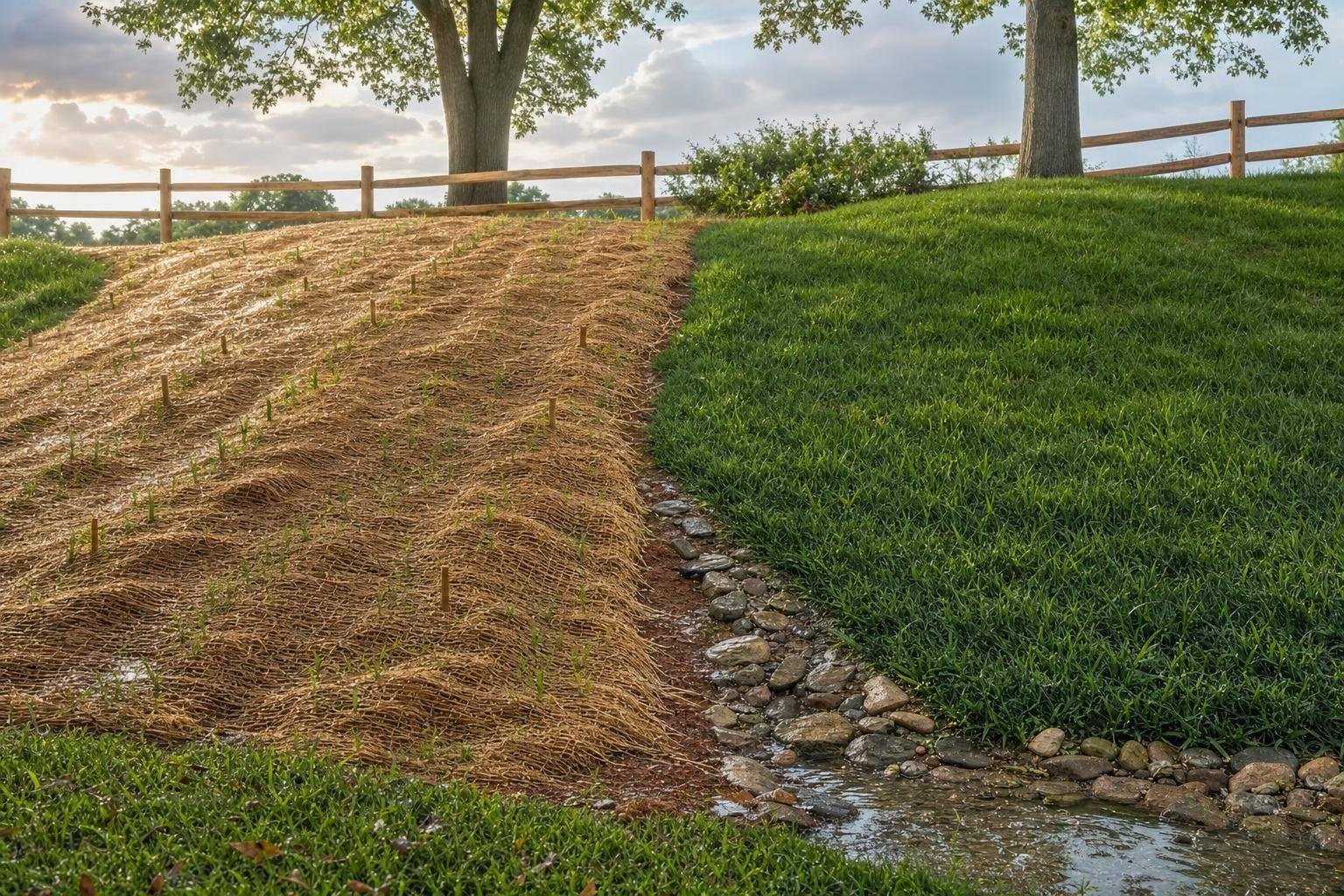
- bhavya gada
- No Comments
If water stays spread out, I’d use an erosion blanket. If water forms a path, I’d move to matting. That’s the short answer for most Maryland home sites.
For a new lawn, open slope, or graded yard, blankets help hold seed, soil, and moisture in place for months to a few years. For a steep side yard, swale, or downspout outlet, matting is built for harder flow, steeper grades, and long service life. In Maryland, that choice matters because clay-heavy soils, strong summer storms, and freeze-thaw cycles can wear out the wrong product fast.
Here’s the article in plain terms:
- Erosion control blankets are for temporary cover
- Soil stabilization matting (TRMs) is for long-term turf support
- Blankets fit sheet flow
- Matting fits concentrated runoff
- Blankets often suit slopes around 3:1 to 2:1
- Matting is more suited to slopes near 2:1 to 1:1
- Blankets may handle about 2.0–2.5 lb/ft² shear
- TRMs may handle about 13–14 lb/ft² vegetated shear
- Maryland disturbed slopes often must be stabilized within 7 to 14 days
Erosion Control Blankets and Turf Reinforcement Mats
sbb-itb-843f8be
Quick Comparison
| Factor | Erosion Blanket | Matting / TRM |
|---|---|---|
| Main job | Hold seed and soil until grass grows | Reinforce turf where runoff is harder |
| Best use | Open slopes, new lawns, sheet flow | Swales, steep slopes, outfalls, repeat flow paths |
| Material | Biodegradable fibers like straw, coir, excelsior | Permanent synthetic fiber matrix |
| Lifespan | About 6 months to 3 years | Long-term |
| Water handling | Lower flow force | Higher flow force |
| Slope fit | Moderate slopes | Steeper slopes |
| Upkeep | More storm checks early | Fewer repairs after grass fills in, but still inspect |
My takeaway: use a blanket when you need short-term seed protection. Use matting when you need long-term support where water keeps hitting the same area. And if drainage is bad, fix that first – because neither product solves runoff by itself.
Erosion Control Blankets: Temporary Slope Protection and Seed Establishment
Erosion control blankets make sense when the main goal is simple: keep topsoil and seed from washing away long enough for grass or groundcovers to get started. They cover seeded soil until plant growth fills in.
Blanket Materials and Common Residential Uses
The fiber type affects how long a blanket lasts and where it works best. Straw blankets fit gentle slopes around 3:1 or flatter, with a lifespan of about 3–12 months.[10] Excelsior blankets, made from curled wood fibers, sit tightly against uneven soil and stay put during rain, which makes them a good pick for moderate slopes.[7] Straw/coconut blends stretch protection to about 18–24 months and work well on slopes in the 2:1–3:1 range.[10] 100% coir blankets can last up to 24–48 months and handle steeper grades around 1:1 or sites that need longer cover while vegetation gets established.[10]
In most yards, these lighter blankets do best where runoff stays spread out and the goal is fast turf establishment.
How Blankets Handle Runoff, Seed, and Early Growth
Blankets add a fiber layer between bare soil and falling rain. That layer softens raindrop impact and slows sheet flow, so water spreads across the slope instead of carving small rills into exposed soil. At the same time, it helps hold moisture at a steadier level for germination and early plant growth.[4]
Seed should go down first, then the blanket should be placed within about 24 hours so seed stays in even contact with the soil.[6][4] Anchor the blanket at the top of the slope, unroll it downslope in the same direction water moves, and overlap the seams.[6][11] There’s one big limit here: blankets are built for diffuse sheet flow, not concentrated runoff.[4]
That’s why they work on open slope areas, but not in narrow channels or below a downspout where water piles up and runs hard.
Blanket Lifespan and Repair Work
Blankets are temporary by design. In Maryland, humid summers, frequent thunderstorms, and winter freeze-thaw cycles can cut down their working life, especially for straw products. So the blanket type needs to match how long the site will need cover.
After heavy rain, the best maintenance step is a short site walk. Check for lifted edges, torn sections, or small washed-out spots under the blanket. Re-staple loose edges, patch torn areas with new blanket material overlapped by several inches, and fill washed-out spots with tamped soil before reseeding.[4][6][11] If germination was weak after a major storm, reseed bare spots to replace seed loss or seedling mortality.[8]
When water starts moving faster or gathers into a single path, soil stabilization matting is the better tool.
Soil Stabilization Matting: Steeper Slopes and Concentrated Water Flow
When runoff starts funneling into one path, or a slope gets too steep for a blanket to stay put, matting is usually the better fit. Soil stabilization matting – most often a turf reinforcement mat, or TRM – works well on slopes and flow paths where a temporary blanket just won’t hold.
Mat Strength and Long-Term Function
TRMs are permanent synthetic mats made from polypropylene or similar fibers.[12][16][17] As grass roots grow through the openings and weave into the fibers and the soil below, they build a reinforced root zone. That root-and-mat system stands up to much more runoff force than grass by itself.
Compared with blankets, TRMs can handle stronger flow and more erosion pressure. Some products are rated for shear stress up to 4, 8, or 12 lb/ft² and flow velocities up to about 15 ft/s.[17][23] After vegetation fills in, the mat remains in place and keeps reinforcing the soil-plant system for the life of the slope or channel.
Where Matting Fits Around Maryland Homes
Around Maryland homes, matting makes sense in spots that take repeat runoff and need lasting support. Common examples include long driveways, steep side yards, swales, downspout outfalls, and slopes near retaining walls.[15][17][18]
On many lots, water from roofs, driveways, and repeated summer storms keeps hitting the same track. That repeated flow can wear out weaker cover in a hurry. Matting helps protect those high-use runoff paths before they turn into rills or washed-out channels.
Matting Installation, Lifespan, and Maintenance
Installation begins with anchor trenches at the top of the slope or the upstream end of a channel. These trenches are usually 4–6 inches deep and 6–8 inches wide. The mat edge is buried and backfilled to lock it in place.[13][14][19][20]
From there, the mat is unrolled in the direction of water flow. Adjacent panels should overlap so the upper piece covers the lower one, which helps keep water from getting under the seam. The mat is then secured with staples or pins at about 1.3–1.7 fasteners per square yard, with closer spacing in channels.[24]
Seeding can happen before installation or over the top of the mat. On some jobs, crews also place about 1/2 inch of topsoil over the mat and seed to help grass get started.[20]
Once the mat is down, routine upkeep is usually lighter than with a blanket, but storm checks still matter. After major storms, inspect for:
If edges come loose, they can be re-anchored. Washed areas can be backfilled, and thin spots can be reseeded. During the grass-establishment period, guidance often calls for checking the installation within 24 hours of each rain event and at least once every seven days.[22][26] After that, care shifts more toward inspections, mowing, debris removal, and spot repairs.
Erosion Control Blankets vs. Soil Stabilization Matting: Side-by-Side Comparison
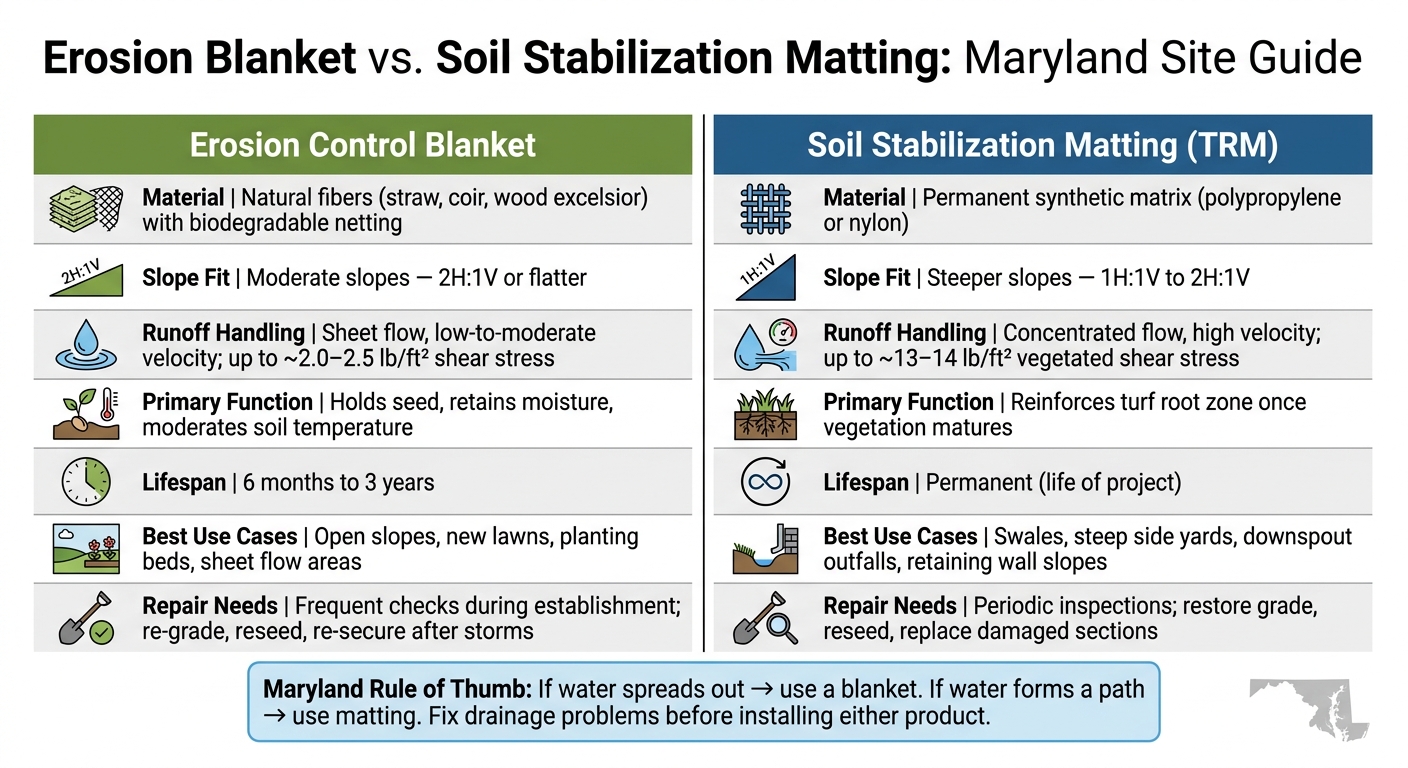
Erosion Blanket vs. Soil Stabilization Matting: Maryland Site Guide
Here’s how the two products compare on the factors that matter most for Maryland residential sites. The biggest difference isn’t only lifespan. It’s how much water movement the surface can take before the cover gives out.
Use the table below to match the product to the slope, runoff, and upkeep needs on a Maryland property.
| Factor | Erosion Control Blankets | Soil Stabilization Matting (TRMs) |
|---|---|---|
| Material | Natural fibers (straw, coir, wood excelsior) with biodegradable or photodegradable netting | Permanent synthetic matrix (polypropylene or nylon) |
| Slope fit | Moderate slopes, generally 2H:1V or flatter[32][9] | Steeper slopes, typically 1H:1V to 2H:1V depending on TRM type[32][9] |
| Runoff handling | Sheet flow, low-to-moderate velocities; generally up to about 2.0–2.5 lb/ft² of shear stress[32][33] | Concentrated flow and high velocities; up to about 13–14 lb/ft² vegetated shear stress[32][33] |
| Seed support | Primary function – holds seed, retains moisture, and moderates soil temperature | Secondary – seeded into or over the mat surface; reinforces roots once vegetation matures |
| Lifespan | 6 months to 3 years depending on fiber type[31][5] | Permanent; intended to last for the life of the project[27][28][30][25] |
| Repair needs | Frequent checks during establishment and after storms; re-grade, reseed, and re-secure as needed[4][3][6][29][1][2] | Frequent inspections on high-stress sites; restore grade, reseed, and replace damaged sections as needed[22][28][30][25] |
Material, Slope Fit, and Water Flow Capacity
Blankets are temporary. They break down as grass or other plant cover fills in. TRMs stay in place and strengthen the root zone for long-term protection. That’s the core split between the two.
The other big divider is slope and water force. Blankets work best on lower-shear areas with sheet flow. TRMs make more sense on steeper ground or where runoff hits harder and more often. On a Maryland residential lot, that usually means a gently sloped front yard falls into blanket territory, while a steep side yard or a backyard swale carrying roof and driveway runoff is a better match for matting.
Seed Support, Lifespan, and Repair Needs
Blankets are built to help seed get started. They hold moisture, protect the soil surface, and soften temperature swings while the stand gets established. After that, they decompose. TRMs play a different role. Seed can be placed into or over the mat, but the mat’s main job is to keep reinforcing the turf once vegetation is in place.
That changes the upkeep picture too. Blankets usually need closer attention early on, especially after storms, because washed-out spots may need to be re-graded, reseeded, and pinned back down. TRMs also need inspections, but the focus is more on higher-stress locations where flow can damage sections over time. In plain terms: pick the product based on how the site drains and how steep it is.
Applying the Comparison to Real Residential Projects
A newly seeded front lawn on a moderate slope is a straightforward blanket case. The blanket protects the seed through the first growing season, then breaks down on its own.
A backyard swale, downspout outfall, or steep embankment near a retaining wall is different. Those spots deal with concentrated, repeated runoff. That’s exactly where blankets can get overwhelmed. Matting, anchored into the slope and seeded, forms a reinforced vegetated channel that can stand up to Maryland’s hard summer thunderstorms and localized flash runoff. Those are the decision points most homeowners run into around a typical Maryland home.
Where Each Option Works Best and Final Decision Points
Use the comparison above to match the product to the slope, the runoff pattern, and the amount of upkeep the site can handle.
Best Uses for Blankets Around Maryland Homes
Erosion control blankets make the most sense when you need short-term cover on a freshly graded, seeded slope with sheet flow and a brief window for grass or other plants to take hold. They help protect the seedbed, then break down as the turf fills in.
They’re also a good match for planting beds and terraced garden areas where runoff is light to moderate and you don’t want fabric left exposed for the long haul.
Once water starts to gather and move in a defined path, or the slope gets steeper, it’s time to switch to matting.
Best Uses for Matting Around Maryland Homes
Use matting on steep slopes, swales, downspout outlets, and other spots that deal with repeated concentrated flow. If a slope has failed before, matting is the safer pick.
That leaves one final question: how much support does the site need, and for how long?
Key Takeaways for Homeowners and Property Managers
Choose based on slope, flow, and how long the area needs protection. Blankets are a short-term option that pass the job to vegetation. Matting is a long-term structural layer that keeps reinforcing the root zone long after plants are established.
Neither product fixes drainage on its own. For Maryland properties with runoff trouble, fix drainage first and choose surface protection second. Blankets protect new turf. Matting protects areas with problem runoff.
FAQs
How do I tell if my yard has sheet flow or concentrated runoff?
Watch your yard during or right after a moderate rainfall. Sheet flow moves in a thin, even layer across the ground. Concentrated runoff collects into visible paths, channels, or gullies, and it moves faster.
Signs of erosion can point to spots where water is moving or starting to cut a path. Look for mud on paved surfaces, exposed tree roots, or grass that seems to struggle.
When should I fix drainage before installing a blanket or matting?
Fix drainage issues before installing erosion blankets or matting. If you skip that step, the soil can get saturated, slopes can fail, and the ground cover can wash out from underneath.
Start with grading and drainage plans so water flows away from foundations and disturbed areas. Once those drainage paths are in place, you can move on to soil stabilization.
Can I use erosion blankets or matting around a downspout outlet?
Yes, but they need to fit into a broader drainage plan.
Erosion blankets and matting can help hold soil in place during rain and surface runoff. But a strong, concentrated flow from a downspout can hit too hard and wash right past them.
For better protection, pair them with structural drainage options such as French drains, dry riverbeds, or stone-lined channels. These help redirect the water and slow it down before it cuts into the soil.
Chat with Us