









- bhavya gada
- No Comments
Erosion control blankets (ECBs) are an effective way to combat soil erosion, especially in Maryland’s challenging climate and clay-heavy soils. These blankets, made from natural or synthetic fibers, protect bare soil, reduce runoff, and help vegetation establish strong roots. Here’s a quick look at five real-life examples where ECBs solved erosion issues:
- Ellicott City: Stabilized a steep backyard slope with straw-coconut ECBs, reducing runoff and erosion channels.
- Germantown: Managed a drainage swale with straw ECBs, improving water flow and preventing sediment buildup.
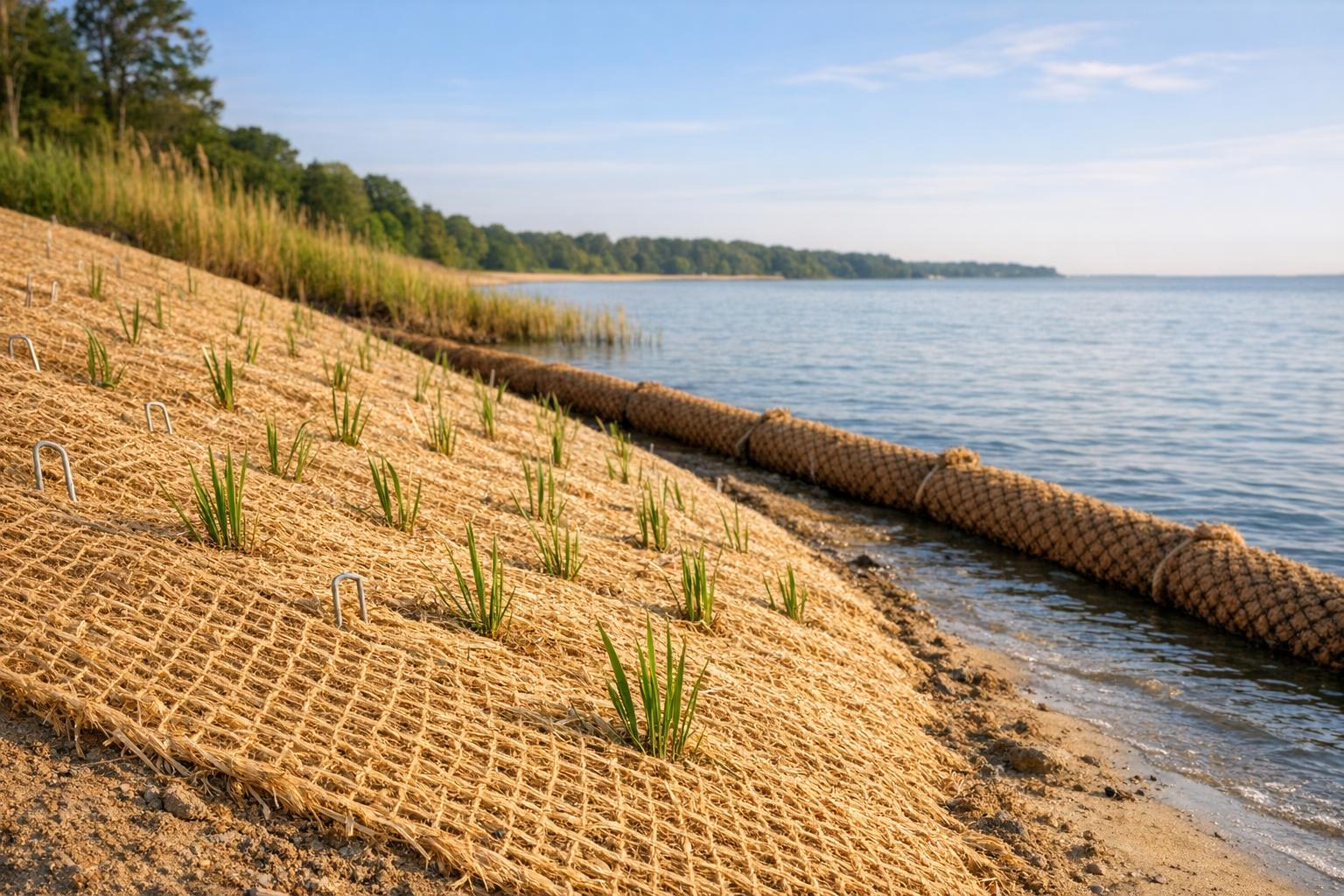
- Howard County: Preserved a pond shoreline using coir ECBs and native plants to prevent undercutting and sediment loss.
- Mount Airy: Temporarily protected a bare slope during construction with straw ECBs and seeded grass.
- Bethesda: Secured terraced slopes with jute ECBs and groundcovers to stop soil sliding and rilling.
Each case highlights how ECBs, combined with proper grading, seeding, and planting, can protect landscapes, reduce maintenance, and enhance soil stability. ECBs are not just a quick fix – they’re a practical tool for long-term erosion control.
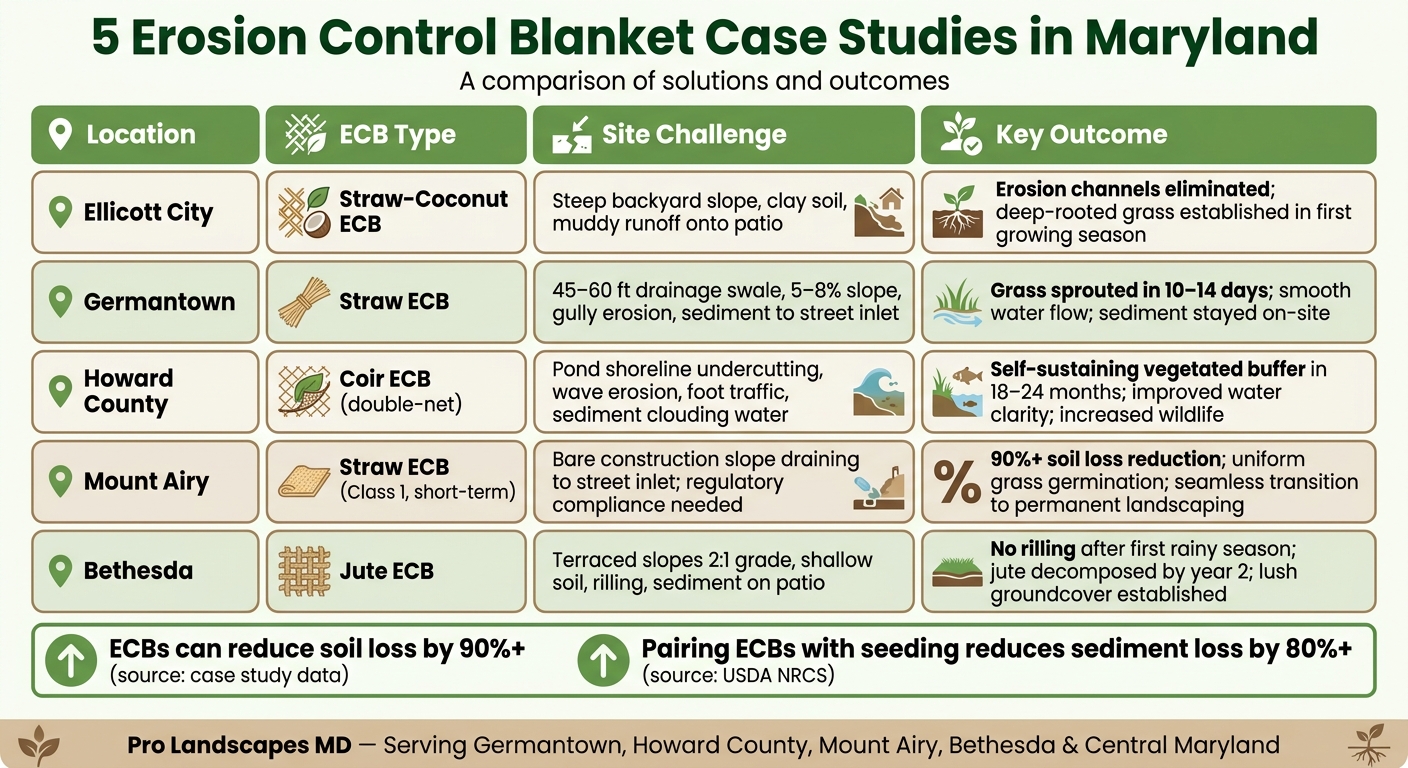
5 ECB Case Studies: Maryland Erosion Control Solutions at a Glance
Case Study 1: Stabilizing a Steep Backyard Slope in Ellicott City
Site Challenges
In Ellicott City, Maryland, a homeowner faced a tough problem: a steep backyard slope directly behind their paver patio. A recent landscaping project had disturbed the area’s heavy clay soil, leaving the slope bare and vulnerable. Heavy rains turned this into a real headache, with muddy runoff streaming toward the patio and fence. This isn’t unusual for Howard County, where clay-heavy soils are common. These soils tend to repel water instead of absorbing it, leading to issues like erosion. Small channels had already started forming on the slope, and sediment was piling up at the patio’s edge, threatening both the patio’s foundation and the appearance of its pavers.
Erosion Control Solution
To tackle the problem, the plan focused on managing runoff and stabilizing the soil. First, the slope was regraded to smooth out areas where water flow was concentrated, creating a more even angle that slowed down water movement. The soil surface was then loosened and enriched to ensure better seed-to-soil contact before applying any protective covering.
A composite straw-coconut erosion control blanket (ECB) was chosen for this project. The coconut fibers provided added strength and decomposed more slowly than straw-only blankets, offering protection for up to 2–3 years. This gave the grass enough time to establish strong roots in the dense clay soil. The blanket was installed perpendicular to the slope’s flow direction, with seams overlapped and the edges carefully trenched and stapled at the top to keep it secure during storms. Before the blanket was fully installed, a deep-rooted grass mix – well-suited to Maryland’s humid climate – was seeded underneath.
Outcomes and Benefits
By the end of the first growing season, the results were clear. The deep-rooted grass had successfully taken hold across the slope, runoff was significantly reduced, and erosion channels were no longer forming. This project not only solved the homeowner’s immediate issue but also demonstrated how effective ECBs can be in managing similar challenges across Maryland’s varied landscapes.
sbb-itb-843f8be
Case Study 2: Managing a Drainage Swale in Germantown
Site Challenges
In Germantown, Maryland, a homeowner faced persistent issues with a backyard drainage swale that was supposed to channel stormwater effortlessly off the property. Instead, the swale, stretching about 45–60 feet along the side property line, became a source of frustration. It collected runoff from two roof downspouts, the rear lawn, and part of the patio, directing it toward a street inlet. With a 5–8% slope, the water rushed through during heavy summer storms, eroding the bare soil along its path.
The soil, a Piedmont clay loam typical of Montgomery County, was particularly troublesome. When wet, it compacted easily, and once grass cover was lost, it eroded quickly. Maryland’s clay soils, known for poor water absorption, made matters worse. Repeated storms carved gullies into the swale, exposing roots and creating uneven terrain that was unsafe and difficult to mow. Sediment washed into adjacent turf, creating muddy patches prone to lawn disease and weeds. The homeowner constantly battled these issues, raking displaced soil, adding topsoil after storms, and dealing with sediment-laden water flowing toward the street inlet – raising concerns about clogged drains and potential code violations. Clearly, stabilizing the swale and managing sediment on-site required a precise plan.
Erosion Control Solution
The contractor began by assessing the swale during dry conditions and after a moderate storm to map water flow and measure the slope. A simple infiltration test confirmed the slow absorption rate of the clay soil, which influenced the entire strategy.
The first step was clearing vegetation and sediment before reshaping the swale into a smooth, parabolic cross-section. The swale bottom was widened to 18–24 inches, with gently sloping sides to control water flow. A laser level ensured a consistent grade, avoiding flat spots that could lead to water pooling. After grading, the soil was lightly scarified and amended with a thin layer of compost to create a better seedbed. A mix of tall fescue, Kentucky bluegrass, and perennial ryegrass was sown – grasses chosen for their ability to handle occasional flooding, recover from storm flows, and tolerate mowing.
Instead of using rock lining, which would have been harder to maintain and visually unappealing, the team opted for straw erosion control blankets (ECBs). These were installed parallel to the water flow, overlapping by 3–4 inches, with staples placed every 12–18 inches along the center. The edges were trenched 2–3 inches deep and backfilled at key points, such as where downspouts entered, to prevent the blankets from lifting. This method followed established best practices for managing runoff effectively.
Outcomes and Benefits
The customized solution worked wonders in addressing the erosion problems. During the first heavy rains after installation, water flowed smoothly through the swale without creating new rills, and the runoff leaving the property was noticeably clearer – indicating that sediment was staying put rather than washing into the street inlet. Within 10–14 days, grass began sprouting through the mesh, forming a uniform cover along the flow line. This was a stark improvement compared to the patchy, eroded growth the homeowner had struggled with before.
Case Study 3: Shoreline Preservation in Howard County
Site Challenges
This case study highlights the shoreline preservation efforts undertaken by a Howard County HOA managing a community pond. The shoreline faced constant erosion due to wind-driven waves, which undercut the bank and created steep edges in several areas [4]. Heavy storms left behind bands of saturated soil that, without protection, were washed away during subsequent rainfalls [5].
Foot traffic compounded the problem, as trampled paths concentrated runoff, accelerating erosion in the most vulnerable parts of the bank. The collapsing edges deposited sediment into shallow areas of the pond, clouding the water and damaging near-shore habitats [5]. The HOA found itself frequently spending time and money on emergency repairs after significant storms.
Erosion Control Solution
To address the issue, the team conducted a detailed survey of the shoreline. They mapped areas of undercutting, measured slopes, and pinpointed sections impacted by foot traffic [4]. Soil testing revealed silty clay with a fine texture, which becomes dangerously soft when saturated [5].
The most eroded sections were reshaped to a gentler 3:1 slope (horizontal to vertical), reducing the forces that caused bank failure [4]. A narrow bench was created at the water’s edge to anchor erosion control blankets both above and slightly below the normal waterline [5]. Medium-weight, double-net coir blankets were chosen for their durability in wet conditions, maintaining tensile strength for 3–5 years – enough time for native plants to establish strong root systems [4].
The blankets extended from below the waterline to 2–3 feet above it. Panels were overlapped and securely anchored with biodegradable stakes, arranged in a staggered grid with tighter spacing on steeper sections [5]. To protect the vegetated blanket, a designated access point was reinforced with stone [5].
Native plants, including soft rush, pickerelweed, blue flag iris, wetland grasses, sedges, redtwig dogwood, and buttonbush, were planted in bands through slits in the coir mat. These plants were selected to quickly establish a canopy and safeguard the shoreline installation [4].
Outcomes and Benefits
The results were clear: bank slumping and undercutting significantly decreased after storms that previously caused visible damage. Near-shore water clarity improved, and vegetation steadily grew through the coir mat, reducing the need for emergency repairs [4][5]. Within 18–24 months, the shoreline had transformed into a self-sustaining vegetated buffer [4]. Residents observed more wildlife activity, such as frogs, dragonflies, and birds, along the new shoreline. HOA members even expressed interest in using the same approach in other community areas [5].
This project highlights how well-planned erosion control solutions can stabilize soil while improving local habitats, adding to the success stories across Maryland.
Case Study 4: Temporary Erosion Control on a Bare Slope in Mount Airy
Site Challenges
In Mount Airy, a residential construction project left behind a freshly graded, exposed slope that needed immediate attention. Without intervention, the slope risked losing soil quickly and discharging sediment into nearby areas. Adding to the urgency, the slope drained toward a street and curb inlet, raising concerns about compliance with Maryland’s erosion and sediment control regulations. This situation called for a fast, temporary solution to stabilize the area.
Erosion Control Solution
To address the issue, the team acted promptly after final grading. They seeded the slope with a temporary grass mix and covered it with Class 1 short-term straw erosion control blankets (ECBs). These blankets were installed following the manufacturer’s guidelines, with 6-inch-deep trenched top edges and secure overlapping. Staples were arranged in a grid pattern to ensure firm contact, especially on steeper sections. Additionally, a silt fence was placed at the slope’s base, near the property boundary by the street, to act as a secondary line of defense against sediment runoff during heavy rains. This temporary setup provided effective stabilization until permanent landscaping could be completed.
Outcomes and Benefits
The combination of temporary grass, straw ECBs, and a silt fence delivered quick and effective results. The straw blankets and seeding significantly reduced visible erosion and kept the nearby pavement cleaner during construction. The blankets also helped retain moisture and regulated soil temperature, creating an ideal environment for seed germination. This led to more uniform grass growth [1]. Studies indicate that properly installed ECBs can cut soil loss by over 90% compared to untreated bare soil [1]. As the grass rooted firmly, the straw blanket naturally decomposed, leaving behind a stable, vegetated slope. This seamless transition into final landscaping avoided the costly repairs often needed when slopes are left unprotected.
Case Study 5: Soil Stability on Terraced Slopes in Bethesda
Site Challenges
A homeowner in Bethesda faced ongoing challenges with their terraced backyard, which featured stacked-stone and segmental block retaining walls. These terraces, though only 3 to 6 feet high, had steep slopes with grades nearing 2:1. The soil on these slopes was shallow – just 4 to 6 inches deep over compacted subsoil – making it difficult for plants to establish roots and for rainwater to soak into the ground.
The homeowner dealt with several recurring problems: soil sliding off the slopes during thunderstorms, small rills forming in the exposed soil, and muddy water running onto a flagstone patio below. Fine soil also seeped through the retaining wall joints, leaving unsightly stains. Attempts to plant shrubs and perennials between the terraces were largely unsuccessful, as the plants tilted downslope with their roots frequently exposed. These issues led to mounting maintenance costs and frustration [2].
Erosion Control Solution
This project required a customized approach to address the unique conditions of the site. The contractor began by recontouring the terrace faces – smoothing out rills, filling low spots, and softening sharp transitions. In areas where the soil was particularly thin, screened topsoil mixed with compost was added to increase the rootable depth to 6 to 8 inches. To manage water flow, level spreaders were installed near the upper downspouts to disperse runoff before it reached the slopes.
Jute erosion control blankets were selected as a key component of the solution. These biodegradable blankets are ideal for short residential slopes with ornamental plants. Over 12 to 24 months, the jute naturally breaks down, aligning with the time it takes for groundcovers to establish a strong root system. Unlike synthetic alternatives, jute leaves no residue behind. The blankets were installed in overlapping strips, secured with biodegradable wooden staples placed 18 to 24 inches apart. To prevent water from undermining the blankets, the top edges were buried in shallow trenches 4 to 6 inches deep.
For planting, the design incorporated spreading, mat-forming groundcovers tailored to the mid-Atlantic climate. Sunny terraces were planted with creeping juniper, sedum varieties, and dwarf ornamental grasses, while shadier areas featured pachysandra and ajuga. Each plant was carefully inserted through X-shaped slits in the jute, which was then folded snugly around the base to maintain erosion protection at the planting site.
Outcomes and Benefits
The results were immediate and impressive. After the first rainy season, the terraces showed no signs of rilling, and the soil remained stable beneath the jute blankets. Sediment accumulation on the patio below decreased significantly, reducing the need for post-storm cleanup. By the end of the first growing season, groundcovers had begun spreading across the jute, with roots anchoring firmly into the enriched soil. Plant survival rates were much higher compared to previous attempts without erosion control.
By the second year, the jute had decomposed, leaving behind a lush, green "step" effect between the retaining walls. The walls themselves appeared cleaner, with fewer soil streaks and less staining at the joints and weep areas [2].
"Retaining walls prevent soil from washing away, protecting your property and keeping your landscape stable." – Pro Landscapes MD [2]
Maintenance requirements shifted dramatically. Instead of frequent regrading and re-mulching, the homeowner only needed to perform seasonal pruning and occasional replanting. This lighter upkeep routine proved far more manageable and cost-effective over time.
Erosion Control Blankets and Turf Reinforcement Mats
Key Lessons for Maryland Homeowners
Drawing from detailed case studies, Maryland homeowners can learn how to use erosion control blankets (ECBs) effectively. These examples highlight how combining ECBs with proper slope management, drainage solutions, and planting can significantly improve erosion control.
How to Choose the Right ECB
Choosing the right ECB depends on your slope’s angle and soil type. For gentle slopes (3:1 or flatter), lightweight options like straw or straw-coconut blankets work well to manage erosion while vegetation takes root. However, steeper slopes – such as the 2:1 terraces in Bethesda or the bare cut slope in Mount Airy – require stronger materials like coir or straw-coir blends to withstand Maryland’s intense summer storms.
For drainage channels and swales, it’s vital to select an ECB rated to handle the expected runoff. Standard lawn blankets won’t hold up under concentrated water flow. In areas like central Maryland, where clay-heavy soils are common, textured materials like coir or jute are ideal. These materials offer better surface grip and minimize the risk of water seeping underneath. The results seen in Ellicott City and Bethesda emphasize how critical it is to match the ECB to the specific site conditions.
Using ECBs Alongside Drainage and Landscaping Work
"Drainage problems are complex and require a custom approach for each project… involving a detailed understanding of water flow, grading, and erosion control." – Pro Landscapes MD [1]
ECBs play a key role in stabilizing soil, but they work best when combined with effective drainage systems. Proper grading, along with features like swales, French drains, or downspout extensions, reduces the strain on the ECB. For example, diffusing water from downspouts using splash blocks or level spreaders can prevent concentrated flows from overwhelming even a well-installed blanket.
Hardscaping adds another layer of protection. When ECBs are used on slopes above and below retaining walls or along planted banks near steps and walkways, they help prevent sediment from washing onto patios or clogging wall joints. To ensure long-term stability, coordinate ECB installation with your planting plan. Pre-marking slit locations and ensuring the soil has enough depth before installation can minimize the need for future repairs.
Pro Landscapes MD: Erosion Control and Landscaping Services

For homeowners looking for expert solutions, professional services can make all the difference. Pro Landscapes MD specializes in integrating ECBs into comprehensive erosion and drainage projects throughout central Maryland. Their approach combines custom grading, expertly installed drainage systems (like French drains and swales), and strategic planting to create stable landscapes. On challenging or steep sites, they often incorporate retaining walls made from natural stone, Techo-Bloc, or Allen Block to create terraced slopes before adding ECBs and plantings.
Their expertise ensures that every project complies with local regulations, including securing necessary permits for larger erosion control and drainage efforts. As seen in their case studies, professional installation not only provides immediate results but also enhances the long-term stability of your landscape.
Conclusion: Using ECBs to Protect Your Property
Erosion control blankets (ECBs) have proven their worth across various scenarios by excelling in three key areas: keeping topsoil in place, stabilizing slopes during Maryland’s intense summer storms, and shielding structures like patios, foundations, and walkways from sediment-related damage. Research supports these findings, highlighting that well-installed ECBs can reduce erosion by 90% or more, while the USDA Natural Resources Conservation Service states that pairing blankets with seeding can reduce sediment loss by over 80%.[3][6] These results emphasize the importance of incorporating ECBs into broader erosion control efforts.
Maryland’s frequent heavy rainfall and clay-heavy soils make erosion control especially important.[7][8] The case studies illustrate that ECBs not only preserve topsoil but also protect structures, reinforcing what research has shown. Without protection, slopes can lose more than just soil – they can jeopardize retaining walls, clog storm drains, and direct water toward your home’s foundation, creating costly problems.
For the best results, ECBs should be part of a larger erosion management plan. Combining them with proper grading and drainage solutions – like French drains or swales – addresses surface erosion and its root causes. Adding deep-rooted native plants ensures long-term stability once the blanket naturally breaks down. Together, these steps create a landscape capable of withstanding even Maryland’s toughest weather.
If you’re dealing with recurring erosion issues like bare patches, sediment buildup, or driveway washouts, it’s time for a professional evaluation. Pro Landscapes MD offers free estimates and custom ECB-based solutions tailored to the unique slopes, soils, and drainage patterns in areas such as Germantown, Howard County, Mount Airy, and Bethesda. Their services include everything from grading and French drains to retaining walls and planting, ensuring erosion control becomes part of a durable, well-rounded landscaping plan – not just a quick fix.
FAQs
Which erosion control blanket is best for my slope?
Choosing the right way to control erosion starts with understanding your slope’s water flow and soil conditions. Pro Landscapes MD advises getting a professional evaluation to figure out the best strategy. This might involve installing retaining walls to keep the soil stable or adding features like berms and swales to direct runoff effectively. Every property has its own challenges, so working with experts helps ensure the solution fits your landscape perfectly.
Do I need grading or drainage work before installing an ECB?
Getting the grading and drainage right is key when it comes to controlling erosion. Without proper drainage, water can wreak havoc on your landscape, causing soil erosion, instability, and even unsightly bare patches.
That’s why Pro Landscapes MD emphasizes the importance of a professional evaluation of your property’s water flow and grading before starting any installation. This step ensures that stormwater is managed effectively, safeguarding your landscape and setting the stage for long-lasting results.
How long do erosion control blankets last in Maryland?
The text doesn’t provide details about how long erosion control blankets last in Maryland. For tailored guidance on erosion control and choosing the best materials for your specific needs, reach out to Pro Landscapes MD. They are experts in drainage solutions, stormwater management, and customized erosion control services throughout Maryland and Washington, DC.
Chat with Us