









- bhavya gada
- No Comments
Shady areas in your yard are erosion hotspots. Grass struggles to grow without sunlight, leaving soil exposed to runoff and compaction. The solution? Replace weak turf with plants that thrive in low light. Shade-tolerant shrubs, trees, and groundcovers stabilize soil with strong roots, reduce runoff, and enrich the ground with organic material. Here’s how to identify erosion-prone spots, select the right plants, and plant effectively:
- Common problem areas: Slopes under trees, lawn edges near woods, drainage paths, and areas with compacted soil.
- Best plants for shade: Shrubs like inkberry holly and Virginia sweetspire, trees like serviceberry and river birch, and groundcovers like pachysandra.
- Planting tips: Space plants to create dense cover, loosen compacted soil, and use mulch or erosion blankets for extra protection.
For severe erosion, combine plantings with drainage solutions like French drains or dry creek beds. This layered approach protects your landscape while improving its resilience.
Erosion in Shaded Maryland Yards: What You Need to Know
Common Erosion Problem Areas in Shady Yards
Not all shaded areas in Maryland yards face the same erosion challenges. The most vulnerable spots include slopes under mature trees, edges where lawns meet wooded areas, and low-lying drainage paths where runoff from downspouts or driveways accumulates. Other common trouble zones are found along the downhill sides of patios, retaining walls, and foundations, where water tends to concentrate. Persistent shade in these areas often hinders grass growth, leaving the soil more exposed.
In counties like Howard and Montgomery, many properties sit on clay-rich soils, such as the Glenelg and Manor complexes. These types of soil, combined with slopes steeper than 8–15%, create moderate to severe erosion risks when vegetation is sparse. The combination of shade and soil compaction in these areas further reduces plant cover, worsening the erosion problem.
Why Shade Makes Erosion Worse
Turfgrass requires 4–6 hours of direct sunlight to thrive. Dense tree canopies block this sunlight, stunting grass growth and leaving soil exposed. Without adequate grass or groundcover, the soil becomes more vulnerable to erosion.
Compaction is another issue often seen in shaded areas. Soil under trees or along shaded side yards is frequently compressed by foot traffic, tree roots, or past construction. Compacted soil absorbs less water, causing rainfall to flow across the surface rather than soaking in. This runoff gains speed, carrying away topsoil in the process. If you notice moss growing in shaded areas, it’s a sign of compacted, acidic, and moist soil where turfgrass has already declined.
The USDA highlights the importance of groundcover for erosion control. A groundcover density of 50% can reduce soil loss by more than half compared to bare soil, while dense coverage above 80% can cut erosion by over 90%. These statistics underscore how critical vegetation is in stabilizing shaded areas.
How to Spot Erosion in Your Yard
There are several telltale signs of erosion to watch for in your yard. Exposed tree roots are one of the clearest indicators, signaling that soil has been displaced. Other signs include rills or small channels forming on slopes after storms, mulch building up at the bottom of beds or fences, and muddy streaks or sediment deposits on sidewalks or driveways.
After heavy rain, check for areas where water enters and soil seems to be missing. Runoff often creates rills or washes away mulch, while poor drainage can leave certain spots saturated or waterlogged. When roof runoff hits a compacted, shaded slope, erosion can escalate quickly. Observing these areas over multiple storms can help you differentiate between normal wear and true erosion.
"Signs of drainage issues include standing water, soggy areas, erosion, and water pooling near your home’s foundation." – Pro Landscapes MD [1]
If you notice signs such as gully erosion, undermined patios, or water pooling near your foundation, it’s time to act. Addressing these issues early can prevent further damage. For severe cases, professional help may be necessary. Companies like Pro Landscapes MD specialize in serving central Maryland homeowners, offering solutions like grading, French drains, dry riverbeds, and shade-tolerant planting to tackle erosion and drainage problems at their roots.
sbb-itb-843f8be
How Shade-Loving Plants Control Erosion
How Plant Roots and Foliage Prevent Erosion
Shade-loving plants work on two fronts to combat erosion – underground and above ground. Beneath the surface, their root systems grip soil particles tightly, increasing the soil’s resistance to erosion by 30–60% in the top 12–24 inches. This top layer is the most prone to being washed away, making the role of roots crucial.
Above ground, the plants’ leaves and stems act as a protective barrier. When rain hits bare soil, it can dislodge particles and create a crusty surface. However, a mix of shade-tolerant trees, shrubs, and groundcovers breaks the force of rainfall at different levels, reducing its impact before it reaches the ground. Additionally, fallen leaves and dense foliage slow down runoff, trap sediment, and allow more water to soak into the soil. This combination of actions gives shade-tolerant plants an edge over struggling turfgrass in shady areas.
Why Shade-Tolerant Plants Outperform Turfgrass in Low Light
Turfgrass has a hard time thriving in shade. It typically requires 4–6 hours of direct sunlight to grow deep roots and maintain a thick, protective cover. In areas with constant shade – like under mature trees or along north-facing slopes – turf often thins out, leaving shallow roots and bare patches. In deep shade, turf coverage can drop below 50%, which isn’t enough to protect slopes during heavy rain.
Shade-tolerant plants, on the other hand, flourish with much less sunlight – sometimes as little as 1–3 hours of direct or filtered light. For instance, inkberry holly (Ilex glabra) develops a dense root system within the top 12–18 inches of soil, offering strong soil binding. Groundcovers like pachysandra and liriope form a thick, continuous mat that turfgrass simply can’t match in shady conditions. This results in better soil stability, improved water absorption, and reliable ground cover where turf often fails.
Other Benefits of Shade-Loving Plants
These plants do more than just control erosion. Over time, their roots and fallen leaves improve soil structure and increase organic matter, which helps loosen compacted soil and enhances water infiltration. Dense shade plantings also create a cooler microclimate, reducing reflected heat, stabilizing soil moisture, and keeping surfaces cooler during Maryland’s hot summers.
From an ecological perspective, many shade-tolerant native shrubs and understory trees provide flowers, berries, and dense foliage that attract birds, pollinators, and other beneficial wildlife. Visually, a well-planted shady slope can transform an eroded, muddy area into a lush, layered garden that adds beauty to your landscape. These added perks not only strengthen slopes but also make your yard more resilient to erosion.
"Native plants are like your yard’s best friends – they thrive with minimal care. Plus, they’re great for local wildlife." – Pro Landscapes MD [3]
For the best results, shade plantings work well when combined with professional drainage solutions like French drains, grading, or dry creek beds. This combined approach is especially useful in central Maryland, where heavy clay soils and intense summer storms can overwhelm plants alone on steep or severely eroded sites.
Best Plants for Erosion Control | How to Protect Your Landscape with Native Plants 🌿
Top Shade-Tolerant Shrubs for Erosion Control
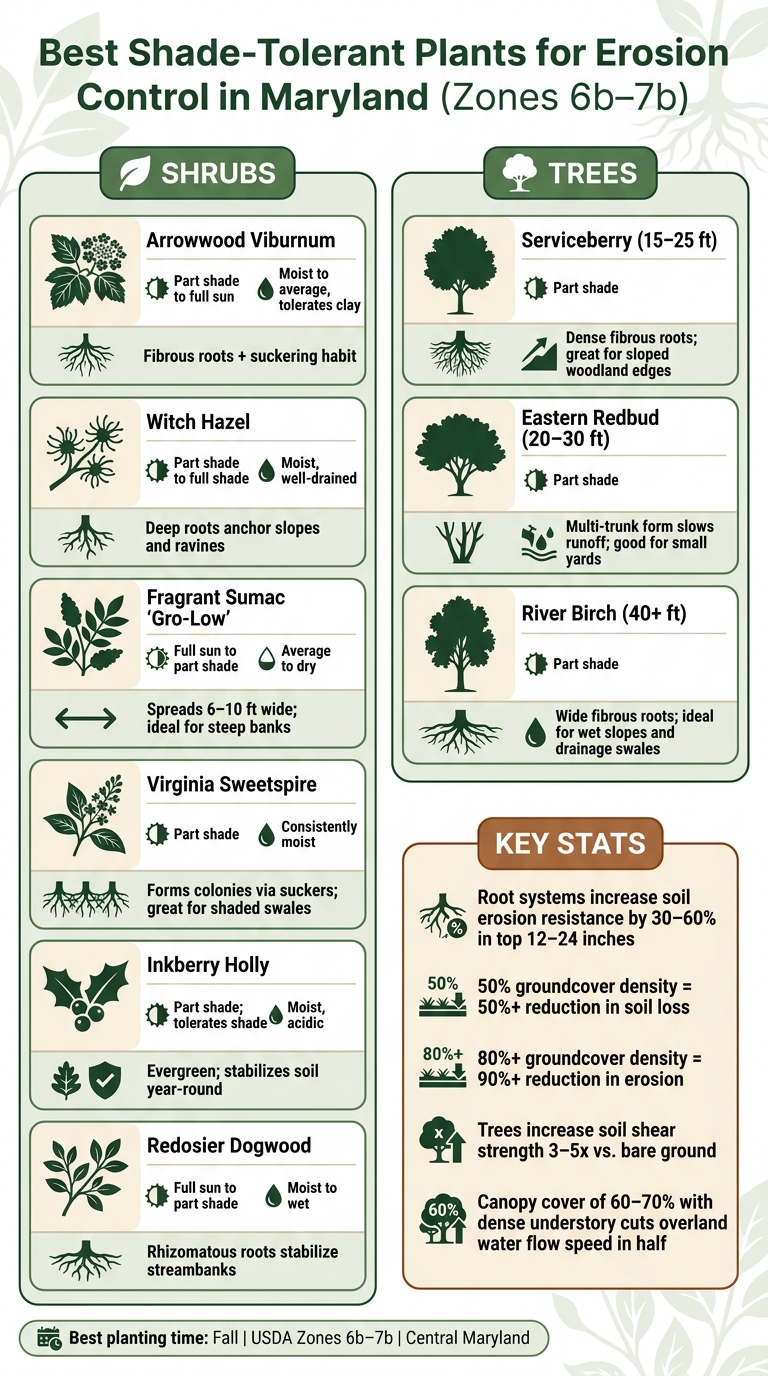
Best Shade-Tolerant Shrubs & Trees for Erosion Control in Maryland
Shrubs That Work Well on Shady Slopes
If you’re dealing with shady slopes in Maryland (USDA Hardiness Zones 6b–7b), choosing the right shrubs can make a big difference. Certain native shrubs not only thrive in low light but also help stabilize soil, making them perfect for erosion control in the Mid-Atlantic climate.
| Shrub | Light Needs | Moisture Preference | Key Erosion Benefit |
|---|---|---|---|
| Arrowwood viburnum (Viburnum dentatum) | Part shade to full sun | Moist to average; tolerates clay | Fibrous roots and suckering habit that secure soil |
| Witch hazel (Hamamelis virginiana) | Part shade to full shade | Moist, well-drained | Deep roots anchor slopes and ravines |
| Fragrant sumac ‘Gro-Low’ (Rhus aromatica) | Full sun to part shade | Average to dry | Spreads wide with dense roots, ideal for steep banks |
| Virginia sweetspire (Itea virginica) | Part shade | Consistently moist | Forms colonies via suckers, perfect for shaded swales |
| Inkberry holly (Ilex glabra) | Part shade; tolerates shade | Moist, acidic | Evergreen cover stabilizes soil year-round |
| Redosier dogwood (Cornus sericea) | Full sun to part shade | Moist to wet | Rhizomatous roots stabilize streambanks and wet slopes |
These shrubs are versatile, offering solutions for a range of moisture levels and slope conditions. For wetter, shaded areas – like the base of a slope near a downspout – arrowwood viburnum, Virginia sweetspire, and redosier dogwood stand out as excellent options. On drier, shady slopes under mature trees, witch hazel and ‘Gro-Low’ fragrant sumac excel in handling compacted soil.
"Native plants, grasses, and water-tolerant shrubs are ideal for swales. These plants absorb water, filter pollutants, and provide habitat for local wildlife." – Pro Landscapes MD [2]
One shrub worth spotlighting is the ‘Gro-Low’ fragrant sumac. This low-growing plant reaches just 2–3 ft in height but spreads 6–10 ft wide, making it a fantastic choice for steep banks where mowing isn’t practical [4].
How to Plant Shrubs for Maximum Effect
To maximize the erosion control benefits of these shrubs, proper planting techniques are essential. Arrange plants in staggered, triangular patterns along the slope’s contour. This layout slows water runoff and promotes absorption. Space medium-sized shrubs 4–6 ft apart and low-growing varieties 3–4 ft apart to create a dense groundcover that holds soil in place. On long slopes, each row acts as a barrier, slowing water flow as it moves downhill.
Prepare the planting site by loosening compacted soil and mixing in 2–3 inches of compost. This improves root penetration, especially in heavy clay soils. When digging, make the hole 2–3 times wider than the root ball but no deeper, ensuring the crown sits at or just above the surrounding soil level. Add a small berm on the downhill side of the plant to help retain water near the roots.
After planting, apply a 2–3 inch layer of shredded hardwood mulch around the base, extending to the dripline. Be sure to keep the mulch a few inches away from the stems to prevent rot. On steeper slopes, shredded mulch works better than bark chips because it stays in place more effectively. Water deeply once or twice a week during dry spells in the first one to two growing seasons to encourage strong root growth.
Let suckering shrubs – like arrowwood viburnum, Virginia sweetspire, and fragrant sumac – spread naturally. Avoid cutting them back too much, as their colony-forming growth creates the dense root systems that are critical for slope stabilization.
Shade-Tolerant Trees for Slope Stabilization
Trees That Excel at Stabilizing Shaded Slopes
Shrubs are great for protecting the soil’s surface, but trees take it a step further by anchoring the deeper layers. Together, they create a sturdy, multi-layered barrier against erosion. Thanks to their deep roots, trees can increase soil shear strength by 3–5 times compared to bare ground – an essential benefit for steep or eroding slopes.
If you’re dealing with shaded areas in Maryland’s USDA Zones 6b–7b, several native understory trees are excellent choices:
| Tree | Mature Size | Shade Tolerance | Best For |
|---|---|---|---|
| Serviceberry (Amelanchier spp.) | 15–25 ft | Part shade | Sloped woodland edges; dense fibrous roots |
| Eastern redbud (Cercis canadensis) | 20–30 ft | Part shade | Small yards; multi-trunk form slows runoff |
| River birch (Betula nigra) | 40+ ft | Part shade | Wet slopes, drainage swales, streambanks |
Serviceberry is particularly effective for residential slopes, thanks to its multi-stem structure and dense, fibrous roots that thrive even in Maryland’s clay-heavy soils. Eastern redbud naturally grows along woodland edges, where its broad canopy intercepts rainfall and its spreading roots stabilize the ground. For wetter areas, such as near drainage channels or low-lying spots, river birch is a standout. Its wide, fibrous root system is ideal for streambanks and wet slopes. If you’re working with deep shade and consistent moisture, consider pawpaw for its stabilizing root suckers or American hornbeam, which develops a strong root network.
To maximize slope stabilization, pair these trees with shrubs and groundcovers for a layered approach.
Combining Trees with Shrubs and Groundcovers
Trees alone can’t do all the work when it comes to erosion control. A layered planting strategy – combining trees, shrubs, and groundcovers – replicates a natural woodland structure. This approach slows water runoff, improves soil absorption, and ensures continuous ground cover. Trees anchor the upper and mid-slope, shrubs fill the mid-story, and groundcovers like woodland sedges, ferns, or pachysandra knit the soil surface together. Studies show that a canopy cover of 60–70% with a dense understory can cut overland water flow speed in half, significantly reducing erosion risk.
For example, on a wet slope, plant a clump of river birches alongside mid-story shrubs, with native sedges or ferns at the ground level. On a drier, shaded slope, a multi-stem serviceberry pairs well with shrubs and a spreading groundcover like wild ginger (Asarum canadense). To further enhance erosion control, stagger plants in a triangular pattern instead of straight rows downhill. This layout disrupts water flow and creates a more connected root system.
In cases of steep or severely eroded slopes, vegetation alone might not be enough. Pro Landscapes MD can combine plantings with solutions like grading, French drains, or retaining walls. These added measures are especially useful in Maryland’s challenging terrain, where compacted clay and drainage issues are common.
Steps to Stabilize Shady Erosion Sites
Assessing Your Site Before Planting
Start by observing your yard during heavy rain to pinpoint areas where water flows, pools, or creates channels. Sketch a simple map to mark these problem zones. This will help you decide where to place plants, mulch, and drainage features for maximum impact.
Next, evaluate the shade levels in your yard throughout the day. Full shade means less than 2 hours of direct sunlight, part shade gets 2–4 hours, and dappled shade occurs under tree canopies. Knowing these patterns ensures you position plants where they’ll thrive. To check soil compaction, try inserting a screwdriver into the ground; if it’s tough to push in, the soil may need loosening and organic matter. In central Maryland, compacted or clay-heavy soils are common and will benefit from this preparation before planting.
Preparing the Area for Planting
Remove invasive plants like English ivy or weak-rooted turfgrass to clear the area. When clearing steep slopes, work from the top down to avoid dislodging soil onto areas you’ve already prepared. For invasive plants, cut and pull them carefully to minimize soil exposure.
If the soil is compacted, use a garden fork or broadfork to loosen the top 6–12 inches, then mix in 2–4 inches of compost to improve its structure and ability to absorb water. Around mature tree roots, skip deep digging and instead spread a light layer of compost on the surface. For areas actively eroding, lay biodegradable erosion control blankets like jute or coconut coir netting over the soil. Secure them with stakes before planting. These materials cost between $0.30 and $1.00 per square foot and naturally decompose within 6–24 months, giving plants time to establish roots while protecting the soil from rain.
Planting and Maintenance Tips
Once the site is ready, it’s time to plant. On slopes, dig planting holes deeper on the uphill side and create a small berm on the downhill side to catch water and shield the roots. Stagger plants in a triangular pattern across the slope instead of straight rows to slow water flow and encourage root interconnection. This arrangement helps shade-loving shrubs and trees provide natural erosion control.
Space shrubs so their canopies will just touch when mature – typically 3–6 feet apart, depending on the species. For groundcovers, plant them 12–18 inches apart to ensure they fill in within one to two growing seasons. After planting, spread 2–3 inches of shredded hardwood mulch, keeping it a few inches away from plant stems. On steep slopes, secure the mulch with pinned jute netting to prevent it from sliding. Water deeply 1–2 times per week during the first growing season to promote strong root growth. In the Mid-Atlantic, fall is the ideal time to plant woody shrubs and trees on slopes, as cooler weather and seasonal rain help roots establish before summer.
After heavy storms, inspect the slope for bare spots, shifted mulch, or loose netting. Address small washouts immediately to prevent them from worsening. If you notice water flow exceeding what the plants can manage, it may be time to consult a professional for solutions like grading, a dry creek bed, or a French drain. These additions can work hand-in-hand with your plantings to stabilize the area effectively.
Conclusion: Pairing Plants with Professional Help
Shade-loving plants can play a key role in controlling erosion, especially when integrated into a larger strategy. Fibrous-rooted shrubs and trees help anchor soil, absorb rainfall, and enrich the ground with organic matter. By layering trees, shrubs, and groundcovers on a shaded slope, you create a multi-level defense system that protects the soil at different depths. Research from the USDA highlights that proper vegetative cover can significantly reduce erosion – an important consideration for Maryland homeowners dealing with sloped or wooded areas.
That said, plants alone can’t handle everything, particularly when it comes to managing concentrated water flow from roofs, driveways, or neighboring properties. For steep slopes or actively eroding areas, structural solutions like grading, French drains, dry riverbeds, or retaining walls are often necessary to complement plantings. As Pro Landscapes MD explains, "Drainage problems are complex and require a custom approach for each project. These issues can cause long-term damage to your property if not handled correctly, which is why hiring an experienced team is critical." [1]
Deciding when to bring in professional help depends on the severity of the issue. Minor erosion under trees might be manageable with shade-tolerant shrubs and a fresh mulch layer. However, if water is pooling near your foundation, gullies are forming, or past planting efforts have failed, professional expertise becomes essential. In these cases, a well-designed plan and expert installation can make all the difference.
For residents in central Maryland, Pro Landscapes MD offers tailored solutions to tackle these challenges. Serving Howard, Montgomery, Carroll, Frederick, Prince George’s, and Baltimore Counties, they specialize in addressing the unique issues of the region, such as clay-heavy soils, mature tree canopies, and sloped lots. Their services include everything from custom planting plans to installing French drains, dry riverbeds, and retaining walls. As one satisfied customer shared, "They came through with everything promised. I love the stacked stones we placed around our trees and flowerbed."
FAQs
How can I tell if my shady spot has erosion or poor drainage?
To spot the difference, look for erosion clues such as bare patches of soil, exposed roots, or channels carved out by water flow. Poor drainage, however, often shows up as standing water or puddles that linger after rainfall. If you notice areas where water refuses to drain, it’s likely a drainage problem. On the other hand, shifting soil or deep cuts in the ground are clear signs of erosion. Pro Landscapes MD can evaluate your property and suggest the right fix for your situation.
Which shade plants work best for my slope’s wet or dry soil?
Pro Landscapes MD specializes in designing custom garden plans that perfectly match your slope’s specific soil type and light conditions. Their team of skilled horticulturists focuses on selecting native plants that are well-suited to Maryland’s climate, ensuring both erosion control and long-term plant vitality. Whether your soil tends to stay wet or dry, they identify species that not only stabilize slopes but also flourish in shaded environments. Reach out to their experts for a tailored landscape plan that meets the unique demands of your property.
When do I need a French drain or grading, not just plants?
When dealing with water buildup, flooding, or risks to your foundation that plants alone can’t solve, you might need a French drain or professional grading. French drains are designed to redirect significant amounts of water away from problem areas, while grading adjusts the slope of your land to control runoff more effectively. These approaches are ideal for tackling standing water, heavy runoff, or drainage issues that demand a more structural solution.
Chat with Us