









- bhavya gada
- No Comments
Geotextile prices in Maryland vary due to material type, weight, regulations, and market conditions. Woven fabrics are stronger and suited for reinforcement, while nonwoven options excel in drainage and filtration. Costs range from $0.20 to $0.40 per square foot, influenced by GSM weight, polymer type, and UV resistance. Regulatory standards, such as those from MDE and MDOT SHA, often require higher-quality fabrics, increasing costs.
External factors like crude oil prices, freight expenses, and supply chain disruptions also impact pricing. Larger projects benefit from bulk discounts, while site conditions – like soil quality, access, and slopes – affect labor and installation costs. Proper planning, early purchasing, and consulting with experienced contractors can help manage these variables and ensure long-term durability for Maryland projects.
Woven vs Nonwoven Geotextile Fabric | Choosing the Correct Geotextile for Your Project
sbb-itb-843f8be
Material Types and Performance Specifications
The type of geotextile you pick can significantly impact costs for any Maryland project. There are two primary categories to consider: woven and nonwoven, each designed for specific purposes.
Woven vs. Nonwoven Geotextiles
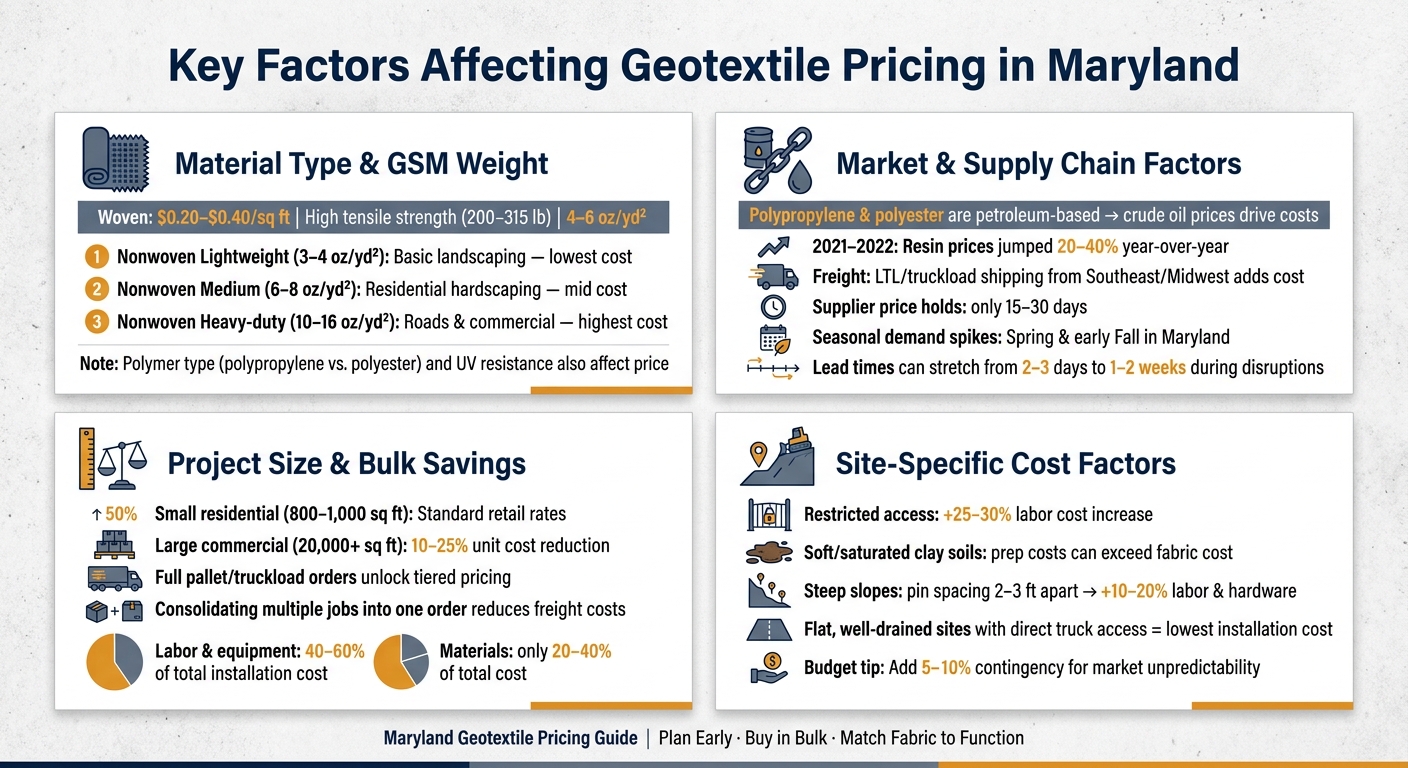
Woven geotextiles are created by weaving polypropylene or polyester yarns on a loom. This process results in a fabric with high tensile strength and low elongation, making it ideal for load-bearing applications like subgrade reinforcement under driveways, parking lots, and retaining wall bases. For example, woven stabilization fabrics can achieve tensile strengths of 200–315 lb in the machine direction while maintaining a lightweight profile of just 4–6 oz/yd².
Nonwoven geotextiles, on the other hand, are made by needle-punching or heat-bonding loose fibers into a mat. Their unique three-dimensional fiber structure makes them excellent for filtration and drainage. These qualities make nonwoven fabrics the preferred choice for applications like French drains, behind retaining walls, or beneath paver systems. While they don’t offer the same tensile strength as woven fabrics, their superior water flow and soil-retention capabilities make them indispensable for drainage-focused projects.
| Feature | Woven | Nonwoven |
|---|---|---|
| Uses | Reinforcement, separation under loads | Filtration, drainage, cushioning |
| Strength | Higher for a given weight | Lower for a given weight |
| Elongation | Low (stiff) | Higher (more flexible) |
| Permittivity | Lower | Higher |
| Typical applications | Driveways, road bases, retaining wall bases | French drains, behind retaining walls, under pavers |
Understanding these differences highlights how material quality and GSM weight influence pricing. Both the construction method and fiber density are critical for accurate cost estimation.
How Material Quality and GSM Weight Affect Cost
GSM (grams per square meter) – or its imperial equivalent, oz/yd² – indicates how much fiber is packed into a fabric. Heavier fabrics with higher GSM ratings offer increased thickness, puncture resistance, and durability, but this also leads to higher costs per square foot.
For nonwoven geotextiles, weight categories generally fall into these ranges:
- Lightweight (3–4 oz/yd²): Best for basic landscaping needs, like separation under mulch or decorative stones. These are the most affordable options.
- Medium-weight (6–8 oz/yd²): A popular choice for residential hardscaping projects such as paver patios, walkways, and small retaining wall backfills.
- Heavy-duty (10–16 oz/yd²): Suited for demanding applications like roadways, commercial parking lots, and stormwater systems where long-term strength is critical.
Beyond weight, other factors like polymer type and UV stabilization also affect costs. Polypropylene is widely used due to its affordability, while polyester is chosen for applications requiring higher sustained-load capacity. In Maryland’s climate, UV-resistant fabrics are particularly important for large commercial projects with multi-phase timelines, where materials may be exposed to sunlight for extended periods.
It’s essential to remember that weight alone doesn’t determine a fabric’s performance or price. Two fabrics with the same GSM rating can vary greatly in quality and cost depending on factors like fiber composition, pore structure, and tested properties such as permittivity (ASTM D4491), grab tensile strength (ASTM D4632), and apparent opening size (ASTM D4751). Projects adhering to AASHTO M288 classifications – commonly referenced by Maryland DOT and county engineers – must meet strict minimum values across multiple performance metrics. These rigorous standards are what separate budget options from compliant, high-quality products.
Up next, we’ll explore how external market factors influence pricing even further.
Market and Supply Chain Factors
Woven vs. Nonwoven Geotextiles: Cost & Performance Comparison
Geotextile pricing in Maryland goes beyond just material quality – it’s also shaped by external market dynamics like raw material trends, freight expenses, and supply chain disruptions. These factors directly influence supplier quotes and, ultimately, project costs.
Raw Material Availability and Freight Costs
After product specs are nailed down, external market forces come into play. Geotextile pricing, for example, is closely tied to crude oil and petrochemical markets because polypropylene and polyester, the main materials used, are petroleum-based. When resin prices spike, manufacturers pass those increases down the line, leaving Maryland contractors and property owners to absorb the added costs in their quotes.
Freight is another major factor. Geotextile rolls, while relatively lightweight, take up a lot of space, making shipping expensive. Since most U.S. geotextile production happens in the Southeast and Midwest, shipments to Maryland often involve LTL (less-than-truckload) or full truckload deliveries over hundreds of miles. Maryland’s proximity to major corridors like I-95, I-70, and I-83 helps keep freight costs somewhat manageable. However, tolls, traffic congestion, and extra fees for things like lift-gate services or residential deliveries can drive up costs. Smaller orders, which don’t fill a pallet, are particularly vulnerable to these added expenses.
Location within Maryland also plays a role. Sites near major freight routes, like Columbia or Ellicott City, generally benefit from lower delivery costs. In contrast, remote locations in western Maryland may face higher prices due to the need for extra transfers or smaller delivery trucks.
Price Changes Caused by Supply Chain Disruptions
Supply chain disruptions can wreak havoc on pricing and availability. From 2020 to 2022, for instance, polypropylene resin prices in North America jumped 20–40% year-over-year, while trucking costs for building materials soared due to rising diesel prices and a tight shipping market. These challenges led some distributors to impose product allocation limits, restricting how much customers could purchase.
For Maryland project planners, these disruptions often translate into three key issues:
- Sudden surcharges on material quotes
- Extended lead times, stretching from the usual 2–3 days to as long as 1–2 weeks
- Pressure to accept substitute products when specified brands or weights are unavailable
Contractors who locked in quotes early – most suppliers hold prices for just 15–30 days – were able to avoid some of these cost increases. Those who delayed often faced much higher prices by the time materials were delivered.
Seasonal demand patterns also come into play. In Maryland, spring and early fall see a surge in construction activity, tightening distributor inventories. This seasonal crunch can push prices up and lead times out even further. To navigate these challenges, contractors can plan ahead by ordering before peak seasons, consolidating shipments into full-pallet quantities, and asking suppliers about engineer-approved alternatives that meet AASHTO or ASTM standards.
These market and supply chain factors create a complex backdrop for geotextile pricing in Maryland, setting the stage for the more specific cost considerations that follow.
Project Size and Installation Scope
When it comes to geotextile pricing, it’s not just about material and freight costs. Factors specific to your project – like size and site conditions – play a significant role in determining overall expenses.
Cost Savings Through Bulk Purchasing
The size of your project directly affects the price you pay per square foot for geotextile fabric. For example, a small residential driveway requiring around 800–1,000 sq ft of fabric will likely be charged standard retail rates. On the other hand, larger projects, such as a subdivision road or a commercial parking lot needing 20,000+ sq ft, often qualify for tiered pricing, which can lower the unit cost by 10–25%, depending on the supplier and product line. Suppliers are typically more willing to offer discounts on orders that fill a pallet or truckload.
Contractors in Maryland can maximize savings by consolidating orders across multiple jobs. For instance, placing a single 40,000-sq-ft order to cover several projects – like driveways and retaining walls – can secure better pricing. This approach also reduces freight charges, as only one delivery is needed instead of multiple smaller ones. Additionally, bundling geotextiles with other materials such as drainage pipes, aggregate, or pavers may qualify for package discounts from landscape supply yards. Mobilization costs follow a similar pattern: spreading the fixed cost of transporting crews, equipment, and materials over a larger area reduces the per-square-foot expense on bigger projects.
However, these savings can be offset by challenging site conditions, which may increase labor and installation costs.
Labor and Site-Specific Cost Factors
Labor and equipment typically account for 40–60% of geotextile installation costs, while the material itself comprises only 20–40%. This balance can shift significantly depending on the site conditions.
Restricted site access can increase labor costs by 25–30%. For instance, properties in areas like Howard, Carroll, or Frederick Counties with open space for trucks and equipment allow for quicker and more efficient installation. In contrast, narrow lots or rear-only access can slow down the process. Subgrade quality is another critical factor. If the soil is firm and well-drained, installation is relatively straightforward. However, soft, saturated clays or organic soils – common in Maryland’s low-lying regions – may require additional preparation, such as undercutting, imported fill, and extra base stone. In some cases, these prep costs can exceed the cost of the geotextile fabric itself.
Steep slopes add further complexity. On such terrains, the fabric must be anchored more securely, with closer pin spacing (typically 2–3 ft apart) and longer overlaps. This increases labor time and hardware expenses by 10–20% compared to flat installations.
Here’s a summary of how site-specific factors influence costs:
| Factor | Lower Costs | Higher Costs |
|---|---|---|
| Project size | Large, continuous areas | Small or fragmented phases |
| Site access | Direct truck and equipment access | Narrow lots, rear-only access |
| Subgrade | Firm, well-drained soil | Soft clay, saturated or organic soils |
| Slope | Flat or gently graded | Steep slopes or erosion-prone channels |
| Layout complexity | Simple rectangles, few obstructions | Irregular shapes, utilities, mature trees |
To better plan your budget, request an itemized estimate that breaks down material, base, and labor costs. This will help you understand how specific site conditions impact the overall expense and allow for more accurate financial planning.
Practical Cost-Planning Tips for Maryland Projects
Building on earlier discussions about materials and project factors, these tips can help simplify your budgeting process.
Key Variables to Assess Before Budgeting
Before diving into costs, identify the fabric’s primary function – whether it’s for separation, filtration, drainage, or reinforcement. This decision shapes every other aspect of your project. For example, a French drain in a waterlogged backyard in Olney will require a completely different product than a retaining wall backfill on a steep slope in Frederick County.
Next, evaluate the site conditions. Soil type and water flow play a significant role in determining the fabric grade and its cost. Areas near Chesapeake Bay tributaries or with high groundwater levels might need sturdier drainage layers and carefully matched filter fabrics to prevent erosion and structural issues. Also, consider the expected load intensity. A mid-grade woven fabric might work for a residential gravel driveway, but a commercial truck route will require a stronger, more expensive product to handle the wear and tear over time while reducing long-term maintenance costs.
Don’t forget to include preparatory work – like grading and drainage corrections – when estimating your overall budget.
These factors will help you choose the right geotextile for your project.
Choosing the Right Geotextile for Your Project
Once you’ve established a budget based on your site’s specific needs, the next step is selecting the proper geotextile. Avoid cutting corners by prioritizing price over performance. A cheaper roll might save money upfront but could lead to costly replacements if it fails.
- Woven geotextiles are ideal for projects requiring reinforcement or structural separation, such as road subgrades, paver driveways, or retaining wall backfill.
- Nonwoven geotextiles are better suited for filtration, drainage, or erosion control applications, like French drains, underdrains, or bioretention cells.
Take local stormwater regulations into account when finalizing your choice. Maryland’s stormwater policies, aimed at reducing nutrient and sediment runoff into the Chesapeake Bay, often favor nonwoven fabrics for use beneath riprap, around underdrains, or inside bioretention cells [2][3]. Be sure to include a small contingency in your budget for potential specification upgrades, just in case.
For projects that combine multiple elements – like a paver patio with an integrated French drain – consult with a contractor experienced in drainage, grading, and hardscaping. This ensures the geotextile aligns with the overall site design. Companies like Pro Landscapes MD, which specialize in drainage installation, retaining walls, grading, and hardscaping in central Maryland, can guide you in choosing the right material. They’ll help you decide when a mid-grade nonwoven fabric is sufficient and when a higher-strength woven product might be the better long-term investment – avoiding both over-specification and under-specification.
Conclusion
Choosing the right geotextile is a critical step for ensuring long-term savings and project success. In Maryland, geotextile pricing varies based on factors like material type, GSM weight, market conditions, project scope, and site-specific challenges. Each of these elements can significantly affect both the cost per square yard and the total budget for installation.
While opting for the cheapest material might seem appealing initially, it often leads to higher expenses down the line. Maryland’s unique environmental conditions – like freeze-thaw cycles, heavy rainfall, and clay-rich soils – require durable geotextiles to prevent issues like clogged drains, driveway deformation, and slope instability. Repairs for these problems can far outweigh any upfront savings from using lower-grade materials.
Supply chain issues, such as the sharp resin price increases of 20–40% during 2021–2022, have also impacted geotextile costs [5][2]. For larger or long-term projects, adding a 5–10% contingency to your budget is a smart way to handle market unpredictability. These fluctuations emphasize the importance of detailed planning and timely purchasing.
Matching your project needs with expert advice is essential. For drainage, stormwater management, and hardscaping projects in central Maryland, Pro Landscapes MD offers services like grading, French drain installation, and stormwater solutions across Howard, Montgomery, Frederick, and nearby counties. They help property owners choose the right materials, avoiding the pitfalls of both over-specification and under-specification [4].
"Drainage problems are complex and require a custom approach for each project." – Pro Landscapes MD [1]
A thorough initial assessment ensures that both geotextile choices and overall project costs remain manageable.
FAQs
Which geotextile should I use for my Maryland project – woven or nonwoven?
When deciding between woven and nonwoven geotextiles for projects in Maryland, it all comes down to what you’re trying to achieve.
- Woven geotextiles are your go-to for ground stabilization and handling heavy loads. Their high tensile strength makes them perfect for supporting tough conditions.
- On the other hand, nonwoven geotextiles shine in drainage systems. They allow water to flow freely while keeping soil from migrating, making them essential for preventing blockages.
For permeable pavers, geotextiles play a crucial role by separating soil from the gravel base. This helps maintain functionality and prevents clogs over time.
How can I estimate total installed cost, not just fabric price?
When budgeting for total installed costs, it’s essential to look beyond just the price of geotextile fabric. Factors like soil type, slope, and the complexity of drainage or hardscaping requirements can significantly impact expenses. For instance, working with clay soil or handling grading might demand additional materials or specialized labor. It’s a good idea to consult professionals who can evaluate your site and help ensure every structural element is accounted for in your budget.
How can I avoid price spikes and long lead times when ordering geotextile in Maryland?
To avoid unexpected price increases and delays when ordering geotextile in Maryland, it’s important to plan ahead and secure your materials before the project kicks off. For more intricate drainage projects, collaborating with seasoned professionals can make a big difference. Experts can evaluate your site, ensure accurate material sourcing, and navigate availability challenges effectively. Reaching out to specialists like Pro Landscapes MD early in the process can help keep your project timeline on track and prevent expensive disruptions caused by supply chain hiccups.
Chat with Us