









- bhavya gada
- No Comments
If your stormwater inspection failed in Maryland, I’d treat it like a deadline problem first and a repair problem second. In many cases, you may have about 30 days to fix the listed issues, clean up your records, and request reinspection before the matter moves toward fines, notices, or more enforcement.
Here’s the short version of what I’d do:
- Read the inspection report line by line
- List each failed item
- Fix safety, drainage, and structural problems first
- Handle sediment, erosion, and plant repairs next
- Gather photos, invoices, logs, and plan sheets
- Request reinspection only after every item is fixed
A failed inspection usually comes down to one or more of these problems:
- Clogged inlets or outlets
- Standing water that does not drain within 48 hours
- Sediment buildup
- Erosion or damaged slopes
- Dead or missing vegetation
- Missing maintenance records or plan documents
The main point: I would not guess at the fix. I’d use the report as a checklist, match each item to the exact part of the system, and then make repairs in the same order the risk shows up on site: people safety first, water flow second, structure third, paperwork last but before reinspection.
A few Maryland-specific details matter here:
- Some local programs use a 30-day correction window
- Maintenance logs may need to be kept for at least 5 years
- In serious cases, fines can reach up to $10,000 per violation
- A continuing violation may be counted day by day
This article breaks the process into three plain steps: review the report, complete repairs in the right order, and prepare a clean reinspection file so you can close out the failed inspection with less back-and-forth.
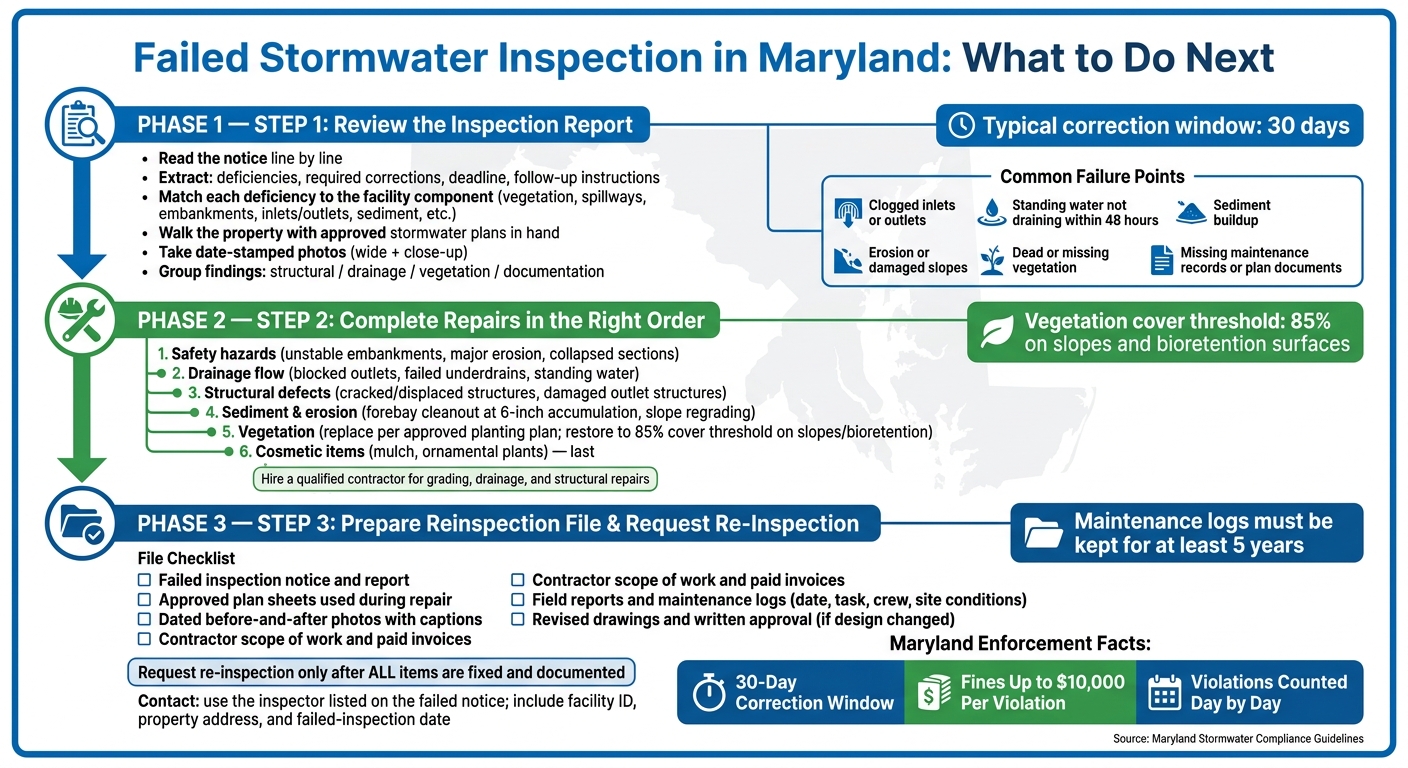
Failed Stormwater Inspection in Maryland: 3-Step Correction Process
Step 1: Review the Inspection Report and Find the Cause of Failure
Read the notice line by line and pull out four things: the deficiencies, the required corrections, the deadline, and any follow-up instructions. Maryland counties usually put all of that in writing.[7][8][12] In many cases, the correction window is 30 days, though more involved repairs may get extra time.[7][8][12]
Next, match each deficiency to the part of the facility it belongs to. Maryland inspection checklists often sort problems by vegetation, safety devices, spillways and valves, embankments and slopes, reservoir or treatment areas, inlet and outlet structures, underground drainage, and sediment or debris buildup.[3][11] That setup helps you see what kind of problem you’re dealing with: physical, operational, or administrative.
Common Failure Points Inspectors Cite
Inspectors often cite:
- Clogged inlets or outlets
- Standing water that does not drain on time
- Sediment buildup
- Erosion
- Dead vegetation
- Bare soil
- Blocked overflow paths[2][6][13]
How to Check Site Conditions
After you read the report, walk the property with your approved stormwater plans in hand and inspect each cited area in the same order listed in the report. That keeps the review simple and cuts down on missed items.
Take date-stamped photos from both wide and close-up views so you have a clear record of what you found. Then group your findings into structural, drainage, vegetation, or documentation issues.[2][9][13] Once you know what’s causing the failure, it becomes much easier to line up the right fix.
When the Problem Is Documentation
Sometimes the system itself is in decent shape, but the inspection still fails because records are missing, incomplete, or out of date. Maryland stormwater programs expect owners to keep O&M agreements, maintenance logs, periodic inspection reports, repair invoices, and plan sheets that match current site conditions. Maintenance logs should be kept for at least five years.[8][9][13][14]
Outdated drawings can lead to a failed inspection even if the system is working. If the issue is paperwork, clean up the records before the reinspection. Then you can move on to the repairs and record updates in the next step.
sbb-itb-843f8be
Step 2: Plan and Complete Repairs in the Right Order
Once you know what failed, don’t sit on it. Move from diagnosis to repair, and make sure the work follows the approved stormwater and O&M plans so the facility can get back to doing its job.[1][2][18]
Fix Safety, Drainage Flow, and Structural Defects First
Start with problems that create a safety issue or keep water from moving through the system the way it should. That means tackling unstable embankments, major erosion or gullying, damaged or shifted outlet structures, collapsed channel or embankment sections, and blocked outlets first.[19][20][21]
Standing water that should have drained goes in this same first round. It often points to a blocked outlet, a failed underdrain, or poor grading. It can also hurt treatment performance and increase mosquito risk.[1][2][21] Cosmetic items, like mulch or ornamental plant replacement, should wait until the end.
Match Each Repair to the Failed Component
Each deficiency should lead to a specific repair, not a vague to-do.
| Failed Component | Corrective Action |
|---|---|
| Clogged outlet or inlet | Clear debris, clean trash racks and orifices, jet or rod clogged pipes, and repair cracked, separated, or displaced outlet structures and headwalls |
| Sediment buildup in forebay | Remove sediment when accumulation reaches 6 inches and haul away sediment as required.[1] |
| Standing water that should drain | Inspect cleanouts and underdrains, flush or replace underdrain lines, and if ponding continues in bioretention areas, clean or replace gravel, soil, or sand media. |
| Eroded or low-graded areas | Re-establish design slopes, fill depressions, shape swales and channels to the approved cross-section, and stabilize the area with mulch, matting, stone, or other armoring. |
| Dead or missing vegetation | Replace plants with species from the approved planting plan and restore vegetative cover to the required threshold, often 85% on slopes and bioretention surfaces.[15][22] |
| Cracked or displaced structures | Repair concrete weirs, risers, or walls, and reset displaced riprap or block retaining features. |
A simple way to handle the work is in phases: take care of structural repairs first, then stabilization and planting, then cleanup and records.[4][21]
When to Hire a Contractor
Some repairs are not DIY territory. If the work involves grading, drainage, or structural elements, bring in a qualified contractor. The same goes for major regrading, underdrain replacement, embankment stabilization, and repairs to regulated control structures. Those fixes need to match the approved plan details exactly.[20][21]
Montgomery County also sets a clear bar here: anyone doing repair or maintenance on a stormwater facility must have shown stormwater experience and training, and the County performs a final inspection after the repairs are done.[17]
After the repair work is finished, keep the records you’ll need for reinspection.
Step 3: Prepare for the Follow-Up Inspection and Update Records
Repairs are only half the job. The follow-up inspection often comes down to the paper trail. Once the work is done, your file becomes the proof that the system is ready to pass. Inspectors also check whether repairs were finished within the required timeframe.[3][8][5]
What to Keep in Your File Before Re-Inspection
Put together one re-inspection file before you contact the county. It should include the failed inspection notice and report, the approved plan sheets used to check the repair, and dated before-and-after photos with locations and captions tied to each cited deficiency.[3][8][5][23][4] Add the contractor’s scope of work, paid invoices, and any field reports.[1][8][5]
If the repairs changed the design, keep revised drawings and written approval in the file.[1][8] For each maintenance entry, log the date, task, crew, and site conditions that were observed.[25][26][5] If those logs are missing, approval can stall and the failed item may stay open.
With the file in place, set clear roles so the re-inspection doesn’t get hung up.
Owner, Contractor, and County Responsibilities
Clear ownership keeps the process moving.
| Responsibility | Property Owner | Contractor | County/Local Authority |
|---|---|---|---|
| Repairs | Coordinates and submits corrections within the notice deadline.[3][8][12] | Repairs and documents the work per approved plans.[1][5] | Verifies and closes the case; enforces compliance if repairs are not completed.[3][8] |
| Documentation | Maintains the reinspection file and provides records on request.[3][1][23][5] | Supplies proposals, field reports, invoices, and as-built sketches.[1][5] | Maintains official inspection records for each stormwater system.[12][24] |
| Follow-Up Inspection | Contacts the local program to request re-inspection and provides site access.[8][5][11] | May be present to explain complex repairs on-site.[5][11] | Conducts the re-inspection, issues compliance or non-compliance notices, and sets the next inspection date.[10][16][20][27] |
Once those roles are set, request the re-inspection.
How to Request Re-Inspection and Avoid Repeat Failures
The last step is sending a clean, complete re-inspection request. Use the contact listed on the failed notice.[3][8][5] Include the facility ID, property address, and failed-inspection date so the request reaches the right team.[8][5][11] Check whether the local office wants anything submitted ahead of time, such as updated photos or maintenance logs.[1][23][8]
Use the failed report like a checklist. Every cited item should have a repair note, photo, and invoice before the re-inspection happens.[4][5][6] Send the request only after each deficiency has been fixed and documented.
Conclusion: Maryland Next Steps After a Failed Stormwater Inspection
A failed inspection kicks off a correction process. First, review the notice, fix each item listed by the deadline, and then request a reinspection.[3][5][29]
Start with the biggest risks first: safety hazards, structural damage, and blocked drainage. After that, move on to sediment, erosion, and vegetation issues. Use the approved stormwater plan and maintenance schedule for every repair so the work puts the system back the way it was meant to function, not as an unapproved patch.[28][24]
Once the repairs are done, the next step is showing what changed. Keep dated photos, invoices, maintenance logs, inspection reports, and any approved plan updates in one place. That way, you can show exactly what was fixed and when. Then contact the assigned inspector and ask for the follow-up inspection needed to close the case.[5][30]
If the repairs are more involved, get sign-off from the local inspector before you go back to routine maintenance. After approval, stay on schedule with seasonal checks, sediment removal, and inlet and outlet reviews.
FAQs
What happens if I miss the correction deadline?
If you miss the stormwater correction deadline in Maryland, you may be considered noncompliant. That can lead to fines and possible legal action. In some counties, enforcement can escalate if you don’t finish the required fixes within the allowed correction period.
Keep detailed records of every communication, along with proof that repairs were completed. It also helps to be ready for re-inspections or other enforcement steps if the county asks for more follow-up.
Do I need a contractor for stormwater repairs?
Yes. Hiring a professional contractor is often the smart move after a failed stormwater inspection in Maryland, and in many cases, it may be required.
Repairs like grading, pipe replacement, structural work, or erosion control aren’t simple fix-it jobs. They take specialized knowledge to meet Maryland rules and pass inspection. A qualified contractor, such as Pro Landscapes MD, can manage permits, make the repairs the right way, and provide the paperwork needed for follow-up inspections.
What documents should I have ready for reinspection?
Have these ready for your Maryland stormwater reinspection:
- As-built plans
- Drainage schematics
- Recent inspection reports
- Maintenance records
- Prior compliance paperwork
Also bring photos of current site conditions and corrective-action records that show required repairs were completed. Keep all documents up to date and available on-site.
Chat with Us