









- bhavya gada
- No Comments
If you’re planning a home improvement project involving digging, grading, or paving, you might need to consider federal stormwater rules. Here’s the key takeaway: Federal permits are typically required for projects disturbing 1 acre or more of land. However, smaller projects may also need permits if they’re part of a larger development or near wetlands and waterways.
Quick Facts:
- No federal permit needed for routine yard work, minor landscaping, or maintenance of existing structures.
- Permits required for new impervious surfaces (e.g., patios or driveways) if total disturbed land reaches 1 acre or more.
- Local rules may be stricter – always check with your municipality before starting any work.
- Projects near wetlands or streams may require additional reviews from agencies like the U.S. Army Corps of Engineers.
To avoid surprises, calculate your project’s total disturbance area, review local stormwater ordinances, and secure all required approvals before breaking ground. Proper planning ensures compliance and protects water quality.
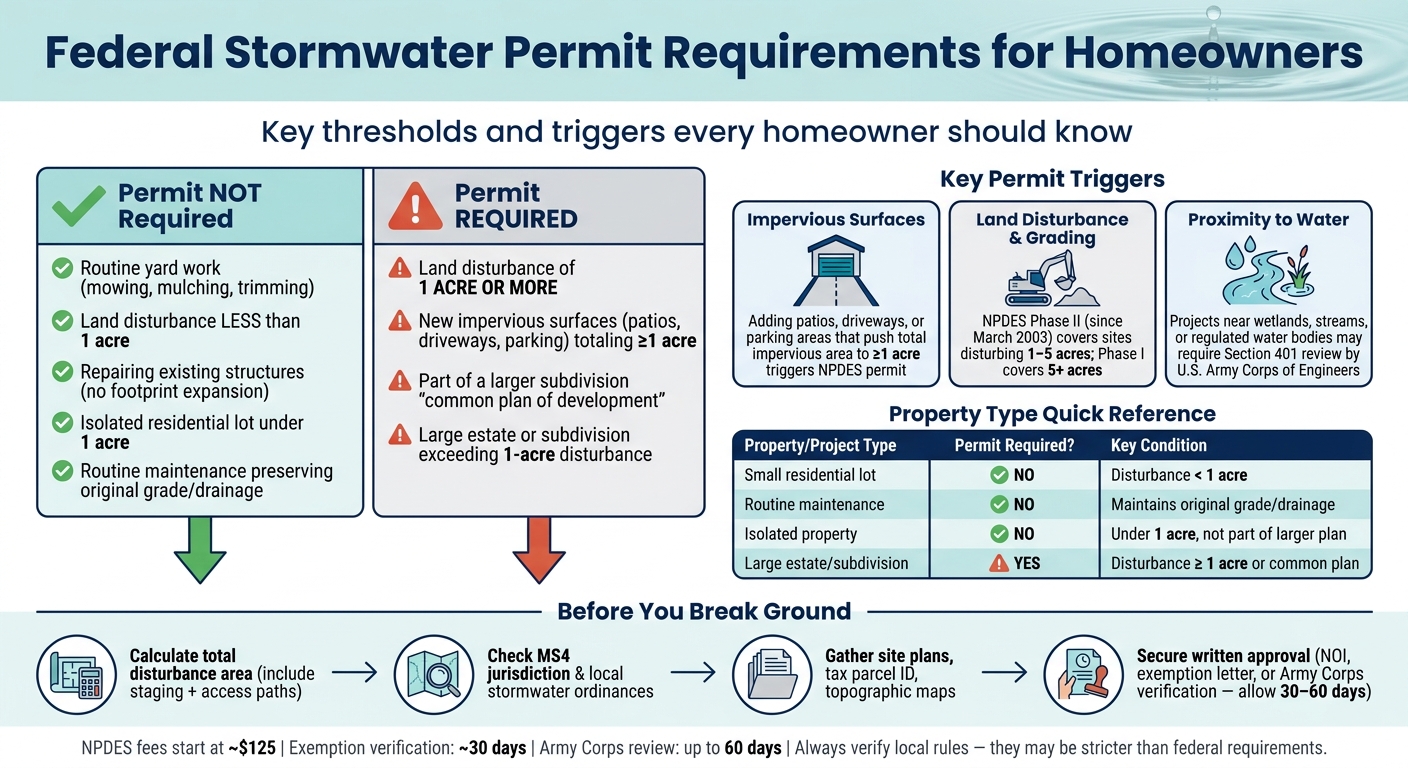
Federal Stormwater Permit Requirements for Homeowners: Quick Reference Guide
NPDES vs Stormwater Permits: What They Mean and Which One You Need | Resource Management Associates
When Homeowners May Not Need a Permit
For most residential projects, federal permits are rarely required. This can save homeowners from dealing with extensive paperwork for stormwater-related work.
Non-Regulated Discharges
Whether or not you need a permit often depends on the size of your project. For example, projects that disturb less than 1 acre of land – like planting a garden, regrading a small area, or adding a small patio – typically don’t require federal NPDES permits [1][3].
Routine yard work also falls outside of federal regulations. Activities such as mowing the lawn, mulching, trimming plants, or doing minor landscaping don’t usually create the type of runoff that the Clean Water Act is designed to regulate [1]. As long as you’re not significantly changing drainage patterns or leaving large patches of soil exposed, these tasks are considered non-regulated.
Next, let’s look at maintenance projects involving existing structures.
Maintenance of Existing Structures
Repairing or maintaining structures that are already in place usually doesn’t require a permit. For instance, fixing a driveway, patio, or walkway without expanding its original footprint is excluded from federal permitting for small construction activities [1]. If your repairs maintain the structure’s original slope and don’t alter how water drains off the surface, you’re likely in compliance.
"If your project disturbs less than one acre and is small enough where a Stormwater Permit is not required, you may still need permitting through the US Army Corps of Engineers and our 401/Isolated Wetlands Group." – Ohio Environmental Protection Agency [1]
However, it’s important to remember that a federal exemption doesn’t mean you’re free from all permitting. If your project is near wetlands or waterways, other agencies may still require reviews or permits.
Finally, let’s examine how property type can affect permit requirements.
Property Types Excluded from Federal Rules
In addition to project size, the type of property plays a role in determining whether a federal permit is needed. Here’s a quick overview:
| Property/Project Type | Federal Permit Required? | Key Condition |
|---|---|---|
| Small residential lot | No | Total land disturbance is less than 1 acre |
| Routine maintenance | No | Activity maintains original line, grade, or hydraulic capacity |
| Isolated property | No | Exempt if project is isolated and under 1 acre |
| Large estate or subdivision | Yes | Disturbance exceeds 1 acre or is part of a larger common plan |
One important detail homeowners often miss is the "common plan of development" rule. If your property is part of a subdivision that was initially permitted as one large project, even small-scale work on your lot could still fall under the original permit’s requirements [1]. To avoid surprises, check your subdivision’s permitting history before assuming you’re exempt.
What Can Trigger a Permit Requirement
Even if your project seems straightforward, certain factors can push it into territory where permits are required. Understanding these potential triggers before starting can help you avoid costly compliance issues later. Here are some common conditions that might mean your project needs a permit.
Adding New Impervious Surfaces
Creating new surfaces that block water absorption, like patios, driveways, or parking areas, often requires permits. These impervious surfaces increase runoff, which can lead to more pollutants being carried into local waterways [1]. Local governments may count surfaces like gravel driveways, brick patios, and even decks as impervious when calculating stormwater fees or determining if permits are needed. If your project results in a total impervious area of 1 acre or more, a federal NPDES stormwater permit is typically required [1][4].
"Stormwater discharges are generated by runoff from land and impervious areas such as paved streets, parking lots, and building rooftops during rainfall and snow events." – Ohio Environmental Protection Agency [1]
Land Disturbance and Drainage Changes
Activities like grading, excavating, or removing vegetation can change how water flows through your property. These changes often increase the speed and volume of runoff, which may trigger permit requirements [1][5]. Under the NPDES program, Phase II rules (effective since March 2003) lowered the threshold for permit coverage to construction sites disturbing 1 to 5 acres, compared to the previous 5-acre minimum under Phase I [4]. If your project involves significant soil disturbance, even on a smaller residential lot, you may need to check whether you meet the permit criteria. Preparing a Stormwater Pollution Prevention Plan (SWP3) can help outline measures to control erosion and sediment during construction [1].
Projects Near Regulated Water Bodies
Proximity to water is a common but often overlooked factor that can require permits. Even small projects near streams, wetlands, or other jurisdictional waters may need additional review under Section 401 of the Clean Water Act, overseen by the U.S. Army Corps of Engineers [1][2].
Many municipalities also enforce riparian setbacks – buffer zones along streams and wetlands where construction or land disturbance is restricted [1]. If your property is in a sensitive watershed or near protected water features, stricter rules might apply, and you may need to work with both your local government and the Army Corps of Engineers [1].
sbb-itb-843f8be
Documents and Resources to Review Before Starting
Before beginning any project that could impact stormwater, it’s essential to gather the right documents. This step ensures everything is in order and that your project complies with local, state, and federal regulations.
Local Stormwater Ordinances
Start by contacting your local planning or public works department to check if your property is part of a Municipal Separate Storm Sewer System (MS4) area. MS4 ordinances are local regulations mandated by federal Phase I and Phase II rules. These rules govern how stormwater is collected and discharged into nearby water systems [1][4]. Generally, Phase I applies to larger municipalities (populations over 100,000), while Phase II focuses on smaller, urbanized areas (populations between 10,000 and 100,000) [4].
In addition to MS4 regulations, many areas have Erosion and Sediment Control (E&S) ordinances for projects that disturb the ground. Some regions enforce even stricter rules for properties near sensitive watersheds. If your county imposes a stormwater utility fee, check if you qualify for a hardship exemption. Some counties waive these fees for eligible low-income homeowners [6]. Once you confirm the rules, collect all property-specific documents for a thorough review.
Site Plans and Property Records
Gather your tax parcel ID from your latest property tax bill or local assessor’s office; this ID links your property to regulatory databases [7]. You’ll also need an overhead view and cross-section drawing of the project area, as well as topographical maps showing drainage patterns on and around your property [1][7].
For projects near shorelines or streams, make sure your site plans include the Mean High-Water Line (MHWL) and Mean Low-Water Line (MLWL) [7]. Free tools like Google Earth can be helpful for capturing GPS coordinates, which are often required for exemption verification forms [7].
"A permit exemption allows qualified projects to move ahead without a full permit review, greatly simplifying the process for homeowners." – Savanna Barry, Sara Martin, and Eric Sparks, University of Florida IFAS [7]
With these records ready, double-check all permit approvals to avoid compliance issues.
Permit Approvals and Exemption Notices
Never begin work without documented approval. Secure written confirmation, such as an approval letter from your state environmental agency or a formal Notice of Intent (NOI) if your project falls under a general permit [1]. For projects disturbing less than 1 acre, complete the necessary exemption form. After finishing the project and stabilizing the site, submit a Notice of Termination (NOT) to officially close out your permit requirements [3].
"The NOT [Notice of Termination] ends both your coverage and your obligations under the permit." – South Carolina Department of Environmental Services [3]
Many states now handle these submissions electronically through platforms like the Ohio EPA eBusiness Center [1]. Be mindful of processing times: a Verification of Exemption Request usually takes about 30 days, while projects requiring U.S. Army Corps of Engineers review can take up to 60 days [7].
Stormwater Compliance Checklist for Homeowners
Use this checklist to ensure your project complies with federal stormwater regulations and avoids potential permit issues.
Pre-Project Assessment
Start by calculating the total area of land disturbance. This includes the planned hardscape footprint, as well as staging areas, temporary access paths, and any other ground that will be disturbed during the project. Next, check if your property falls under MS4 jurisdiction and review any watershed-specific regulations using your state’s mapping tools.
Here’s a quick guide to common project scenarios and the required actions:
| Project Characteristic | Action Required |
|---|---|
| Disturbance of less than 1 acre | Check if a local permit or wetland review is necessary |
| Disturbance of 1 acre or more | Apply for an NPDES Construction General Permit |
| Located in an MS4 area | Submit applications through the appropriate local government agency |
| Near protected wetlands | Seek review from the U.S. Army Corps of Engineers if applicable |
| Routine maintenance only | Often exempt from permit requirements |
Once you’ve assessed your project, move on to verifying the necessary documents to maintain compliance.
Document Verification
Before breaking ground, secure written approval for your project. After submitting your Notice of Intent (NOI), wait for official confirmation to ensure compliance with federal and local guidelines.
Make sure exemption forms and any applicable SWP3 (Stormwater Pollution Prevention Plan) requirements are completed. If an SWP3 is necessary, finalize it before submitting your NOI. Be aware that NPDES fees start at around $125 but may increase depending on the size of the disturbed area.
When to Bring in Professional Help
If your project involves complex factors, it’s a good idea to consult with a professional. This is especially true for projects requiring significant drainage modifications or those near regulated water bodies. Experts can help develop effective Best Management Practices (BMPs) for your SWP3, assist with electronic NOI submissions, and identify possible permit triggers. When hiring for site inspections or technical guidance, look for certifications like the Certified Professional in Erosion and Sediment Control (CPESC) or equivalent state credentials.
For those in central Maryland, Pro Landscapes MD provides stormwater management solutions such as French drains, grading, dry riverbeds, and drainage systems. Partnering with a team like Pro Landscapes MD during the design phase can help you manage runoff effectively while ensuring your project meets all permit requirements.
Final Considerations
Federal stormwater regulations come down to three key elements: understanding thresholds, maintaining detailed documentation, and starting your planning process well before breaking ground. If your project disturbs an area of one acre or more, you’ll need to secure an NPDES permit. Even smaller projects, especially those near wetlands or other sensitive areas, might require additional reviews and approvals [1]. These guidelines form the backbone of a solid project plan.
Thoughtful planning doesn’t just ensure compliance – it can also save you money in the long run. According to the Ohio EPA, low-impact development strategies often prove to be more cost-effective over time:
"Reducing the amount of runoff, or relying on existing natural features at a site, often can lead to cheaper, more effective storm water management strategies. In the short-term, costs are lowered because less piping or other infrastructure is required. Over the long-term, savings can be realized because fewer controls require less maintenance, and natural controls do not need to be replaced." [1]
Even if your project is exempt from certain regulations, it’s still essential to maintain Best Management Practices (BMPs) to safeguard downstream water quality. Exemptions don’t mean you can skip ongoing maintenance – it’s a critical part of staying compliant and protecting the environment.
For projects involving drainage adjustments, grading, or hardscaping near environmentally sensitive areas, seeking professional advice is a smart move. Homeowners in central Maryland can turn to Pro Landscapes MD for services like grading, French drains, and dry riverbeds. Their solutions are designed to meet compliance requirements from the outset, ensuring that your project is both effective and environmentally responsible.
Start planning early, double-check local regulations, and bring in qualified experts when needed. Stormwater compliance isn’t just about meeting legal requirements – it’s about protecting your property, your community, and the local ecosystem for years to come.
FAQs
How do I calculate my project’s total disturbed area?
- Start with a scaled map or plot plan – something like 1 inch = 50 feet works well. Use this to outline all areas that will be disturbed, including driveways, lawns, and outbuildings.
- Measure the length and width of each disturbed section. Multiply these figures to calculate the square footage for each area.
- Add up the square footage of all the areas. If you need the total in acres, divide the final number by 43,560 (since there are 43,560 square feet in an acre).
This method ensures you have an accurate calculation for your project’s overall disturbed area.
What is a “common plan of development” for stormwater permits?
A “common plan of development” involves multiple construction activities happening within a connected area. If the total land disturbance reaches one acre or more, a stormwater permit becomes mandatory. This applies to any form of documentation or physical markers that show planned construction activities on the site.
What permits might I need if my project is near wetlands or a stream?
If your project is close to wetlands or streams and includes land disturbance or construction, you might need a federal or state NPDES stormwater permit. In some cases, sites can qualify for exemptions if they are adequately protected from stormwater exposure. Be sure to review both local and federal guidelines to stay compliant with water quality regulations.
Chat with Us