









- bhavya gada
- No Comments
If my Maryland lawn is damaged, I don’t start with fertilizer. I start with a soil test, follow state fertilizer limits, seed in fall if needed, and keep each application under 0.9 lb. of nitrogen per 1,000 sq. ft.
That’s the short answer. For most thin or patchy cool-season lawns in Maryland, the recovery plan is simple:
- Test the soil first to check pH, phosphorus, potassium, and lime needs
- Plan repair work for fall, mainly September through early November
- Use starter fertilizer only when seeding or patching
- Pick slow-release nitrogen for steady feeding
- Wait 4 to 8 weeks before the next application
- Stop before the blackout period: November 15 to March 1
Here’s the part many homeowners miss: a damaged lawn often has more than one problem. Fertilizer can help, but it won’t fix poor drainage, compacted soil, heat stress, or grading issues by itself.
A few Maryland rules also shape the plan:
| Item | What I need to know |
|---|---|
| Nitrogen limit | 0.9 lb. per 1,000 sq. ft. per application |
| Winter blackout | No nitrogen or phosphorus from November 15 to March 1 |
| Phosphorus use | Allowed with seeding/renovation or a soil test showing need within 3 years |
| Soil pH target | 6.0 to 7.0 |
| Slow-release rule | Lawn fertilizer must contain at least 20% slow-release nitrogen |
Bottom line: if I want a damaged Maryland lawn to fill back in, I test first, repair in fall, feed lightly, and avoid putting down fertilizer just because the grass looks weak.
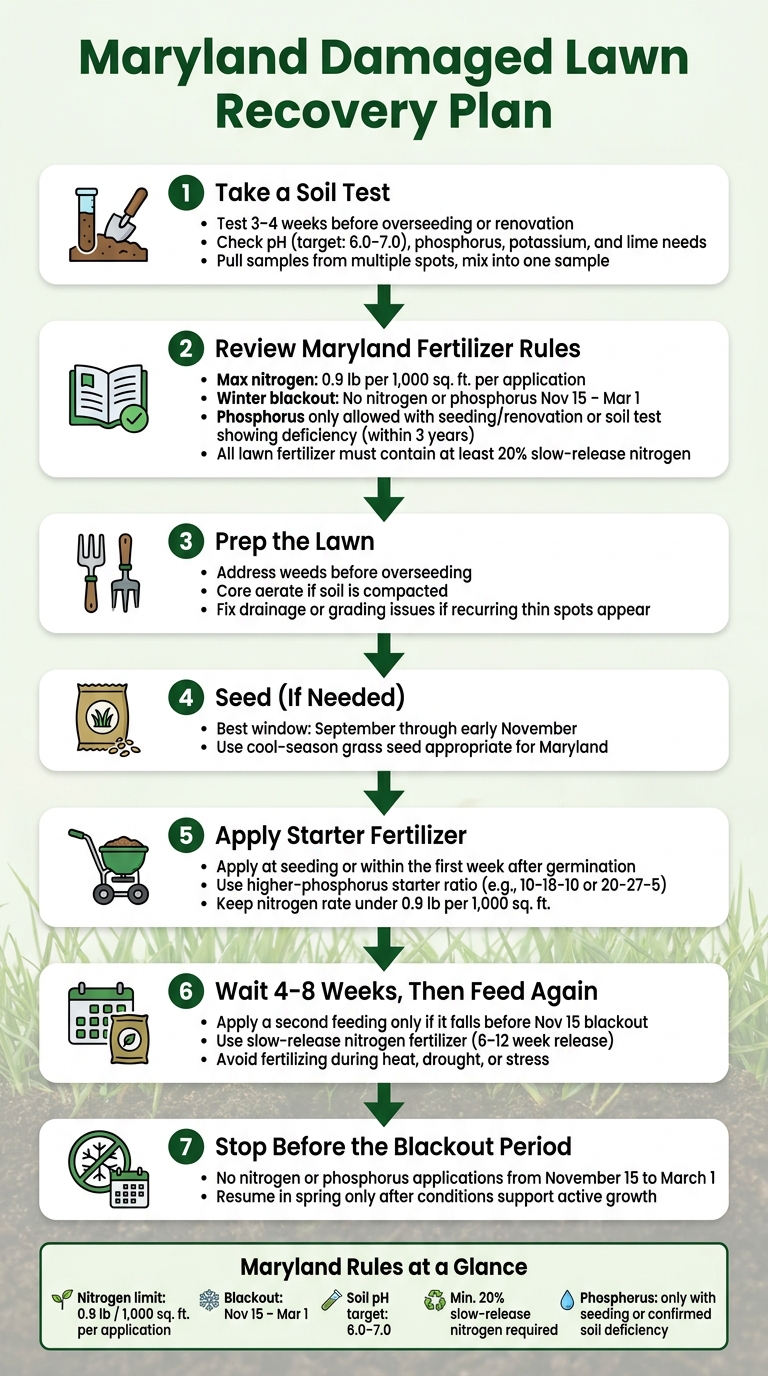
Maryland Damaged Lawn Recovery Plan: Step-by-Step Fertilizer Guide
How to fertilize your lawn and protect the Chesapeake
sbb-itb-843f8be
Start with soil testing and Maryland fertilizer rules
Start with a soil test so you can match your fertilizer to the lawn’s recovery stage. It’s the simplest way to know what the soil needs before you spend money on the wrong product.
How to take a soil test
Try to test 3 to 4 weeks before overseeding or lawn renovation. That window gives you time to get the results back and make any changes before seeding starts.
Use a clean trowel or soil probe and pull samples from several spots across the lawn. Then mix them together into one sample. Skip areas that were fertilized not long ago, since they can throw off the results.
How to read pH, phosphorus, potassium, and lime recommendations
Your soil test will show a few numbers, but pH is one of the big ones. For Maryland turf, the ideal soil pH is 6.0 to 7.0. That matters because soil pH affects nutrient availability. In plain English, it helps decide how well your grass can use the nutrients already sitting in the soil.
If the pH is too low, the report may tell you to add lime. It should also show whether your lawn needs phosphorus or potassium, which makes it easier to choose the right fertilizer analysis.
Maryland fertilizer application limits homeowners must follow
These rules matter most when you’re reseeding or fixing damaged turf. Before you spread anything, check these limits:
| Rule | Details |
|---|---|
| Winter blackout period | No nitrogen or phosphorus applications between November 15 and March 1 |
| Per-application nitrogen limit | Maximum 0.9 lb. of nitrogen per 1,000 sq. ft. per application |
| Phosphorus restriction | Phosphorus is allowed only when a soil test from the past 3 years confirms a deficiency, or the application is part of a seeding or renovation project |
| Setback requirement | Follow setback rules near waterways, storm drains, driveways, and sidewalks |
For damaged lawns, phosphorus may be allowed during seeding or renovation if the soil test supports it. If you’re not seeding or renovating, stick with a phosphorus-free product unless the soil test shows a deficiency.
With your soil test in hand, you’re ready to pick a fertilizer that fits the lawn’s condition and the time of year.
Choosing the right fertilizer for thin or stressed turf
Once the soil test is done, the next move is picking a fertilizer that fits the lawn’s repair stage. Thin or patchy turf does best with light, measured feeding. Too much fertilizer can push top growth faster than weak roots can handle, which can slow recovery.
Slow-release vs. quick-release nitrogen for lawn recovery
Slow-release nitrogen breaks down over 6–12 weeks with help from soil microbes and moisture. That steady feed supports root growth without the spike-and-drop pattern you often get from fast-acting products. For most damaged Maryland lawns, that makes slow-release nitrogen the go-to option.
| Feature | Slow-Release Nitrogen | Quick-Release Nitrogen |
|---|---|---|
| Release Pattern | Gradual (6–12 weeks) | Immediate (2–4 weeks) |
| Risk of Fertilizer Burn | Very low | High, especially on thin turf |
| Best Timing | Maintenance and recovery | Early spring green-up |
| Cost | Higher | Lower |
| Impact on Damaged Lawns | Supports steady, deep root growth | Can cause surge growth that stresses weak roots |
There’s also a legal piece here. Maryland law requires that at least 20% of the nitrogen in any lawn fertilizer be in slow-release form, so this isn’t just a lawn-care call. It’s also a compliance issue.
When to use starter fertilizer after seeding or patch repair
If you’re seeding bare spots or doing a full renovation, starter fertilizer is usually the right pick. These products have a higher phosphorus number in the N-P-K ratio because phosphorus helps new seedlings build roots early. Common starter ratios include 10-18-10 and 20-27-5.
Phosphorus is allowed when you’re establishing, patching, or renovating a lawn with seed or sod. Before you buy, check the Guaranteed Analysis on the bag. Then make sure the nitrogen rate keeps you under Maryland’s 0.9 lb. of nitrogen per 1,000 sq. ft. per-application cap.
Timing matters too. Apply starter fertilizer at seeding or within the first week after germination, since phosphorus tends to stay close to where the roots are forming.
Organic vs. synthetic fertilizers and spreader calibration basics
Once you’ve picked the nutrient type, match the product to how fast the lawn needs to bounce back. Organic fertilizers feed soil biology and come with very little risk of fertilizer burn. Synthetic fertilizers act faster and give you tighter control at a lower cost per pound, but they need careful spreader setup on stressed turf.
A simple mistake can cause trouble here. Calibrate the spreader on a hard surface before applying anything to the lawn. Even a small over-application can burn new grass and stall recovery.
For damaged turf, the best fertilizer is the one that fits the seeding stage, nitrogen release speed, and application rate.
Timing fertilizer applications around seeding and seasonal recovery
Once you’ve picked the right fertilizer, the next job is timing. In Maryland, that matters a lot in the fall. You want each step to line up with the state’s main recovery window, so the lawn has time to fill in without getting pushed too late in the season.
The right order for lawn renovation: test, prep, seed, then feed
Start with a soil test. Then deal with weeds before overseeding, core aerate if the soil is compacted, overseed with a cool-season grass, and apply starter fertilizer at seeding or right after, based on the label.
That order helps each step do its job. If you skip ahead and feed at the wrong time, you can make the process messier than it needs to be.
A Maryland fertilizer calendar for damaged lawns
Use this schedule to match feeding with Maryland’s fall recovery window.
| Timing | Fertilizer Action |
|---|---|
| September through early November | Best recovery window for damaged Maryland lawns |
| At seeding | Apply starter fertilizer at seeding or immediately after |
| 4 to 8 weeks after starter | Make the next application if it still falls before Maryland’s blackout period |
This spacing keeps recovery feeding steady without pushing too much growth late in the season.
How long to wait between applications
After the first starter application, wait 4 to 8 weeks before feeding again. The key condition is simple: that next treatment still needs to land before Maryland’s blackout period.
In plain English, think of starter fertilizer as the first push and the next feeding as backup. Close enough to support recovery, but not so late that you run into timing problems.
Mistakes that slow lawn recovery and when to call for help
Even a good fertilizer plan can backfire if the timing or amount is off.
Over-fertilizing, fertilizing in heat, and skipping soil testing
Too much nitrogen can burn turf and slow recovery. Fertilizing too often can do the same thing. The grass never gets time to settle between treatments, so instead of bouncing back, it stays under stress.
Hot weather and drought make this worse. If the lawn is already struggling, adding fertilizer usually won’t help much. In many cases, it just piles on more stress.
Skipping a soil test is another common miss. Without one, you don’t know your soil pH or whether phosphorus and potassium are low. A fertilizer plan works best when the test results, timing, and application rates line up with the lawn’s actual condition.
How to spot fertilizer burn and reduce further damage
Watch for brown, scorched leaf tips, streaking, or a white salt crust. Those are common signs of fertilizer burn. If you see them, stop fertilizing right away. Adding more can make the damage worse.
If the same spots keep struggling, fertilizer may be treating the symptom instead of the cause. When thinning comes back even after proper feeding, the issue is often drainage or grading, not fertilizer.
When Pro Landscapes MD can help with lawn recovery

When thin spots keep showing up in the same areas, it may be time to look past feeding and fix the site itself. Pro Landscapes MD serves central Maryland with lawn care, restoration, grading, yard leveling, drainage repair, and French drains. If those problem spots won’t stay fixed, drainage or grading work may be what finally solves it.
Final checklist for a damaged Maryland lawn fertilizer plan
Before you spread fertilizer, run through this final checklist. It helps you avoid guesswork and gives your lawn a better shot at bouncing back.
Key steps to complete before your next fertilizer application
Use this checklist before your next fertilizer application:
- Start with a soil test. Check pH, phosphorus, potassium, and lime needs before you put anything down.
- Check Maryland fertilizer rules and follow application limits.
- Use a slow-release nitrogen fertilizer.
- Time applications for fall recovery.
- Test, prep, seed if needed, then feed.
FAQs
How do I know if my lawn needs lime?
The only dependable way to tell whether your lawn needs lime is to get a soil test. Maryland soils often trend acidic, so a test will show if your pH falls below the ideal 6.0 to 7.0 range.
The University of Maryland Extension offers soil testing resources that can give you clear lime recommendations. Testing every 2 to 3 years helps you avoid putting down lime when you don’t need it and helps keep your grass growing well.
What fertilizer analysis should I buy for overseeding?
Start with a soil test before you buy fertilizer for overseeding. That step matters for two reasons.
First, in Maryland, phosphorus is restricted unless your test shows a deficiency. So the lab results tell you whether you can use a fertilizer that includes phosphorus at all.
Second, nitrogen doesn’t stay the same in soil for long. Even so, a professional lab can still suggest the right amount to apply. Maryland also requires fertilizer to contain at least 20% slow-release nitrogen, which helps support steadier growth and cuts down on runoff.
Why is my lawn still thin after fertilizing?
If your lawn is still thin after fertilizing, the problem may not be the fertilizer itself. In many cases, something else is stopping nutrients from getting to the roots or helping the roots do their job.
Check for compacted soil, excess thatch thicker than 0.5 inches, pests, fungal disease, or a pH imbalance. A professional soil test can also help pinpoint specific nutrient deficiencies or other chemical needs.
Chat with Us