









- bhavya gada
- No Comments
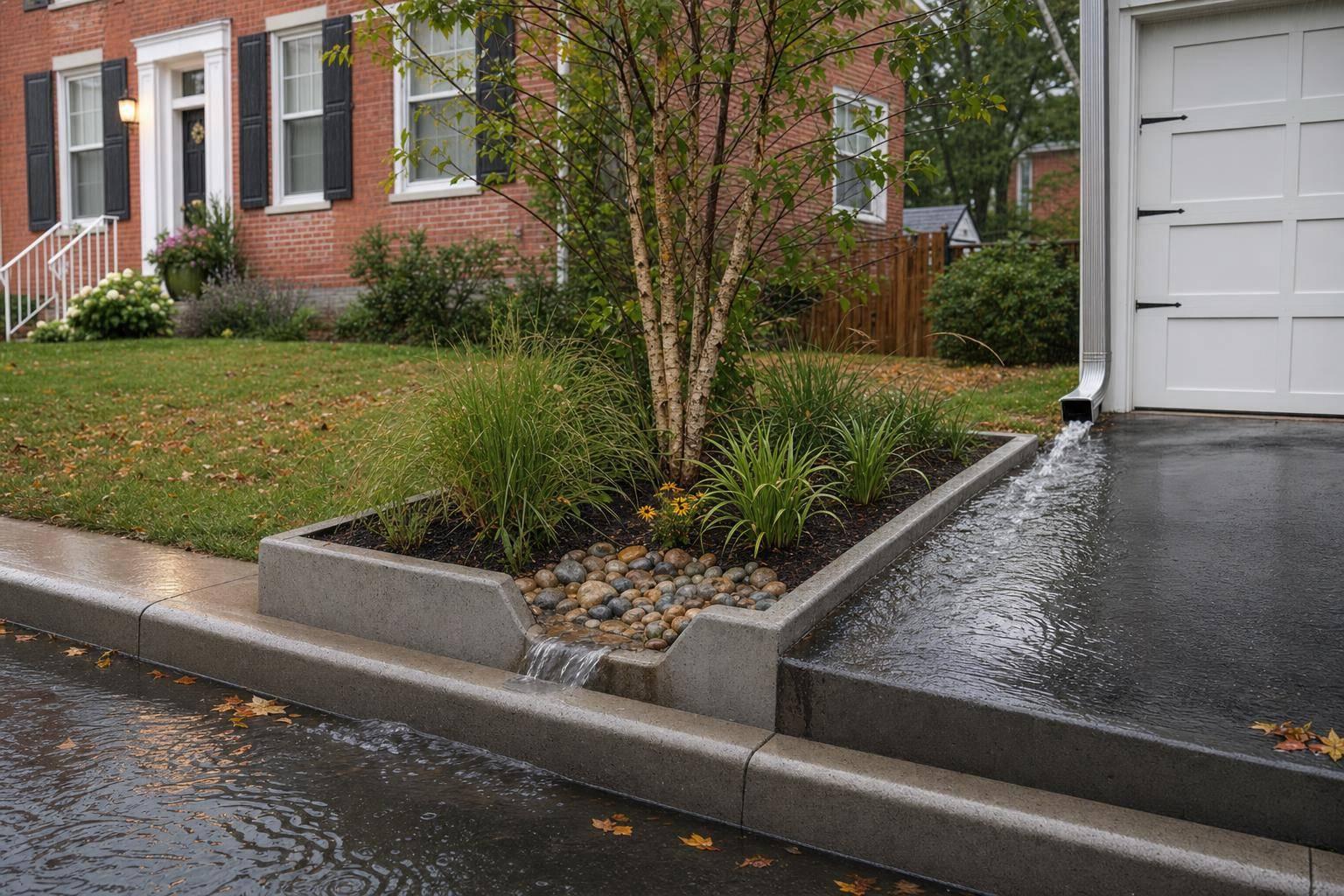
If you have a small lot in Maryland, a Filterra system can treat runoff in a tight space and cut pollution before water leaves your property. Based on the research in this article, these units remove 87% of TSS, 80% of phosphorus, and 70% to 79% of key metals in test data, while treating more than 90% of annual rainfall volume in monitored use.
Here’s the short version:
- Best use: small residential lots, retrofits, and places where full soak-in systems do not fit
- Main job: clean runoff from roofs, driveways, and paved areas
- Strong points: small footprint, underdrain design, and good removal of sediment, phosphorus, metals, and hydrocarbons
- Limits: nitrogen results vary, and flow control drops during larger storms
- Maryland fit: accepted by the state as an ESD practice and tied to Bay cleanup goals
- Long-term care: simple surface maintenance, with media life of 20+ years and plant life of 10 to 20 years
In plain terms: if you need stormwater treatment on a compact home site, Filterra is one of the better-studied options for this type of setup in Maryland. I’d frame it as a space-saving treatment system first, and a flow-reduction tool second.
How the Filterra Stormwater Bioretention System Works – Contech Engineered Solutions
sbb-itb-843f8be
How Filterra Systems Work on Residential Properties
Now that the basic idea is clear, here’s how Filterra moves water through a small residential space.
The flow path is simple: runoff enters the unit, moves through filtration layers, and exits as treated water. In plain terms, water comes in dirty, passes through the system, and comes out cleaner.
Core Components: Inlet, Engineered Media, Mulch, Plants, Stone Layer, and Underdrain
Runoff enters through a curb inlet, grate, or pipe connection, depending on the site setup. It first passes through a mulch layer, which catches heavy sediment and helps shield the media below from erosion.
From there, water moves into the engineered filter media. This is where much of the work happens. Pollutants get trapped and are biologically processed inside the system. The treated water then drains into a stone layer at the bottom, where an underdrain collects it for final discharge. [2]
Plants play an important role too. They help keep the media porous and store captured pollutants in plant biomass. Some Maryland installations also use a sediment chamber to remove large debris before the water reaches the filter media. [2]
Why High-Flow Media Allows a Smaller Footprint
Filterra’s high-flow media can treat runoff at rates of up to 324 inches per hour, which cuts down the surface area the system needs. [2]
That’s a big deal on residential lots where space is tight. It makes Filterra a good fit for compact retrofits like front yards, narrow side yards, and driveway edges. A typical setup needs about 30 inches of elevation difference from inlet to outlet. [2]
Where Filterra Fits Into Maryland Landscape and Drainage Plans
Filterra can connect to roof downspouts, yard drains, curb inlets, or pipes. For larger storms, offline and peak-diversion layouts send excess flow around the unit and into downstream drainage. [2]
There’s also a Bioscape version that blends right into the landscape. [2]
These design details set up the performance results covered next.
What Studies Show About Pollutant Removal and Runoff Control
Filterra Bioretention System: Pollutant Removal Performance Data
With the system design in place, the studies below show how Filterra performs in actual use.
Pollutant Removal: Sediment, Nutrients, Metals, and Hydrocarbons
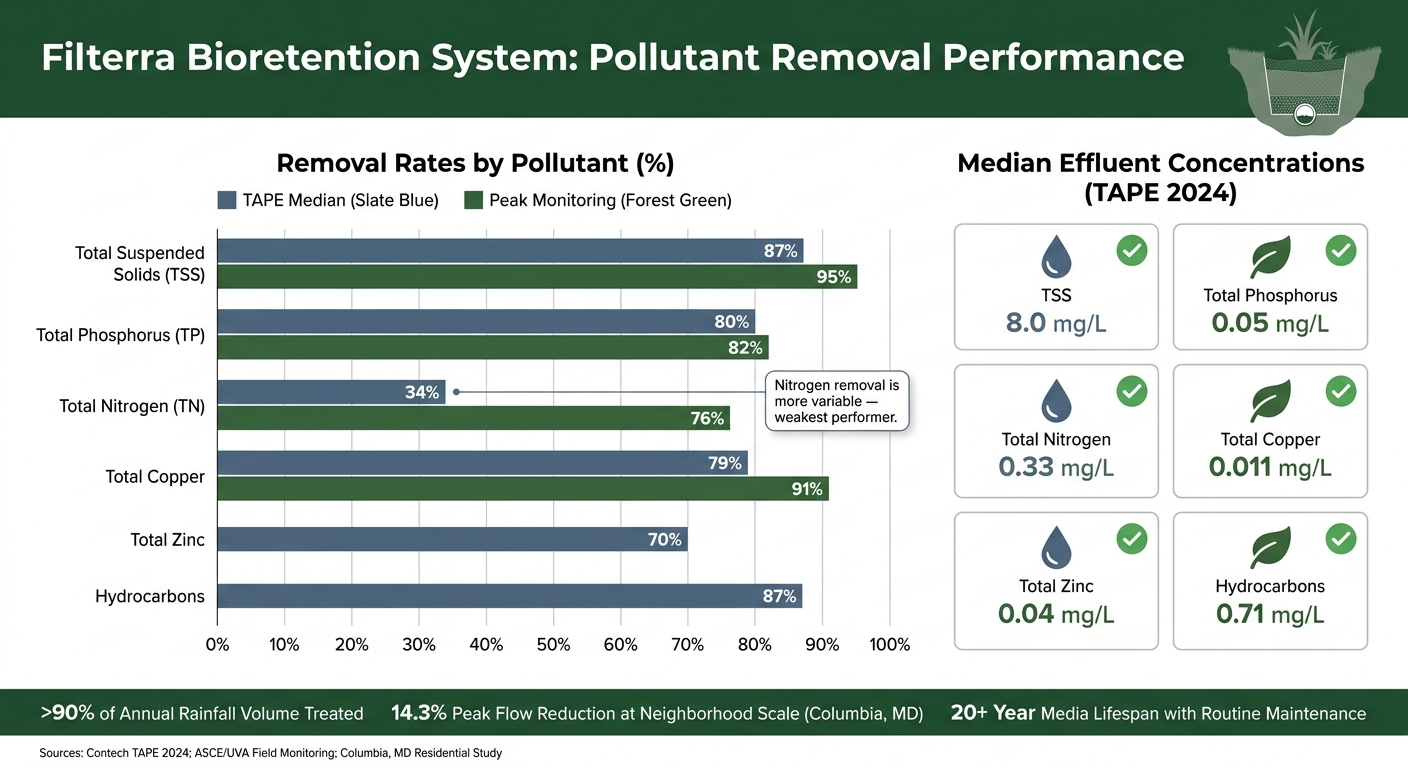
Test data and field monitoring point in the same direction: Filterra does a strong job removing sediment, phosphorus, metals, and hydrocarbons. Nitrogen results are more mixed.
TAPE testing found 87% TSS removal, 80% TP removal, 34% TN removal, 79% total copper removal, 70% total zinc removal, and 87% hydrocarbon removal [2].
ASCE field monitoring showed even higher peak observed removals in some cases, including 95% for TSS, 82% for TP, 76% for TN, and 91% for total copper [1].
That said, water-quality performance is only part of the story. Storm size also shapes how much runoff the system can treat before flows move past treatment capacity.
Hydraulic Performance: Flow Rates, Capture, Overflow, and Large Storm Behavior
Filterra systems treat more than 90% of annual rainfall volume [1]. That’s a strong result, but performance shifts with storm size.
Maryland studies found that peak flow reductions are much greater for storms under 0.5 inches than for events over 1.5 inches [3]. So the system tends to do its best work during smaller, more frequent storms rather than the big downpours that hit all at once.
The Maryland residential data also showed neighborhood-scale runoff control. In a 3.1 km² residential watershed in Columbia, MD, treating 100% of rooftops could cut peak flows by 14.3% and runoff volumes by 11.4% [3].
When flows go beyond treatment capacity, internal bypass and peak-diversion layouts help limit scour [2].
Study Summary Table: Reported Performance Data
| Pollutant / Metric | Median Removal (TAPE 2024) | Peak Monitoring Result | Median Effluent Concentration |
|---|---|---|---|
| Total Suspended Solids (TSS) | 87% [2] | 95% [1] | 8.0 mg/L [2] |
| Total Phosphorus (TP) | 80% [2] | 82% [1] | 0.05 mg/L [2] |
| Total Nitrogen (TN) | 34% [2] | 76% [1] | 0.33 mg/L [2] |
| Total Copper | 79% [2] | 91% [1] | 0.011 mg/L [2] |
| Dissolved Copper | 56% [2] | – | 0.007 mg/L [2] |
| Total Zinc | 70% [2] | – | 0.04 mg/L [2] |
| Dissolved Zinc | 66% [2] | – | 0.02 mg/L [2] |
| Hydrocarbons | 87% [2] | – | 0.71 mg/L [2] |
Sources: Contech (TAPE) 2024 [2]; Herrera (TAPE) 2009 [2]; ASCE/UVA field monitoring [1]; Columbia, MD residential study [3]
Maryland Applications, Maintenance, and Long-Term Results
Best-Fit Residential Uses in Central Maryland
Treatment results matter, but day-to-day fit on the lot matters just as much. On small residential lots in Central Maryland, Filterra can handle runoff from roofs, driveways, and small paved areas, especially where native soils do not infiltrate well. Because the system uses an underdrain, it works in places where full-infiltration designs are not feasible. [2]
Routine Maintenance Documented in Guidance and Case Monitoring
Upkeep is straightforward, which is a big deal for homeowners and property managers. Routine work usually comes down to clearing debris from the inlet, adding mulch as it breaks down, and replacing plants when they decline. Fall inspections are especially helpful because they reduce the chance of leaf buildup and clogging. When the system drains as intended, it also tends to return to normal function after snow and ice melt. [2]
Long-Term Performance and Maintenance Findings Table
Published guidance says Filterra media can last more than 20 years with routine maintenance. Trees and other plantings in the system usually last 10 to 20 years before replacement is needed. [2]
| Monitoring Aspect | Documented Finding | Practical Takeaway |
|---|---|---|
| Media lifespan | 20+ years with routine maintenance [2] | Long service life with periodic upkeep |
| Maintenance access | Surface-level only; no confined space entry [2] | Routine work can be handled with standard landscape tools |
| Maintenance frequency | Typically annual or semi-annual inspection [2] | Regular checks help prevent clogging and bypass |
| Vegetation lifespan | 10–20 years [2] | Plants are a long-term part of the system |
| Winter performance | Resumes normal function after freeze-thaw cycles when properly drained [2] | No special winterization is usually needed |
Conclusion: What the Research Means for Maryland Homes
Key Findings to Remember
Taken together, the design, performance, and maintenance data lead to three plain takeaways: in Maryland, Filterra works best as a compact, high-performance source-control system for residential runoff on small lots and retrofit sites.
Research shows strong removal of sediment, phosphorus, metals, and hydrocarbons, with weaker nitrogen removal.[2] That level of performance helps explain why Maryland treats Filterra as a recognized ESD practice. Maryland recognizes Filterra as an Environmental Site Design practice, which lines up with Chesapeake Bay water-quality goals.[2]
For residential projects, placement and grading matter just as much as the unit itself. If grading stays stable, plants are well suited to the site, and the system gets routine inspection, Filterra media is documented to perform for more than 20 years.[2]
Pro Landscapes MD can fit Filterra into a broader residential drainage plan in central Maryland.
FAQs
How much space does a Filterra system need?
Filterra systems are compact solutions built for urban and residential spaces where land is tight. They use specialized, high-flow-rate media to treat drainage well while taking up very little room.
In many cases, they use only about 0.2% of the drainage area. That small footprint makes them easy to work into landscape settings without cutting stormwater management performance.
Will Filterra help during heavy Maryland storms?
Yes. Filterra Bioretention Systems are built to manage stormwater during storms and can handle high flow rates of up to 324 inches per hour.
If rainfall goes beyond the system’s treatment capacity, the extra water moves through a bypass – such as a downstream inlet structure or curb cut – to help prevent ponding or pooling.
How often does a Filterra system need maintenance?
Maintenance frequency depends on site conditions, but a Filterra system is built for simple, routine upkeep that landscape contractors or maintenance crews can handle.
Typical work includes removing trash, sediment, and old mulch, then adding a new 3-inch layer of mulch. Since the system can be reached from the surface, crews don’t need confined space entry or special equipment.
Chat with Us