









- bhavya gada
- No Comments
Choosing between flagstone and pavers for your Maryland patio comes down to durability, cost, and style. Maryland’s climate – with its freeze-thaw cycles, heavy rainfall, and clay-heavy soil – makes material selection critical for long-lasting outdoor spaces. Both options are durable and weather-resistant, but they differ in appearance, cost, and installation.
- Flagstone: Natural stone with a rustic look. Durable, slip-resistant, and blends well with Maryland’s landscapes. Costs $10–$25 per square foot installed. Labor-intensive to install but lasts up to 100 years.
- Pavers: Manufactured materials offering uniformity and a range of styles. Easier to install, more affordable ($10–$24 per square foot), and suitable for modern designs. Permeable options help with drainage.
Quick Takeaway: Choose flagstone for a timeless, natural aesthetic and longevity. Opt for pavers if you want affordability, design flexibility, and easier maintenance. Proper installation is key to handling Maryland’s challenging weather and soil conditions.
Flagstone vs Pavers: Which is Best for Your Patio?
sbb-itb-843f8be
What Is Flagstone?
Flagstone is a flat, natural stone known for its irregular shapes and interlocking design. It’s often made from sandstone, limestone, slate, bluestone, or quartzite, giving it a one-of-a-kind appearance. Unlike manufactured pavers, each flagstone piece is distinct, creating a rustic, natural look. This makes it a popular choice for Maryland homeowners looking to design patios that complement the local landscape.
The material is long-lasting and resistant to cracking, making it an excellent option for outdoor spaces exposed to heavy foot traffic, moisture, and fluctuating temperatures. It also provides strong slip resistance, which is especially useful for areas like pool decks and walkways. With proper installation and care, flagstone maintains its beauty and functionality for decades.
Flagstone Characteristics
Flagstone’s natural properties make it an excellent material for outdoor use. It’s highly resistant to weather and performs well through Maryland’s freeze-thaw cycles, heavy rains, and humid summers. Its textured surface also offers good traction, even when wet, reducing the likelihood of slips.
"Flagstone is a favorite in Howard County due to its natural look that blends perfectly with wooded landscapes and rolling hills", says Rhine Landscaping [2].
The stone comes in earthy tones like blue-gray, buff, and brown, which align beautifully with Maryland’s scenery. Bluestone, a denser variety, is known for its sophisticated blue-gray color and stays cooler under direct sunlight, making it ideal for upscale patios and steps. Travertine, another type of flagstone, is naturally porous and heat-resistant, making it a smart choice for pool decks. While flagstone is generally easy to maintain, some types, like bluestone, may benefit from sealing to prevent fading and simplify cleaning. These qualities make it a go-to material for many outdoor projects in Maryland.
How Flagstone Is Used in Maryland
In Maryland, flagstone is a popular choice for patios, walkways, pool decks, and garden features. Its natural look blends seamlessly with the wooded landscapes and rolling hills found in areas like Howard County. Skilled masons can use its irregular shapes to create custom patterns that mimic organic stone paths, adding to its charm.
Flagstone is also gaining popularity for newer applications like outdoor kitchen floors, fire pit surrounds, and garden pathways. Whether cut into uniform shapes for a polished look or left irregular for a more rustic feel, it’s versatile enough to suit a variety of styles. This adaptability makes it a staple for Maryland homeowners seeking a natural yet functional design for their outdoor spaces [3].
What Are Pavers?
Pavers are man-made hardscaping materials designed for outdoor spaces like patios, driveways, and walkways. Typically crafted from concrete or brick, they offer precise control over both strength and appearance, giving homeowners a wide range of options to suit their needs.
Thanks to their modular design, pavers are easier to install than irregular natural stones. Each piece is engineered to fit together seamlessly, speeding up the installation process. Plus, manufacturers can create pavers in various colors, textures, and styles, some of which mimic the look of natural stone or brick. These qualities make pavers a practical and stylish choice for many Maryland landscapes.
Concrete pavers, in particular, are a cost-effective hardscaping solution for homeowners in Maryland. They’re durable yet more affordable than many natural stone options. This affordability, combined with their design flexibility, makes them especially popular in areas like Columbia, Maryland. For properties dealing with drainage issues, permeable pavers are a smart choice. These specialized designs allow water to flow through the joints and into the ground, helping to manage stormwater during Maryland’s frequent heavy rains.
Paver Characteristics
Pavers come in a variety of shapes, colors, and textures, making them suitable for both modern and classic designs. Their uniform shape not only makes installation easier but also simplifies maintenance. If one paver gets damaged, it can be replaced individually without disturbing the rest of the surface – something that’s much harder to do with natural stone.
To install pavers, you’ll need a compacted base of crushed stone or gravel to ensure stability and prevent shifting. A thin layer of sand is added on top to allow for leveling adjustments during the laying process. Once the pavers are in place, the joints are filled with sand or mortar to lock them in and help prevent weed growth. Finally, a compactor is used to press the pavers firmly into the bedding material, creating a stable and long-lasting surface.
How Pavers Are Used in Maryland
Pavers are highly adaptable and work well in a variety of outdoor settings across Maryland. They’re commonly used for driveways, walkways, and patios, especially in high-traffic areas like entryways. Their durability and uniformity make them a great fit for both suburban neighborhoods and wooded landscapes in central Maryland.
Many Maryland hardscaping companies now use 3D modeling technology to help homeowners visualize different paver styles and colors in their outdoor spaces. This makes it much easier to choose the perfect design for your property.
Flagstone vs. Pavers: Direct Comparison
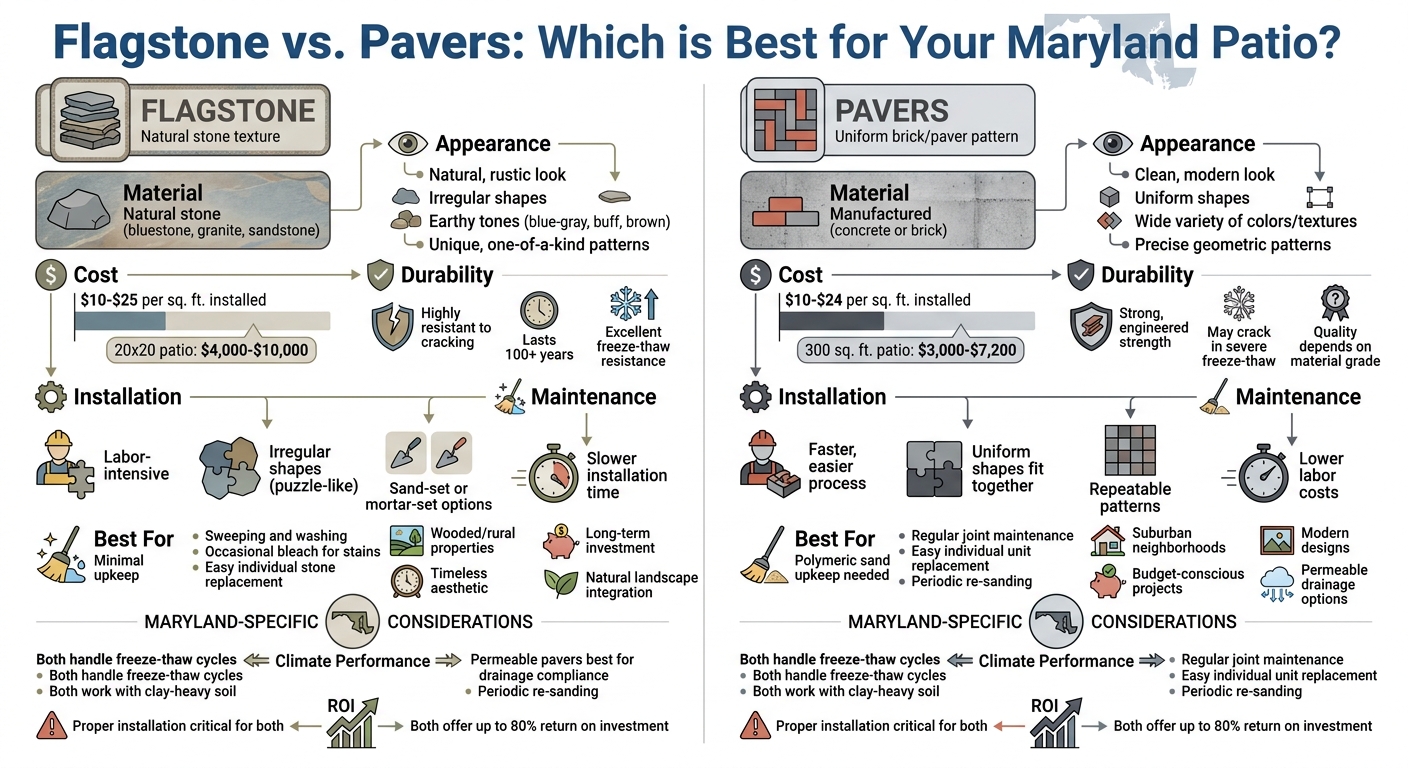
Flagstone vs Pavers Comparison for Maryland Patios
Here’s a detailed look at flagstone and pavers, focusing on key factors that matter for patios in Maryland.
Material Composition and Durability
Flagstone is a natural stone prized for its strength and resistance to cracking. In Maryland, popular choices include bluestone, known for its density and ability to endure heavy use, and granite, which is nearly indestructible and resists fading, cracking, and staining [2]. These stones are particularly suited to handle Maryland’s freeze-thaw cycles.
Concrete pavers, on the other hand, are manufactured to meet specific durability standards. While they are designed to withstand the state’s weather conditions, they can be more prone to cracking during extreme freeze-thaw cycles compared to dense natural stones like granite.
Given Maryland’s challenging weather and soil conditions, durability is a key consideration when choosing between these materials.
Installation Methods
Installing flagstone is a bit like solving a puzzle, as the stones come in irregular shapes. There are two main methods:
- Sand-set (dry-laid): Offers flexibility but may need occasional releveling as the ground shifts.
- Mortar-set (wet-laid): Creates a permanent, rigid structure that keeps the stones firmly in place.
"Though flagstone is technically easy to install, it is time-consuming and labor-intensive to install. The stones are quite heavy, so you better be prepared to put in some good sweat equity or to pay someone to do the installation for you." – Centurion Stone of Arizona [4]
Pavers, with their uniform shapes, are quicker to install. They fit together in repeatable patterns, making the process more efficient. This difference impacts both the timeline and the overall performance of your patio.
Cost Breakdown
Cost is a major factor when deciding between these materials.
- Flagstone: Installation costs range from $10 to $25 per square foot [1]. For a standard 20×20-foot patio, expect to spend between $4,000 and $10,000, depending on the stone type and site preparation [1]. Premium options like granite fall on the higher end of this spectrum.
- Concrete pavers: These are generally a more affordable option [2]. While prices vary by brand and style, pavers typically cost less than natural flagstone.
Maintenance Requirements
Flagstone requires little maintenance – regular sweeping or a light water spray is often enough [4]. For tougher stains or mold, a bleach-water solution works well. Sand-set installations may need occasional releveling, but mortar-set options usually stay put. Damaged stones are easy to replace without disturbing the rest of the patio.
Pavers require periodic upkeep, particularly with polymeric sand in the joints to prevent weed growth and maintain stability. Like flagstone, individual damaged pavers are easy to replace, though depending on the installation, replacing multiple units might be necessary.
Pros and Cons Comparison
| Feature | Flagstone | Pavers |
|---|---|---|
| Durability | Highly durable; resists cracking [2] | Strong but may crack in severe freeze-thaw cycles [2] |
| Appearance | Natural, rustic, irregular shapes [1] | Wide variety of textures and colors; some mimic natural stone [2] |
| Ease of Installation | Labor-intensive; irregular shapes [4] | Faster due to uniform shapes |
| Cost | $10 – $25 per sq. ft. installed [1] | Generally more affordable [2] |
| Maintenance | Minimal; sweeping, washing, occasional bleach [4] | Requires polymeric sand upkeep; easy to replace individual units |
| Longevity | Can last for centuries [4] | Depends on material quality |
| Drainage | Naturally porous (e.g., travertine) [2] | Permeable options available for stormwater [2] |
Performance in Maryland Climate and Soil
This section dives into how concrete pavers and flagstone hold up against Maryland’s unique environmental challenges, including its climate and soil conditions.
Freeze-Thaw Resistance
Maryland’s freeze-thaw cycles can wreak havoc on hardscaping materials, but both concrete pavers and flagstone are up to the task – though they handle it differently. Concrete pavers are specifically engineered to resist cracking caused by freeze-thaw cycles[5]. Flagstone, on the other hand, benefits from the natural density of stones like bluestone and granite, making it naturally resistant to temperature fluctuations common in colder regions[5]. As Taylor Webb from Webby Landscaping explains:
"Natural stone is also slip-resistant and can be sealed to enhance durability and prevent staining from snow and ice"[5].
Permeability and Stormwater Compliance
Managing water effectively is a big deal in Maryland, especially with the area’s frequent rainfall. Permeable pavers are designed to allow rainwater to flow through their wider joints (1/4–1/2 inch) filled with coarse aggregate and a deep gravel base of 6–8 inches[6]. This setup helps reduce surface pooling, filters out pollutants, and meets strict drainage regulations in places like Howard County[2]. Traditional flagstone and standard pavers, which use tighter joints (around 1/8 inch) filled with polymeric sand or mortar, block vertical drainage and aren’t as effective for stormwater management.
Permeable pavers also create safer conditions during winter. By allowing meltwater to drain into the subsurface, they reduce the risk of black ice forming on the surface[6]. However, this added functionality comes at a cost – permeable systems generally range from $15–$25 per square foot, compared to $10–$18 for traditional pavers[6].
Performance in Maryland’s Clay-Rich Soils
Maryland’s clay-heavy soils can be tricky, as they expand when wet and shrink when dry, potentially destabilizing hardscaping. A thorough assessment of drainage and grading is crucial to prevent issues like shifting or settling[2]. Both flagstone and pavers can perform well in these conditions if installed correctly. Flagstone’s natural durability helps it resist cracking under the stresses of soil movement[2]. Meanwhile, pavers, with their uniform design and engineered strength, are less prone to chipping or cracking under heavy use[7].
For areas with significant clay content, permeable pavers have an edge. Their superior drainage capabilities help minimize the soil’s moisture-related expansion and contraction[2]. Regardless of the material, proper base preparation by experienced professionals is critical to ensuring a stable, long-lasting installation in Maryland’s challenging soil conditions[2].
Design and Appearance Options
Flagstone and pavers each bring their own distinct visual appeal. Flagstone is all about a natural, rustic vibe, with its irregular shapes and earthy textures creating an organic, one-of-a-kind charm. No two pieces are alike, making every installation unique. As Rhine Landscaping explains, "Flagstone is a favorite in Howard County due to its natural look that blends perfectly with wooded landscapes and rolling hills" [2]. Common color choices include blue-gray bluestone, warm buff tones, and various shades of brown. For those seeking a more refined touch, premium options like granite offer hues ranging from white and pink to gray and black.
Pavers, on the other hand, are all about precision and versatility. Their machine-cut design ensures uniformity, resulting in a sleek, modern aesthetic with clean lines. The manufacturing process allows for a broader spectrum of colors, textures, and styles. Pavers can also be arranged in specific interlocking patterns – like Ashlar (8-size), Jumbo (4-size), Random (3-size), or Rectangular (5-size) – giving homeowners precise control over the final look. These differences make it easy to customize designs to suit individual preferences.
Customization Options
The natural irregularity of flagstone and the engineered precision of pavers offer unique opportunities for customization. Flagstone’s charm lies in its unpredictability. It can be installed in traditional, free-form patterns for a natural look or cut into uniform shapes for a more structured design while still showcasing its rich, varied colors. Stone Universe Inc highlights this versatility, noting that "the variety of colors found in natural stones gives any area a look that is unmatched" [8].
Pavers, by contrast, excel in offering a wide range of options through their manufactured variety. Homeowners can select from numerous colors, finishes, and textures, tailoring their patios with precise geometric layouts. Whether you prefer a sleek and modern design or something more intricate, pavers provide the flexibility to bring your vision to life.
Fitting Maryland’s Natural Scenery
When selecting materials, it’s worth considering how they complement Maryland’s diverse landscapes. For properties surrounded by woods or in rural settings, flagstone’s earthy tones and irregular shapes blend beautifully with the natural environment. Fieldstone, for instance, pairs well with traditional Maryland homes, while the blue-gray tones of bluestone add a touch of elegance to upscale entryways. In affluent areas like Clarksville and Highland, travertine’s light tones and Mediterranean-inspired look are particularly popular.
Concrete pavers, on the other hand, shine in suburban neighborhoods like Columbia. Rhine Landscaping notes that pavers are "extremely popular in Columbia neighborhoods for their versatility and affordability" [2]. Their uniform appearance works seamlessly with contemporary architecture and high-density residential designs. Beyond aesthetics, the choice of material also plays a role in how well your patio withstands Maryland’s unpredictable climate, making both flagstone and pavers practical options depending on the setting.
Cost and Long-Term Value
When planning a patio in Maryland, it’s important to weigh both the initial costs and the long-term benefits. Flagstone installation typically ranges from $10 to $35 per square foot, with premium options falling at the higher end [1][9]. Pavers, on the other hand, cost between $10 and $24 per square foot [9]. For a standard 300-square-foot patio, the total cost would be approximately $3,000 to $7,200 for pavers and $6,000 to $10,500 for natural stone [9].
Labor costs make up 40% to 50% of the total installation expense in Maryland [9]. The state’s clay-heavy soil – especially common in areas like Prince George’s County – often requires additional work, such as site stabilization or grading, which can add another $500 to $1,000 to your budget [9]. If you’re considering multi-level or curved designs, expect labor costs to rise by 10% to 20% due to the precision required for cutting and leveling [9]. Permit fees also vary by location, with costs ranging from $50 in Howard County to $300 in Baltimore County for patios larger than 500 square feet [9].
Initial Investment
While the upfront cost difference between flagstone and pavers may not always be huge, the complexity of installation can make a big impact. Flagstone’s irregular shapes require more labor, as its installation resembles solving a giant puzzle [4]. In contrast, pavers, with their uniform dimensions, are quicker and easier to install. To manage costs, you might consider phasing the project – starting with a basic patio and adding features like integrated lighting ($500–$2,000) or built-in BBQs ($3,000–$10,000) later [9]. Additionally, sourcing materials locally from Maryland suppliers can save on delivery fees, which typically range from $200 to $400 in urban areas like Rockville and Annapolis [9]. These decisions can help balance upfront costs while setting the stage for long-term satisfaction.
Lifetime Value
When it comes to longevity, flagstone stands out. It can last over 100 years [9]. As Centurion Stone of Arizona explains:
"Flagstone is a beautiful and long‑lasting stone that will require little maintenance over the years. Meanwhile, it will give you the same look and performance year after year, saving you money and the aggravation of replacing a patio you don’t really want to replace" [4].
Pavers are also durable with proper care, though their lifespan doesn’t quite match flagstone’s century-long endurance. Many professional paver installations in Maryland include warranties, such as a 5-year guarantee against settling, which can save homeowners $500 to $2,000 in potential repair costs [9]. Whether you choose flagstone or pavers, both options can deliver up to an 80% return on investment (ROI) when selling your home [9].
Ultimately, the choice depends on your budget and how long you plan to stay in your home. If you’re thinking long-term, flagstone’s durability and timeless appeal may justify its higher upfront price. For shorter timelines, pavers could offer a more budget-friendly yet dependable solution.
These factors – cost, durability, and ROI – are essential in deciding which material will work best for your Maryland patio.
Which Material Is Right for Your Maryland Patio?
When deciding on the best material for your patio in Maryland, two popular choices stand out: flagstone and pavers. Each has its own set of advantages depending on your priorities.
If you’re drawn to a natural, timeless aesthetic, flagstone might be the way to go. Its irregular shapes and natural color variations create a unique, organic look that blends beautifully with Maryland’s landscape. However, this material comes with higher labor costs due to the complexity of its installation. On the bright side, flagstone is incredibly durable and can add long-term value and appeal to your property.
On the other hand, pavers offer a more budget-friendly alternative. Their uniform size makes installation faster and less expensive, and they deliver a clean, structured design that suits a wide range of styles. Whether you choose flagstone or pavers, both materials can withstand Maryland’s climate and soil conditions – provided they’re installed correctly.
Professional Patio Installation with Pro Landscapes MD

Proper installation is key to ensuring your patio stands the test of time, especially in Maryland’s unique environment. Pro Landscapes MD specializes in designing and building patios with both flagstone and pavers, tailoring their approach to the specific needs of central Maryland homeowners.
Their team has extensive experience dealing with the area’s clay-heavy soils, which require meticulous site preparation and drainage planning. Whether you’re leaning toward the natural charm of flagstone or the clean lines of pavers, Pro Landscapes MD offers expert advice on material selection, site assessment, and installation techniques to ensure your patio is both beautiful and durable.
Final Thoughts
Both flagstone and pavers can elevate your outdoor space, combining functionality with style. Your decision should take into account your budget, design preferences, and how much value you want to add over time. For a patio that performs well and looks great for years to come, consulting experienced professionals is essential to address site-specific challenges like drainage and soil conditions.
FAQs
Which patio material handles Maryland freeze-thaw best?
Concrete pavers are an excellent option for Maryland’s freeze-thaw cycles. Their durability allows them to handle repeated freezing and thawing without cracking or shifting, making them a practical choice for the region’s challenging climate.
Do I need permeable pavers for drainage compliance?
Permeable pavers are a practical solution for managing stormwater runoff while meeting drainage compliance standards. These pavers are designed to let water flow through their surface into an underlying drainage system, reducing surface water buildup. This makes them especially useful in regions with heavy rainfall or where stormwater regulations are more stringent.
What base prep prevents shifting in Maryland clay soil?
To keep Maryland clay soil from shifting, start with proper base preparation. Install a stable sub-base using gravel or crushed stone, which helps with both drainage and support. Make sure to compact the base thoroughly to create a firm foundation and reduce the risk of movement over time.
Chat with Us