









- bhavya gada
- No Comments
If you’re planning construction or land-disturbing activities in Frederick County, MD, you’ll likely need an erosion control permit. These permits are required by local and state laws to prevent soil erosion, protect water quality, and ensure proper drainage and storm water management. Here’s what you need to know:
- When Permits Are Needed: Projects disturbing over 30,000 sq. ft. or moving more than 500 cubic yards of soil require permits. Smaller projects, like patios or retaining walls, may also need approval.
- Permit Types: Minor Grading Permits for smaller projects; Major Grading Permits for larger ones. Single-family homes may qualify for simplified agreements.
- Required Documents: Grading plans, sediment control agreements, site drawings, and financial guarantees (e.g., bonds or escrow).
- Process: Applications are submitted online. Fees apply, and inspections occur before, during, and after the project.
- Compliance: Maintain erosion controls throughout the project. Final stabilization requires 75% vegetation cover with no bare spots.
Non-compliance can lead to penalties, project delays, or permit revocation. Consulting professionals with local expertise can simplify the process and help you meet all requirements efficiently.
MDE Guidance For Protecting Stormwater Best Management Practices During Construction November 2023
sbb-itb-843f8be
When Do You Need an Erosion Control Permit?
Many residential projects require permits, and understanding when you need one can save you a lot of hassle. Let’s break down the key thresholds and project types to help you figure out your permit requirements.
Land-Disturbance Thresholds That Trigger a Permit
The size of the area you’re disturbing is the primary factor in determining your permit type. For example, in Frederick County, MD, if your project disturbs less than 30,000 square feet and involves moving less than 500 cubic yards of earth, you’ll likely need a Minor Grading Permit [1]. However, if your project exceeds either of these limits, you’ll need to go through a more detailed application process.
Even smaller grading projects, like building a new single-family home, require Micro-Stormwater Management Practices (also known as Environmental Site Design). Keep in mind that exemptions from permits don’t mean you can skip stormwater controls [1].
Common Residential Projects That Require Permits
Here are some typical projects that often require erosion control permits:
- Patios, walkways, or driveways: Whether you’re using stone, concrete, or gravel, these projects disturb soil and create surfaces that change how water drains on your property.
- Retaining walls: These structures, used for managing slopes, usually involve significant grading and soil movement.
- Land clearing and preparation: Activities like clearing vegetation, demolishing structures, or installing drainage systems (e.g., French drains or dry riverbeds) often trigger the need for erosion control measures.
Exemptions and Exceptions
Not every project requires a full permit. For example:
- Agricultural and forestry activities: Farming and timber harvesting are generally excluded from land-disturbance permits, as they don’t fall under the definition of "development" [3].
- Single-family homes: You might qualify for an "Agreement in Lieu of a Plan", which is a simplified contract outlining conservation methods without needing a full erosion and sediment control plan [3].
| Permit/Exemption Type | Threshold or Criteria |
|---|---|
| Minor Grading Permit | Less than 30,000 sq. ft. disturbed AND under 500 cubic yards of earth [1] |
| Agreement in Lieu of Plan | Applies to single-family homes under certain conditions [3] |
| Agricultural Stabilization | Returning disturbed land to its original agricultural use [3] |
Before starting your project, measure the area you’ll be disturbing. Knowing which permit applies ensures you’re ready to submit a compliant application.
How to Get an Erosion Control Permit
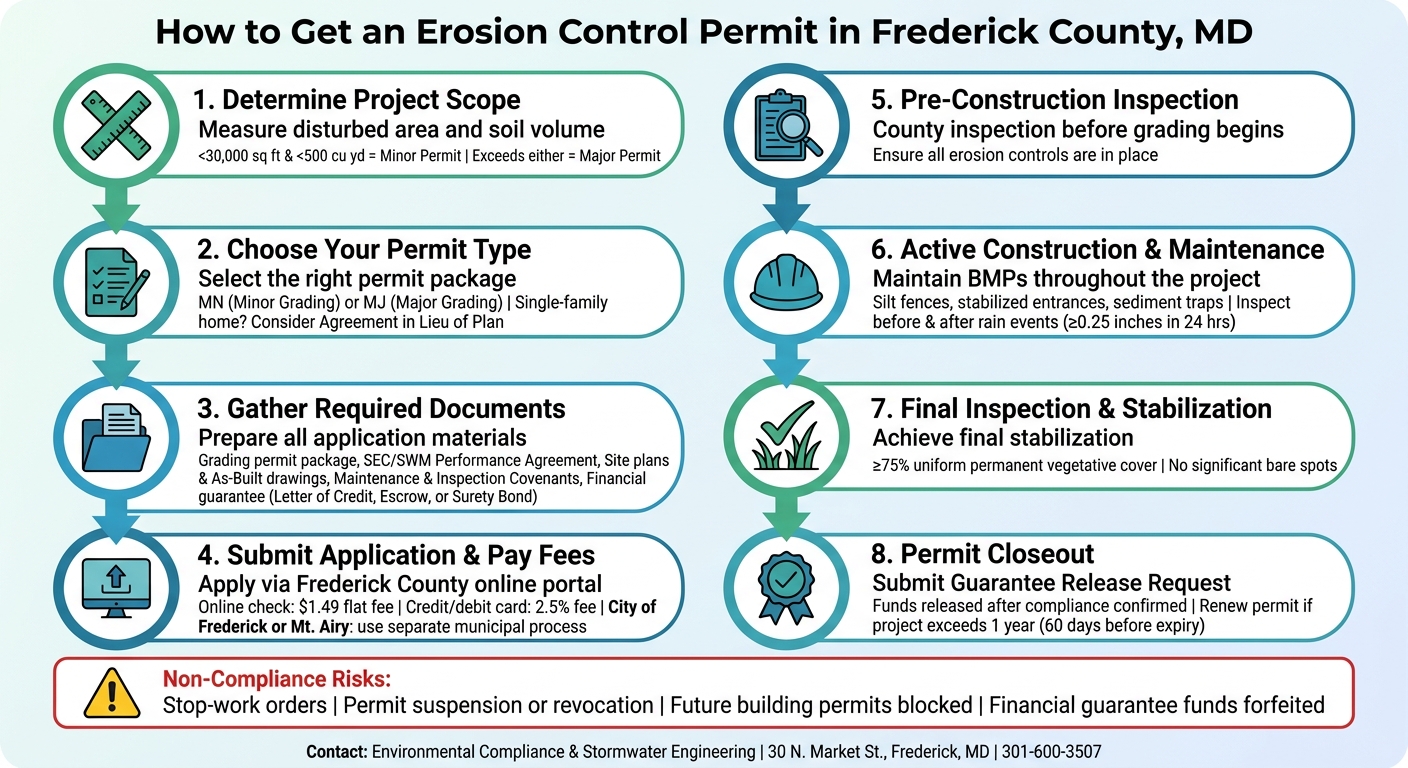
Frederick County Erosion Control Permit Process: Step-by-Step Guide
How to Prepare and Submit Your Application
Start by confirming the size and scope of your project to determine whether you need the MN (Minor) or MJ (Major) permit package – this step is crucial. Once you’ve identified the right permit type, head to the Frederick County application portal to submit the necessary forms and pay the associated fees [4]. Keep in mind that online check payments come with a $1.49 flat fee, while credit or debit card transactions will have a 2.5% fee [4]. If your property is located within the City of Frederick or Mt. Airy, you’ll need to follow their separate municipal building permit processes [4].
Documents You Will Need
Having all the required documents ready before you apply can save you a lot of time and prevent delays. Here’s a list of what you’ll typically need [1]:
- A completed grading permit package (either minor or major)
- A Sediment and Erosion Control (SEC) and/or Stormwater Management (SWM) Performance Agreement, backed by a Letter of Credit, Escrow, or Surety Bond
- A Surety Bonds Checklist (if you’re using a bond)
- Site plans and "As-Built" drawings
- Maintenance and Inspection Covenants for Environmental Site Design (ESD) practices
For single-family home construction projects, additional documents are required, including ESD flow charts, check sheets, and construction details for Micro-Stormwater Management Practices like dry wells [1]. To estimate the secured funds you’ll need, use the county’s "Cost Estimate Worksheet" along with their "Approved Unit Pricing" list [1].
If you have questions or need assistance, you can contact the Environmental Compliance & Stormwater Engineering department at 30 N. Market St., Frederick, MD, or call them at 301-600-3507 [4].
For a smoother process, consider consulting professionals who are well-versed in Maryland erosion control permits.
How Professionals Can Help
Hiring experts can make your permit application process easier and more efficient. Professionals who specialize in grading, drainage, and hardscaping – like the team at Pro Landscapes MD – can evaluate your property before you start, helping you determine the applicable thresholds and the necessary erosion control measures [2].
"Retaining walls provide essential structural support to prevent soil erosion, but they also serve as beautiful design elements." – Pro Landscapes MD [2]
Experienced crews use high-quality materials such as Techo-Bloc, Allen Block, and North American Paver to create erosion control structures that can withstand local weather conditions [2]. Scheduling a site visit early in your planning allows you to address potential issues upfront, reducing the likelihood of delays when you’re ready to submit your application.
Compliance, Inspections, and Maintenance
What Inspections to Expect
Once your permit is approved, Frederick County officials may visit your property to ensure everything aligns with the approved plan [6]. Inspections typically happen at three key points: before grading begins, during active land disturbance, and after final stabilization.
For dry-well installations, you might be able to use photo documentation instead of an on-site inspection [1]. These photos must be clear, detailed, and accurately labeled for each practice installed. To help with this process, the county provides a Dry-Well Self-Inspection Form [1]. If your project takes more than a year, remember to renew your permit at least 60 days before it expires [6].
With inspections lined up, it’s essential to keep all erosion control measures functioning effectively throughout the project.
Keeping Erosion Controls in Working Order
All Best Management Practices (BMPs) – like silt fences, stabilized construction entrances, and sediment traps – must be maintained throughout the project [5]. This is especially critical before and after rain. A measurable storm event (0.25 inches of rain or more in 24 hours) can weaken or damage poorly maintained controls [3]. These maintenance tasks are tied to the permit conditions, requiring consistent oversight until the project is finished.
Final stabilization has a clear standard: permanent vegetative cover must be uniform and cover at least 75% of the area with no significant bare spots before the project is considered complete [3]. Until you meet this standard, all erosion controls must remain in place. If you signed an ESD Inspection & Maintenance Covenant, this responsibility doesn’t end with the project – it applies to the property indefinitely [1].
Consequences of Non-Compliance
Neglecting to maintain these controls can disrupt inspections and lead to serious penalties. At a minimum, you could face a stop-work order until the issues are resolved. More severe or repeated violations might result in permit suspension or revocation, and the county could even block future building permits [6]. Financially, non-compliance can trigger the use of funds secured under your Performance Agreement [1]. These funds will only be released after you submit a Guarantee Release Request and meet all compliance and inspection requirements – making proper erosion control a responsibility that impacts both the environment and your wallet [1].
Conclusion and Key Takeaways
Let’s wrap up with a quick overview of the key responsibilities and benefits tied to effective erosion control.
Steps and Responsibilities at a Glance
Frederick County’s erosion control permit process is straightforward when broken down into steps. First, determine whether your project requires erosion control measures. Then, evaluate the scope of your project, submit the necessary documentation, and implement erosion control solutions such as retaining walls or drainage systems to manage runoff effectively. Engaging experts early in the process can help address specific site challenges. Following this process not only keeps your project compliant with local standards but also safeguards your investment.
Why Proper Erosion Control Matters
Erosion control isn’t just about following regulations – it’s about protecting your property. Without proper measures, uncontrolled runoff can erode soil, damage foundations, and even harm neighboring properties, leading to expensive repairs. Stabilizing soil and managing stormwater effectively helps preserve local waterways and ensures your property remains secure and valuable.
How Pro Landscapes MD Can Help

If your project involves land disturbance – whether it’s grading, drainage work, or hardscaping – Pro Landscapes MD has the expertise to assist. They specialize in designing and installing solutions like retaining walls, patios, and advanced drainage systems, including French drains, dry riverbeds, and rain gardens, all aimed at controlling runoff and preventing erosion. With free site visits and custom hardscaping proposals, they provide tailored solutions to meet your property’s specific needs. Reach out to Pro Landscapes MD for expert help in protecting your property from erosion.
FAQs
How do I measure my disturbed area?
To figure out the size of your disturbed area for erosion control, you’ll need to calculate the total surface impacted by activities like excavation, grading, or construction. Start by measuring the length and width of the affected zone using a tape measure or a measuring wheel. Then, multiply these two numbers to determine the area in square feet or acres. Getting precise measurements is important, especially when it comes to submitting permits and meeting local regulatory requirements.
What counts as “final stabilization”?
Final stabilization refers to the process of finishing all erosion control measures, like seeding, mulching, or setting up permanent structures, to ensure the site is stable. At this stage, the area should be secure enough to prevent erosion without needing further control efforts.
What happens if my permit expires mid-project?
If your permit expires while your project is still ongoing, you might need to either reapply for a new permit or request an extension. Working without a valid permit can result in project delays or even enforcement actions, as Frederick County closely monitors and enforces permit compliance.
Chat with Us