









- bhavya gada
- No Comments
French drains are a reliable solution for managing water issues, such as basement flooding or yard drainage problems. By directing water away from structures, they help prevent costly repairs like water damage or mold removal. In Maryland, the average cost to install a French drain in 2026 is approximately $5,750, which is 20% higher than the national average due to factors like labor rates and clay-heavy soil conditions.
Here’s a quick cost overview:
- Materials: $850–$1,800 for a 100-foot exterior drain
- Pipes: $400–$800 (corrugated or rigid PVC)
- Gravel: $300–$600
- Filter fabric: $50–$100
- Outlet components: $100–$300
- Labor and Installation: $15–$35 per linear foot for exterior systems; $60–$100 for interior systems
- Excavation, backfill, and grading add significant costs, especially in areas with clay soil.
- Additional Costs: Dry wells ($200–$3,000), sump pumps ($500–$2,500), and landscaping restoration ($500–$2,000).
Maryland’s clay-rich soil increases labor and material needs, making professional installation critical for long-lasting results. Proper planning and itemized quotes ensure transparency and help you budget effectively for your drainage project.
How Much Does Drain Installation Cost
sbb-itb-843f8be
Materials Cost Breakdown
French drain materials can be grouped into two main categories: drainage elements (like pipes and gravel) and protective components (such as filter fabric and outlets). Having a clear understanding of these costs is essential for budgeting a 2026 installation in Maryland.
The perforated pipe is a key component and comes in two main options:
- Corrugated flexible polyethylene: Costs range from $1.00 to $3.00 per linear foot. This is a budget-friendly choice for basic installations.
- Rigid PVC: Priced at $3.00 to $8.00 per linear foot, this option offers better durability and makes cleaning easier.
As the UseCalcPro Team notes:
"The extra cost [of rigid PVC] is trivial compared to digging the whole thing up in ten years because corrugated pipe collapsed." [2]
For the gravel, washed drainage gravel (or crushed stone) costs between $15.00 and $75.00 per cubic yard. A trench measuring 12 inches wide by 24 inches deep typically requires about one ton of gravel for every 15–20 linear feet [2].
Filter fabric plays a vital role in preventing clogs by wrapping around the gravel bed to block clay and silt from entering. This is particularly important in Maryland, where clay-heavy soil is common. Non-woven geotextile fabric costs $20.00–$50.00 per 100-foot roll, translating to about $0.15–$0.50 per linear foot [2].
Outlet components handle water redirection. Common options include:
- Pop-up emitters: Priced at $30.00 to $85.00 each.
- Catch basins: Costs range from $20.00 to $130.00, depending on size [1] [6].
- Standard fittings (tees, couplings, end caps): Add $2.00 to $10.00 each [2].
For a standard 100-foot exterior French drain, material costs typically fall between $850 and $1,800. Here’s the breakdown:
Next, we’ll dive into labor and installation expenses to help you complete your French drain budget.
Labor and Installation Costs
Labor makes up a hefty 80%–85% of the total cost for installing a French drain. In Maryland, hourly labor rates typically fall between $50 and $100 [5]. The total expense depends heavily on the installation method and the soil conditions. Let’s break down per-linear-foot labor rates and excavation costs so you can better plan your budget.
Per Linear Foot Labor Rates
Once material costs are accounted for, labor rates per linear foot help paint a clearer picture of your overall costs. In Maryland and the broader Northeast region, the total cost for exterior French drains (including labor and materials) ranges from $15 to $35 per linear foot. Interior basement systems, however, are much pricier, running between $60 and $100 per linear foot [2]. Maryland homeowners should expect to pay about 15% more than the national average [4], with the average project cost in the state projected to hit $5,750 by 2026.
Labor costs for specific tasks break down as follows:
- Machine excavation: $2–$6 per linear foot
- Hand digging: $3–$10 per linear foot
- Pipe and gravel installation: $2–$5 per linear foot
- Backfill and grading: $1–$3 per linear foot [2]
Interior systems come with additional costs for concrete work, such as cutting ($5–$15 per linear foot) and repouring ($5–$15 per linear foot), which explains the significant price difference.
For example, in September 2025, a contractor from UseCalcPro installed a 120-foot exterior French drain in Lehigh County for $3,360, averaging $28 per linear foot. A couple of months later, the same team completed a 90-foot interior basement drain in Allentown for $7,200 – $80 per linear foot. The higher cost came from concrete removal and the addition of a sump pump [2].
Excavation and Backfill Expenses
Excavation is a major cost factor, accounting for 25% to 40% of your total project cost [8]. This phase includes digging the trench, hauling away excess dirt (commonly referred to as "spoils"), and backfilling with gravel and soil. A typical 100-foot trench costs between $500 and $1,200 in labor [7]. However, Maryland’s clay-heavy soil can slow progress, increasing excavation time by 20% to 40% compared to sandy soil [1].
Access to the worksite can also significantly impact costs. A mini-excavator needs at least 30–36 inches of clearance to enter your yard. If that space isn’t available and crews have to dig by hand, labor costs can nearly double. As the UseCalcPro Team explains:
"The moment heavy equipment shows up, the price jumps. Soil conditions matter too… Rocky soil or soil with tree roots slows everything down and adds labor hours." [2]
Additionally, a 50-linear-foot trench generates around 6 cubic yards of excess dirt. If you need to have it professionally removed, disposal fees can add another $300 to $900 to your total [8]. Before hiring a contractor, consider digging a small test hole (18 inches deep) to check your soil type. If you encounter heavy clay or rock, be prepared for labor costs at the higher end of the range [2].
Total Project Cost Ranges by Length
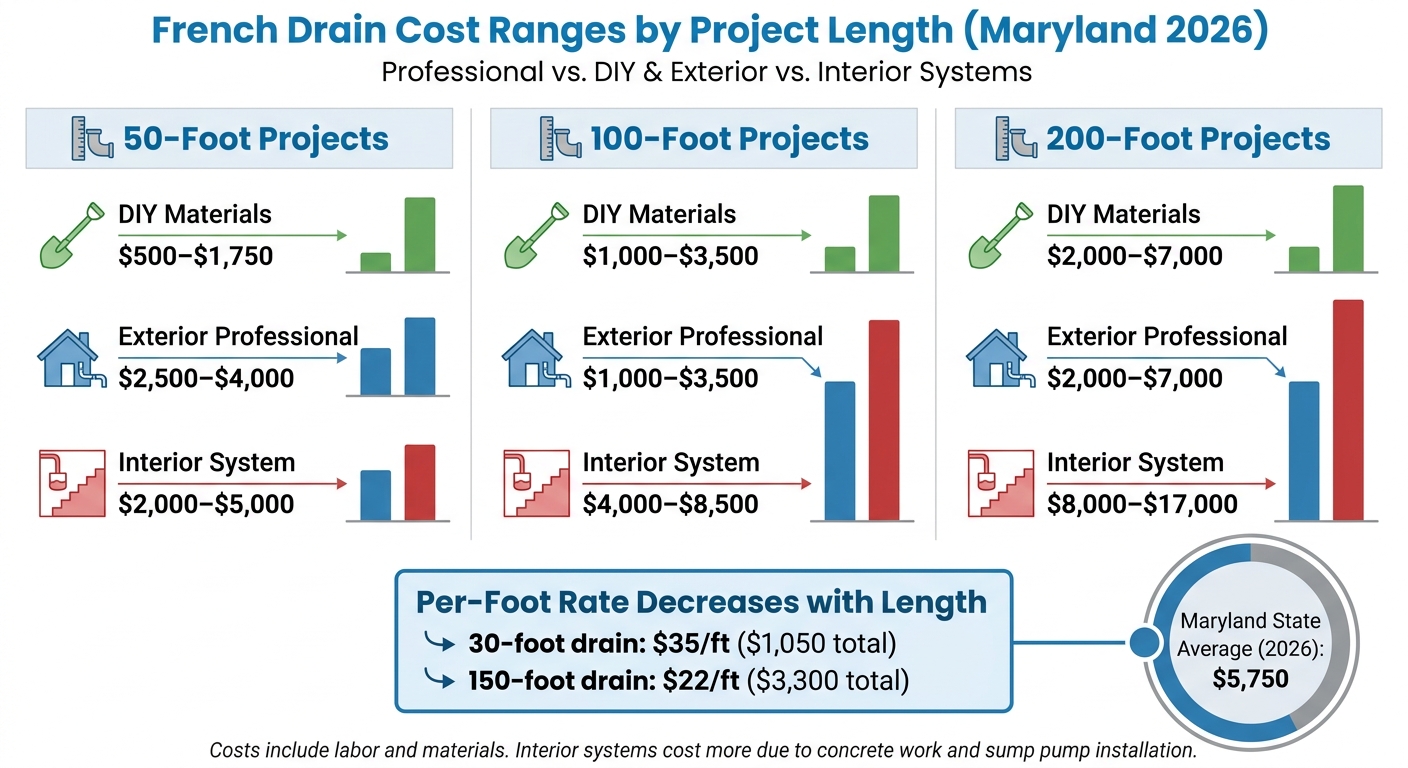
French Drain Cost Breakdown by Project Length Maryland 2026
Here’s a breakdown of cost ranges based on project length. The total expense largely depends on whether you’re installing an exterior yard drain or an interior basement system. In Maryland, factors like clay-heavy soils and higher labor costs push prices above the national average, with state estimates reaching $5,750 by 2026 [4].
Interestingly, longer installations tend to cost less per foot. The UseCalcPro Team explains:
"The per-foot rate drops because setup and teardown happen once regardless of length" [2].
This happens because fixed costs – like permits, equipment delivery, and mobilization – are distributed across the total length of the project. As a result, longer projects benefit from economies of scale, reducing the average cost per linear foot.
50-Foot French Drain Projects
For a 50-foot exterior drain, DIY materials cost between $500 and $1,750, while professional installation ranges from $2,500 to $4,000. Interior systems are pricier, ranging from $2,000 to $5,000 due to additional work like concrete cutting and sump pump installation [1][7].
100-Foot French Drain Projects
A 100-foot exterior drain typically costs $1,000 to $3,500 [7][2]. Interior basement systems for the same length are more expensive, ranging from $4,000 to $8,500 [7]. Factors like soil type and ease of access can push costs higher, especially in areas with clay-heavy ground or limited equipment access.
200-Foot French Drain Projects
For larger, 200-foot projects, exterior drain costs range from $2,000 to $7,000, while interior systems jump to $8,000 to $17,000 [7][2]. Although the total cost is higher, the per-foot rate decreases for longer runs. For instance, a 30-foot drain might cost $35 per foot ($1,050 total), while a 150-foot drain could drop to $22 per foot ($3,300 total) [2]. Renting a trencher for excavation – at $200–$400 per day [1] – can help improve efficiency on extended projects.
Maryland-Specific Factors Affecting Costs
When it comes to installing French drains in Maryland, several local factors come into play. The state’s soil composition and regional labor markets create unique pricing dynamics that homeowners should consider.
Clay Soil and Regional Variations
Maryland’s clay-heavy soil presents specific challenges for French drain installations. Clay particles are fine and tend to clog drainage systems, which means extra steps are needed to ensure the system works properly. For example, trenches in clay soil need to be wider and require more gravel to maintain proper water flow. Additionally, contractors often use non-woven geotextile filter fabric to protect the pipe and prevent sediment from building up, which is essential in these conditions [1].
Excavation costs also increase in clay or rocky soil. For a standard 75-foot drain, clay soil can add $10–$30 per linear foot, which could bring the total cost to anywhere from $2,250 to $9,000 [3]. To maximize the system’s lifespan – typically 30 to 40 years – it’s crucial to use high-quality materials and include features like clean-out access points for annual high-pressure flushing [1][6].
These soil-specific challenges contribute to cost variations across Maryland counties.
Howard County and Montgomery County Averages
Maryland falls within the Northeast pricing bracket, which is known for higher labor rates, costly disposal fees, and strict permitting requirements [2]. In Howard County, the average cost aligns with the state figure of about $5,750, while Baltimore tends to be slightly less expensive at around $5,500 [4].
Statewide, the cost per linear foot ranges from $30 to $120, compared to the national average of $25 to $100 [3]. Interior systems in Maryland and the broader Northeast region are among the priciest in the country, sometimes reaching $100 per linear foot [2]. If your project involves crossing a sidewalk or connecting to a street-side gutter, additional fees may apply. For example, right-of-way permits for curb cutting can cost $400 to $500, and public storm drain connections may add another $275 [6].
Additional Expenses and Custom Quotes
Extra features can increase your overall cost, so it’s smart to plan for these ahead of time to avoid unexpected expenses.
Dry Well Integration and Grading Add-Ons
If your property doesn’t have a natural outlet for water, you might need a dry well. Costs vary depending on the type: gravel pits run between $50 and $250, prefabricated plastic dry wells range from $200 to $700, and concrete dry wells can cost $500 to over $3,000 [7]. Before installation, a percolation test is often required to ensure your soil can absorb water properly, which typically costs between $600 and $2,000 [7].
In Maryland, many properties require yard regrading to meet the 1% slope standard, with prices ranging from $500 to $5,000 [7]. If there are obstacles like driveways or patios, expect an additional $500 to $2,000 for cutting and repairs. For flat lots or interior drainage systems, sump pump integration may be necessary, adding another $500 to $2,500 to your total [1].
"A cheap French drain is just a buried pile of rocks that will clog in two years. Get a high-capacity, engineered system backed by a 10-year guarantee." – Ware Landscaping [5]
Once the installation is complete, landscaping restoration often comes into play. Professional restoration services typically cost between $500 and $2,000, though some contractors may only include basic backfilling in their quotes [2]. To avoid surprises, always request itemized quotes that clearly outline what’s included. These extra costs highlight the importance of getting a detailed, customized quote for your French drain project.
Pro Landscapes MD Drainage Solutions Pricing

For a complete solution, Pro Landscapes MD offers pricing that includes these additional services. Their drainage solutions are specifically designed for Maryland’s clay-heavy soils and are tailored to your property’s unique needs. Their team assesses factors like topography, soil conditions, water discharge requirements, and potential obstructions such as driveways or patios. They also evaluate whether additional features like dry wells or sump pumps are needed.
Pro Landscapes MD specializes in drainage repair and yard restoration, delivering systems built to last and perform reliably. With their custom quotes, you’ll get a comprehensive plan that addresses every detail, ensuring your drainage system is both effective and durable.
Conclusion
Installing a French drain in 2026 comes with several factors that can influence the overall cost. Key considerations include the type of installation, trench depth, soil conditions, and site accessibility. In Maryland, where clay soils are particularly challenging, these factors carry even more weight [3].
When done correctly, a French drain built with rigid PVC pipe and high-quality non-woven geotextile filter fabric can last anywhere from 20 to 40 years, safeguarding your property from expensive water damage [1][2]. The difference between a system that functions reliably for decades and one that fails prematurely often lies in proper slope design, material selection, and skilled installation.
For Maryland homeowners, working with trusted local professionals like Pro Landscapes MD can make all the difference. These experts understand the region’s unique soil challenges and provide solutions tailored to ensure long-term performance. From managing clay-heavy soils to proper grading and stormwater control, their expertise ensures your drainage system is built to last.
When planning your project, request detailed, itemized quotes that outline specifics like pipe type, gravel volume, filter fabric quality, and optional features such as dry well integration. Transparent quotes help you avoid unexpected costs. With careful planning and professional installation, your French drain can provide reliable protection and lasting peace of mind.
FAQs
Do I need an interior or exterior French drain?
To tackle water issues, you can choose between an exterior French drain or an interior French drain, depending on the problem you’re facing.
An exterior French drain is perfect for controlling surface water and preventing yard flooding. It’s installed outside your home and helps redirect water away from your property.
On the other hand, an interior French drain is designed to address basement moisture problems. This option works from inside your home to manage water seeping through your foundation.
The choice comes down to your specific water management needs and where the issue is occurring.
How can I tell if my Maryland soil will raise installation costs?
Soil conditions in Maryland can make installation projects more expensive, especially if the ground is tough to dig through. For instance, clay or rocky soil often demands extra labor and specialized tools, which can drive up costs. It’s a good idea to consult a professional to evaluate your soil before kicking off your project.
What should an itemized French drain quote include?
When reviewing a French drain quote, it should clearly outline the costs for materials, labor, excavation, the type and length of pipe, as well as gravel or any other fill materials. If applicable, the quote should also cover any required permits.
If additional services are included – like installing a sump pump or repairing landscaping – these should be itemized as well. A detailed breakdown like this ensures clarity and gives you a full picture of the project’s scope.
Chat with Us