









- bhavya gada
- No Comments
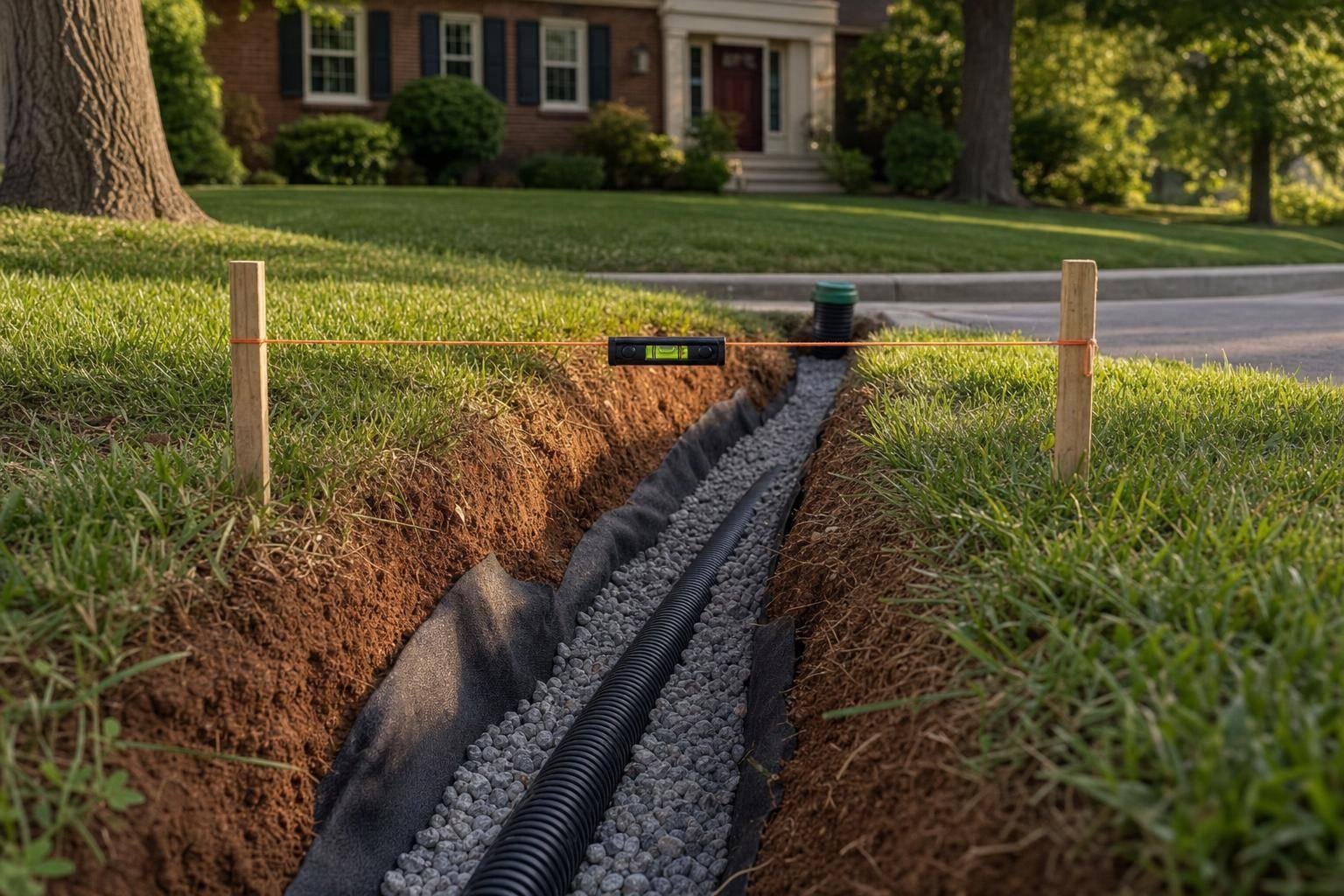
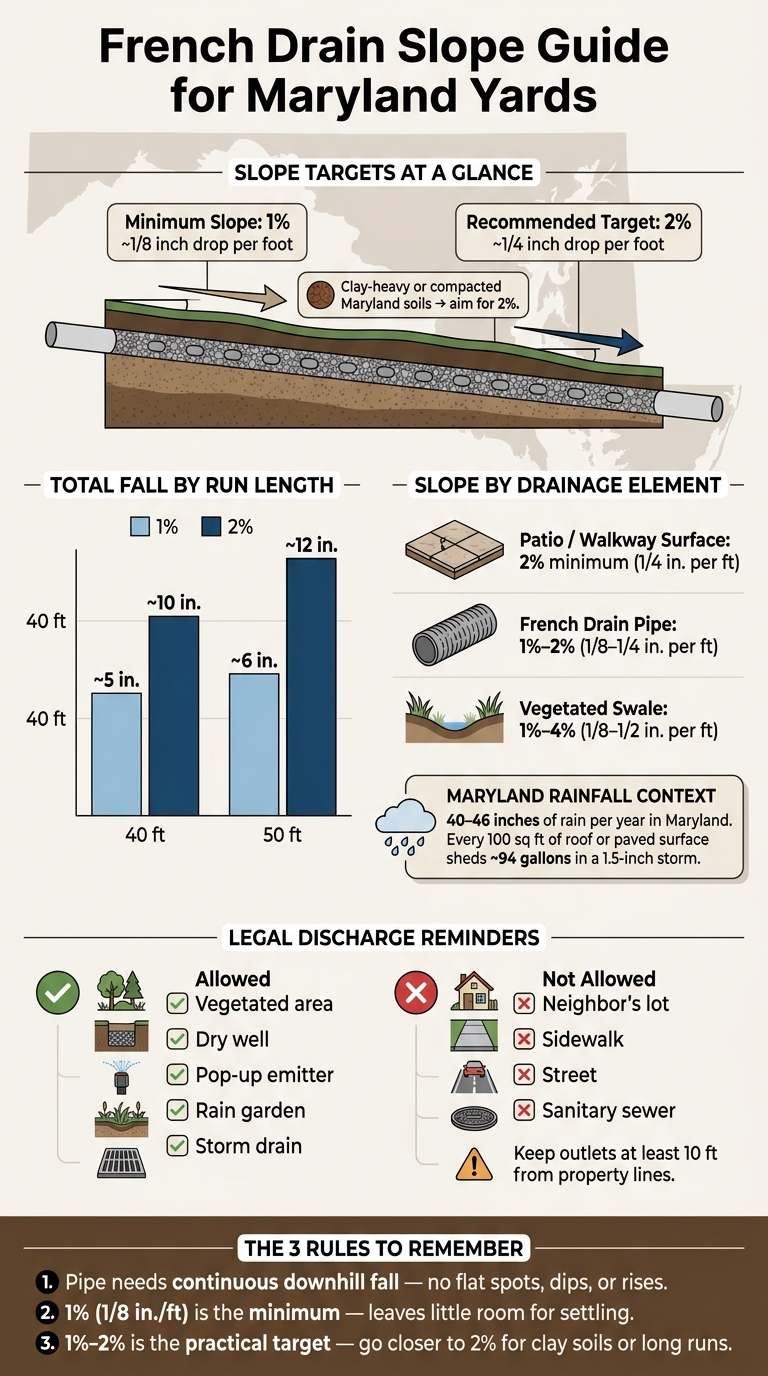
If a French drain doesn’t slope downhill the whole way, it can fail even when the pipe and gravel are installed right. In most Maryland yards, I’d aim for 1% to 2% slope on the drain pipe, with 2% often working better in clay-heavy soil or on runs that may settle over time.
Here’s the short version:
- Minimum pipe slope: about 1/8 inch per foot (1%)
- Better target: about 1/4 inch per foot (2%) when the yard allows it
- Foundation grade near the house: about 6 inches of fall in the first 10 feet
- Patios and walkways: about 1/4 inch per foot away from the house
- Outlet rules: water should not discharge onto a neighbor’s lot, sidewalk, street, or sanitary sewer
- Maryland factor: many yards deal with 40 to 46 inches of rain a year plus slow-draining clay and silt soils
A few things matter just as much as pipe pitch: the lot’s natural fall, trench depth, the outlet height, and whether runoff from patios or walkways is being sent into the right place. If any part goes flat or pitches the wrong way, water can sit in the line instead of moving out.
| Item | Good Rule to Follow |
|---|---|
| French drain pipe | 1% to 2% slope |
| 50-foot run at 1% | about 6 inches total fall |
| 50-foot run at 2% | about 12 inches total fall |
| Patio/walkway surface | 2% away from the house |
| Swale | about 1% to 4% |
I’d treat slope as only one part of the job. You also need to check the full route for dips, humps, roots, short outlet height, and legal discharge limits before digging.
That’s the main idea of this guide: pick a drain slope that fits the yard, confirm the outlet is low enough and allowed, and make sure the surface grade and underground pipe work together.
French Drain Slope Guide: Key Measurements for Maryland Yards
Maryland Site Conditions That Affect Slope Decisions
Rainfall, Storm Intensity, and Slow-Draining Soils
Maryland storms can dump enough water to overwhelm a shallow drain in a hurry. The design benchmark is 1.5 inches of rain in 24 hours – the depth used to capture roughly 90% of average annual runoff.[5][8] On a homeowner scale, Montgomery County’s small-lot drainage guidance makes that easy to picture: every 100 square feet of roof or paved surface can shed about 94 gallons in one 1.5-inch storm.[6] That’s more than enough for a side yard to start pooling fast.
Then the soil makes things harder. Clay-heavy or compacted ground drains slowly, so water lingers instead of soaking in. On a shallow slope, the pipe may not carry water away fast enough during peak flow. The pipe’s slope helps move water. The gravel helps by storing overflow until the pipe can catch up. On tight lots, trench width and outlet length can matter just as much as pipe pitch.
Storm volume is only one side of the problem. The other side is how much yard fall the site can give you.
Lot Grade, Side-Yard Fall, and Foundation Drainage Limits
Even a well-sized drain can fail if the site doesn’t provide enough downhill fall. Many Maryland residential lots are not steep. Side yards are often close to flat, and the run to the street or property line may be short. That puts a hard limit on how much steady downhill fall a French drain can get.
The IRC-based residential code, echoed by Carroll County, says the ground must slope away from foundation walls with at least 6 inches of fall within the first 10 feet, which works out to about a 5% grade.[4][9][10] If lot lines, fences, or hardscaping get in the way, the code allows a drain or swale to carry water away instead.[11] That’s where a French drain comes in – but only if the trench, pipe, and outlet all line up the way they should.
If a yard can’t get that first bit of fall near the foundation, the answer usually isn’t just a steeper pipe. More often, the fix starts with surface regrading, then adds a French drain to handle the water that surface slope alone can’t move.
How County Rules Shape Runoff Handling
Before picking a discharge route, homeowners should check a few local rules:
- Stormwater must discharge to an approved disposal point – usually a vegetated area, a dry well, or a storm drain, not a sanitary sewer.
- Runoff can’t be sent onto neighboring property, sidewalks, or public roads in a way that creates a nuisance.
- County permit and drainage-plan rules differ, so local requirements should be checked before choosing an outlet.
This comes up fast when a French drain might otherwise empty near a shared property line, the edge of a driveway, or the curb. A pipe can be sloped the right way and still create legal trouble if the outlet is not approved.
These site limits shape the slope target for the drain itself. With those limits in view, the next step is picking a slope that works in the yard, not just on paper.
sbb-itb-843f8be
Recommended French Drain Slopes and How to Measure Them
Minimum Slope vs. Working Slope for Maryland Yards
In Maryland, the bare minimum often isn’t enough. Short drain runs, settling, and slow-draining soil can all slow water down. That’s why a French drain usually needs a bit more pitch than the minimum on paper.
The minimum usable slope for a French drain is about 1%, or roughly 1/8 inch per foot.[12][14] But the better target for most yards is 1% to 2%, with 2% preferred when the site has enough fall.[14][15][2]
A 2% slope – about 1/4 inch per foot – pushes water along faster and helps carry sediment out of the line.[14][16] In compacted yards or clay-prone soil, that extra pitch is often the safer bet. A drain built right at the minimum can lose flow over time if the ground settles and creates a dip or reverse pitch.
Converting Percent Grade to Inches Per Foot and Total Fall
These conversions make it easier to match the slope to the full length of the drain.[12][14]
| Slope | Inches per Foot | Total Fall – 50-ft Run | Total Fall – 40-ft Run |
|---|---|---|---|
| 1% | ~1/8 in. | ~6 in. | ~5 in. |
| 2% | ~1/4 in. | ~12 in. | ~10 in. |
If the site doesn’t have enough fall for the slope you want, you’ll usually need to shorten the run, reroute the line, or lower the outlet.[13][16]
Simple Ways to Check Slope Before Digging
Homeowners can check a proposed drain path with a few simple methods. No special gear needed.
A string and line level stretched across the full route helps you measure vertical drop at different points. A 4-foot level with a spacer block under one end works well for checking grade over short sections. And the 100-inch rule is the easiest to remember: 1 inch over 100 inches equals 1% grade, while 2 inches over 100 inches equals 2%.[12][14]
No matter which method you use, check the entire route, not just the straight parts. Watch for:
- Humps
- Low spots
- Reverse pitch
- Tree roots
- Outlet elevation conflicts
This step tells you whether the route will drain the way you expect before you start digging.
Once the grade is set, the outlet and any surface runoff feeding the drain have to match it.
Matching French Drain Slope with Patios, Walkways, and Legal Outlets
How Patio and Walkway Runoff Should Feed the Drain
Once the trench slope is set, surface water still needs a clear path into it. Patios and walkways near the house should slope away at about 2% – about 1/4 inch per foot.[18][19][20][21] That pitch pushes water out toward the yard, where a French drain placed along the low edge can catch runoff and shallow seepage before it heads back toward the foundation.
Here’s the part people often mix up: the patio slope and the pipe slope are not the same thing. The trench still needs a steady downhill fall all the way to the outlet.[15][2][12] If the trench bottom goes flat, even for a short section, water can stall, sediment can drop out, and the line can clog.
So don’t assume the surface pitch proves the trench is graded right. Check the pipe grade on its own with a string line or level. The ground above it can look fine while the drain below is off.
Where a French Drain Can Discharge in Maryland
Maryland rules require stormwater to flow to an approved discharge point.[1] In many yards, that can mean a lower vegetated area on the same property, a pop-up emitter, swale, rain garden, infiltration bed, or dry well.
Some counties, including Howard County, allow uncontaminated foundation or groundwater drainage into the storm system, but the outlet still has to meet local grading and erosion rules.[17]
A few places are off-limits:
- Sanitary sewers
- Sidewalks
- Streets
- Neighboring property
Keep outlets at least 10 feet from property lines and, when practical, from buildings and rights-of-way.[3][25][26]
If the lot can’t meet both the slope rules and the outlet limits, the layout needs to be redone. There’s no point forcing a drain line that has nowhere legal to go.
Surface, Pipe, and Swale Slopes
Each part of a drainage setup has its own job, so each needs its own pitch. Mix them up, and the whole system can fall short.
| Element | Typical Slope Range | Approx. Inches per Foot | Main Purpose |
|---|---|---|---|
| Patio or Walkway Surface | 2% minimum | 1/4 in. per ft | Shed surface water away from the foundation |
| French Drain Pipe | 1%–2% | 1/8–1/4 in. per ft | Move collected water underground to the outlet |
| Vegetated Swale | 1%–4% | 1/8–1/2 in. per ft | Carry surface flow across the yard with erosion control |
Swales below 1% tend to pond. Swales above 4% often need check dams.[22][23][24]
When to Call a Maryland Drainage Contractor and Key Takeaways
Warning Signs That the Drainage Problem Is More Serious
If the drain still doesn’t work after you’ve fixed the slope and outlet, the issue is usually deeper than the pipe itself.
Standing water that hangs around for 24 to 48 hours after a normal rain is a big red flag. Montgomery County expects lawns to drain within 24 hours and swales within 48 hours.[35] If puddles are still sitting there days later, the soil and drainage setup simply can’t handle the water. A soft, spongy lawn, grass that turns yellow or dies in low areas, or mulch that washes out near downspouts after every storm usually points to a bad drain slope, a poor outlet, or grading problems – not just a damp yard.[29][31]
These signs often mean a grading, soil, or foundation problem, not just a wet patch of grass.
Inside the house, keep an eye out for a musty basement smell, white mineral deposits on foundation walls, or damp spots along exterior walls after rain.[29][30][31] Outside, sinking pavers, walkway sections that rock when you step on them, or gaps getting bigger where a patio meets the house can mean water is washing away the base layer underneath.[29][30][31]
Call a drainage contractor right away if:
- Flooding keeps happening
- Water comes in through foundation cracks or the floor-wall joint
- A sump pump runs all the time but the problem stays
- The foundation has horizontal cracks
- Framing is sagging or damaged[37][38][39]
Projects That Usually Need Professional Design
Some yards need more than a basic homeowner slope check.
Flat lots or reverse-sloped lots need exact elevation measurements to keep a steady 1% to 2% fall. Even a 1/2-inch sag can cause trouble.[2][7][32]
Narrow side yards, homes close to neighbors, and lots near public sidewalks or rights-of-way make things tougher. Outlet choices are limited, and sending concentrated runoff across a property line can lead to legal trouble under Maryland stormwater law.[34][27][28] Projects tied to a new addition, major hardscaping, or major regrading are also more likely to face county review. Maryland has required approved stormwater management plans for residential development since July 1, 1984.[36]
Pro Landscapes MD handles drainage installation, French drains, grading, yard leveling, and stormwater management across central Maryland.
Conclusion: The Slope Rules Homeowners Should Remember
Three rules cover most of what homeowners need to know about French drain slope.
First, the pipe needs continuous fall – no flat spots, no dips, and no rises between the inlet and the outlet.[2][7][32][33] Second, 1% is the common minimum, or about 1/8 inch of drop per foot of pipe, but that doesn’t leave much room for settling or small install mistakes.[15][2][32] Third, 1% to 2% is the practical target, and yards with slow-draining soils or longer pipe runs often work better closer to 2%.[15][2][32][33]
The outlet also has to sit below the full pipe run and discharge to a legal location. Soil conditions, surface grading, hardscape runoff, and outlet compliance all need to work together as one system.
French Drain Slope 101: How to Move Water in a Flat Yard
FAQs
How do I know if my yard has enough fall for a French drain?
Aim for a 2% to 3% grade – that’s about 2 to 3 inches of drop per 10 feet. It’s a simple rule of thumb, and it works because that slope helps water move away from your home and toward a drainage point.
In Maryland, though, drainage can get tricky. The state’s topography and clay-heavy soils can change how water moves across a yard. That’s why a professional topographic survey with 1- to 2-foot intervals can help. It shows your yard’s existing flow patterns and tells you whether that amount of fall is even possible on your lot.
What if my property can only handle a 1% slope?
A 1% slope can make gravity-fed drainage less effective. In many homes, the usual guideline is closer to 2% to 3% so water moves away from the foundation with enough force.
If surface grading alone can’t create that flow, a French drain may be needed to collect subsurface water and move it elsewhere. And if the site is tight or tricky, it’s smart to bring in a drainage contractor to review the soil and topography.
Where can a French drain legally discharge in Maryland?
In Maryland, French drain discharge has to follow state stormwater management rules and local review. You can’t just send the water anywhere.
Your system should be part of an approved stormwater management plan so runoff goes to the right place and is handled in a way that works for the site. For location-specific guidance, talk with a professional drainage contractor.
Chat with Us