









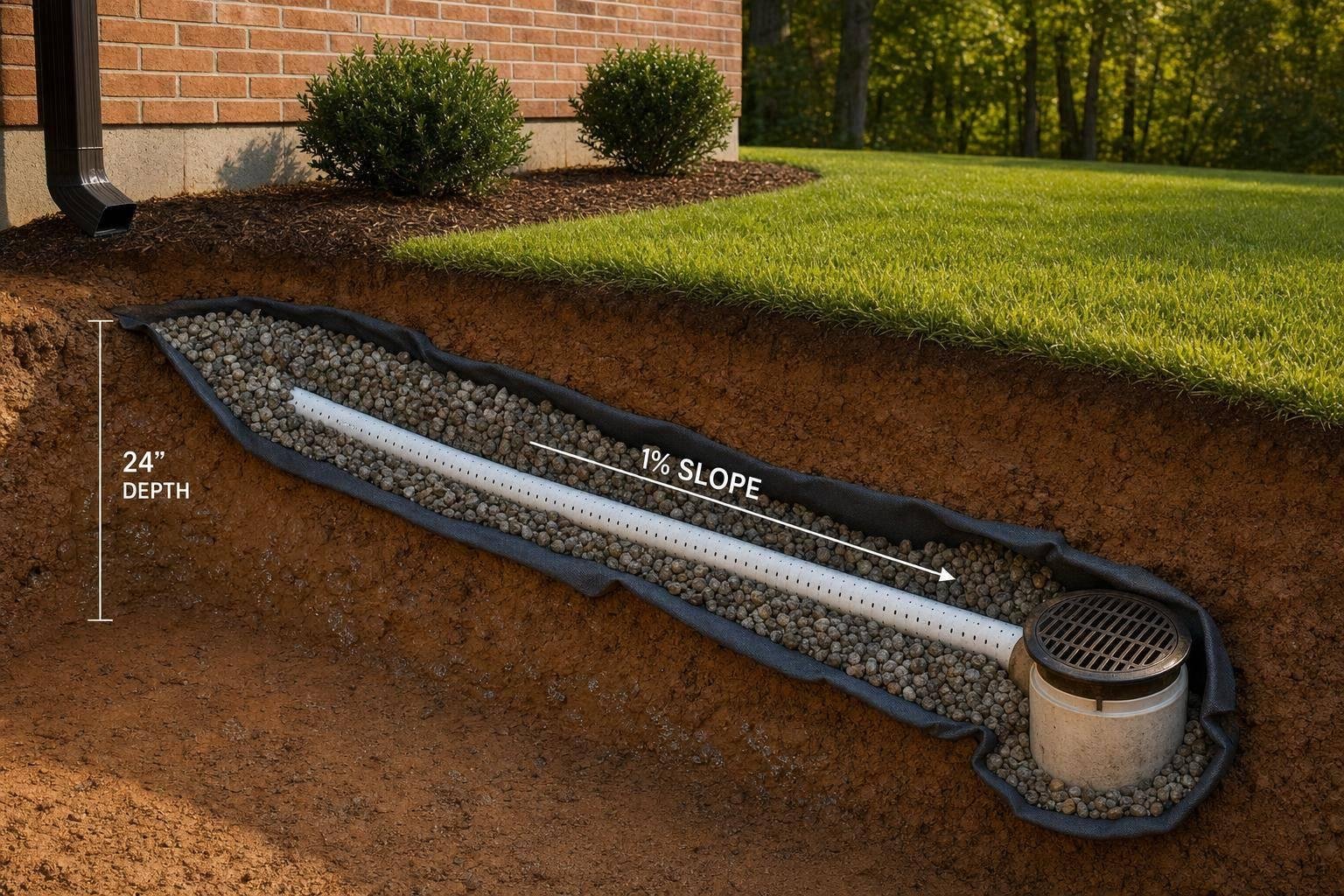
- bhavya gada
- No Comments
Yes – a French drain can work in Maryland clay soil, but only if it moves water to a clear outlet.
If I had to sum it up in one line, it’s this: in clay soil, a French drain should collect water and carry it away, not rely on the ground to absorb it. Maryland clay drains slowly, so a trench can stay wet if the setup has poor slope, shallow depth, or no place for water to exit.
Here’s the short version:
- French drains work best for moving water, not soaking it into clay
- Most yard drains are about 12 to 36 inches deep, based on the water problem
- A 1% to 2% slope helps water keep flowing
- Perforated pipe should collect water, then solid pipe should carry it to discharge
- Washed #57 stone and filter fabric help limit clogging
- Flat low spots, bad grading, and downhill runoff often need more than a French drain
In other words: if your yard has a path for water and a lower outlet, a French drain can help. If water just sits in flat, heavy clay for 24 to 48 hours after rain, you may also need grading, swales, catch basins, or longer downspout extensions.
I’d look at a French drain as one part of the fix – not the whole fix – in many Maryland yards.
How to Make French Drains Work in Clay Soil
sbb-itb-843f8be
What a French Drain Can and Cannot Do in Clay Soil
In Maryland clay, a French drain works like an underground channel. Its job is to collect water that’s already moving and send it to a safe outlet. It is not a soak pit.
That distinction matters a lot in clay soil. The main issue usually isn’t whether water will soak into the ground. It’s whether the drain can intercept that water and move it away. In other words, a French drain here is best understood as a collection-and-outlet system, not a soak pit[2][4][3]. Because of that, trench design matters more than soil absorption.
How Clay Affects French Drain Performance
Maryland clay has fine, tightly packed particles with very little pore space. So water moves through it slowly, and the topsoil can stay saturated for days after heavy rain[3][11].
Since downward absorption is slow, a French drain in this kind of soil mostly intercepts sideways-moving water. That includes water traveling along a slope or sitting above a tight layer, then shifting laterally instead of draining straight down[2][4][5][12].
Compacted soil from construction or traffic can create layers that are close to impermeable[6][11][2]. Dense clay pans, or fill placed over native soil, can also trap water above a tight layer and push it sideways[4][3][15]. Put a French drain at that interface, and it can intercept that flow well.
Drainage Problems a French Drain Can Fix
In plain terms, a French drain works best where water already has a path. That’s where interception does the most good:
- Hillside seepage – water that shows up partway down a slope or behind a retaining wall[2][4][5][12]
- Soggy side-yard strips – where a neighboring lot sends water sideways along a property line after storms[7][11][13]
- Water collecting near foundations – runoff from driveways or downspouts that gathers at one corner of a home can be intercepted and carried to a lower outlet[7][6][14]
A French drain is not the right fix for every wet area. Broad, flat low spots in heavy clay with no lower outlet nearby are a different story. When water spreads out and just sits there, regrading or a surface swale usually needs to come first[4][3][11]. That’s why trench depth, gravel, pipe layout, and outlet choice matter next.
Depth, Gravel, and Pipe Choices That Matter Most
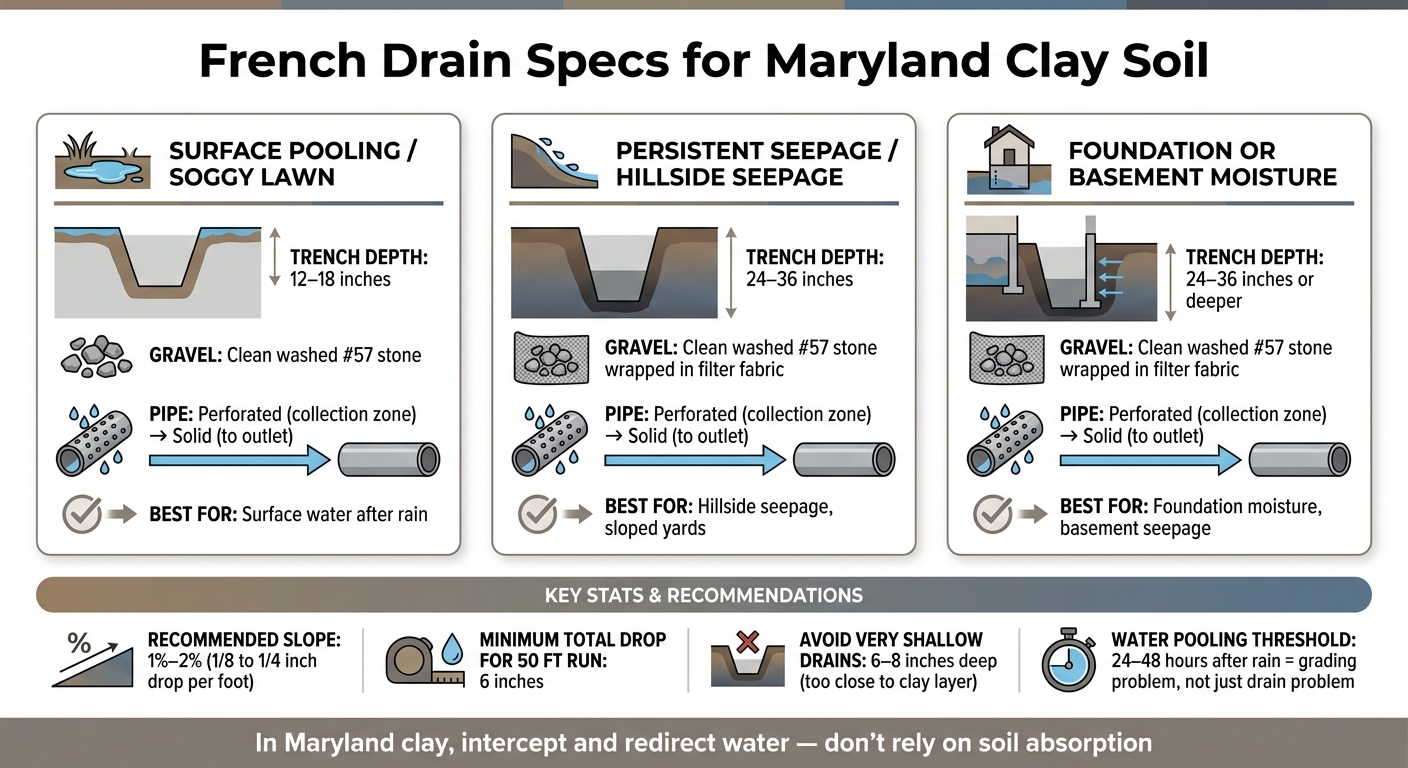
French Drain Specs for Maryland Clay Soil: Depth, Gravel & Pipe Guide
In Maryland clay, depth, gravel, and pipe layout have the biggest impact on how well a French drain works. Clay slows water down, so the drain has to move water away instead of counting on the soil to soak it up. That’s why these choices matter more here than they do in sandy ground.
How Deep to Dig a French Drain in a Maryland Yard
Most residential French drains are 18 to 24 inches deep, but the best depth depends on where the water is coming from[9][19][2].
If you’re dealing with soggy grass or puddles that show up after rain, a shallower trench in the 12 to 18 inch range may do the job[18][21]. If the problem is persistent seepage, downspout runoff, or water gathering near the foundation, a deeper trench of 24 to 36 inches is usually the better move because it intercepts the water before it spreads[8][22].
Very shallow drains – around 6 to 8 inches – usually don’t work well in Maryland clay[2][20]. They sit too close to the upper clay layer, which tends to stay wet and shift with the seasons.
Why Washed Gravel and Filter Fabric Improve Flow
Gravel creates the open spaces that let water reach the pipe. The standard pick is clean, washed angular stone like #57 stone, about ¾ to 1 inch in size, because it leaves connected gaps for water to pass through[23][24][25]. Unwashed stone tends to clog faster in clay soil.
Filter fabric, usually a non-woven geotextile, helps keep nearby clay and fine sediment from working their way into the gravel bed[26][27][28]. The usual setup is simple: line the trench with fabric, add the gravel and pipe, then fold the fabric over the top[26][28].
That fabric helps protect the system, but it doesn’t fix a bad install. It can’t replace clean gravel, proper slope, or a working outlet. Even good materials fall short if water has nowhere to go.
Table: Trench and Material Options for Clay Soil Drainage
| Situation | Trench Depth | Gravel Type | Pipe Type | Best Use Case |
|---|---|---|---|---|
| Surface pooling / soggy lawn | 12–18 in. | Clean washed #57 stone | Perforated in collection zone, solid to outlet | Surface water |
| Persistent seepage / hillside seepage | 24–36 in. | Clean washed #57 stone, wrapped in fabric | Perforated in collection zone, solid to outlet | Hillside seepage |
| Foundation or basement moisture | 24–36 in. or deeper | Clean washed #57 stone, wrapped in fabric | Perforated in collection zone, solid to outlet | Foundation moisture |
The perforated pipe should go in the collection zone, where water enters the system. After that, solid pipe should carry the water to the outlet[16][17]. In plain English: holes where you want to collect water, solid pipe where you want to move it. The setup still depends on steady slope and a clear outlet, which is where slope and outlet design comes in.
Slope, Layout, and Outlet Requirements
Once you’ve picked the trench, gravel, and pipe, layout is what makes the system work. A French drain doesn’t just need parts in the ground. It needs a path that moves water away instead of letting it sit there.
Perforated Pipe for Collection, Solid Pipe for Discharge
Use perforated pipe in the part of the drain that collects water. Then switch to solid pipe for the run leading to the outlet. If you use perforated pipe all the way to the end, water can seep back into the soil before it gets discharged.
That setup only works if the pipe keeps dropping toward the outlet the whole way.
Why the System Needs Steady Slope and a Clear Outlet
The pipe needs a steady downhill slope from the collection area to the outlet, with no flat sections, no dips, and no reverse slope. For home French drains, a good target is about 1% to 2% slope, or around 1/8 to 1/4 inch of fall per foot of run.[10][30][31] So if the drain is 50 feet long, it needs at least 6 inches of total drop from inlet to outlet to move water the way it should.[29]
In clay soil, even small slope mistakes can turn into drain failure. Flat spots collect sediment. Low pockets hold standing water. Reverse slope sends water back toward the area you were trying to dry out.
The outlet also has to go somewhere that can actually take the water. That usually means daylight, a pop-up emitter, a swale, or an approved storm connection. If the outlet empties into a flat or already soggy area, the drain doesn’t fix the problem – it just moves the wet spot. And without a dependable outlet, even a well-built French drain will fail.
When a French Drain Alone Is Not Enough
Even if a French drain is installed the right way, your yard can still end up with too much water. At that point, the issue isn’t the drain by itself. A French drain can deal with subsurface water, but some site conditions can still overload it.[15][2]
Signs Your Yard Also Needs Grading or Added Drainage Work
A few patterns usually mean the problem goes past what a French drain can handle on its own. One of the biggest red flags is water coming downhill from a neighbor’s property during normal rain. That amount of runoff can swamp a single trench system.[15][32]
Downspouts are another common issue. If they discharge just a few feet from the foundation, roof runoff keeps soaking the soil right next to the house.[2][32]
It also helps to look closely at the lawn, patio, and walkways. Low spots that stay wet for 24–48 hours after a normal storm usually mean the surface needs to be reshaped, not just drained below ground.[15][32] And if a patio or walkway slopes back toward the house, rainwater is being sent toward the foundation every time it rains. That’s a grading problem, not just a drain problem.[32]
Repeated pooling in the same places is another clue, especially if those areas stay soggy through the summer. When that keeps happening, you’re usually dealing with a yard that needs more than a trench in the ground.[15][2][33]
In those cases, the fix often includes a mix of surface and drainage work, such as:
- Regrading so the soil slopes at least 2% away from structures
- Extending downspouts 10–20 feet from the foundation with solid pipe
- Adding catch basins in low spots
- Using a dry riverbed to carry overflow to a safe outlet[15][1][32]
Conclusion: What Determines Success in Maryland Clay
French drains can work in Maryland clay, but ONLY when the design matches how clay soil behaves. The goal is to intercept and redirect water, not depend on the soil around the drain to soak it up.[15][2][32][34] When clay drains poorly, the long-term fix is to deal with the water source and the surface slope, not just send water underground.
FAQs
How do I know if my yard has a good outlet for a French drain?
A suitable outlet starts with a site assessment that maps how water moves across the property and identifies the right discharge point. The goal is simple: send water to a designated drainage area or natural waterway where it can leave the system safely.
In Maryland’s clay-heavy soil, slow percolation can make outlet performance harder to manage. That’s why a professional evaluation matters. It helps confirm the outlet can handle the system without causing erosion or flooding.
What happens if a French drain is installed in flat clay soil?
In flat clay soil, a French drain can struggle if it doesn’t have enough slope to move water away from your property. Clay soil drains slowly, so water may sit in the trench instead of flowing through the system.
For the drain to work, it often needs grading or land leveling. That gives water a path to flow by gravity to a proper outlet, like a dry well or another safe discharge area.
When should I add grading or catch basins instead of just a French drain?
Consider adding grading or catch basins instead of, or along with, a French drain if your property gets concentrated runoff or more surface water than a standard underground pipe can handle.
A French drain helps with subsurface water and that steady, nagging dampness. Catch basins, on the other hand, collect and move heavier surface flow, which can matter a lot in heavy clay soils or tougher drainage problems.
Chat with Us