









- bhavya gada
- No Comments
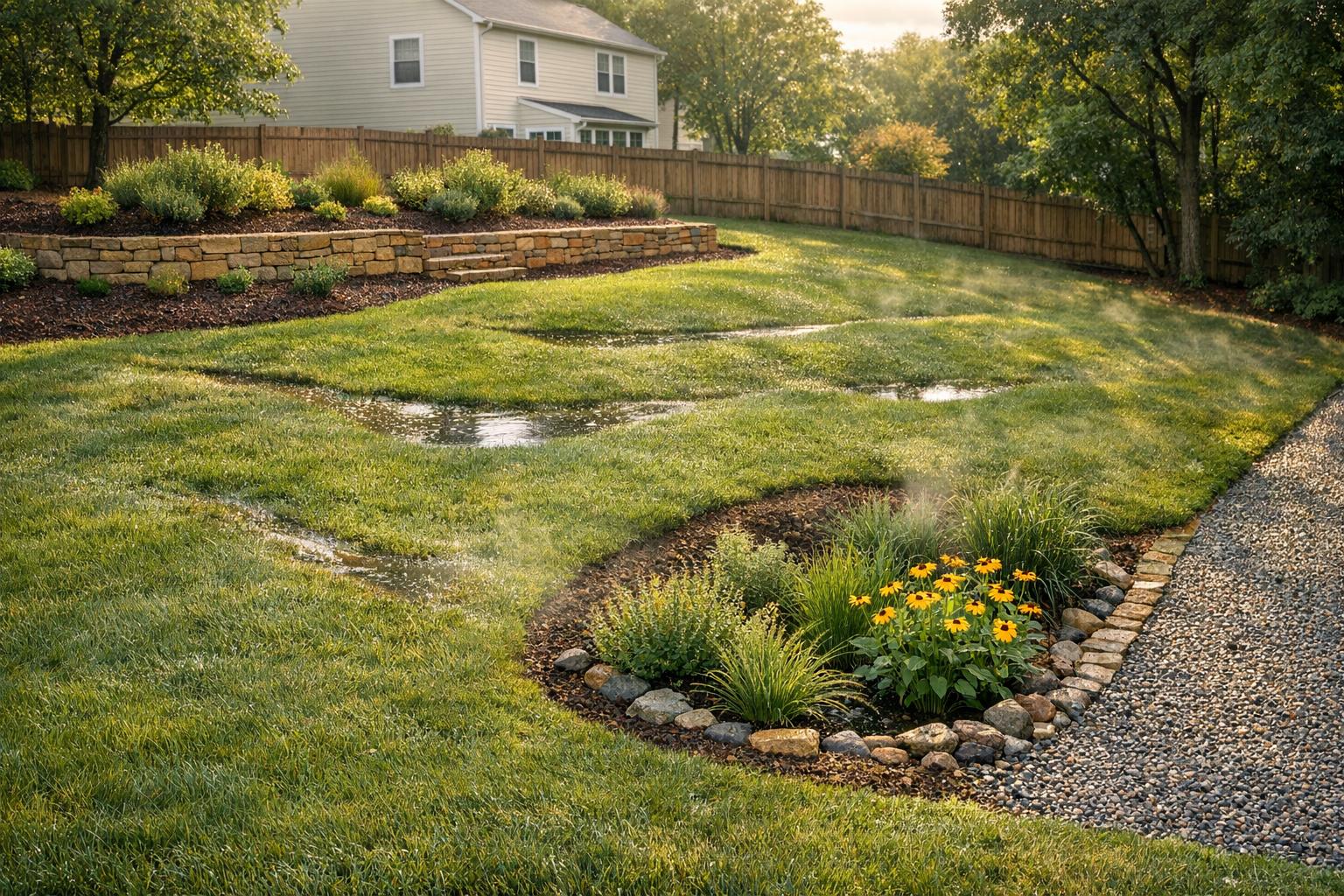
Proper grading and drainage are crucial for managing stormwater on-site in Maryland, especially under strict state regulations like COMAR 26.17.02, which emphasize Environmental Site Design (ESD). This article breaks down three common grading methods used in Maryland ESD projects:
- Conventional Surface Grading: Directs water away from structures using broad slopes but doesn’t fully meet ESD standards. Works best for mild slopes and smaller lots.
- Distributed Micro-Grading: Uses small adjustments like swales and rain gardens to slow and absorb water near its source. Highly effective for runoff reduction and ESD compliance.
- Terraced Grading with Retaining Walls: Ideal for steep slopes, creating flat sections to slow water flow and improve infiltration. Labor-intensive but effective for challenging terrains.
Each method has specific applications, benefits, and challenges depending on site conditions like soil type, slope, and lot size. Combining these approaches often yields the best results for stormwater management in Maryland’s unique climate and regulatory environment.
1. Conventional Surface Grading
Conventional surface grading is a technique designed to channel water away from structures toward specific collection points, such as streets, swales, or storm drain inlets. The general guideline is to apply a 5% slope (6 inches per 10 feet) for the first 5 feet extending from the house perimeter, followed by a 2% slope across the remaining yard. This ensures water continues to flow efficiently.
Regulatory Compliance
While conventional grading is a fundamental component of drainage design, it doesn’t meet the criteria for Environmental Site Design (ESD) under Maryland’s COMAR 26.17.02 stormwater regulations. However, it is still a necessary starting point. Local authorities require grading plans to demonstrate that runoff from impervious surfaces – like driveways, rooftops, and patios – flows into ESD features such as rain gardens or micro-bioretention cells before reaching storm drains or outfalls. Essentially, conventional grading prepares the site, while ESD practices handle the actual treatment of stormwater.
"In some cases, a permit may be required for large drainage projects. Our team will handle any necessary permits and ensure all work complies with local regulations." – Pro Landscapes MD [1]
Runoff Reduction Capacity
By itself, conventional grading primarily moves water rather than reducing it. In Central Maryland, compacted soils often absorb water slowly, leading to most rainfall running off rather than soaking into the ground. According to EPA data, post-development runoff volumes can increase 2 to 5 times compared to wooded, pre-development conditions [3]. However, combining grading with ESD features – like directing driveway runoff to a rain garden or sloping a backyard toward an infiltration swale – can significantly reduce both runoff volume and peak flow during a 1-inch storm. Understanding how water behaves on a property is key to implementing effective solutions.
Construction Complexity
The construction process for conventional grading is straightforward. It begins with rough grading using equipment like excavators or skid steers to establish general slopes. This is followed by fine grading to achieve precise contours. Soil conditioning – through decompaction, adding topsoil, and using soil amendments – stabilizes the surface and enhances infiltration in lawn areas. However, even small errors, such as a reverse slope or unnoticed low spots, can lead to water pooling near foundations instead of draining away.
"Drainage problems are complex and require a custom approach for each project. These issues can cause long-term damage to your property if not handled correctly." – Pro Landscapes MD [1]
Suitability for Maryland Residential Lots
The effectiveness of conventional grading depends heavily on the specific conditions of a site. It performs well on small to medium suburban lots with moderate natural slopes and access to public streets or shared stormwater outfalls. However, it is less effective on properties with steep slopes, high groundwater levels, heavy clay soils, or areas prone to chronic ponding. In such cases, additional measures – like French drains, dry riverbeds, or ESD retrofits – are often necessary to address drainage issues effectively. Pro Landscapes MD frequently combines grading with these additional solutions to manage water flow and meet local stormwater requirements across central Maryland.
sbb-itb-843f8be
2. Distributed Micro-Grading
Distributed micro-grading takes a different approach to managing water compared to traditional grading methods. Instead of channeling water off-site through broad slopes, this method slows and spreads runoff across the property. It uses small, shallow features like depressions, berms, vegetated swales, and soil patches to capture and absorb water where it falls. By creating multiple drainage points, it minimizes the reliance on one or two large drainage paths.
Regulatory Compliance
This method aligns well with Maryland’s ESD (Environmental Site Design) requirements under COMAR 26.17.02, which emphasize controlling runoff to the "maximum extent practicable." Distributed micro-grading achieves this by routing water from surfaces like rooftops, driveways, and patios into several smaller features – such as rain gardens, micro-bioretention cells, and vegetated swales – scattered throughout the property.
In counties like Howard, Montgomery, and Baltimore, permit reviews often require detailed documentation. A compliant plan will outline the drainage areas feeding each feature, their storage and infiltration capacities, soil amendments, and how grading maintains sheet flow instead of channeling water into pipes. This approach not only meets regulatory standards but also significantly enhances runoff management.
"We create a grading plan tailored to your property’s unique layout, ensuring that water flows efficiently and safely." – Pro Landscapes MD [1]
Runoff Reduction Capacity
The benefits of distributed micro-grading over traditional methods are striking. Studies on residential low-impact development retrofits have shown 30–80% reductions in annual runoff volume when these features are properly implemented. For small to moderate storms, peak flow reductions range from 20–70%, especially when most rooftop and driveway areas are treated.
Even modest depressions – just 1 to 4 inches deep – can increase water storage from 0.02 inches to as much as 0.10–0.20 inches. This slows runoff and enhances infiltration. On Maryland’s heavy clay soils, adding compost-enriched loam to these depressions further improves water absorption, making a noticeable difference in performance.
Construction Complexity
Distributed micro-grading requires more precise design and execution than traditional grading. Plans must include detailed spot elevations, smooth transitions between hardscape and planting areas, and careful grading to direct water into infiltration zones. Micro-bioretention features typically range from 6 to 12 inches deep with gentle side slopes (around 3:1) for easier construction and proper water flow.
Avoiding soil compaction in ESD areas is critical, which demands close on-site supervision during construction. Pro Landscapes MD addresses this by managing every aspect of the project – from grading and drainage installation to hardscaping and planting – ensuring the design remains consistent through to completion [1]. This integrated approach is particularly effective for Maryland’s often challenging soil conditions.
Suitability for Maryland Residential Lots
This method is ideal for small to medium residential lots (¼ to ½ acre) found in areas like Columbia, Ellicott City, Silver Spring, Gaithersburg, and Bethesda. Distributed ESD features can blend seamlessly into existing landscaping, eliminating the need for large stormwater facilities.
It’s especially helpful for properties already dealing with drainage issues, such as soggy lawns, erosion along property lines, or wet basements. One important consideration for Maryland homeowners: maintain a positive slope of 2–5% away from the foundation for the first 5–10 feet. Beyond that, you can safely introduce depressions to allow water to pool and infiltrate without risking structural damage.
3. Terraced Grading and Retaining Walls
Terraced grading transforms steep slopes into flat, step-like sections. This design slows down water runoff, increases infiltration, and creates more usable outdoor space. For Maryland homeowners dealing with steep backyards, this method can be a practical alternative when other stormwater management techniques fall short.
Regulatory Compliance
Maryland’s Stormwater Design Manual emphasizes using the best possible environmental site design (ESD) practices. Terraced systems break long slopes into smaller, manageable segments (15–20 feet each), reducing water flow speed by over 50%. These terraces also provide excellent spots to incorporate ESD features, helping meet local MS4 permit standards in areas like Howard, Montgomery, and Baltimore counties.
When it comes to retaining walls in terraced systems, structural and safety regulations are key. In Maryland, unreinforced segmental retaining walls are typically limited to 3–4 feet in height unless reviewed and approved by an engineer. Walls supporting structures, driveways, or those on steep slopes require professional engineering input. Checking your county’s specific height limits early in the planning process can help avoid delays and extra costs.
Runoff Reduction Capacity
Continuous slopes tend to funnel water quickly, leaving little chance for infiltration. Terraces, on the other hand, act like individual basins, allowing water to infiltrate at each level. Planting these terraces with deep-rooted native plants – especially in watersheds that drain into the Chesapeake Bay – further improves infiltration and helps reduce nutrient runoff. According to the U.S. EPA, adding vegetated zones to break up compacted or impervious areas can lower runoff volumes and peak flows by 25–65%. For Maryland’s clay-heavy soils, replacing soil behind retaining walls with granular backfill improves drainage and reduces hydrostatic pressure, which can otherwise damage the walls.
Construction Complexity
Building a terraced system involves several steps, making it more labor-intensive than simple regrading. The process includes excavating each terrace, laying a crushed stone base, installing wall units, and adding a 12–24-inch drainage aggregate layer wrapped in geotextile fabric with a perforated drain. Skipping these drainage steps often leads to wall failures, as poor drainage and hydrostatic pressure are common culprits. Proper sequencing is also crucial – starting with the lower terraces and underdrains ensures stability and prevents erosion or overloading of unfinished walls. Contractors like Pro Landscapes MD specialize in managing all aspects of these projects, from grading and drainage to wall construction and planting, ensuring everything stays on schedule.
Suitability for Maryland Residential Lots
For smaller suburban lots with slopes of 6–15%, using two or three short terraces with 2–3 foot retaining walls is often more effective than building one tall wall. This approach increases planting space, improves water infiltration, and creates a more inviting backyard. On larger rural properties, terracing is usually focused around the house or driveway, while swales or meadow plantings handle stormwater in wider areas. In urban and densely populated areas like Baltimore or Washington, DC, terraced grading is especially helpful for managing runoff before it impacts neighboring properties or public storm drains.
Project costs vary widely. Simple low-wall terracing can cost between $4,000 and $8,000, while more complex systems with multiple levels and integrated drainage features can range from $15,000 to $30,000 or more [3]. Terraced systems, like other grading methods, have their own set of benefits and challenges, which will be explored further in the pros and cons overview.
Pros and Cons of Each Grading Approach
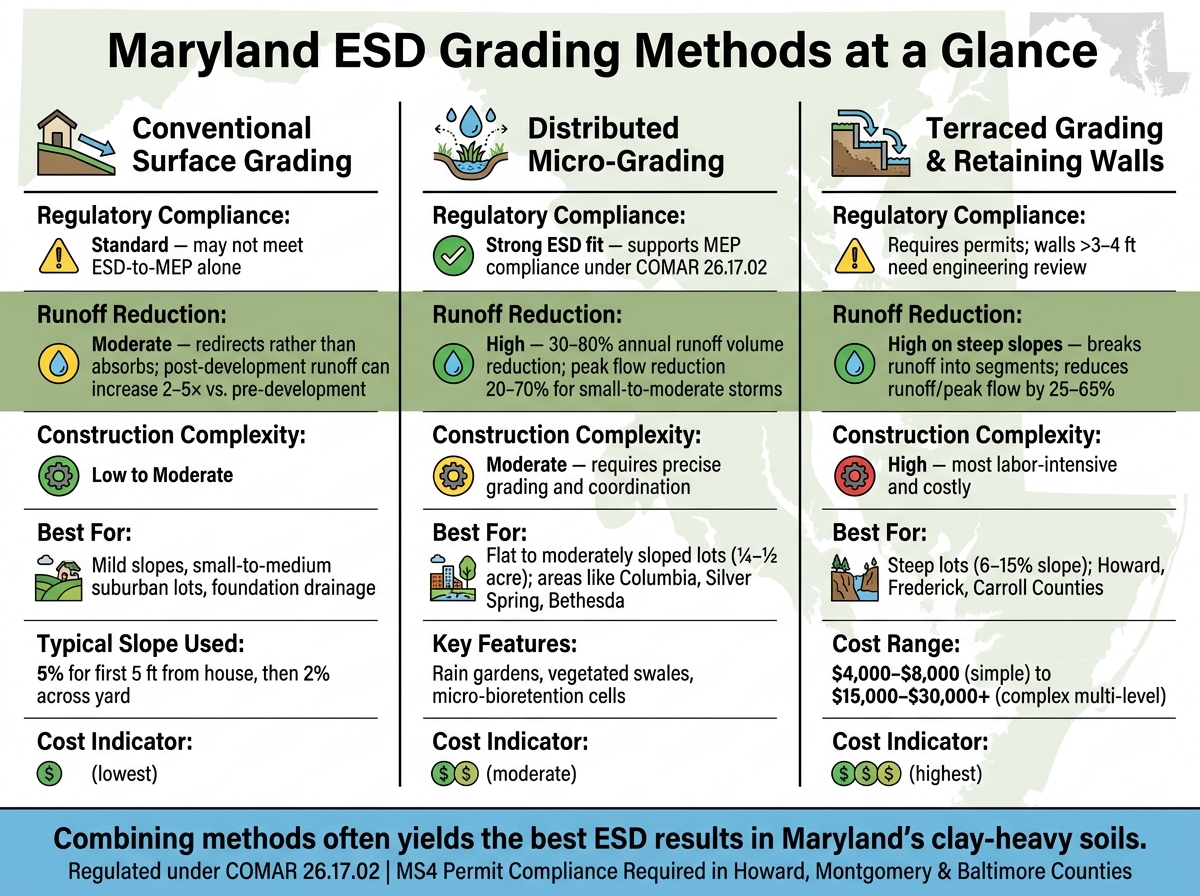
Maryland ESD Grading Methods Compared: Compliance, Runoff & Cost
Here’s a quick breakdown of the strengths and challenges of the grading methods discussed earlier. Each approach has its own way of addressing Maryland’s ESD (Environmental Site Design) standards, balancing regulatory compliance, runoff management, construction demands, and adaptability for residential lots.
Conventional surface grading is the simplest and most cost-effective option. Contractors are familiar with it, and it efficiently directs water away from foundations. However, it often struggles to meet Maryland’s ESD-to-MEP (Maximum Extent Practicable) standards on its own, especially for new builds or major redevelopment projects.
On the other hand, distributed micro-grading excels at meeting ESD requirements. By using features like rain gardens, vegetated swales, and micro-bioretention cells, it slows and spreads out runoff, significantly reducing water volume during smaller storms (as detailed in Section 2). The downside? It needs careful planning and enough open space for lawns or plantings to make it work.
Terraced grading with retaining walls is the go-to method for steep lots. It prevents water from rushing down long slopes by creating flat areas perfect for infiltration features. It also stabilizes soil and adds usable outdoor space. However, this method is the most expensive and labor-intensive. Plus, retaining walls over 3–4 feet require engineering review and permits in Maryland counties.
| Grading Approach | Regulatory Compliance | Runoff Reduction | Construction Complexity | MD Residential Suitability |
|---|---|---|---|---|
| Conventional Surface Grading | Standard; may not meet ESD-to-MEP alone | Moderate – redirects rather than absorbs | Low to moderate | Ideal for mild slopes and foundation drainage |
| Distributed Micro-Grading | Strong ESD fit; supports MEP compliance | High – significant reduction for small storms | Moderate – requires precise grading and coordination | Ideal for flat to moderately sloped lots with open lawn area |
| Terraced Grading & Retaining Walls | Requires permits; walls >3–4 ft need engineering review | High on steep slopes – breaks runoff into manageable segments | High – most labor-intensive and costly | Best for steep lots in areas like Howard, Frederick, and Carroll Counties |
If you’re considering one of these approaches, Pro Landscapes MD offers tailored solutions. They specialize in combining grading, land leveling, French drains, stormwater management, and hardscaping into a single, cohesive plan. For terraced projects, their expertise in retaining wall and drainage installation ensures that potential structural or drainage issues are addressed seamlessly [1][2].
Conclusion
There’s no universal grading strategy that works for every yard. The best approach depends on factors like the slope of the land, soil conditions, available space, and specific Environmental Site Design (ESD) needs.
For flat or gently sloped properties, distributed micro-grading combined with conventional grading often works well. On the other hand, steeper areas benefit from terracing with retaining walls, which help manage runoff and create stable, plantable areas. Often, the most effective ESD solutions layer these methods. Broad site grading protects the foundation, micro-grading enhances infiltration, and terracing addresses structural challenges on slopes. However, even the best designs need regular upkeep to maintain their effectiveness.
Maintenance is just as important as the initial design. ESD features require periodic care and reevaluation, especially when new impervious surfaces are added to the property.
For those in central Maryland and the Washington, DC area, Pro Landscapes MD provides expert services in grading, stormwater management, and hardscaping. They also offer permitting support for ESD-focused projects.
"Drainage problems are complex and require a custom approach for each project." – Pro Landscapes MD
FAQs
Which grading method is best for my yard?
The most suitable grading method for your yard hinges on its unique layout and drainage challenges. Addressing these issues effectively often calls for a customized approach. A professional assessment can help ensure water flows correctly and erosion is minimized. Some common solutions include French drains, which help redirect surface water, berms to steer runoff away from certain areas, and swales that guide water flow naturally. For more severe drainage problems, box and pipe drain systems can manage larger amounts of water efficiently.
How do I keep water away from my foundation?
Managing water flow and grading around your home is key to safeguarding your foundation from potential water damage. Pro Landscapes MD specializes in creating tailored drainage solutions to handle runoff and eliminate standing water effectively.
Some common approaches include:
- French drains: These systems help channel water away from your property.
- Berms and swales: Designed to redirect water flow safely.
- Underground systems: For more severe water issues, box or pipe systems can handle larger volumes, offering an added layer of protection for your foundation.
By addressing water management proactively, you can help ensure your home remains secure and free from damage caused by excess moisture.
Do I need a permit or an engineer for a retaining wall?
When it comes to retaining walls, Pro Landscapes MD doesn’t specify whether you’ll need permits or engineering. While they do offer retaining wall services, the requirements can vary depending on your local city or county regulations. Things like the wall’s height or the type of soil in your area might mean permits or engineering approval are necessary. To avoid any issues, it’s a good idea to check with your local authorities to find out exactly what’s required for your project.
Chat with Us