









- bhavya gada
- No Comments
If I need the short answer: gravel usually costs less on open lots, while chambers often make more sense on tight Maryland lots where space, driveway loading, or service access matter more than unit price.
I’d look at this choice through six points: material cost, labor cost, space use, excavation depth, maintenance, and site fit. Gravel is usually cheaper to buy, but it needs more stone because only about 35%–40% of the volume holds water. Chambers cost more per unit, but they store more water in less space and are often easier to inspect later.
Before I pick a system, I’d keep these facts in mind:
- Gravel beds need about 2.5 cubic feet of stone to store 1 cubic foot of water
- No. 57 stone in Maryland often runs about $53–$121 per cubic yard at retail
- Gravel systems usually need a larger footprint
- Chamber systems can work under driveways when designed with the right cover
- Gravel beds can be harder to restore if sediment clogs the stone voids
- Maryland rules can limit depth, setbacks, and where either system can go
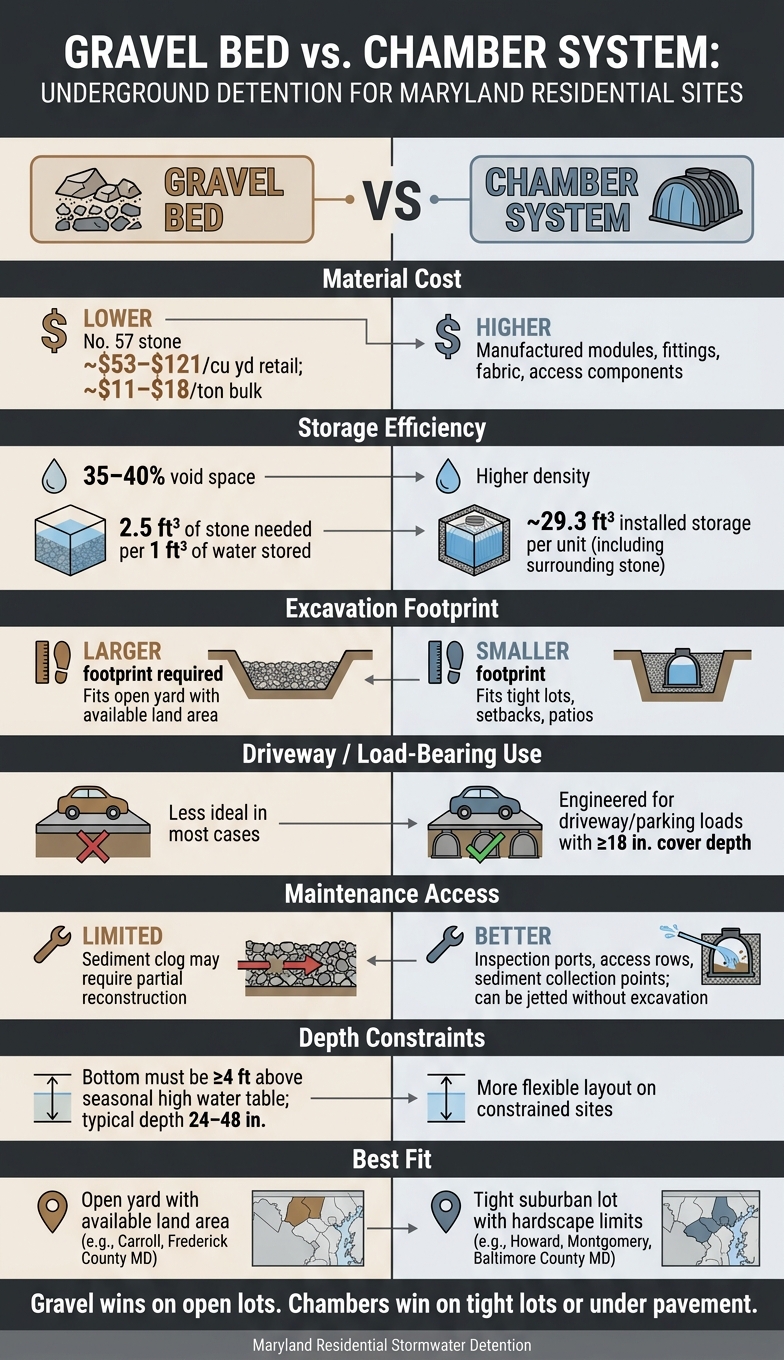
Gravel vs Chamber Underground Detention: Cost & Performance Comparison
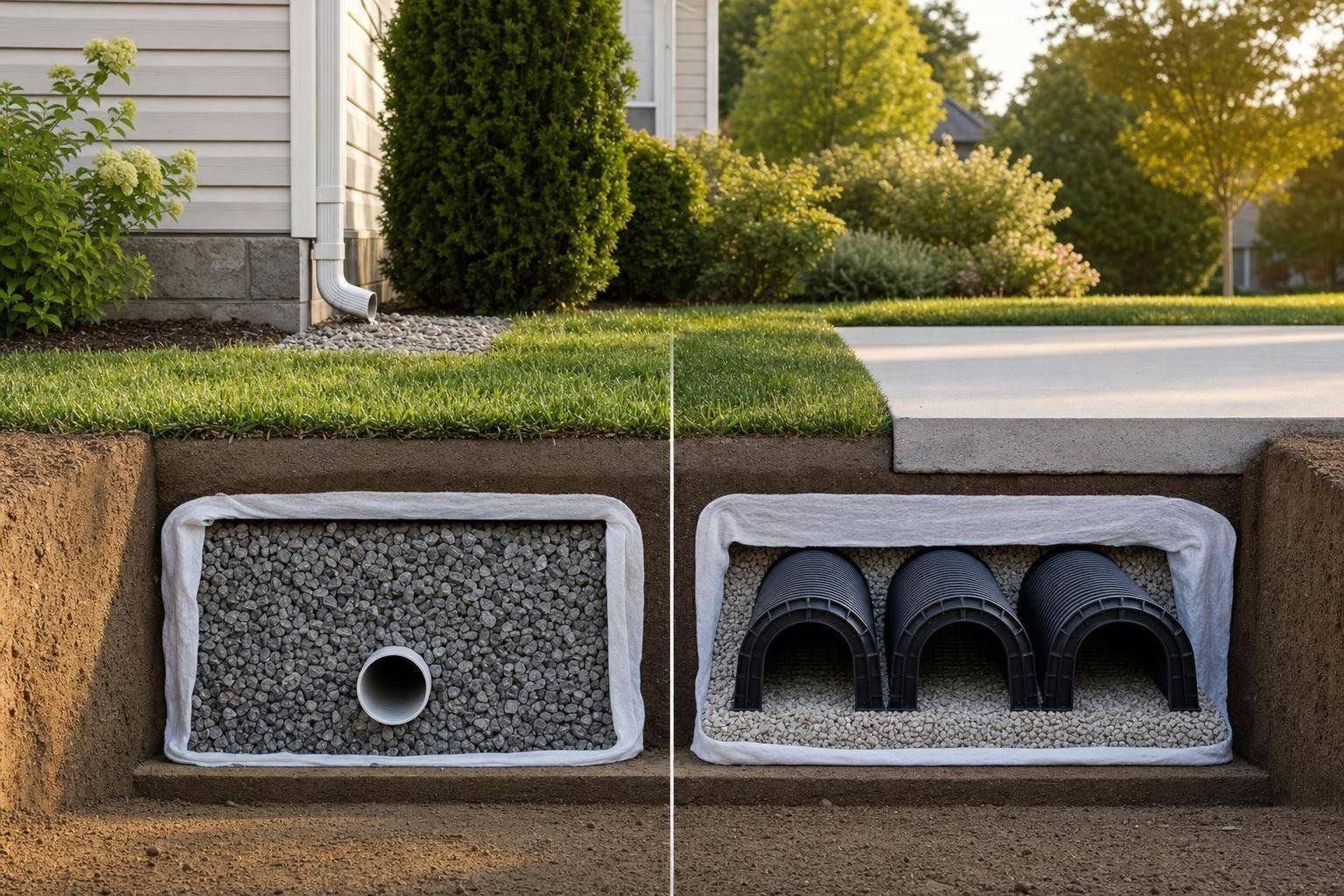
Chambers verses stone and pipe.
sbb-itb-843f8be
Quick Comparison
| Factor | Gravel Bed | Chamber System |
|---|---|---|
| Material cost | Lower | Higher |
| Labor | More digging and stone handling | More layout and careful backfill |
| Storage efficiency | Lower | Higher |
| Footprint | Larger | Smaller |
| Depth and layout limits | Can need more area if depth is limited | Fits tighter sites better |
| Driveway use | Less ideal in many cases | Often a better fit |
| Maintenance access | Limited | Better access points |
| Best fit | Open yard with room | Tight lot with hardscape limits |
So if you’re looking at a Maryland home site, I’d keep it simple: gravel tends to win when land area is available, and chambers tend to win when space is tight or the system has to fit under pavement.
Gravel Bed Underground Detention: Lower Material Cost, More Excavation
A gravel detention bed stores stormwater in excavated space filled with washed stone, wrapped in geotextile, and tied to a perforated underdrain. The basic setup is pretty simple: washed stone, geotextile, a perforated underdrain, and inlet or cleanout structures.[4][6][8][12]
Material and Labor Cost Drivers for Gravel Beds
The stone itself is fairly low-cost. In the Maryland market, No. 57 washed stone usually sells for about $53–$121 per cubic yard at retail landscape suppliers, while bulk plant pricing is closer to $11–$18 per ton.[19][20][21] But stone price alone doesn’t tell the full story. Volume is what moves the total cost.
Here’s why. Gravel void space is usually 35% to 40%, and Maryland guidance often uses 0.40 porosity for sizing stone reservoirs.[14][15] That means storing 1 ft³ of water takes about 2.5 ft³ of aggregate.[16][17] So if a system needs to hold 1,000 ft³ of stormwater, it will need about 2,500 ft³ of stone. That’s a lot of material to buy, haul, place, and compact around.
Labor costs tend to come from site work, not fancy assembly. Crews have to:
- Excavate to the required depth
- Remove and manage spoil
- Set the underdrain piping at the right slope
- Install geotextile
- Place stone in lifts so the fabric doesn’t tear[7][9][12]
None of that is unusual work. The issue is the sheer amount of digging and material handling. On tighter Maryland lots, where equipment access is limited, labor time and cost can climb fast.[2][1]
Space Use, Depth, and Maintenance Limits
Because the stone only stores water in its voids, gravel beds usually need a larger footprint to provide the same detention volume.[10][11][13] On an open yard, that may be fine. On a smaller lot with patios, driveways, or mature trees, it can become a deal-breaker.
Depth has limits too. Maryland rules require the bottom of the gravel bed to sit at least 4 ft above the seasonal high water table, and most residential filter bed designs land in the 24–48 inch depth range.[14][18][5] If you can’t excavate deeper, your only option is to spread the system out over more area. That’s where the footprint problem comes right back.
Maintenance is another weak spot. Gravel beds don’t offer much direct access to the stone reservoir. Once sediment clogs the voids, getting performance back may mean partial reconstruction.[12][13] That’s why Maryland stormwater guidance puts so much focus on pretreatment and access for inspection and cleaning. Common features include forebays, filter strips, stable inflow structures, vertical cleanout pipes, and observation wells.[3][7][9]
Day-to-day upkeep is pretty practical:
- Keep gutters clean
- Reduce sediment entering inlets
- Inspect pretreatment features on a regular basis[3][7]
When space is tight, chamber systems can often provide the same storage in less area.
Plastic Chamber Systems: Higher Unit Cost, Better Storage Efficiency
Compared with gravel beds, chamber systems cost more up front. But they also store a lot more water in the same amount of space. Because plastic chambers hold water in open interior space, they deliver more storage per square foot than gravel beds. That means you can get the same detention volume with a smaller footprint.
Material and Labor Cost Drivers for Chamber Systems
The higher unit cost isn’t just on paper. Chamber systems rely on manufactured modules, fittings, piping, fabric, stone backfill, and access components. All of that adds cost beyond gravel alone.
Labor is higher too. These systems need precise layout, tight elevation control, and careful backfilling. That takes more time than placing bulk stone. On a tight Maryland residential lot, where equipment access may already be limited, that extra precision can directly add labor hours and cost.
Space Use, Loading, and Maintenance Access
Where chambers start to make up for the added cost is footprint. For example, one chamber unit provides 14.7 ft³ of chamber storage and 29.3 ft³ of installed storage with surrounding stone.[24] In plain terms, that storage density can help a system fit between setbacks, patios, and mature trees on tight Maryland lots.
Chambers also make sense when the system has to go under a driveway or parking pad. When properly designed with enough cover depth and structural backfill, chamber systems can support driveway and parking loads, including at least 18 inches of cover below grade.[24] That’s a big reason they’re often used beneath paved areas.
Maintenance access is another strong point. Many chamber products include inspection ports, open-ended access rows, and designated sediment collection points that allow crews to inspect the system and flush sediment without digging it up.[22][23][25][26] That easier access matters over time, especially on sites where excavation would be a headache. The result is a clear tradeoff: higher cost up front in exchange for less space used and simpler access for upkeep.
Gravel vs. Chambers: Direct Cost and Performance Comparison
Installed cost usually depends more on excavation, haul-off, and restoration than on the material itself. That’s where the gravel-versus-chambers choice gets interesting. The sticker price may point one way, but the full install cost can point the other.
Cost tends to come down to three things: how much digging is needed, how much space the system takes up, and how easy the site is to work in.
| Factor | Gravel Bed | Chamber System |
|---|---|---|
| Material cost per unit | Lower | Higher |
| Storage per cubic foot excavated | Lower | Higher |
| Excavation footprint | Larger | Smaller |
| Site fit | Better on open lots | Better on tight lots |
| Maintenance access | Limited; harder to restore if clogged | More defined access points; easier to service |
One public design guide notes that stone storage beds provide the least storage volume per unit area, while chamber and pipe systems provide more storage volume per unit volume.[27] That gap in storage efficiency is often what shifts installed cost on tight Maryland lots.
When Gravel Has the Lower Cost
Gravel usually costs less when space isn’t the main issue. If the needed detention volume is modest, and the site doesn’t have big conflicts with driveways, utilities, or mature trees, the lower material price can stay in your favor.
In that kind of setup, you’re not paying for extra digging, extra restoration, or awkward layout work. Put simply: if the lot is open and the design has room to breathe, gravel often wins on cost.
When Chambers Can Offset Their Higher Purchase Price
Chambers can make up for their higher purchase price on a tight suburban lot, especially one boxed in by a patio, driveway, and setback limits. In those cases, excavation and restoration often drive the job cost more than the chamber units do.
They also fit well when the system needs to go under a driveway or another load-bearing area. That smaller footprint can cut down on disturbance and make the layout easier to manage.
Before picking one system over the other, a site review should look at footprint, slope, access, and loading. Those site limits often end up deciding the final system choice more than material price alone.
Matching the Right System to a Maryland Residential Site
Once you tie cost to site conditions, the layout usually makes the choice a lot clearer. At that point, site fit becomes the main factor.
On a wider backyard in Carroll or Frederick County, where there are no driveway conflicts, a gravel bed can spread storage across a bigger footprint at a shallower depth without special components. In that kind of setup, gravel is often the lower-cost option.
That math shifts when the system needs to go under pavement. On a narrow lot in Howard, Montgomery, or Baltimore County, the only workable spot may be under or next to a driveway. In that case, chambers can be engineered for driveway loads, which often makes them the better fit.
Soil matters too. Much of central Maryland has clay-heavy or compacted fill soils that slow infiltration. When soils perform poorly, a gravel bed may need an underdrain. That adds both cost and extra work. Chambers, on the other hand, can work as detention systems with a controlled outlet, which gives you more room to work in those conditions.
Maintenance can also wipe out early savings. Gravel beds are harder to service once sediment builds up in the void spaces. Chamber systems usually include cleanout ports, so crews can inspect and jet the system without digging it up. That becomes a big deal over time, especially on sites with direct gutter drainage or gravel surfaces nearby.
Setback rules can narrow the options too. Prince George’s County, for example, requires a 25-foot setback from residential lot lines for underground facilities [3]. If you skip that check early, you may end up paying for a redesign later.
Conclusion: Footprint, Budget, and Maintenance Determine the Best Choice
Footprint, soil, and maintenance access decide whether gravel or chambers cost less on a Maryland residential site.
FAQs
Which option is cheaper to install overall?
It depends on the site. In most cases, the total cost for gravel beds vs. chamber systems comes down to labor, excavation, and the conditions on the property.
For a general price range, gravel-based residential drainage systems often cost $2,000 to $6,000. More advanced underground storage systems usually fall between $10,000 and $30,000.
How do I know if my lot needs chambers instead of gravel?
It comes down to your lot’s size, how well the soil drains, and how much runoff you need to handle. Gravel systems can work when you have enough room, but Maryland’s heavy clay soils can make them harder to use.
If your lot drains poorly, has limited space, or includes a lot of impervious surfaces like driveways and patios, chambers may be the better choice. A professional site evaluation can match the system to your soil, slope, and local rules.
Which system is easier to maintain long term?
It depends on how complex the installation is and what your site needs. In general, simpler stormwater systems tend to need less upkeep than more complex setups, which may call for frequent cleaning, inspections, or replacement of specialized parts.
No matter which system you choose, Maryland requires regular maintenance to keep it working properly and in compliance.
Chat with Us