









- bhavya gada
- No Comments
If you build in Maryland, the main rule is simple: use ESD first, and use larger stormwater controls only if that still does not meet the rule.
I’d sum the article up like this: Maryland puts site design first, local review matters a lot, and each practice has to fit the property. The state also ties design to a hard performance target: maintain 100% of the average annual predevelopment groundwater recharge volume for the site. On top of that, once an ESD practice is installed, you usually can’t change it without agency approval.
Here’s the short version:
- ESD comes first under Maryland stormwater rules.
- Bioretention, rain gardens, permeable pavement, swales, and dry wells are common options.
- Hydrologic and hydraulic calculations are required to show the plan works.
- County and city review can differ, even under the same state rules.
- Site limits like poor soils, slopes, utilities, shallow groundwater, and setbacks often decide what can be used.
- Maintenance matters because installed practices must stay in place unless the local agency approves a change.
Webinar | Lessons Learned in Green Stormwater Infrastructure Maintenance
sbb-itb-843f8be
Quick Comparison
| Practice | What I’d watch first | Main review issue |
|---|---|---|
| Bioretention / Micro-bioretention | Drainage area, soil, ponding, setbacks | Must help meet the 100% recharge target |
| Rain gardens | Lot space, planting, upkeep | Often shaped by local site limits |
| Permeable pavement | Soil and base conditions | Must fit site hydrology and local review rules |
| Dry swales / Grass channels | Slope, flow path, pretreatment | Geometry, conveyance, and maintenance matter |
| Dry wells | Infiltration limits and setbacks | Often depends on site-specific approval |
So if I were planning a project in Maryland, I would not start with a pond or another large BMP. I’d start by asking two basic questions: Can this site handle ESD? And will the local agency accept the design path I’m using?
Maryland’s Stormwater Framework and Core Design Documents
Environmental Site Design and the Statewide Regulatory Structure
Maryland starts with the rules that shape how projects get reviewed. COMAR 26.17.02.08 requires ESD to the Maximum Extent Practicable, and MDE sets statewide performance criteria and approves ESD alternatives.[1]
In day-to-day review, the state follows a clear sequence. First comes site planning. Then reviewers look at ESD practices. Structural BMPs come into play only if ESD can’t meet the required management volume.[1] That order matters because it pushes projects to handle runoff through site design before turning to larger built controls.
Local agencies can also go further when site conditions call for it.[1] So while the state sets the base rules, local reviewers may ask for stronger measures on sites with added constraints or risks.
Those rules are put into practice through a small group of core design documents.
Key References Used for Design and Review
The Maryland Stormwater Design Manual is the main reference for ESD and structural stormwater practices.[1] For some project types, Standard Plans, or SSDS, are required design references.[1]
| Standard Plan | Project Type |
|---|---|
| SSDS-SP01 | Standard Stormwater Management Plan for Agricultural Structures |
| SSDS-SP02 | Standard Stormwater Management Plan for Poultry House Development on Maryland’s Eastern Shore |
| SSDS-SP03 | Standard Stormwater Management Plan for Single Lot Residential Construction |
Agricultural projects may also use the USDA NRCS Maryland Conservation Practice Standard Stormwater Runoff Control Code 570 (March 2013).[1] In some cases, agricultural projects can meet state requirements through an approved Soil Conservation and Water Quality Plan (SCWQP) if the site is outside the Chesapeake and Atlantic Coastal Bays Critical Area.[1]
If a project wants modified design criteria, it must include a downstream impact analysis with hydrologic and hydraulic calculations.[1]
Those references guide how practices like bioretention, permeable pavement, and swales are sized and reviewed.
Design Standards for Common Green Infrastructure Practices
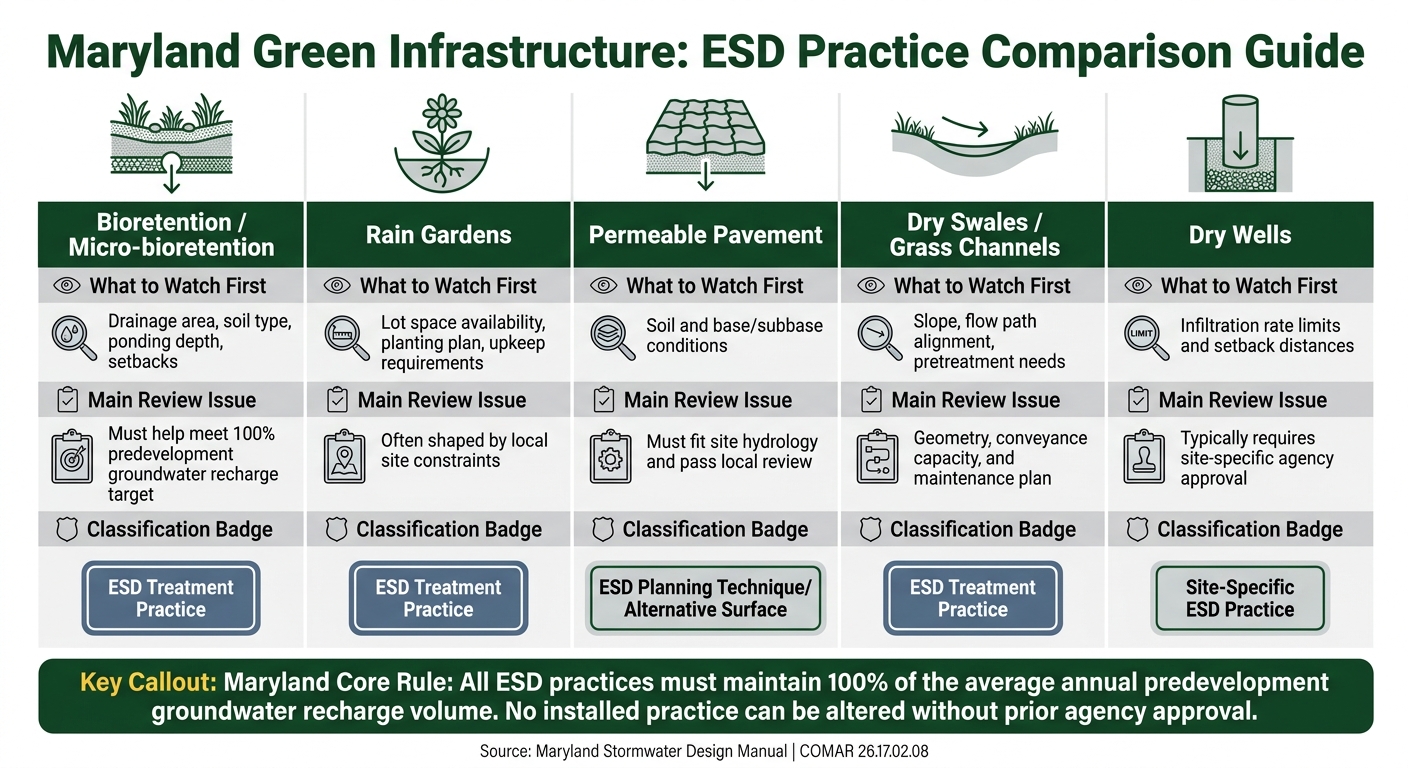
Maryland Green Infrastructure: ESD Practice Comparison Guide
The Maryland Stormwater Design Manual turns Maryland’s ESD framework into design rules for common green infrastructure practices. In this section, that framework shows up in three familiar systems: bioretention, permeable pavement, and swales.
Bioretention, Micro-Bioretention, and Rain Gardens
Micro-bioretention and rain gardens are classified as ESD treatment practices under the Maryland Stormwater Design Manual.[1] For single-lot residential projects, SSDS-SP03 gives applicants a simpler path to meet minimum control requirements.[1]
The main design inputs include drainage area size, ponding depth, engineered media depth, underdrain placement, soil infiltration rate, and setbacks from structures and utilities. Specific technical values, such as subbase depth, slope limits, and infiltration testing protocols, are set out in the Maryland Stormwater Design Manual.[1]
Permeable pavement follows the same ESD approach, but it does the job through surface design that cuts runoff at the lot level.
Permeable Pavements and Environmental Pavers
Permeable pavement, including permeable interlocking concrete pavers (environmental pavers), porous asphalt, and porous concrete, is classified as an ESD planning technique and alternative surface that reduces impervious cover and runoff.[1] Maryland’s design standards for these systems are meant to maintain 100% of the average annual predevelopment groundwater recharge volume for the site.[1] After installation, these practices cannot be altered without agency approval.[1]
Dry Swales, Grass Channels, and Retrofit Practices
Swales are categorized as ESD treatment practices, while open channel systems are treated as structural stormwater management measures under the Maryland Stormwater Design Manual.[1] Redevelopment and retrofit practices need local approval, and agencies may require added controls when downstream flooding or water quality risks call for them.[1]
Sizing and compliance hinge on hydrologic modeling and county-specific review standards.
Modeling, County Implementation, and Project Constraints
Hydrologic Methods, Design Storms, and Compliance Modeling
Once a practice is picked, Maryland review moves from concept to proof.
At that stage, the project team has to show – through hydrologic and hydraulic calculations – that the ESD system will work on the site and won’t create problems downstream. Maryland review also requires the plan to show ESD to the Maximum Extent Practicable before structural BMPs can be approved.[1]
One core sizing rule drives a lot of this work: ESD practices must maintain 100% of the average annual predevelopment groundwater recharge volume for the site.[1] If a project needs to change minimum control requirements or design criteria because of site limits, those same hydrologic and hydraulic calculations are required. They also have to show how hydrograph timing affects the first downstream tributary at or beyond the project’s contributing area.[1]
That downstream review can’t stop at the property line. It also has to account for dams, highways, and natural stream constrictions.[1]
County-Level Differences Across Central Maryland
State rules set the floor. Local review often sets the bar in practice.
Maryland’s stormwater system is built at the state level under COMAR 26.17.02.08, but local approving agencies decide how those rules are applied day to day. Counties and municipalities can ask for tighter controls, added engineered review, and written long-term maintenance duties. Approval paths and modification rules also change by jurisdiction, which makes local review the step that often decides the outcome.[1]
For property owners, this means one simple thing: don’t assume the same design will move the same way in every county. Checking with the local public works or environmental department before locking in a plan is usually the best way to avoid review delays.
Site Design, Installation, and Maintenance in Practice
A model can look good on paper and still run into hard limits in the field.
Poor soils, shallow groundwater, steep slopes, utilities, setbacks, and redevelopment conditions can all limit where green infrastructure can go. Maryland law also says that once an ESD practice is installed, it can’t be changed without prior approval from the local approving agency. That rule still applies if the property changes hands.[1]
When a standard plan doesn’t fit the site, agencies may ask for a full engineered stormwater management plan, especially where site conditions are tough or where downstream flooding and erosion are a concern.[1] In practice, that often pushes teams toward measures that match the site, such as:
- rain gardens
- micro-bioretention
- permeable pavement
- swales
- dry wells
Findings and Conclusion
Comparing Practice Types Under Maryland Standards
Maryland’s standards don’t say one practice beats every other option. The rule is simpler than that: use the practice that fits the site. In Maryland, there is no one-size-fits-all answer. Selection depends on site conditions and the performance criteria in the Design Manual.
| Practice | Primary Constraint |
|---|---|
| Bioretention / Micro-bioretention | Must be sized and sited to help meet the 100% predevelopment groundwater recharge volume requirement |
| Rain Gardens | Depends on local site conditions and long-term planting and maintenance needs |
| Permeable Pavement | Must fit the site’s hydrologic and geologic conditions and project review requirements |
| Dry Swales / Grass Channels | Geometry, conveyance, pretreatment, landscaping, and maintenance all matter |
Bioretention, rain gardens, permeable pavement, and swales all stay site-dependent under Maryland’s ESD framework.
In practice, Maryland expects teams to look at feasibility, conveyance, pretreatment, treatment, geometry, landscaping, and maintenance before choosing a practice. That shifts the focus to two plain questions: Will it work on this site? And can it be maintained over time?
For owners and managers, that usually makes the biggest issue pretty clear: match the practice to the property and to the local review path.
Key Takeaways for Maryland Property Owners and Managers
Maryland requires ESD first. Structural controls come after that, and only when ESD cannot meet the requirement.[1] So before turning to ponds, wetlands, or other structural BMPs, projects should review rain gardens, micro-bioretention, permeable pavement, and swales.
Local review can also shape the path of a project. Counties and municipalities must adopt ordinances that align with the state framework, and approving agencies can require engineered stormwater management plans when a project does not meet ESD to the MEP or when downstream impacts need closer analysis.[1] In plain English, a project that moves smoothly in one jurisdiction may face a different review process in another.
Maintenance is not optional. Maryland law requires ESD planning techniques and treatment practices to remain unaltered by subsequent owners, and any change must be approved by the appropriate agency.[1]
FAQs
When does Maryland allow structural BMPs instead of ESD?
Maryland permits structural BMPs only when they’re absolutely necessary. Before a developer can use them, they must show that ESD has been used to the maximum extent practicable.
Structural BMPs may also be required in a few other cases. For example, an approving agency can require them if it finds that the plan does not meet ESD standards. They can also be required when a statute or regulation says they must be used, or when channel protection volume discharge is more than 8,000 cubic feet – or 4,000 cubic feet in certain sensitive watersheds.
How do local county rules affect stormwater design approval?
Local county rules put the Maryland Stormwater Management Act of 2007 into practice by writing state-required Environmental Site Design (ESD) standards into county ordinances. Counties also have to revise zoning and public works codes so those rules don’t get in the way of ESD.
These local rules set the floor, not the ceiling. A local approving agency can still ask for stricter measures or a more detailed engineered stormwater plan. It also handles plan review and approval, which helps make sure the design stays in place instead of being changed later by future property owners.
What site conditions can prevent green infrastructure use?
Green infrastructure, also called stormwater best management practices (BMPs), needs to fit the site. You can’t just pick a practice off a list and drop it anywhere.
A site’s physical conditions shape what will work and what won’t. That includes soil type, groundwater levels, drainage area, slope, and head conditions. If one or more of these are off, some practices may be limited or ruled out.
Site constraints go beyond the ground itself. Wetlands, floodplains, forest conservation areas, and nearby public water supply wells can all affect what you’re allowed to build. These conditions need review to meet local and state requirements.
Chat with Us