









- bhavya gada
- No Comments
Biochar concrete can lower the carbon load of a patio, driveway, or wall by cutting cement use and storing carbon inside the finished concrete. If I were sizing up this option, I’d focus on four things right away: biochar dose, strength target, curing plan, and drainage.
Here’s the short version:
- Most concrete emissions come from cement, and cement production can emit about 500 kg of CO₂ per metric ton.
- Biochar is a carbon-rich material made from plant waste heated in low oxygen, then mixed into concrete.
- In many hardscape mixes, biochar is used at about 1% to 5% of cement weight.
- It can replace a small share of cement or part of the fine material/sand, depending on the mix.
- The carbon stays in the slab because the biochar is held inside the hardened concrete.
- Over time, concrete can also take in some CO₂ from air through carbonation.
- For Maryland weather, the mix still needs air entrainment, a strength target of about 3,500 psi to 4,000 psi, and good curing.
- Site work still matters: a slab should drain with about a 1% to 2% slope away from structures.
- In winter, I’d want clear rules: no deicing salts the first winter, use sand for traction, and protect the surface from standing water.
Bottom line: biochar concrete is not just about lower carbon. It also has to last through heat, rain, and freeze-thaw cycles. If the slab fails early, the carbon cost of tear-out and replacement can wipe out much of the gain.
If I were talking to a contractor, I’d ask simple questions: How much biochar is in the mix? What is it replacing? What strength is the mix designed to hit? How will you cure it? How will you keep water away from the slab? Those answers tell me a lot, fast.
Engineering Biochar for Carbon-Negative Concrete and Beyond
sbb-itb-843f8be
How Biochar Is Added to Concrete Mixes
Biochar is a carbon-rich material made by heating wood, crop waste, or yard waste in a low-oxygen setting. That process drives off gases and water, leaving behind stable carbon that can stay stored for centuries. In a hardscape, that carbon ends up locked into the finished concrete.
In ready-mix or precast production, biochar is usually premeasured and blended with cement and aggregates so it spreads through the mix evenly. On smaller jobs, crews can also add bagged biochar to site-mixed concrete at a measured ratio.
Once biochar is in the mix, the next issue is simple: how curing and hardening help keep that carbon in place.
Biochar as a Partial Cement Replacement
The most direct use case is to swap out a small share of Portland cement by weight. Research and early field trials often use 1% to 5% by weight of cement for hardscape mixes, with low single-digit amounts often giving the best mix of carbon cuts, strength, and workability [3][4][5].
At those lower amounts, some mixes can hold performance steady or even improve it. Why? Biochar particles can give cement crystals more places to form during hydration.
Push the percentage too high, though, and the mix can lose strength, become harder to place, and show a weaker finish. That’s why contractors usually stay in the low single digits for residential patios, walkways, and similar hardscape work.
Biochar as a Filler or Fine Aggregate Replacement
Biochar can also take the place of part of the sand. Since biochar particles are lighter and more porous than natural sand, this can lower the mix’s density and change the way it handles water. Its pores can hold moisture and help reduce shrinkage [1].
There’s a catch. If the biochar isn’t pre-moistened before mixing, workability can drop. Strength can also start to fall once sand replacement goes above about 10% by volume [2].
For non-structural hardscape elements like garden walls, decorative pavers, and infill concrete behind retaining walls, those trade-offs are often acceptable. The loads are modest, so a slightly lower density or a different surface feel may be fine, as long as freeze-thaw durability and abrasion resistance are checked for that mix.
Where Biochar Concrete Works Best in Hardscapes
Mix design plays a big part in where biochar concrete makes sense in residential hardscapes.
| Hardscape Application | Suitability for MD Climate |
|---|---|
| Patios & walkways | High – foot traffic only, manageable exposure |
| Garden walls & seat walls | High – low loading, good carbon storage opportunity |
| Pavers & stepping stones | High – manufacturer controls mix and curing |
| Residential steps | Moderate – edge durability and slip resistance must be checked |
| Retaining walls | Moderate – structural engineering review recommended for taller walls |
Precast units still need to meet the strength and durability requirements for the job they’re meant to do.
After the right application is selected, curing and long-term exposure have a big effect on how the finished hardscape holds up.
How Carbon Stays Locked Inside Finished Hardscapes
Biochar only helps with carbon storage if that carbon stays put inside the finished hardscape.
Stable Carbon Stored Inside the Concrete Matrix
Biochar is carbon-rich plant material made under low-oxygen conditions. Its carbon is much more stable than untreated plant matter and can last for centuries.[9] Once biochar is mixed into concrete and the concrete cures, that carbon gets physically trapped inside the hardened matrix.[9]
Concrete also helps on its own here. Its dense, low-permeability structure shields the biochar from breakdown, which helps keep the carbon stored for decades in a finished hardscape.
That’s only one part of the carbon picture.
How Carbonation Can Add to Total Carbon Capture
A second, slower process can add to the total carbon stored in a concrete hardscape: carbonation. As CO₂ in the air slowly moves into the concrete’s pores, it reacts with calcium compounds in the cement paste and forms calcium carbonate, which is a stable mineral form of carbon.[6][8] This happens on its own over decades in outdoor surfaces like patios, steps, and retaining walls that are exposed to air and moisture.
Biochar can also change how carbonation moves through the concrete.[11] In practice, biochar plus carbonation can cut net CO₂ by about 10% to 20%, depending on the mix.[7][9][10] That’s why contractors need to be precise about mix design, curing, and long-term exposure.
What to Ask Contractors About Mix Design, Curing, and Long-Term Use
Biochar Concrete vs. Standard Concrete: Key Specs for Hardscapes
Once the carbon is locked into the mix, the next step is simple: can the contractor actually build it the right way? For outdoor hardscapes, focus on three areas: the mix itself, the curing plan, and how the surface will hold up through years of weather.
Mix Design Details That Affect Strength and Durability
Start with a direct question: what percentage of biochar are you using, and what does it replace? You should also ask which parts of the project will use the biochar mix. Not every contractor will use the same mix across the whole job.
Then get a little more specific. Ask how the mix changes workability and finish quality. A mix can look good on paper and still be harder to place or finish in the field.
You’ll also want to know whether the contractor is using a published mix design or manufacturer guidance tested for exterior freeze-thaw exposure. For strength, ask if the mix is targeting at least 3,500 psi compressive strength for freeze-thaw exposure, or 4,000 psi if deicing salts will be used. And make sure air entrainment is included. For severe freeze-thaw conditions with deicing salts, standard guidance is around 6–7% air content.[13]
Curing Practices That Protect the Finished Surface
Curing matters with any concrete. Biochar mixes don’t get a pass here.
Ask when curing will start. Best practice is within 15 minutes of final finishing. Then ask how long the contractor plans to keep it going. For outdoor slabs that need to last, a minimum of 7 days of moist curing is standard.[12][13]
The method matters too. Moisture can be held in with:
- Wet burlap
- Plastic sheeting
- Curing compound
In Maryland, summer heat can dry fresh concrete fast. That bumps up the risk of plastic shrinkage cracking, so ask how the crew changes its curing approach in hot weather and in cold weather.[12][13]
After the curing period, drainage and winter exposure do a lot of the heavy lifting. They often decide whether the surface keeps performing well or starts to break down early.
Service Life, Maintenance, Drainage, and Winter Exposure
Long-term performance depends on more than the concrete mix. The hardscape also needs sound drainage, the right joint materials, and some care around deicing chemicals, especially in the first year.
Ask the contractor for plain guidance on winter use. You want to hear:
- No deicing salts during the first winter
- Sand used for traction
- A 30-day wait after curing before any salt exposure[12][13]
After that, a breathable silane or siloxane sealer can help reduce moisture intrusion and scaling.[12][13]
Drainage deserves its own question. Ask for a plan that shows a 1–2% slope away from structures, plus extra drainage where needed. If water collects at slab edges or near wall bases, freeze-thaw damage can show up much sooner, even if the mix itself is solid.
Use those answers to compare contractor proposals side by side.
A Comparison Table for Evaluating Contractor Proposals
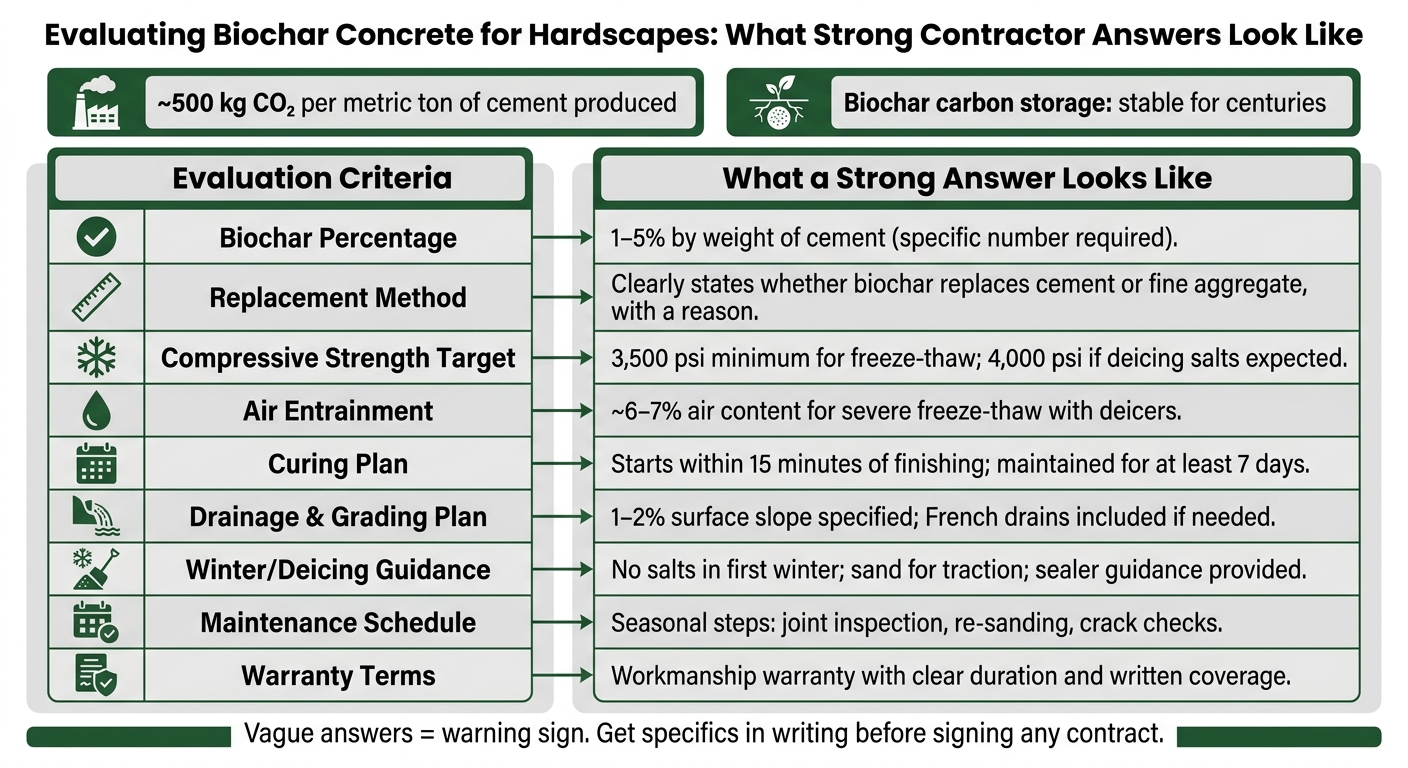
Use this table to track what each contractor says. If an answer is vague, that’s a warning sign.
| Evaluation Criteria | What a Strong Answer Looks Like |
|---|---|
| Biochar percentage | A specific number, typically in a low-dose range such as 1–5% by weight of cement |
| Replacement method | Clearly states whether biochar replaces cement or fine aggregate/filler, with a reason |
| Compressive strength target | 3,500 psi or higher for freeze-thaw exposure; 4,000 psi if deicing salts are expected |
| Air entrainment | About 6–7% air content for severe freeze-thaw exposure with deicers |
| Curing plan | Starts within 15 minutes of finishing; maintained for at least 7 days |
| Drainage and grading plan | Surface slope specified; French drains or similar included if needed |
| Winter/deicing guidance | No salts in the first winter; sand recommended for traction; sealer guidance included |
| Maintenance schedule | Specific seasonal steps such as joint inspection, re-sanding, and crack checks |
| Warranty terms | Workmanship warranty with clear duration and coverage stated in writing |
Planning Biochar Concrete Hardscapes in Maryland
Why Drainage and Grading Still Determine Long-Term Performance
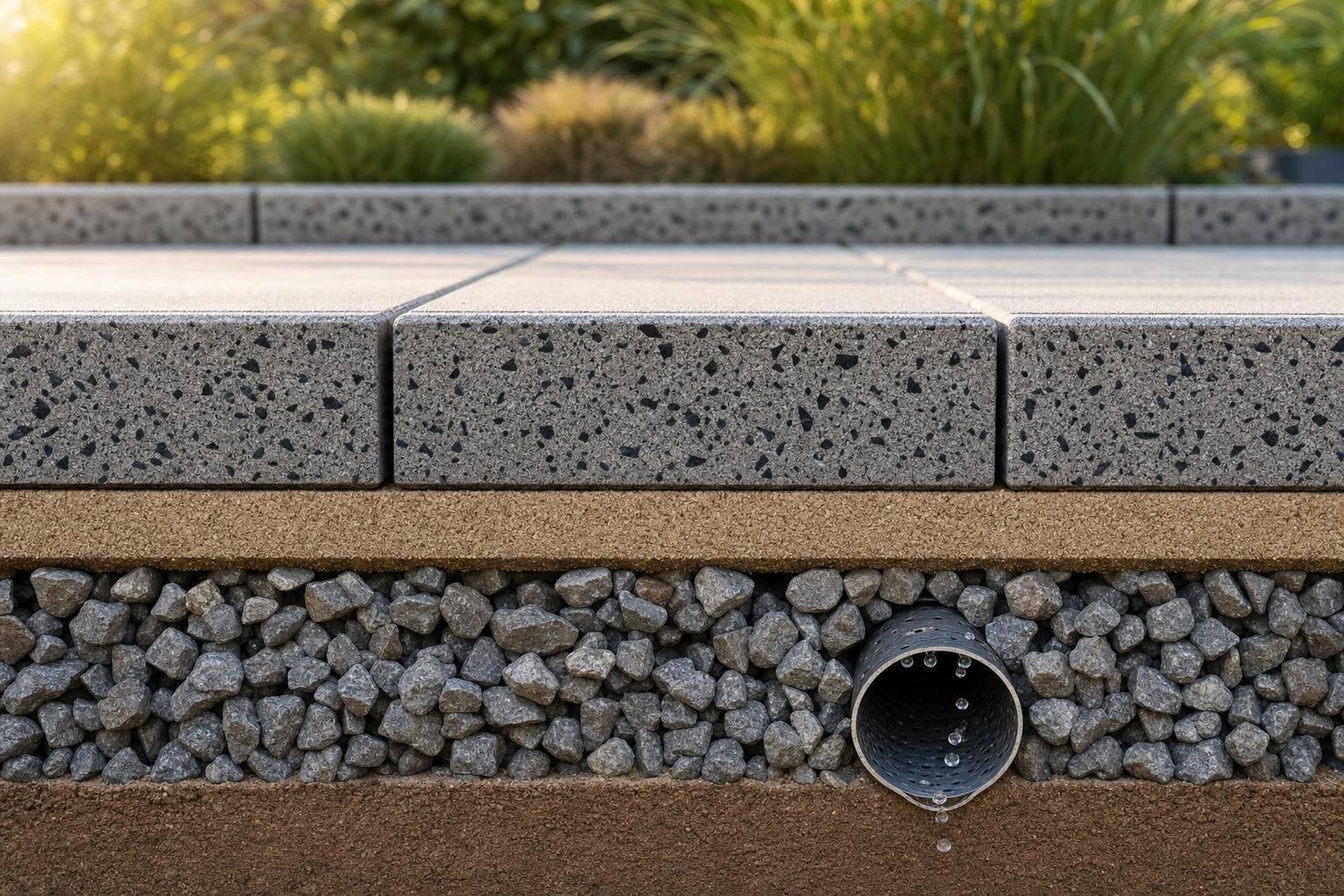
A lower-carbon concrete mix can still fail if the site stays wet. In central Maryland, damp ground and freeze-thaw cycles are hard on outdoor concrete. Even a well-made biochar mix needs a dry, stable base.
If water builds up under a patio or along a retaining wall footing, the base layer can shift and become saturated. That can lead to cracks and early failure. Good grading and drainage help keep that base dry and steady.
Even permeable hardscapes need enough drainage capacity to move water down and away from the surface. So the prep work matters just as much as the mix itself.
How Pro Landscapes MD Can Support Lower-Carbon Hardscape Projects
That’s why Pro Landscapes MD supports lower-carbon hardscape projects with grading, drainage, hardscape installation, and stormwater management across central Maryland and Washington, DC. They also install environmental pavers, which can fit into a broader low-impact hardscape approach.
Conclusion: Biochar Concrete Turns Hardscapes into Long-Term Carbon Storage
Bottom line: Biochar concrete stores carbon by locking biochar inside a durable concrete matrix. But that only works when the project is designed and installed the right way – using the right mix, proper curing, and a site built to deal with drainage, grading, and freeze-thaw exposure. In Maryland, drainage, grading, curing, and freeze-thaw protection determine how long that carbon stays stored.
FAQs
Is biochar concrete as strong as regular concrete?
It depends on the mix design, because adding biochar can change structural performance.
Concrete is prized for durability, but how it holds up also comes down to good installation and careful planning, especially with Maryland’s freeze-thaw cycles. Ask your contractor how they adjust the mix so the finished hardscape stays reliable and built to last.
How much carbon can a biochar concrete patio store?
A specific number isn’t given. Biochar concrete can lock away carbon, but the total in a finished patio depends on the mix design and how much biochar goes into the concrete.
Ask your contractor about:
- the percentage of biochar in the mix
- how curing helps keep that carbon in place
- how the material is expected to hold up over time in your local climate
What should I ask a contractor before using biochar concrete?
Ask how the contractor plans to handle mix design, curing, and fit with local soil and moisture conditions. Bio-based additives can need a few tweaks to keep the hardscape strong and stable.
If you’re in Maryland, make sure the plan also covers soil testing, proper drainage, and reinforcement. Those steps help the hardscape deal with freeze-thaw cycles and hold up over time.
Chat with Us