










- bhavya gada
- No Comments
If you change drainage on a Maryland lot, you usually need to show that ESD comes first. In plain terms, that means I would start with small, on-site runoff controls like rain gardens, swales, permeable pavement, dry wells, rooftop disconnection, and rainwater tanks before turning to larger stormwater systems.
Here’s the short version:
- Maryland requires an “ESD first” approach under COMAR 26.17.02.
- Local review often starts with impervious area, such as roofs, driveways, patios, and walkways.
- Common project triggers include additions, driveway widening, new patios, and major grading.
- Most retrofit planning starts with a site map that shows runoff paths, low spots, slopes, soil limits, and hard surfaces.
- Practice choice depends on soil, space, drainage, and setbacks.
- Roof runoff and driveways are often the first places to look because they send off a large share of runoff on home lots.
- You may need a county or municipal submittal, and some sites need an engineered plan.
- After installation, inspection and recordkeeping matter so the system keeps working and matches the approved plan.
A few facts stand out. Maryland’s rules point to preserving predevelopment recharge volume as a core target, and local agencies may require more documentation if a site has steep slopes, poor drainage, flooding, erosion, or water-quality issues downstream.
If I were planning a retrofit, I’d keep the path simple: check local triggers, map runoff, treat the hardest-working hard surfaces first, match each area to the right ESD practice, then maintain and document the work.
MDE Stormwater Regulations and Design Manual Updates Listening Session – October 28 (2025)
Maryland Stormwater Rules That Shape ESD Retrofits
Maryland stormwater compliance starts with COMAR 26.17.02 and the Maryland Stormwater Design Manual. COMAR 26.17.02 lays out the legal requirements. The Design Manual covers the technical side: sizing methods, approved practices, and design criteria that show how to meet those rules [1][2].
Put simply, these two sources are the rulebook for any project that changes how water moves across a site.
Stormwater review usually happens at the county or municipal level, and local procedures can vary [2]. Once you know which rules apply, the next move is to map the site features that affect runoff.
When Existing Properties Must Address Stormwater
Common home projects that can trigger stormwater review include additions, driveway expansion, new patios, and major grading. That’s why the site’s impervious layout often becomes the main compliance driver. Redevelopment also often has to meet current runoff-reduction standards [2].
Because local thresholds for what counts as a major site change differ by jurisdiction, check your exact triggers with your local stormwater office before design work starts [2].
The Core Standards: Runoff Volume, Water Quality, and Impervious Area
Maryland focuses on three main things: runoff volume, water quality, and impervious coverage. The day-to-day goal is simple: capture, slow, and infiltrate runoff close to where it falls [1].
Hard surfaces like roofs, driveways, patios, and walkways are the main targets. ESD practices are then sized and placed to capture and treat runoff from those surfaces. That standard shapes which ESD options fit best on a residential lot.
ESD Practices vs. Structural BMPs
Maryland’s rules follow a strict three-step sequence. First, minimize runoff at the source. Second, use distributed ESD practices across the site. Third, use structural BMPs only if ESD can’t fully handle the job [2].
"Each ordinance shall require that a developer demonstrate that ESD has been implemented to the MEP and, only where absolutely necessary, is a structural BMP used in developing a stormwater management plan." – COMAR 26.17.02.08 [1]
ESD uses small, spread-out practices such as rain gardens, swales, permeable pavement, and rooftop disconnection [1]. Structural BMPs, such as ponds or large basins, come later in the process [2]. For residential retrofits, ESD is the starting point the rules expect.
With the rules and targets clear, the next step is planning the retrofit around your site conditions.
Plan Your Property for an ESD Retrofit
Begin with a simple site map, check local submittal rules, and focus first on the spots that send off the most runoff. That map becomes the basis for picking the right retrofit.
Assess Drainage Patterns, Impervious Surfaces, and Site Limits
Sketch your property and mark every impervious surface: the roof footprint, downspout locations, driveway, patio, and any other paved area. Then note where water flows and where it tends to sit after a rainstorm. Those are your main runoff sources, and they show where ESD needs to do the heavy lifting.
Next, mark the site limits that could shape your options. Steep slopes, compacted soils, and poor drainage can rule out infiltration-based practices. Rain gardens and similar ESD features need the right ground conditions to work as intended.
Check County and Municipal Stormwater Submittal Requirements
Local stormwater offices often ask for ESD planning details, but the exact submittal rules vary[1]. In some places, you can use a standard single-lot residential stormwater plan instead of paying for a custom engineered design[1]. In others, you may need grading details, drainage calculations, or a full engineered plan, especially if the site has steep slopes, poor drainage, or known downstream flooding, erosion, or water-quality issues[1].
"An approving agency may require that an engineered stormwater management plan be submitted if… flooding, stream channel erosion, or water quality problems exist downstream from a proposed project." – Md. Code Regs. 26.17.02.08 [1]
Also, get approval before you change any recorded stormwater practice[1].
Prioritize Roof Runoff, Driveways, and Other High-Impact Surfaces
Start with rooftops and driveways. These are the most common ESD treatment areas[1], and they often give you the best return for the effort. A simple move, like sending a downspout toward a rain garden or another pervious area, can be a smart first step.
After that, look at patios and compacted yard areas. These spots often pair well with permeable pavement or infiltration landscaping. Once you’ve mapped the main runoff sources, you can match each one to an ESD practice that fits the site.
sbb-itb-843f8be
Choose ESD Practices That Fit Maryland Guidance
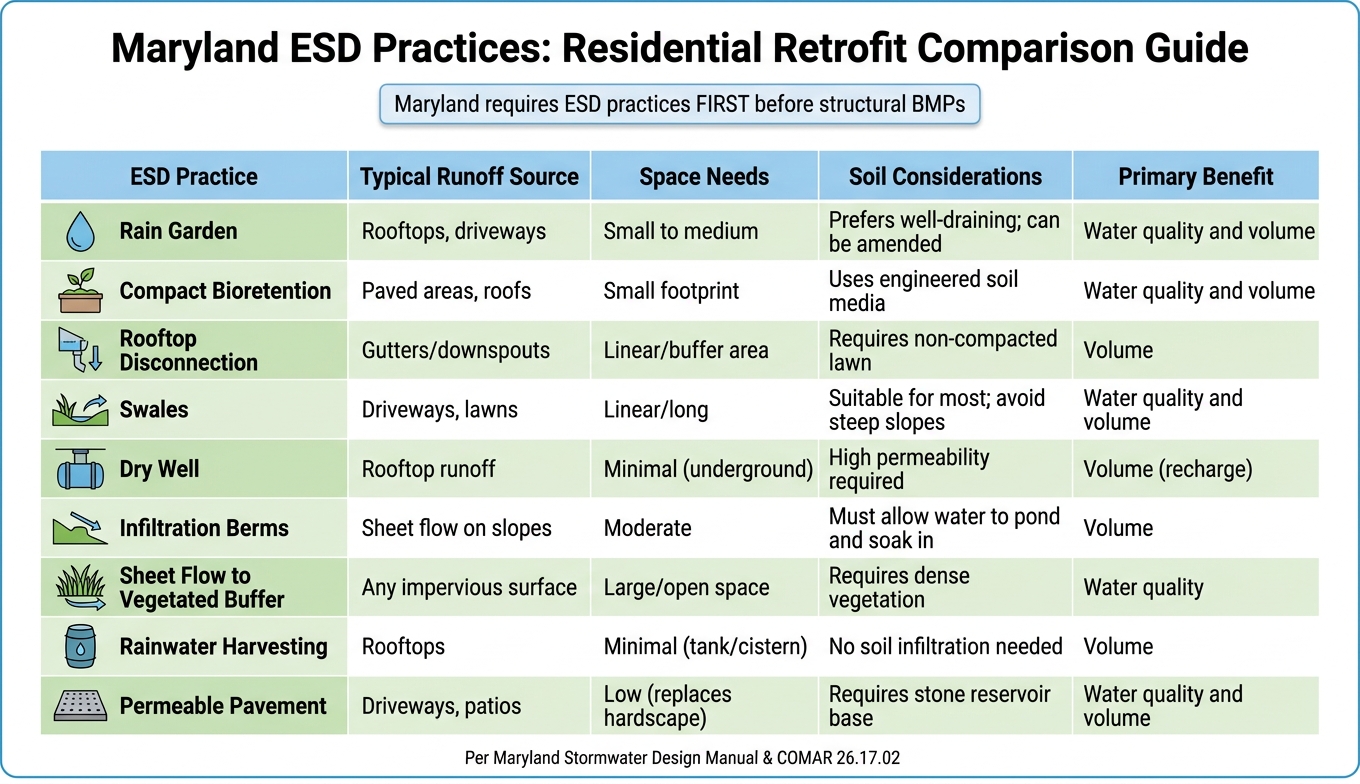
Maryland ESD Practices: Side-by-Side Comparison for Residential Retrofits
Now that you’ve mapped your runoff sources, the next move is to pick the ESD practice that handles each one with the least disruption to the site. The goal is simple: match each runoff source to the simplest practice your lot can handle.
Residential ESD Options That Work on Existing Lots
| ESD Practice | Typical Runoff Source | Space Needs | Soil Considerations | Primary Benefit |
|---|---|---|---|---|
| Rain Garden | Rooftops, driveways | Small to medium | Prefers well-draining; can be amended | Water quality and volume |
| Compact Bioretention | Paved areas, roofs | Small footprint | Uses engineered soil media | Water quality and volume |
| Rooftop Disconnection | Gutters/downspouts | Linear/buffer area | Requires non-compacted lawn | Volume |
| Swales | Driveways, lawns | Linear/long | Suitable for most; avoid steep slopes | Water quality and volume |
| Dry Well | Rooftop runoff | Minimal (underground) | High permeability required | Volume (recharge) |
| Infiltration Berms | Sheet flow on slopes | Moderate | Must allow water to pond and soak in | Volume |
| Sheet Flow to Vegetated Buffer | Any impervious surface | Large/open space | Requires dense vegetation | Water quality |
| Rainwater Harvesting | Rooftops | Minimal (tank/cistern) | No soil infiltration needed | Volume |
| Permeable Pavement | Driveways, patios | Low (replaces hardscape) | Requires stone reservoir base | Water quality and volume |
How Landscaping and Hardscaping Can Support Compliance
Landscaping and hardscaping choices can do a lot of the heavy lifting here. Permeable pavement and reinforced turf cut impervious area and reduce runoff right where it starts. That matters because it lowers the amount of water your ESD system has to handle.
Downspout routing also plays a big part. If you redirect downspouts toward landscaped areas or a rain garden, water moves into a treatment area instead of heading straight to the street. It’s a simple shift, but it can change how the whole lot drains.
Sizing and Placement Rules That Matter Most
One of the main sizing targets under Maryland guidance is meeting the full predevelopment recharge volume for the site [1]. That number shapes the size of your rain garden, dry well, or infiltration area based on the drainage area flowing into it.
Placement is just as important as size. ESD features need to fit the site and account for flow path, pretreatment, footprint, and maintenance access, and local ordinances may add setback rules of their own [1]. In plain English: a system that looks fine on paper can still fail if it’s squeezed into the wrong spot.
Soil checks matter too. Dry wells and other infiltration-based practices only work where the soil has enough permeability. If the ground won’t let water soak in, that practice isn’t the right fit.
Once you’ve picked the practice, the next step is to draft the retrofit plan and get construction lined up.
Implement, Maintain, and Verify the Retrofit
Prepare a Stormwater Plan and Coordinate Construction
Once you’ve picked the right ESD practice, the next phase is pretty simple on paper: get approval, build it, and keep it working.
After you choose an ESD practice, submit a plan that shows why each practice can be built on the site and how it follows Maryland’s ESD-first sequence [1][2]. For single-lot residential projects, use SSDS-SP03 to make the review process easier [1]. Submit the plan through the county or municipal program [2].
During construction, keep soil disturbance as limited as you can. Also, keep heavy equipment out of planned rain garden, swale, and infiltration areas so the soil doesn’t get compacted [1]. That step matters more than it may seem. If those areas get packed down, they may not drain the way the approved plan expects.
Inspect and Maintain Rain Gardens, Swales, and Infiltration Areas
After construction, the job shifts from installation to regular inspection.
Inspect the system on a routine basis, fix damage quickly, and keep a maintenance log with dates, findings, and repairs [1][2]. Leave approved practices as they are unless the local approving agency signs off on a revision [1].
It also helps to keep your paperwork in one place. Hold on to:
- The approved plan
- Any written reasons for why a practice was or was not selected
- The maintenance log
Those records help show that the retrofit still matches the approved design and stays easy to verify [1][2].
Conclusion: The Basic Path to Meeting Maryland Rules with ESD
Meeting Maryland’s stormwater rules comes down to four main actions: know what triggers compliance on your property, document why each ESD practice is practicable or not, choose the right practices for the site, and then inspect, repair, and document what you install so compliance holds over time.
If you’re working through a retrofit in central Maryland, Pro Landscapes MD can help coordinate drainage, grading, landscaping, and hardscaping needed for an ESD plan.
FAQs
Do I need stormwater review for a small home project?
It depends on your county or city rules, and those rules have to line up with Maryland’s stormwater regulations. For small home projects, the process is often simpler.
In many cases, a Standard Stormwater Management Plan for Single Lot Residential Construction is enough to meet the minimum requirements. That said, check with your local approving agency. It can still ask for engineered plans if the project calls for them.
How do I know which ESD practice fits my lot?
The right Environmental Site Design (ESD) practice depends on your lot’s available space, slope, soil drainage, and groundwater depth. Those details help show whether infiltration-based practices are a good fit and whether they’ll work as planned.
You also need to factor in site constraints, like required setbacks from foundations, wells, and septic systems. Pro Landscapes MD can review these conditions and help put the right drainage solution in place while protecting your landscape.
When does Maryland require an engineered stormwater plan?
Maryland may require an engineered stormwater management plan when a project does not meet the ESD to the maximum extent practicable standard.
It can also be required by statute or regulation. And in some cases, site hydrologic or topographic conditions make it necessary. The same goes for sites with existing downstream flooding, stream channel erosion, or water quality problems.
Chat with Us