









- bhavya gada
- No Comments
Retaining walls are a practical solution to prevent soil erosion on sloped properties. They hold back soil, manage water runoff, and stabilize landscapes, protecting your property from damage caused by heavy rain and gravity. By addressing key factors like lateral earth pressure and water drainage, these walls ensure long-term stability while also improving usability by turning steep areas into functional spaces.
Key Points:
- Prevents Soil Erosion: Retaining walls counteract soil movement caused by gravity and water.
- Manages Water Runoff: Proper drainage systems reduce water pressure behind the wall.
- Stabilizes Slopes: Supports soil and prevents landslides, especially in areas with heavy rainfall.
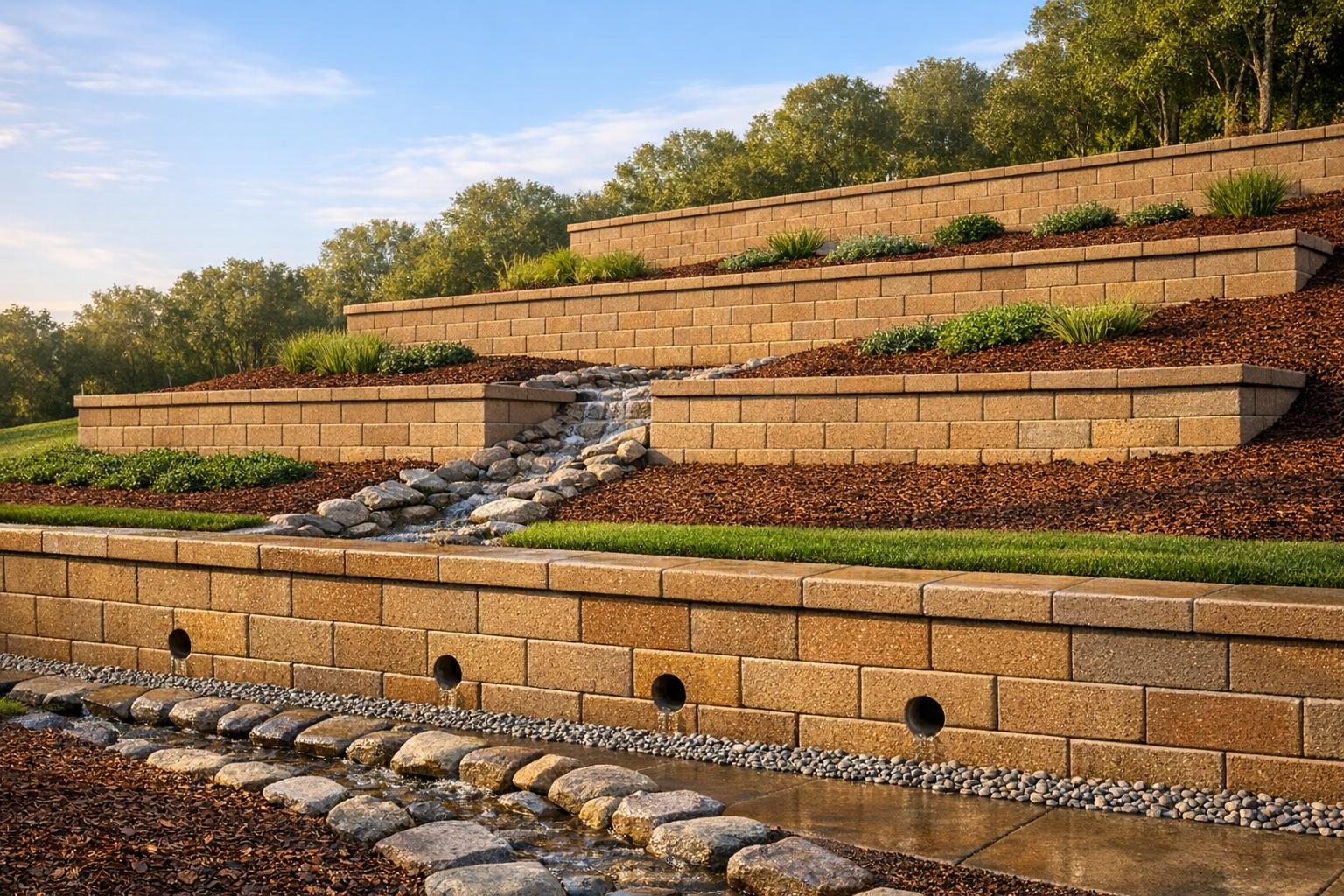
- Improves Property Use: Transforms unusable slopes into terraces for gardens, patios, or walkways.
- Durable Materials: Options like concrete and natural stone ensure longevity.
For Maryland homeowners, retaining walls are particularly effective in managing the challenges posed by the region’s terrain and weather conditions. Regular maintenance, like clearing drainage systems and inspecting for damage, is critical for their performance and durability.
Retaining Walls: The Solution to Slope Stabilization and Soil Erosion
sbb-itb-843f8be
What Causes Soil Erosion
Understanding what leads to soil erosion is key to protecting your property. Soil stability is influenced by both natural forces and human actions, particularly on sloped areas like those found in central Maryland. When these factors interact, even a stable hillside can become prone to washouts and significant damage.
Natural Causes of Erosion
Gravity is the main force behind soil movement on slopes. Without it, erosion and landslides wouldn’t happen. On steeper slopes, gravity’s pull becomes stronger, increasing the likelihood of soil displacement, especially during heavy rainfall [2].
Water is the most powerful natural driver of erosion. Raindrops break apart exposed soil, making it easier for particles to move downhill [3]. Surface runoff then transports these loosened particles in three distinct ways:
- Sheet erosion: Removes thin layers of soil uniformly across large areas.
- Rill erosion: Creates small, shallow channels in the soil.
- Gully erosion: Forms deeper channels, which speed up soil loss dramatically [3].
The faster water flows down a slope, the more soil it picks up along the way.
Wind also contributes, especially during dry spells when loose soil particles can be lifted and carried across your property [3]. Meanwhile, weathering – both physical and chemical – gradually weakens rocks and minerals, leaving soil more prone to erosion [2][4]. Vegetation provides a natural shield against these forces: plant leaves protect soil from raindrop impact, while roots anchor the soil, reducing its vulnerability to movement [4].
While these natural processes play a significant role, human activities often amplify soil erosion.
Human-Induced Factors
Human actions frequently accelerate soil erosion beyond what natural forces would cause. Research from 2019 analyzed sediment cores from 632 lakes and revealed that deforestation and intensive farming have been driving erosion for thousands of years. The study showed that 35% of these lakes had higher sedimentation rates linked to human land-use changes rather than climate variations [5].
"It wasn’t simply cutting down the trees that caused the erosion; it was keeping them off the landscape through farming practices." – David Montgomery, Professor of Earth and Space Sciences, University of Washington [5]
Construction activities are another major contributor. Urban development can cover up to 70% of soil with buildings and roads, preventing water from being absorbed and increasing runoff onto nearby unsealed areas [6]. Clearing land for construction or landscaping removes vegetation that once stabilized the soil. Additionally, repetitive plowing, tilling, and poor grading practices leave land exposed, making it vulnerable to erosion from water and wind [5]. Human activities have already altered about 50% of the Earth’s ice-free land area [6].
Understanding these natural and human-driven forces is crucial when planning solutions, like retaining walls, to stabilize slopes and protect your property from erosion.
How Retaining Walls Prevent Soil Erosion
How Retaining Walls Prevent Soil Erosion: Key Mechanisms and Features
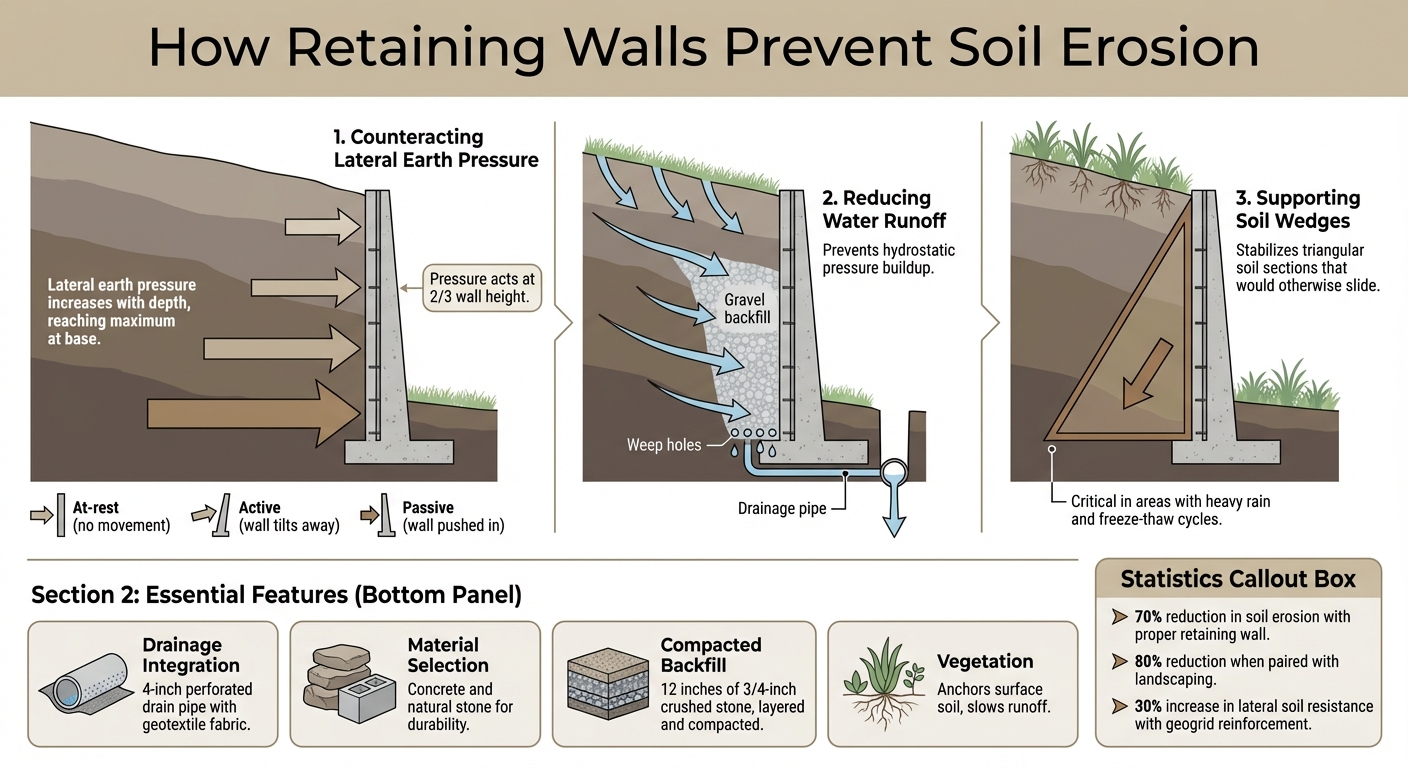
Retaining walls are designed to hold back soil, countering the forces that cause it to move. One of the biggest challenges they face is lateral earth pressure – the horizontal force soil exerts as it pushes against the wall. This pressure behaves much like water pressure: it starts at zero at the surface and grows stronger as you move deeper, reaching its maximum at the base [7].
"One of the main loads acting on a retaining wall is the lateral earth pressure. For that reason, doing a good estimation of its magnitude and distribution is decisive in the design." – SkyCiv Engineering [7]
The way a retaining wall performs depends largely on how it interacts with the soil. Engineers classify lateral earth pressure into three categories:
- At-rest: When the wall doesn’t move at all, fully restraining the soil.
- Active: When the wall tilts slightly away from the soil, reducing the pressure.
- Passive: When the wall is pushed into the soil, which increases the pressure.
Typically, the soil’s resultant force acts on a point about two-thirds of the way down the wall’s height [7]. Let’s look at how retaining walls handle these forces and manage water to keep soil in place.
Counteracting Lateral Earth Pressure
A retaining wall serves as a vertical barrier, keeping soil from sliding downhill. Its design must account for the lateral forces exerted by the soil, factoring in variables like the slope of the backfill and the soil’s natural friction [7]. By carefully calculating these forces, engineers ensure the wall can withstand the pressure without failing.
Reducing Water Runoff and Soil Displacement
Water management is a critical part of a retaining wall’s function. Without proper drainage, water can build up behind the wall, creating hydrostatic pressure that weakens its structure [1]. Features such as gravel backfill, weep holes, and drainage pipes help channel water away, reducing runoff and keeping the soil stable [1].
Supporting Soil Wedges
Retaining walls also stabilize soil wedges – the triangular sections of soil that would otherwise slide away. By anchoring these wedges, the walls reduce the risk of landslides. Proper drainage is especially important here, as oversaturated soil can lose stability. This is particularly crucial in areas prone to heavy rains and freeze-thaw cycles, like Maryland, where such conditions can test a wall’s durability [1].
Key Features of Effective Retaining Wall Systems
Retaining walls are more than just barriers – they’re carefully engineered systems designed to withstand lateral pressure and manage water flow. To ensure their longevity and functionality, certain design features are absolutely essential.
One of the most critical aspects is drainage integration. Without proper drainage, water builds up behind the wall, creating hydrostatic pressure that can lead to bulging or even a complete collapse. A well-designed system includes a 4-inch perforated drain pipe installed behind the lowest course of the wall. This pipe should be wrapped in geotextile fabric to prevent sediment from clogging it. Additionally, the backfill should extend at least 12 inches behind the wall and consist of angular 3/4-inch crushed stone – materials that don’t retain moisture [8][9].
"Water can accumulate behind the wall, exerting pressure that leads to bulging or even collapse. Ensuring proper drainage is critical for a long-lasting retaining wall." – McCluskey Contracting [8]
Material selection is another cornerstone of a reliable retaining wall system. For areas with high soil pressure or harsh weather conditions, materials like concrete and natural stone are ideal due to their durability. On the other hand, wood can be a cost-effective option for shorter walls, though it may require more frequent replacement. When constructed properly, retaining walls can reduce soil erosion by 70%, and when paired with landscaping, this figure jumps to 80% [10]. For taller walls – those exceeding 3 to 4 feet – or installations on steep slopes, consulting a professional is highly recommended to ensure the structure can handle the load safely.
Vegetation and backfill also play an important role in stabilizing the wall. Vegetation planted in terraced sections helps anchor surface soil and slows water runoff, adding an extra layer of erosion control [10]. Backfill material should always be compacted in layers, with each layer thoroughly compressed before adding the next. This prevents settlement over time and ensures long-term stability [8][9]. In colder climates, like Maryland, proper drainage is especially vital. Without it, trapped water can freeze and expand, causing frost heave that displaces wall blocks [9].
For challenging terrain, geogrid reinforcement can boost lateral soil resistance by up to 30%, offering additional support where needed [10]. By combining effective drainage, durable materials, compacted backfill, and thoughtful landscaping, retaining walls transform unstable slopes into stable, erosion-resistant areas.
Pro Landscapes MD: Custom Retaining Wall Solutions in Maryland

Pro Landscapes MD specializes in creating retaining walls that safeguard sloped properties in Maryland. By combining structural integrity with effective drainage, they deliver solutions tailored to the region’s diverse terrain and weather challenges. Their approach is more than just stacking blocks – they engineer walls designed to withstand Maryland’s unique environment.
Serving Central Maryland Communities
Pro Landscapes MD proudly serves a wide range of areas across central Maryland, including Howard County, Montgomery County, Carroll County, Frederick County, Prince George’s County, and Baltimore County. They work in communities such as Ellicott City, Columbia, Bethesda, Potomac, Gaithersburg, Towson, Silver Spring, Annapolis, and Baltimore, as well as Washington, DC. This localized focus allows them to understand the specific soil and weather conditions that impact retaining wall performance in the region. With this knowledge, they craft solutions tailored to each property’s needs.
Custom Designs Tailored to Your Property
Properties face different erosion challenges, and Pro Landscapes MD takes a custom approach to meet these needs. They use top-tier wall systems like Cornerstone Wall, Nicolock, Hanover Wall, and Techo-Bloc, offering options such as the Brandon Wall, G-Force, Mini Creta Architectural (available in 3-inch and 6-inch heights), Semma, and Raffinato. These systems are designed to suit various aesthetic and functional preferences. Their installations also incorporate drainage features to control water effectively [1][8]. For added style, architectural details like Bullnose and Bullnose Grande provide a polished look without compromising strength.
Additional Landscaping and Hardscaping Services
Pro Landscapes MD doesn’t stop at retaining walls. They offer a range of services that enhance erosion control and improve the usability of your property. Their drainage solutions include French drains, dry riverbeds, stormwater management, grading, and land leveling, all of which complement their retaining wall systems. They also install flagstone and paver patios, walkways, driveways, garden walls, seat walls, and natural stone steps. As experienced horticulturists, they provide landscape design, planting, and lawn care services. These can be seamlessly integrated with terraced retaining walls to further stabilize soil and minimize runoff.
Conclusion
Retaining walls play a crucial role in preventing soil erosion and stabilizing sloped properties. By holding back soil during heavy rains and guiding runoff away from foundations and gardens, they protect your landscape and home. Features like weep holes, drainage pipes, and gravel backfill are essential to prevent water buildup behind the wall, ensuring both the structure and the surrounding area remain secure.
These walls also transform steep, unusable areas into level, practical spaces for patios, gardens, or recreational use. Beyond managing erosion, they safeguard driveways, walkways, and other structures by keeping the underlying soil stable and dry.
Routine maintenance is key. It’s important to inspect your wall regularly for cracks, bulges, or other signs of wear. Clearing debris from drainage components ensures proper water flow, and after severe weather, a professional inspection can catch issues early, preventing costly repairs. With proper care, a retaining wall can protect and enhance your property for years.
For those in Maryland dealing with erosion concerns, Pro Landscapes MD provides tailored retaining wall solutions designed for the region’s specific soil and weather conditions. Their team blends expert engineering with thoughtful design, using high-quality materials and effective drainage strategies. Reach out to schedule a professional assessment and discover how a custom retaining wall can safeguard your property.
FAQs
Do I need a permit for a retaining wall in Maryland?
Yes, a permit is required in Maryland to build a retaining wall under specific conditions. If the wall exceeds 30 inches in height, supports a surcharge load, crosses a property line, or is designed to contain certain liquids, you’ll need to obtain one. Be sure to review local regulations to ensure compliance with all requirements.
How do I know if my slope needs a retaining wall or drainage work?
If you’re wondering whether your slope might need a retaining wall or drainage work, keep an eye out for some telltale signs. A retaining wall could be the solution if the soil on the slope seems unstable, erosion happens often, or the incline is too steep to handle grading alone. On the other hand, drainage work might be necessary if you spot standing water after heavy rainfall, yellowing plants, or water stains on nearby structures – these are clear indicators of poor drainage and possible water pooling problems.
What warning signs mean my retaining wall is failing?
Signs that a retaining wall may be failing include cracks, leaning or bulging, water pooling, soil erosion, efflorescence (a white, powdery residue), and gaps between the wall and the soil. These problems often signal structural stress, pressure buildup, or instability. Tackling these issues promptly can help avoid more extensive damage and keep the wall secure.
Chat with Us