









- bhavya gada
- No Comments
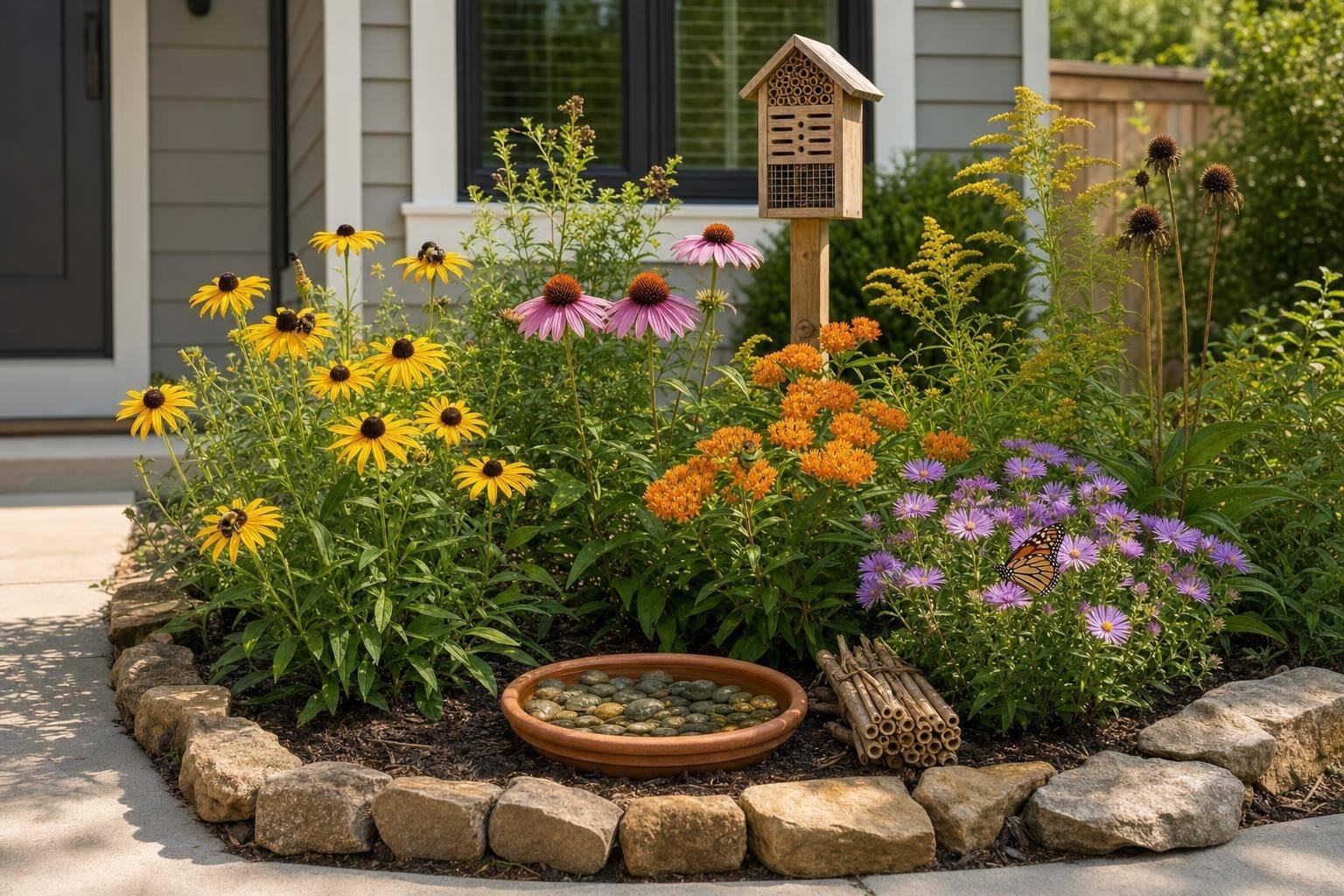
You do not need a big yard to help bees and butterflies. In Howard County, local programs show that even a 4-by-14-foot garden – just 56 square feet – can provide pollinator habitat. The main pattern is simple: if you use native plants, keep blooms going from spring to fall, and add a little shelter, a small lot can still do the job.
Here’s the short version:
- Small plots count: even a tiny bed or lawn strip can help.
- Flowers do most of the work: native perennials carry most of the nectar and pollen load.
- Spring-to-fall bloom matters most: aim for flowers across the season, not just one peak.
- Shrubs, trees, grasses, and sedges add support: they fill early bloom gaps and give cover.
- Layout matters on tight lots: plant in small drifts instead of scattering single plants.
- Rain gardens and low spots can do double duty: they can take runoff and support pollinators.
- Low-disturbance care helps: leave some stems and leaf litter through winter, and avoid spraying when plants are blooming.
If I were planning a small Howard County pollinator garden, I’d focus on three things first:
- Match plants to the site – sun, shade, and wet or dry soil.
- Use overlapping bloom times – early spring, summer, and fall.
- Include shelter – a small bare-soil patch, stems, grasses, or a log section.
A few plant groups show up again and again in local guidance:
- Spring: redbud, serviceberry, dogwood, Virginia bluebells
- Summer: bee balm, milkweed, coneflower, black-eyed Susan
- Fall: asters and goldenrods
- Structure: little bluestem, sedges, wildrye
Bottom line: on a compact lot, plant diversity and bloom timing matter more than bed size.
| Small-lot setup | Best use | What it can add |
|---|---|---|
| Front-yard bed | Season-long flowers | Steady nectar and pollen |
| Foundation or edge border | Perennials plus shrubs | Early bloom and layered cover |
| Lawn strip conversion | Low meadow or lawn-mimic mix | Lower-input bloom space |
| Rain-garden-style bed | Wet-area natives | Runoff handling plus habitat |
So if your yard is small, narrow, HOA-visible, or oddly shaped, the local evidence points in the same direction: a modest native planting can still help if it blooms across the season and is left a little less tidy.
5 Favorite Native Garden Plants for Pollinators in the Eastern U.S. 🐝🌼
sbb-itb-843f8be
Howard County and Maryland sources: trials, demonstration gardens, and official habitat guidance
Howard County’s small-lot pollinator guidance isn’t based on guesswork. It comes from field trials, demonstration gardens, and county and state habitat standards. In plain English, that means two things: which plants tend to do well here and how to tell if a small yard is pulling its weight for pollinators.
Howard County Bee City USA lawn mimic and meadow work
Howard County Bee City USA ran replicated field trials that compared eight seed mixes and two planting methods for lawn mimics and pollinator meadows. The aim was simple: find lower-maintenance options than turf that also support pollinators and cut emissions.[20]
The county also planted demonstration meadows at Rockburn Branch Park and Belmont Historic Manor using native wildflowers and grasses such as butterfly weed, wild bergamot, mountain mint, black-eyed Susan, little bluestem, and goldenrods.[15][13] Those same plant picks, along with the low-work planting approach, fit small lots well too.[2][13]
That sets up the next issue for homeowners: bloom timing and habitat structure in a compact space.
How county and state programs define usable pollinator habitat
Maryland’s baseline guidance calls for at least three flowering species in bloom from early spring through late fall. Larger-site habitat plans add higher targets for species counts and bloom coverage.[12][17][18][19] For a small residential lot, three species blooming at the same time is the most practical benchmark.
University of Maryland Extension advises residents to:
- Match plants to the site
- Use overlapping bloom periods
- Add host plants
- Leave stems and leaf litter in place over winter for nesting bees[1][6][12][14][16]
LiveGreen Howard and Howard County Bee City USA also offer Native Plant Pollinator Garden Design Templates for different site conditions. These give residents ready-made plant combinations for small spaces, including specialty designs for cul-de-sac islands and other awkward suburban spots.[3][4][21]
Those standards make it easier to see which plant groups and bloom windows matter most on compact lots. The next step is matching those standards to specific flowers, shrubs, trees, and grasses.
Plant types linked to higher pollinator activity on small Maryland lots
Local guidance from Howard County Bee City USA and University of Maryland Extension keeps landing on the same point: wildflowers do most of the heavy lifting in small residential gardens, while woody plants and native grasses add shape, shelter, and bloom at other times of year.[11][1][4] On compact Maryland lots, tight groupings of high-value native plants tend to do better than scattered ornamentals.
Core flower, shrub, and tree groups for the Maryland Piedmont
The flowering perennials that show up again and again include bee balm (Monarda spp.), coneflower (Echinacea spp.), blazing star, and asters.[25][16] These plants offer nectar and pollen, and they tend to bloom long enough to matter in a small bed.[11][1][4]
Woody plants help cover early-season gaps, which is a big deal when many perennials haven’t started yet. Common picks include Eastern redbud, serviceberry, flowering dogwood, blueberries, native viburnums, shrubby willows, native cherries, and native hollies.[22][23][7] In a small yard, even one or two well-placed shrubs or a small tree can add height and bring in early blooms.[1][7]
Why native grasses and straight species keep appearing in the guidance
Native grasses and sedges keep showing up in local planting advice, even for small beds, and not by accident. Plants like little bluestem, Virginia wildrye, blue sedge, yellow indiangrass, and other native sedges and rushes add structure and give overwintering insects places to shelter.[13][24][26][1]
Howard County’s "Sunny & Dry Garden for Pollinators" template specifically advises choosing native species over cultivars when possible.[11][4] Maryland Extension and DNR guidance also note that double-flowered forms can swap out reproductive parts for extra petals, which can leave pollinators with little or no pollen or nectar.[1][7] In practice, these plant groups do best when bloom times are staggered across the season and the bed includes shelter as well.
Bloom timing and habitat features that help small gardens support more pollinators
Seasonal bloom coverage from early spring through fall
Once you’ve picked the plants, bloom timing and shelter shape how much the garden helps. On small Howard County lots, the big goal is simple: keep something blooming from spring through fall. In most yards, that means mixing woody plants, perennials, and flowers that can bloom in low-mow lawn areas.
In early spring, native woody plants can help cover the March-April gap. Virginia bluebells and other spring woodland natives also work well in partly shaded spots.[28][29][32][33] Maryland tip sheets also suggest letting common low-mow lawn flowers bloom in low-mow areas during that spring gap.[30]
From late spring into summer, native perennials and herbs keep food in front of pollinators. Wild columbine, golden alexanders, bee balm, milkweeds, purple coneflower, and black-eyed Susan are all common picks for Maryland pollinator plantings.[1][12][27][33] In a small bed, layout matters. Planting flowers in small drifts instead of one here and one there makes them easier for pollinators to spot.[31]
Fall is where asters and goldenrods do a lot of the heavy lifting. Native asters can bloom into October and, with goldenrods, provide late-season nectar for migrating monarchs and other pollinators.[7][6][28][31] Maryland DNR‘s Pollinator Habitat Plan also says flowering periods should cover at least 80% of the growing season.[7][6] Even a small garden can hit that mark by combining early, midseason, and fall bloomers.
Small-space habitat features beyond flowers
Flowers are only part of the picture. Pollinators also need places to nest, rest, and ride out bad weather, and those features don’t need much room.
Maryland Extension materials recommend bare or lightly vegetated soil patches, rocks, and untreated logs with drilled holes in sunny, well-drained spots for ground-nesting and cavity-nesting bees.[30] In a compact yard, that might look like:
- A 1-2 sq ft patch of open soil
- A small cluster of rocks
- One log section set along a bed edge
Shallow water dishes with pebbles or stones also give bees and butterflies a safer place to drink.[29][30]
How you manage the space matters too. Avoid insecticide applications when plants are in bloom, and use herbicides only for targeted invasive control instead of routine weeding.[1][7] Fertilizer should be used sparingly and based on a soil test, since too much can favor aggressive grasses over native forbs.[1][12] Leaving standing stems and some leaf litter through winter also gives overwintering insects more shelter.[29]
Drainage and stormwater features that can support pollinator plantings
Water management can help here too. Features like rain gardens, dry riverbeds, and swales can handle roof and driveway runoff while also supporting pollinators.[5][34][35] When planted with native shrubs, grasses, and perennials, they can turn a problem spot into useful habitat.
Montgomery County rain garden guidance recommends using at least 75% native plants and notes that these features can provide pollinator habitat while treating runoff.[36][37] A well-built rain garden also drains fast enough to limit mosquitoes while still staying moist enough for native plants.[35][38] On a small lot, that kind of stormwater bed can do double duty as habitat.
What the local evidence suggests about performance on small lots
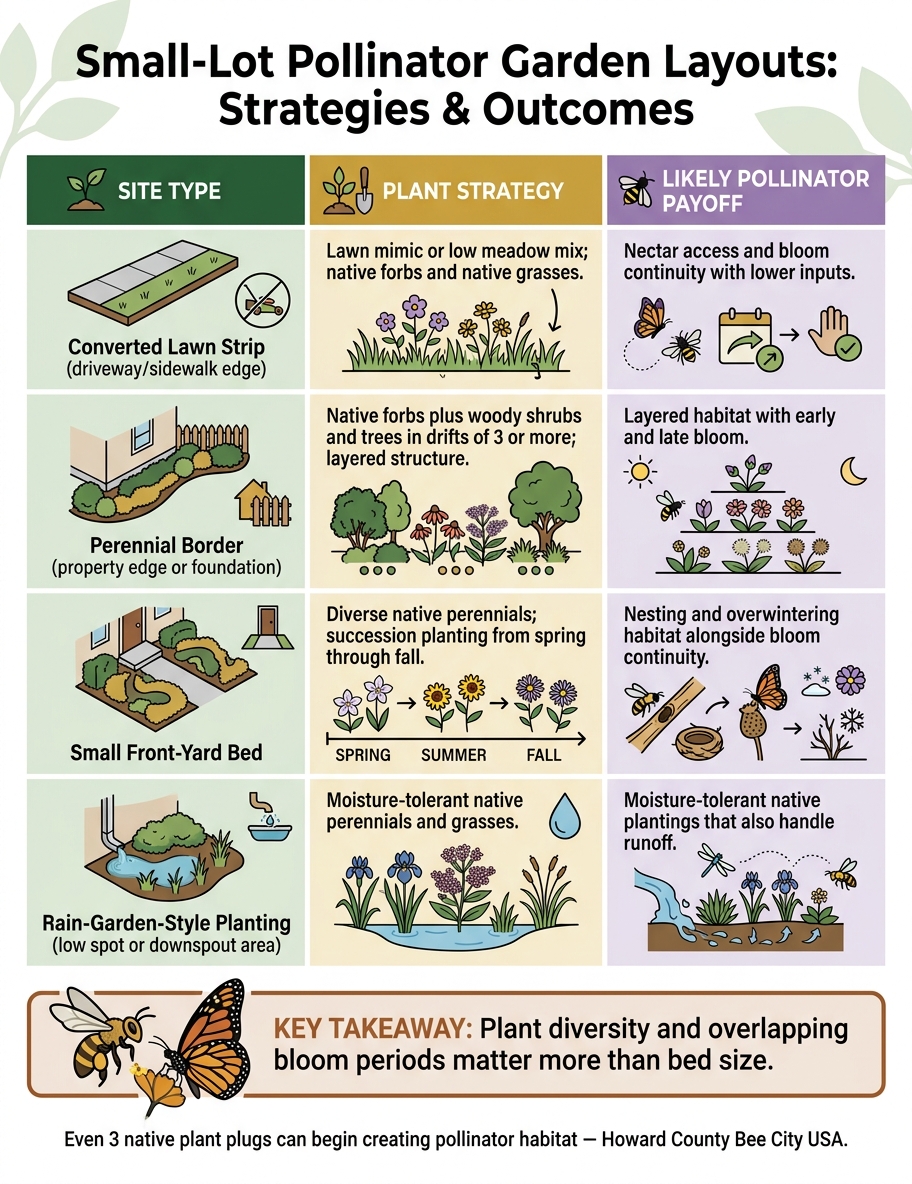
Small-Lot Pollinator Garden Layouts: Strategies & Outcomes
Comparison of small-lot planting approaches and expected outcomes
Local trials point to a handful of small-lot layouts that tend to support more pollinators. On small Howard County lots, the layouts that do best usually fit the site’s moisture, sun, and available space.
| Site Type | Plant Strategy | Likely pollinator payoff |
|---|---|---|
| Converted lawn strip (driveway/sidewalk edge) | Lawn mimic or low meadow mix; native forbs and native grasses | Nectar access and bloom continuity with lower inputs |
| Perennial border (property edge or foundation) | Native forbs plus woody shrubs and trees in drifts of three or more; layered structure | Layered habitat with early and late bloom |
| Small front-yard bed | Diverse native perennials; succession planting from spring through fall | Nesting and overwintering habitat alongside bloom continuity |
| Rain-garden-style planting (low spot or downspout area) | Moisture-tolerant native perennials and grasses | Moisture-tolerant native plantings that also handle runoff |
The main thread across all four setups is pretty simple: plant diversity and overlapping bloom periods matter more than bed size.
Local programs show three consistent patterns:
One point shows up again and again in local programs: small plots still matter. Howard County’s Bee City USA Habitat Registration program tracks individual residential patches and gives participants a free habitat sign, treating each small yard planting as part of the county’s total pollinator habitat.[13][39] The Pollinator Patch Starters initiative makes the point even more plainly. It suggests that even three native plant plugs can be enough to begin creating habitat.[15]
The next pattern is about what you plant, not just how much space you have. For small lots, local guidance leans toward using several native species with staggered bloom times, along with a mix of forbs plus grasses or sedges.[10][40] That mix does more than fill space. It helps keep flowers available across the season and gives the planting more shape and function.
State and county guidance also keep coming back to the same planting formula: forb-heavy mixes with some native grasses or sedges.[8][9][41] The reason is practical. Grasses and sedges add structure, but the planting should not lean so hard on them that they crowd out the forbs.
Put another way, a small lot doesn’t need to do everything. It just needs to offer a good spread of native plants, bloom at more than one point in the season, and avoid too much disturbance. On small lots, native diversity, layered structure, and low-disturbance care matter most.
FAQs
How many native plants do I need to start?
You don’t need a big yard or a set minimum number of native plants to start a pollinator garden on a residential lot.
Even one native oak tree can make a positive difference. It can support more than 500 species of beneficial insects and birds.
That means even a small planting area can do a lot more than most people think. By putting the focus on native varieties, you can improve your landscape’s ecological value no matter how much space you have.
Which natives work best for sun, shade, or wet spots?
For residential lots in Howard County, native plants are the best pick for supporting local pollinators. They fit the local climate better and provide food and shelter for helpful insects and birds.
That said, every yard is a little different. The best plant choices depend on your lot’s sun exposure and moisture levels.
How do I keep a small pollinator garden HOA-friendly?
Keep it HOA-friendly with a clear, polished design that blends pollinator support with a neat appearance. Use native plants in structured beds with clean stone or paver edging.
Garden or seat walls add clear boundaries, visual order, and can help with drainage. Pro Landscapes MD can design and install low-maintenance, manicured spaces that meet community standards while supporting local pollinators.
Chat with Us