









- bhavya gada
- No Comments
If you’re planning to build a retaining wall in Howard County, you’ll likely need a permit. Here’s what you need to know:
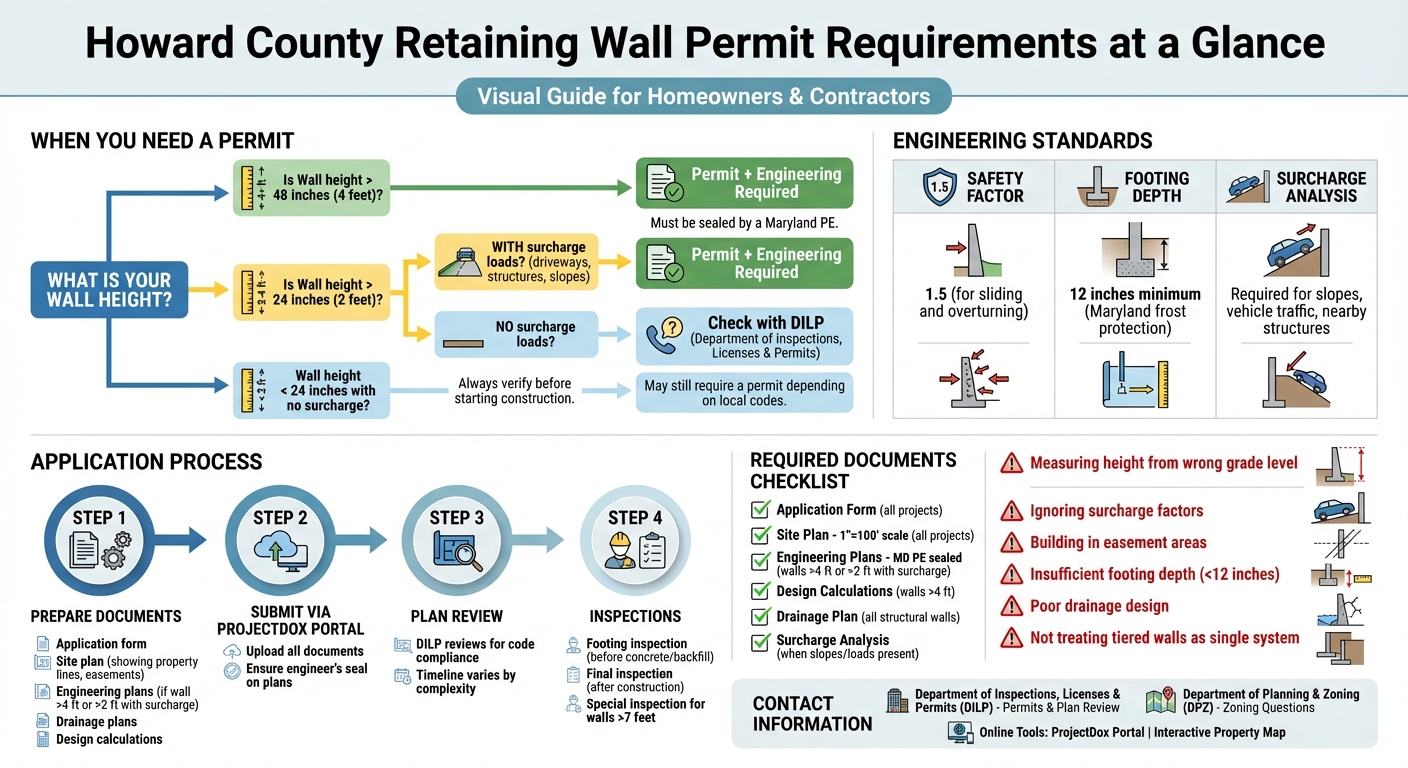
- Permit Required: Walls over 4 feet tall or over 2 feet if supporting extra loads (like driveways or structures) require permits and engineered designs.
- Engineering Standards: Maryland regulations mandate a safety factor of 1.5 for stability and 12-inch-deep footings for frost protection.
- Application Process: Submit your plans via the ProjectDox portal, including site plans, engineering designs (if needed), and drainage plans.
- Costs and Timelines: Fees vary based on project size; ensure complete documentation to avoid delays.
- Inspections: Footing and final inspections are mandatory, with additional requirements for walls over 7 feet.
Proper planning and compliance with Howard County’s rules ensure your retaining wall is safe, durable, and meets local standards.
Howard County Retaining Wall Permit Requirements Guide
Do You Need Permits to Build a Retaining Wall? | Landscaping and Rockery Construction Services
sbb-itb-843f8be
When You Need a Retaining Wall Permit
In Howard County, most retaining walls need permits based on their height, load, and location. Understanding these requirements can help you avoid delays and ensure compliance with local codes. Let’s break down the key height and load criteria that determine when a permit is necessary.
Height and Structural Requirements
If your retaining wall holds back more than 48 inches (4 feet) of unbalanced fill, you’ll need a permit and professional engineering approval. This aligns with Maryland’s Building Performance Standards (MBPS) Residential Code [2]. But height isn’t the only factor – walls subjected to additional loads may require permits even if they are shorter.
For walls facing surcharge loads – like sloping driveways, vehicle traffic, or nearby structures – the threshold for requiring engineering drops to just 24 inches (2 feet) [2][6]. A surcharge refers to any extra vertical load on the soil behind the wall, which increases lateral force. For example, a 30-inch wall supporting a patio or parking area above it would still need an engineer’s certification, even though it’s under 4 feet tall.
Engineered walls must follow Maryland MBPS standards, including a 1.5 safety factor to guard against lateral sliding and overturning [2]. Additionally, concrete footings must extend at least 12 inches deep to meet Maryland’s frost depth requirements. However, segmental retaining walls may have different embedment rules.
| Requirement Category | Standard/Threshold |
|---|---|
| Engineering Required (Standard) | Walls > 48 inches (4 feet) [2] |
| Engineering if Surcharge | Walls > 24 inches (2 feet) [2] |
| Safety Factor (Sliding/Overturning) | 1.5 [2] |
| Maryland Frost Depth | 12 inches [2] |
Zoning and Property Line Rules
In addition to structural guidelines, zoning laws also play a role in determining permit requirements. These rules, enforced by the Howard County Department of Planning & Zoning, regulate where retaining walls can be built. They include property line setbacks, easement restrictions, and public rights-of-way considerations [1][3].
Before applying for a permit, check for any setback requirements specific to your property. Building too close to a property line without approval could lead to a permit denial. If your project involves significant grading or is near drainage easements, consulting a professional early on can help you navigate all applicable regulations.
For accurate guidance, contact the Department of Inspections, Licenses & Permits to confirm any restrictions or requirements for your project [1]. Proper planning ensures your retaining wall meets both structural and zoning standards from the start.
Permit Costs and Processing Time
When you’ve gone through the structural and zoning requirements, it’s time to figure out the financial and time commitments for your project.
Cost Breakdown by Project Size
Permit fees depend on the scale of your project, as outlined in the DILP’s Forms & Fees section [1][3]. If your wall exceeds 4 feet in height – or 2 feet if it involves surcharge loads – engineering fees are mandatory [2]. These fees cover professional engineering approval, which is required for such projects. Be sure to include these costs in your budget from the outset.
For the most up-to-date fee information, consult the DILP’s Forms & Fees page [1][3]. Additional costs may come from plan reviews and inspections performed by the Construction Inspection Division to ensure compliance with building codes [1][3].
Application Review Timeline
Once you’ve accounted for the costs, you can move forward with the application process. Submit your application through Howard County’s ProjectDox Plan Submission Portal, the digital platform for managing plan reviews and permits [3]. The review timeline varies based on the complexity of your project and the completeness of your documentation. For simpler projects, such as walls under 4 feet without surcharge loads, the process tends to move quicker. On the other hand, projects requiring engineering approval or missing documents may face delays.
To avoid setbacks, ensure your initial submission includes all necessary documents, and have any required engineering plans stamped by a licensed professional engineer. DILP staff will carefully review your submission to confirm it meets code requirements [1][3].
How to Apply for a Permit
Preparing Your Application
First, determine if your project requires engineered plans by checking the wall’s height and load criteria [2]. If engineering approval is needed, you’ll have to hire a licensed professional engineer. They’ll provide signed and sealed designs that confirm your wall meets Maryland’s safety standards, including maintaining a 1.5 safety factor against lateral sliding and overturning [2].
Visit the Department of Inspections, Licenses & Permits website and download the necessary forms from the "Forms & Fees" section [1]. Your plans should demonstrate stability against overturning, sliding, water uplift, and excessive foundation pressure [2]. Also, ensure your design meets footing requirements for Maryland’s frost depth [2].
Once everything is prepared, you’re ready to submit your application online.
Submitting Your Application
Head to the ProjectDox Plan Submission Portal on the Department of Planning & Zoning website. Upload your completed forms, engineering plans (if applicable), and any required supporting documents, making sure they align with the county’s technical guidelines [3].
If you need assistance or have questions, you can visit the Public Service Counter at the Department of Planning & Zoning for in-person help [3].
After Submission
Once you’ve submitted your application, the Plan Review team at the Department of Inspections, Licenses & Permits will take over. They’ll examine your submission to ensure it complies with all applicable codes [1][3]. The review timeline will depend on how complex your project is and whether your documentation is complete. Submitting thorough, properly stamped documents can help speed up the process.
If any issues or missing information are identified, the reviewers will contact you with specific feedback. Address these concerns quickly to keep your application moving forward without unnecessary delays.
Required Documents and Plans
Document Checklist
When submitting your permit application, you’ll need to gather specific documents to ensure your submission is complete. The exact requirements depend on the wall’s height and the type of load it will need to support.
For all applications, you must include a completed application form and a site plan. The site plan should clearly show the wall’s location in relation to property lines, existing structures, and any utility or drainage easements. This ensures the wall complies with setback and property line regulations.
If your wall is over 4 feet tall, or over 2 feet tall and resisting surcharges (like sloping soil, vehicle traffic, or nearby building footings), you’ll need engineering plans. These plans must be signed and sealed by a Maryland Professional Engineer, verifying the design meets a safety factor of 1.5 [2]. Additionally, you’ll need design calculations to prove the wall’s stability against overturning, sliding, excessive foundation pressure, and water uplift [2].
Including drainage plans is highly recommended for all structural walls. These plans outline how water pressure will be managed to prevent wall failure [2][4]. Make sure your plans also show footings that extend at least 12 inches deep to meet Maryland’s frost protection requirements [2].
| Document Type | When Required | Purpose |
|---|---|---|
| Application Form | All applications | Starts the permit process via the ProjectDox portal [3] |
| Site Plan | All applications | Shows wall location, property lines, and proximity to easements [7][6] |
| Engineering Plans | Walls >4 feet or >2 feet with surcharge | Provides structural details; must be signed/sealed by a MD engineer [7][2] |
| Design Calculations | Walls >4 feet | Proves stability against overturning, sliding, and other forces [7][2] |
| Drainage Plan | All structural walls | Details how water pressure will be managed [2][4] |
| Surcharge Analysis | When slopes or loads are present | Evaluates lateral pressure from nearby structures or vehicles [6] |
By submitting accurate and complete documentation, you’ll not only meet regulatory standards but also ensure the wall’s structural safety. Now, let’s look at common mistakes to avoid during the documentation process.
How to Avoid Documentation Errors
- Measure wall height correctly: Always measure from the lowest adjacent grade, not just the higher side [6].
- Account for all surcharges: Include details for sloping soil, vehicle loads, or other factors that could affect the wall’s stability [6].
- Meet footing depth requirements: Ensure footings extend at least 12 inches deep for frost protection [2]. Missing this detail can delay your review.
- Tiered wall systems: If your project includes multiple stacked walls, treat them as a single structural system. This triggers stricter permit requirements [6].
- Use the correct scale: Site plans should use a minimum engineer’s scale, such as 1 inch = 100 feet, to meet review standards and confirm the wall is outside utility or drainage easements [6][7].
These tips will help you avoid common pitfalls and ensure a smoother review process for your permit application.
Inspections and Common Mistakes
Inspection Requirements
In Howard County, a footing inspection is required before pouring concrete or backfilling. This step ensures the foundation meets the 12-inch frost depth requirement and maintains structural integrity. A final inspection is also mandatory after construction to confirm everything aligns with the approved plans[2][6].
To keep your project on track, schedule inspections at least 24 hours in advance. Always have a hard copy of your permit and the Howard County–approved construction plans on-site during inspections. Without these documents, you risk delays in getting approval[6].
For walls taller than 7 feet, you might need to participate in a Special Inspection Program. Check with Howard County to see if this applies to your project.
Knowing these inspection requirements can help you avoid common mistakes, which we’ll break down next.
Common Errors to Avoid
One frequent misstep is failing to account for surcharge factors. Surcharges can come from sloping soil, nearby buildings, or even vehicular loads, and underestimating these can lead to complications[6].
Another mistake is building in easement areas or misjudging these zones. Either can result in extra permit requirements and approval delays. If your wall is on a shared property line, securing written consent from your neighbor can help sidestep potential legal headaches.
Drainage design is another area where errors often occur. Poor drainage doesn’t just risk failing inspections – it can also jeopardize the wall’s long-term stability. According to the Maryland Residential Code, retaining walls must include drainage materials behind them to prevent hydrostatic pressure unless they are specifically engineered to hold water[5]. Carroll Landscaping, Inc. emphasizes the importance of proper installation:
A retaining wall is only effective if installed correctly in the right area, so trusting a professional with the job is critical. We take care of the site preparation and proper installation, always considering grading and drainage along the way.[4]
Neglecting to include detailed drainage plans can delay final inspection approval, so it’s worth getting it right the first time.
Howard County Department Contact Information

Contact Details
If you’re navigating the application and inspection process for a retaining wall permit in Howard County, knowing where to turn for support is key. The Department of Inspections, Licenses and Permits (DILP) is your go-to agency for managing permits and reviewing technical plans related to retaining walls [8][3].
For zoning questions, the Department of Planning and Zoning (DPZ) handles these through its Public Service Counter, offering resources tailored to both residents and professionals [8][1]. Make sure to check their current office hours online. The staff is available to assist with any questions about permits or zoning during your application or inspection process.
Online Resources
Howard County provides several online tools to simplify the permit process. ProjectDox is an electronic system that allows you to submit and track your permit application [1][3]. To use it, you’ll need to create an account before starting your application.
Another helpful tool is the Howard County Interactive Map, offered by the Department of Planning & Zoning. This map lets you review property details, zoning classifications, and potential easements – valuable information to have before finalizing your design [1][3]. Additionally, the DILP website hosts essential resources like permit forms and fee schedules.
Taking advantage of these tools and resources can help you better understand the requirements and costs involved, ensuring a smoother process from start to finish.
Conclusion
Final Thoughts
Successfully navigating Howard County’s permitting process for retaining walls requires careful attention to design standards, documentation, and inspections. Meeting all regulatory requirements is crucial to ensuring your project complies with local rules. For walls that exceed height limits or involve surcharge loads, engineered plans, inspections, and detailed documentation are mandatory, as outlined earlier.
Preparation is key. Assemble all necessary documents – such as site plans and design calculations – before submitting your application to minimize delays [7]. Opting for professional installation can help ensure your wall meets structural requirements and passes inspections without issues.
If your project needs engineered designs, Pro Landscapes MD offers specialized services in retaining wall design and installation across Howard County. They provide expert support throughout the permitting process, delivering sturdy, code-compliant walls built to last.
FAQs
How do I measure retaining wall height for permit rules?
To determine a retaining wall’s height for permit purposes, measure the vertical distance from the finished grade at the base of the wall to its top. In Howard County, Maryland, a permit is necessary for walls exceeding 3 feet (36 inches) in height or those that support surcharge loads. Be sure to check local building codes for exact measurement guidelines and any additional documentation that may be required for taller structures.
What is a surcharge behind a retaining wall?
A surcharge refers to additional loads or pressures, such as soil, vehicles, or stored materials, that exert force against a retaining wall. Retaining walls taller than 24 inches or those supporting more than 48 inches of uneven backfill typically need a professionally engineered design to safely manage these added forces.
What causes delays in Howard County permit reviews?
Permit reviews in Howard County might take longer than expected due to several factors. These include the need for thorough plan reviews to confirm compliance with codes and standards, coordination with various county agencies, or requests for revisions and extra documentation. These measures are essential to ensure all requirements are met while prioritizing safety and quality.
Chat with Us