









- bhavya gada
- No Comments
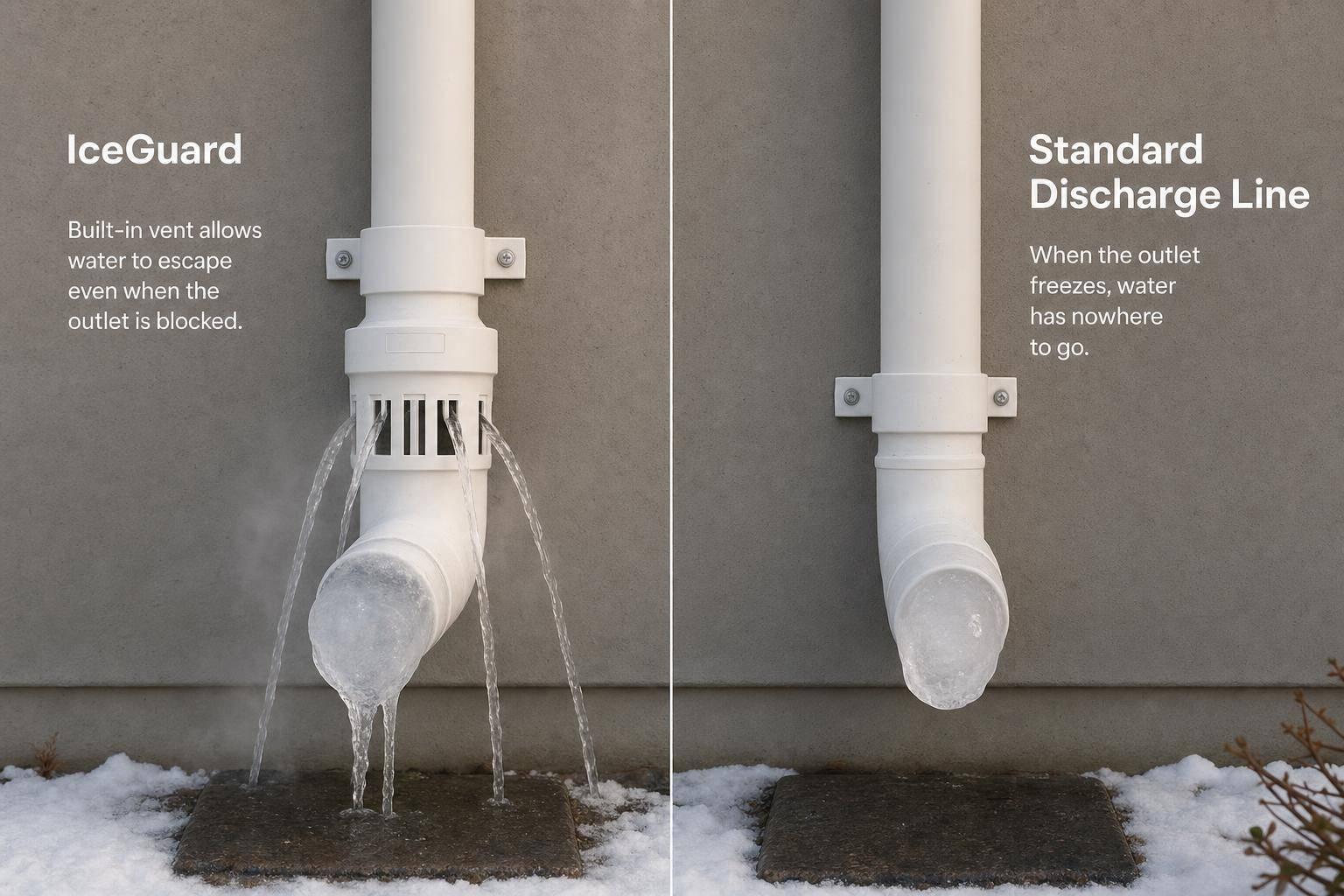
If your sump pump discharge outlet freezes, a standard line can leave the pump stuck pushing water into ice. IceGuard adds a backup exit near the house, so water still has a place to go.
If I had to sum it up in one line, it would be this: a standard discharge line works only when the outlet stays open, while IceGuard is made for the moment that outlet freezes.
Here’s the short version:
- Standard discharge line: moves water away through buried pipe
- IceGuard: adds a slotted bypass if the buried outlet gets blocked
- Main risk in winter: exposed or snow-covered outlets can freeze at 32°F and below
- Higher-risk setup: flat yards, clay soil, shaded sides of the house, and frequent winter pump cycles
- Typical outlet distance: water should discharge 10 to 20 feet from the house
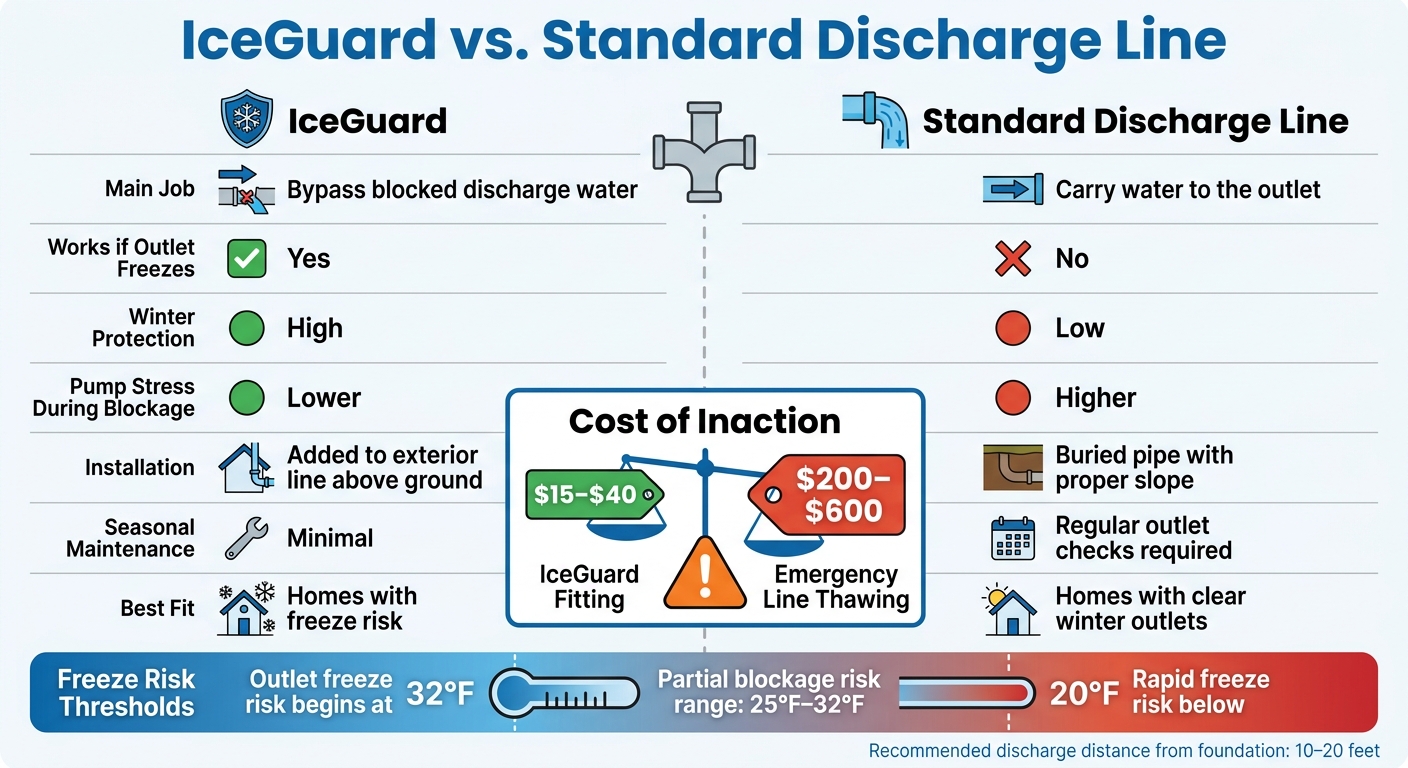
- Cost snapshot: IceGuard fitting often runs about $15 to $40, while thawing a frozen line may cost $200 to $600
For me, the choice is pretty simple: if your outlet stays clear all winter, a standard line may be enough. If freezing is even a common risk, IceGuard gives your system a backup path and helps lower the chance of pump trouble and basement water.
Quick Comparison
| Feature | IceGuard | Standard Discharge Line |
|---|---|---|
| Main job | Bypass blocked discharge water | Carry water to the outlet |
| Works if outlet freezes | Yes | No |
| Winter protection | High | Low |
| Pump stress during blockage | Lower | Higher |
| Installation | Added to exterior line above ground | Buried pipe with proper slope |
| Maintenance | Little added winter care | Seasonal outlet checks |
| Best fit | Homes with freeze risk | Homes with clear winter outlets |
So if you’re comparing the two, I’d look at three things first: freeze risk, yard drainage, and how often the pump runs in winter.
IceGuard vs. Standard Discharge Line: Winter Performance Comparison
What is an IceGuard? | All Things "Basementy"!
sbb-itb-843f8be
How IceGuard and standard discharge lines work
These two systems do different jobs. A standard discharge line moves water out only if its outlet stays open. IceGuard adds a backup route when that outlet freezes. That gap shows up fast in winter, when ice and snow can block the end of the line.
IceGuard: a freeze-bypass fitting for blocked discharge lines
IceGuard is a passive freeze-bypass fitting installed on the exterior discharge line, just above ground level [6][5]. It has slotted openings on the outside face. Under normal conditions, water keeps flowing through to the buried line. But if that line gets blocked, water spills out through those slots instead [1][5].
There’s no switch to flip and nothing to monitor. It works on its own, with no adjustment or supervision [6][1]. And because the slots face outward, overflow is directed away from the foundation [5].
"The IceGuard system allows water to escape from a sump pump discharge line if the pipe freezes or becomes blocked for any reason. Even if the pipe outlet is buried under a foot of ice and snow, the water can escape." – Basement Systems [6]
That built-in bypass is the big difference between IceGuard and a standard discharge line in freezing weather.
Standard discharge lines: buried piping that depends on an open outlet
A standard discharge line is buried pipe that carries water to a daylight outlet, dry well, or drain field [4][1]. For it to work properly, the pipe needs a steady 1/4-inch-per-foot slope [4].
Here’s the catch: the whole setup depends on a clear, open outlet. If that outlet stays open, the line does its job. If it gets blocked, the system can stop working in a hurry.
IceGuard vs. standard discharge lines: key performance differences
Freeze protection and how each system responds to a blocked outlet
The biggest gap shows up when the outlet freezes.
With a standard discharge line, ice at the outlet creates a backup. The pump keeps forcing water toward the blockage, which can lead to overheating, overload trips, and even pump failure [3][7].
IceGuard reacts differently. When the outlet is blocked, water is redirected through its slotted openings. That release of pressure helps protect the pump while the buried line remains clear [6]. In plain terms, IceGuard gives the water somewhere else to go instead of letting pressure build inside the system.
That matters in Maryland, where winter freeze-thaw cycles can freeze exposed discharge lines fast [1][2]. In those conditions, the bypass feature is the more dependable choice when temperatures fall.
Installation, maintenance, and long-term reliability
The two setups also differ in the amount of attention they need over time.
Standard discharge lines need trenching, proper slope, and an open outlet to work as intended. IceGuard installs as a retrofit on the exterior discharge line and doesn’t need seasonal adjustment [3][4][6].
Maintenance is another clear split:
- Standard lines need seasonal checks, including clearing debris from the outlet, looking for ice buildup, and making sure pop-up emitters still work [3][4].
- IceGuard does not add routine seasonal maintenance [6].
So while both systems move sump pump discharge, they don’t ask for the same amount of work once winter hits.
Maryland drainage conditions that affect the choice
Maryland’s winter weather and yard conditions play a big role in whether a discharge line keeps flowing or freezes shut.
How freeze-thaw winters affect discharge line performance
Central Maryland winters often bounce above and below 32°F. That back-and-forth can let small ice clogs build up until the outlet seals off [3]. If a discharge line is exposed, it can freeze within hours once temperatures drop below 20°F [3].
Even temps between 25°F and 32°F can cause trouble. In that range, lines may not freeze all at once, but they can develop repeated partial blockages through the winter [3]. It’s a slow-burn problem.
Soil matters too. Clay soils tend to hold water near the outlet, which makes ice blockages more likely [3][4]. And some outlet locations are just more prone to freezing than others. Shaded walls, windy sides of the house, and outlets buried under snow face the highest risk [3][6].
But temperature isn’t the whole story. Where the outlet sits, and how water moves through the yard, can make a big difference.
Coordinating sump discharge with grading and yard drainage
Poor outlet placement has a direct effect on how often a discharge line freezes and whether a standard line can handle a Maryland winter. A properly installed line should carry water at least 10 to 20 feet away from the foundation [4].
If the outlet ends in a low spot or flat area, the water can pool there. Once that happens, the soil around the outlet gets saturated, and water can work its way back toward the basement. That often makes the pump kick on again right away [4]. It’s a frustrating loop: pump, discharge, pooling, then more pumping.
Good grading helps break that cycle by keeping water moving away from the outlet instead of letting it sit there and freeze.
That’s why it makes sense to plan discharge routing, grading, and yard drainage together. For homes in central Maryland, Pro Landscapes MD can integrate sump discharge routing with grading and stormwater drainage.
Recommendations and conclusion
When to add IceGuard and when a standard line may be enough
Given the freeze-thaw risks above, the main question is simple: will the outlet stay open through winter? If the answer is yes, a standard buried line can do the job. That usually works when the outlet stays clear and the yard drains well.
IceGuard makes more sense when the discharge outlet may get buried in snow or ice, when the line can’t be buried deep enough, or when the pump runs often in winter. It gives the system a backup path and usually costs $15 to $40 for the fitting itself, while emergency thawing for a frozen line can cost $200 to $600 [3].
These situations usually point to IceGuard:
- Burial depth limited or outlet exposed to snow buildup: IceGuard gives water a way out if the outlet gets blocked or buried [6].
- Flat or low-lying yard with a shaded, north-facing outlet: IceGuard helps reduce backup from ice at the end of the line and offers another path if the outlet freezes [3].
- Frequent winter pump cycles: IceGuard helps the system keep running when repeat cycling increases freeze risk [3].
For many Maryland homes, the most dependable setup is a buried Schedule 40 PVC line, a well-placed outlet, and IceGuard as a backup at the foundation.
FAQs
Do I need IceGuard if my sump pump line has never frozen?
Yes. An IceGuard fitting is a smart add-on for homes in freezing climates, even if your discharge line has never frozen before.
Here’s why: snow buildup, ice at the outlet, or ground movement can block the line with little warning. If that happens and there’s no automatic release point like IceGuard, water can back up into your basement. In some cases, the pump can also burn out because it keeps running against the blockage.
Where should an IceGuard fitting be installed?
An IceGuard fitting should be installed on the outside of your home, attached to the sump pump discharge pipe. It’s usually placed near the foundation wall, above grade.
That spot gives water a backup route if the main discharge line gets blocked by ice or debris. In plain terms, it helps stop water from backing up into your basement.
Can IceGuard replace a proper discharge line?
No. IceGuard is not a replacement for a proper discharge line.
It’s a secondary safety fitting that attaches to the existing discharge pipe. Under normal conditions, water flows through the main line. IceGuard only comes into play as an emergency escape route if the main line gets blocked by ice, snow, or debris. That helps stop water from backing up into your basement.
The main system still needs a proper discharge pipe to move water away from your foundation.
Chat with Us