









- bhavya gada
- No Comments
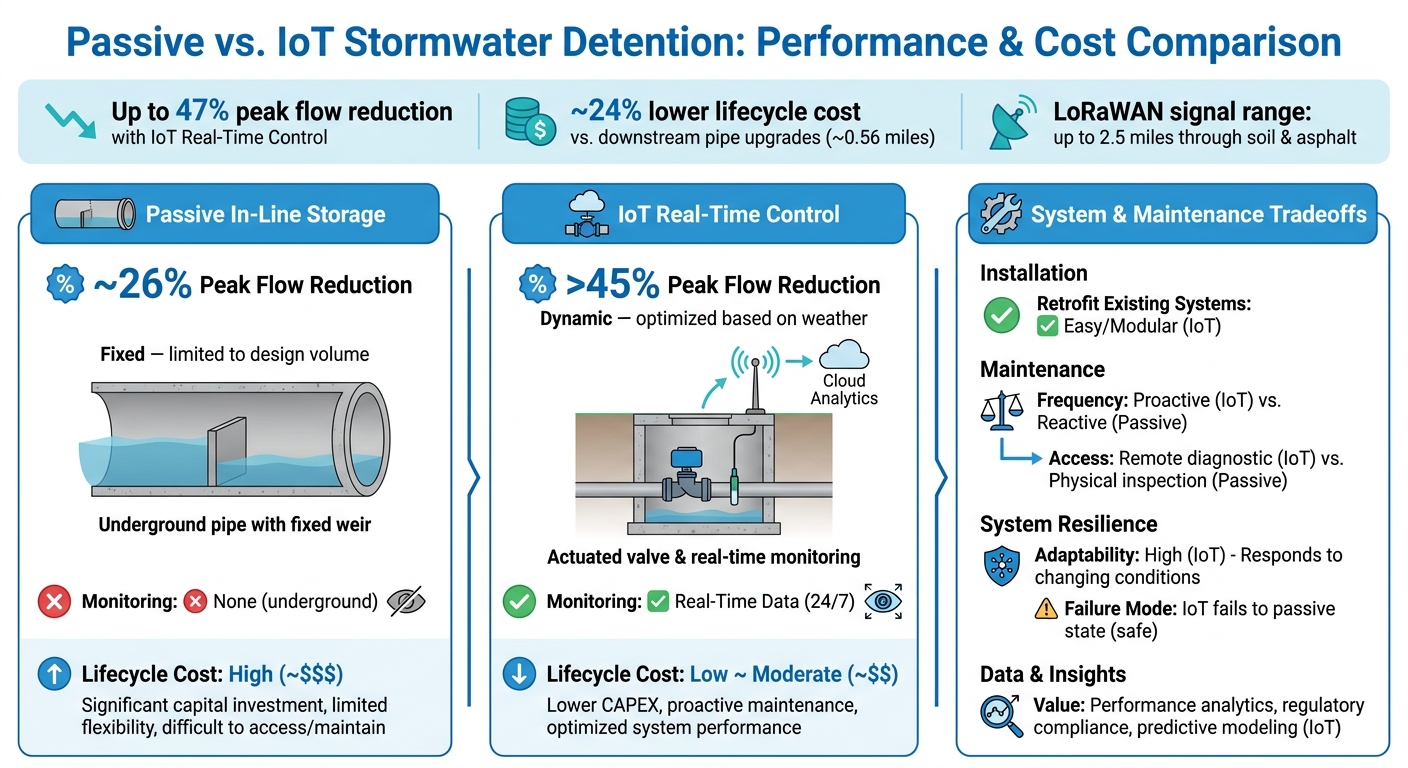
If you need the short answer: IoT can make underground stormwater detention work better by turning fixed storage into a system that can monitor water and control release in real time. In the studies cited here, real-time control cut peak flow by up to 47%, compared with about 26% for static in-line storage and 39% for off-line detention. One study also found about 24% lower lifecycle cost than adding about 0.56 miles of downstream pipe upgrades.
Here’s what I’d want you to know right away:
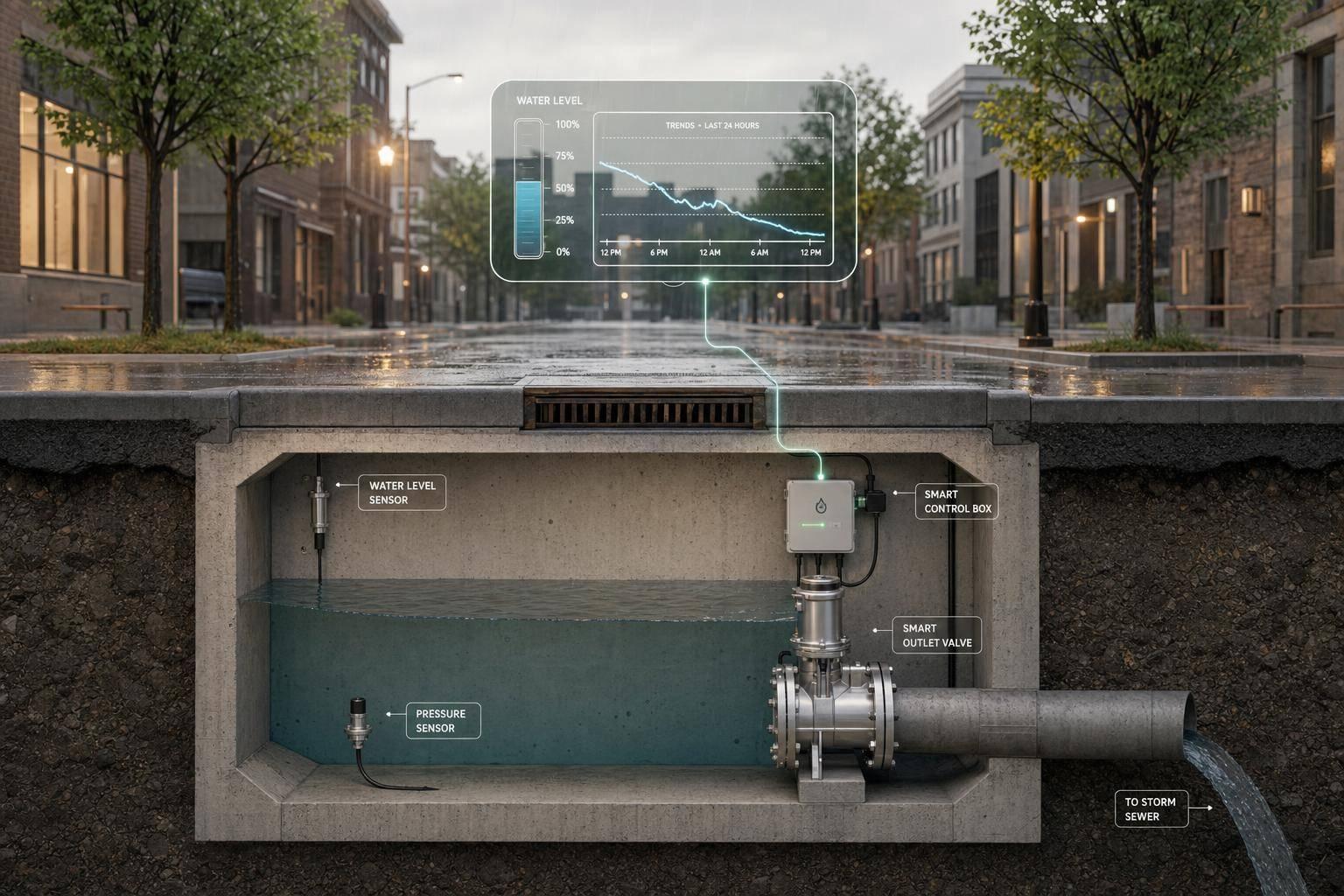
- What IoT adds: water-level sensors, flow sensors, dashboards, alerts, and motorized valves
- What it helps with: lower peak flow, better use of buried storage, earlier warning of blockages and high-water events
- Where it fits best: paved, space-tight sites like apartments, commercial lots, and retrofit projects
- What can go wrong: sediment, battery limits, signal loss underground, uneven sensor readings, and added upkeep
- Why Maryland matters here: hard rain, lots of pavement, older drainage systems, and site-to-site runoff differences
This is the main takeaway in plain English: smart underground detention can do more than passive detention, but only if the site can support the added equipment, power, data links, and maintenance.
| Setup | Peak Flow Reduction | Visibility | Flow Control | Main Tradeoff |
|---|---|---|---|---|
| Passive in-line | ~26% | None | Fixed | Limited control |
| Passive off-line | ~39% | None | Fixed | Uses more dedicated space |
| IoT with real-time control | Up to 47% | Live data | Automated valves/weirs | More parts to maintain |
I see the article as less about gadgets and more about a simple shift: from “store water and wait” to “watch conditions and respond.” That shift is what makes IoT worth looking at for stormwater systems in Central Maryland.
Passive vs. IoT Stormwater Detention: Performance & Cost Comparison
What Recent Studies Say About Smart Stormwater Systems
Main Research Themes in Recent IoT Studies
Recent studies look at a pretty practical question: can IoT tools and real-time control cut peak flow, trim costs, and make old detention systems work better without a full rebuild?
The research is moving past theory and into measured results. In a 10-hectare urban testbed, RTC cut peak flow by up to 47%. That beat static in-line systems at 26% and conventional off-line detention tanks at 39%. The same study also found total cost dropped by about 24% once downstream pipe-upgrade costs were included [1].
Another big theme is cost. Instead of relying only on pricey custom hardware, researchers are testing simpler retrofit setups. Arduino– or ESP32-based controllers, paired with low-cost ultrasonic sensors, can be added to existing drainage systems for automated control [2][3][6]. That matters because many sites don’t need a brand-new system. They just need a smarter way to run the one they already have.
Why Mid-Atlantic Storm Patterns Make This Research Relevant
This work hits hardest in places where storms show up fast and hit hard. Mid-Atlantic storms often bring short, intense rainfall, which leaves little warning time [6]. In that kind of weather, fixed drainage setups can struggle because they can’t react once conditions start changing.
A University of Maryland study of three campus outfalls found that local rainfall and imperviousness strongly shape runoff behavior [5]. In plain terms, two nearby sites can respond very differently during the same storm if the ground cover and drainage patterns aren’t the same.
That’s why site-specific monitoring matters so much for Maryland drainage projects. If the storm pattern is fast and the runoff response shifts from site to site, local data becomes a core input for design decisions.
sbb-itb-843f8be
Continuous Integration for IoT-Enabled Stormwater Performance Management with Opti
Core IoT Tools Used in Underground Detention Research
These systems usually come down to three parts: sensors, networks, and controls.
Sensors for Water Level, Flow, and Basic Water Quality
Research most often uses two types of water-level sensors: ultrasonic sensors like the HC-SR04 and submersible pressure sensors [6][3][2]. Ultrasonic sensors sit above the water and measure distance without touching it. Pressure sensors sit below the surface and measure the height of the water column directly.
For flow monitoring, researchers use Hall effect flow sensors and motorized valves to track and manage discharge [2]. Some projects also add basic water quality probes for pH, turbidity, conductivity, and dissolved oxygen to flag pollution risks linked to runoff [5].
In June 2025, researchers including Qianyao Si and Marccus D. Hendricks deployed an IoT-based monitoring framework across three stormwater outfalls at the University of Maryland campus. That setup collected continuous water quantity and quality data [5].
One catch: ultrasonic sensors can produce unstable readings in humid buried conditions [3]. To deal with that, sensor nodes are usually sealed inside protective enclosures [3].
Those readings then move into the network layer.
Networks, Dashboards, and Automated Controls
Recent studies show that low-cost IoT retrofits can improve stormwater control without rebuilding the whole system.
LoRaWAN shows up often in underground detention research because it uses little power and can send data over long distances. Studies also show that wireless underground transmitters can communicate through about 4 inches of asphalt and 8 inches of soil to a gateway up to 2.5 miles away [4].
Field data then moves to cloud dashboards such as AWS or Arduino Cloud. From there, managers can check real-time conditions, look at past data, and get event triggers such as email alerts [6][3].
On the control side, automated systems use motorized ball valves and adjustable weirs to change storage and release rates based on live sensor data, rainfall forecasts, or hydraulic model simulations [2][6][1]. That shift matters. In a Tallinn, Estonia testbed, real-time control reduced peak flow by up to 47%, compared with about 26% for in-line storage without automated controls [1].
That difference helps decide whether a detention system stays passive or reacts in real time.
How These Tools Apply to Landscape Drainage Projects
For Maryland properties, underground drainage systems should leave space for sensors, access points, and controlled-release hardware. That choice matters even more on dense residential sites, where buried infrastructure and site-specific runoff patterns can make local monitoring a practical part of stormwater planning.
That tradeoff leads into the next section on benefits and limitations.
Measured Benefits and Reported Limitations
Flood Reduction, Storage Efficiency, and Release Timing
These tools only make sense if they improve stormwater performance enough to pay for the extra gear.
A Tallinn testbed gives a clear comparison. Real-time control (RTC) beat passive storage because it used pipe volume more efficiently during storms. Static in-line storage cut peak flow by about 26%, standard off-line detention tanks reached about 39%, and smart in-line storage with RTC reached 47% [1].
RTC also changed how existing pipe corridors worked during storm events. Instead of sitting idle until water hit a fixed overflow level, the system used live sensor data to adjust weirs and valves in real time. That meant more of the installed network could act as storm storage when it was needed most.
Maintenance, Power, Data Reliability, and Cost
That said, IoT systems come with real tradeoffs.
Sediment buildup in buried detention tanks can shrink storage capacity and throw off sensor readings over time [1]. Ultrasonic sensors and other buried devices can also return uneven readings in underground field conditions [3]. Put those issues together with battery limits and signal loss, and one thing becomes clear: buried systems need a solid maintenance plan.
Battery-powered buried nodes usually run on low-power settings and slower sampling intervals, often every 8 to 24 hours [3]. Signal strength also drops as soil and asphalt become thicker, wetter, or hotter [4]. On top of that, wireless sensor networks bring cybersecurity concerns, so automated control systems need encrypted communication protocols [2].
Those reliability issues shape long-term cost just as much as day-to-day performance. Installation costs are higher at the start, but lifetime costs can still come out lower. Smart RTC systems cost more to put in, yet total lifecycle cost was about 24% lower than rebuilding about 0.56 miles of downstream drainage collectors to manage uncontrolled runoff [1].
Passive vs. IoT-Enabled Underground Detention: A Side-by-Side Look
Here’s the tradeoff at a glance:
| Feature | Passive Underground Detention | IoT-Monitored (Static) | IoT-Monitored with RTC |
|---|---|---|---|
| Peak Flow Reduction | ~26% (in-line) to ~39% (off-line) [1] | Moderate | Up to 47% [1] |
| Storage Utilization | Fixed; limited to design volume | High visibility; manual adjustments possible | Dynamic; pipe capacity used as active storage |
| Monitoring Visibility | None – underground "black box" | Real-time dashboards | Real-time dashboards + automated response |
| Maintenance Demands | Scheduled or reactive; sediment hard to detect | Condition-based; blockage alerts reduce manual checks | Condition-based; actuators (weirs/valves) need care |
| Lifecycle Cost | Higher – downstream upgrade costs likely [1] | Moderate | ~24% lower than traditional systems [1] |
For Maryland homeowners and HOAs, the right setup depends on site size, runoff volume, and how much maintenance they can handle. In plain terms, the best option isn’t always the smartest one on paper. It’s the one the property can actually support.
What the Research Means for Maryland Properties
Where Underground Detention with Monitoring Makes the Most Sense
For Maryland properties, this approach fits best on paved sites with very little extra room. Think parking-heavy commercial lots, dense multifamily sites, and other hardscaped areas where open land is scarce.
That’s where buried drainage can do its best work. Instead of carving out a big surface area for an off-line tank, in-line storage uses enlarged pipe sections with automated weirs to spread storage through an existing pipeline. In plain terms, you’re putting storage where the drainage system already runs. On tight sites, that can make layout far easier, especially when crews have to work around gas lines, electrical conduits, and other buried utilities [1].
There’s also a retrofit angle here. If a drainage system is already overloaded, low-cost controllers and smart valves can be added to help manage flow without rebuilding the whole site from scratch [2].
How Smart Drainage Fits Broader Landscape Design
Flood control is only part of the story. The same monitoring data can also help with drainage planning and compliance.
A June 2025 study led by Qianyao Si and Marccus D. Hendricks at the University of Maryland used an IoT monitoring framework across three campus outfalls to track runoff volume and water quality. That setup supported site planning and compliance work at the same time [5].
This kind of monitoring also pairs well with surface landscape measures. Research points to combining smart monitoring with green infrastructure, such as green roofs or bioretention, to improve long-term runoff control [5].
Key Takeaways and Gaps in the Research
For Maryland sites, the clearest fit is usually highly paved property that needs to retrofit existing stormwater infrastructure [1][2]. If blockages keep happening, real-time monitoring changes the maintenance approach too. Instead of cleaning on a fixed schedule, teams can respond when the system shows a problem [3].
FAQs
Is IoT stormwater control worth the extra maintenance?
Yes. IoT integration is often worth the spend for stormwater management because it gives teams the data they need to use time, labor, and budget more wisely.
With continuous, real-time monitoring of water levels and blockages, crews can move from reactive repairs to proactive, targeted maintenance. That means fewer routine manual inspections and a better shot at stopping costly flooding before it starts.
Pro Landscapes MD offers stormwater management and drainage installation services in Maryland.
What types of properties benefit most from smart underground detention?
Smart underground detention works best on properties in dense urban areas where buildable space is tight.
It’s a strong fit for redeveloped sites too, especially former industrial properties that have been turned into residential neighborhoods or business districts. In those settings, compact underground storage helps control stormwater runoff and lower flood risk, even when space is limited and utility lines are competing for room below the surface.
Can an existing stormwater system be retrofitted with IoT controls?
Yes. Existing stormwater infrastructure can be retrofitted with IoT controls like smart sensors, microcontrollers, and automated valves.
These upgrades allow for real-time monitoring and automated management. That helps make better use of system capacity and lowers flood risk. Pro Landscapes MD offers stormwater management and drainage installation services to help tackle these water-related issues.
Chat with Us