









- bhavya gada
- No Comments
Your lawn can add emissions – or help cut them. I’d focus on 7 simple moves: mulch clippings, mow less, keep grass taller, switch to electric equipment, use lower-impact fertilizer, water with care, and improve soil.
Here’s the short version: most lawn emissions come from gas equipment, synthetic fertilizer, water use, and yard waste. At the same time, healthy turf can store carbon in roots and soil. That means small lawn-care changes can lower fuel use, trim fertilizer demand, cut water waste, and keep clippings out of landfills.
A few numbers show why this matters:
- Gas lawn mowers can produce 11 times as much pollution as a new car, hour for hour
- Nitrous oxide has 273 to 300 times the warming effect of CO2
- Grass clippings can supply up to 40% of a lawn’s nitrogen needs
- Turfgrass covers about 1.2 million acres in Maryland
- Home lawns can store 25.4 to 204.3 grams of carbon per square meter per year
If I wanted the shortest path to lower lawn emissions, I’d start here:
- Use a mulching mower to feed the soil and cut fertilizer use
- Mow less often to lower mower run time
- Keep cool-season grass at 3 to 4 inches to help roots and hold moisture
- Use electric mowers and blowers to avoid on-site exhaust
- Pick slow-release or organic fertilizers to cut nitrogen loss
- Water deeply, not often, and fix leaks
- Add compost and ease soil compaction to help soil store more carbon
Eco-Lawn Care Made Simple
sbb-itb-843f8be
Quick Comparison
| Practice | Main way it cuts emissions | Main thing to watch |
|---|---|---|
| Mulching mower | Cuts fertilizer use and landfill waste | Works best with frequent mowing |
| Mow less | Lowers fuel or power use | Grass can get too tall if ignored |
| Taller mowing height | Helps roots grow and trims water use | May look less neat |
| Electric equipment | Stops direct exhaust during use | Higher upfront cost |
| Low-impact fertilizer | Cuts manufacturing and soil emissions | Often costs more |
| Watering with care | Lowers energy tied to pumping and treatment | Takes some planning |
| Healthier soil | Stores more carbon in the ground | Needs time and effort |
Bottom line: I see lawn care as one of the easiest places to cut household emissions. You do not need a perfect yard. You just need better habits.
Why Lawn Care Has a Carbon Footprint
Most lawn emissions come from four inputs: equipment, fertilizer, water, and yard waste. Those are the main pressure points, and they’re the same ones the next seven practices cut back.
The most obvious source is gas-powered mowers and blowers. The EPA estimates that gasoline-powered lawn mowers produce 11 times as much pollution as a new car, hour for hour.[2] If you mow often, those emissions add up.
Fertilizer is another big piece of the puzzle. Synthetic fertilizer creates emissions during manufacturing. Then, after it’s spread, excess nitrogen can break down in the soil and release nitrous oxide.[8] That matters because nitrous oxide has 273 to 300 times the warming potential of CO2.[4]
Water use and yard waste round out the list. Pumping and moving water takes electricity, and soil that gets too much water can also release methane.[8] Yard waste adds its own problem: grass clippings, leaves, and plant debris make up about 7.2% of all municipal solid waste – about 10.5 million tons sent to landfills in a single year.[3] Once that organic material ends up in a landfill, it breaks down without oxygen and releases methane.
There’s another side to this. Healthy turf and soil can sequester carbon. But lawns that depend on lots of chemicals and lots of water can wipe out part of that gain. That’s why cutting back on water use, fertilizer, gas equipment, and wasted plant material can make such a big difference.
7 Lawn Care Practices That Cut Emissions: Quick Overview
7 Lawn Care Practices That Cut Carbon Emissions
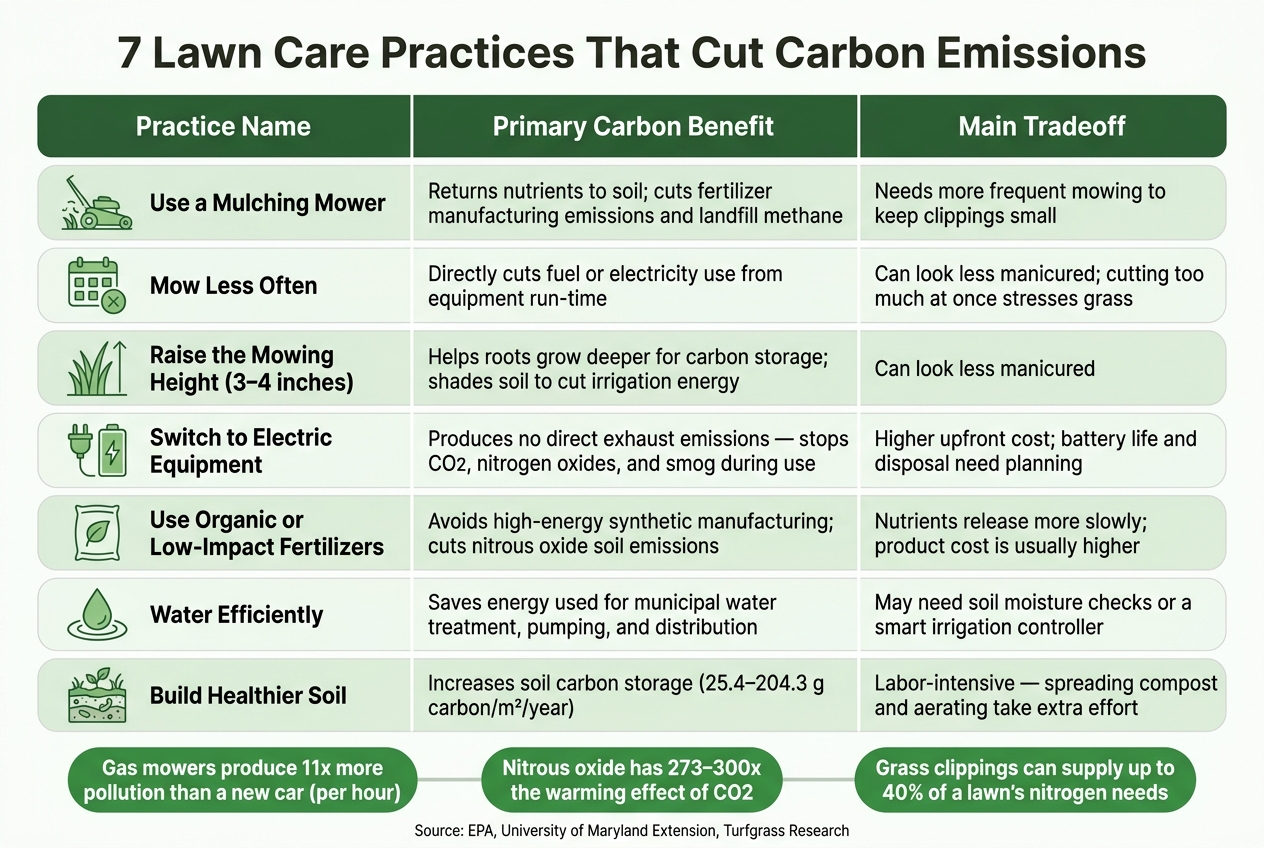
Now that the main sources are clear, it helps to see the best fixes side by side. The table below breaks down seven practical ways to cut lawn emissions and the main tradeoff that comes with each one.
| Practice | Primary Carbon Benefit | Main Tradeoff or Consideration |
|---|---|---|
| 1. Use a Mulching Mower | Returns nutrients to soil; cuts fertilizer manufacturing emissions and landfill methane [10][6] | Needs more frequent mowing to keep clippings small and avoid clumping [10] |
| 2. Mow Less Often | Directly cuts fuel or electricity use from equipment run-time [5][4] | Can look less manicured; cutting too much at once stresses the grass [1] |
| 3. Raise the Mowing Height | Helps roots grow deeper for carbon storage; shades soil to cut irrigation energy [10][6] | Can look less manicured [2] |
| 4. Switch to Electric Equipment | Produces no direct exhaust emissions, which stops the release of CO2, nitrogen oxides, and smog-forming pollutants during use [10][5] | Higher upfront cost; battery life and disposal need planning [5] |
| 5. Use Organic or Low-Impact Fertilizers | Avoids high-energy synthetic manufacturing and cuts nitrous oxide soil emissions [5][4] | Nutrients release more slowly, and product cost is usually higher [1] |
| 6. Water Efficiently | Saves energy used for municipal water treatment, pumping, and distribution [10][5] | May need soil moisture checks or a smart irrigation controller [5][4] |
| 7. Build Healthier Soil | Increases soil carbon storage [6] | Labor-intensive – spreading compost and aerating often take extra effort or equipment [6] |
Some of these changes are easy wins. Others ask for more work up front or more money at the start. Electric equipment and healthier soil practices usually fall into that second camp. Next, each practice gets a closer look.
1. Use a Mulching Mower
Mulching is one of the easiest ways to start. It cuts waste and lowers fertilizer use at the same time. A mulching mower chops grass clippings into small pieces and sends them back into the lawn. Those clippings break down fast, adding organic matter and nutrients back into the soil.
That matters more than a lot of people think. Grass clippings can supply up to 40% of a lawn’s nitrogen needs, which can cut back on synthetic fertilizer use and the emissions linked to it [6]. And that adds up fast: producing 1 ton of nitrogen fertilizer can release 4 to 6 tons of carbon into the atmosphere [8].
In Maryland, using less fertilizer also helps reduce nitrogen runoff into the Chesapeake Bay [2]. It can also help you stay in line with Maryland’s Lawn Fertilizer Law, which limits phosphorus applications unless a soil test shows a deficiency [1].
A few small mowing habits make mulching work better:
- Sharpen mower blades often, and mow only when the grass is dry. Dull blades tear grass instead of cutting it cleanly, which can increase disease risk in Maryland’s humid climate [2][1].
- Follow the one-third rule, and keep most cool-season lawns in central Maryland at 3 to 4 inches. That helps roots grow deeper and can cut how often the mower needs to run [6][1].
Those same mowing habits also help the next practice work better.
2. Mow Less Often
Each time you start a mower, it uses fuel or electricity. Gas mowers have the biggest emissions effect, so one of the fastest ways to shrink your lawn’s footprint is simple: run the mower less. Fewer minutes of mowing lower emissions right away. After that, the next move is to avoid extra passes you don’t need.
Mow based on how fast the grass is growing, not by the calendar. In Maryland, cool-season lawns should stay at 3 to 4 inches, and you can often skip mowing during peak summer dormancy until growth picks up again [1].
If the grass gets too tall, don’t scalp it all at once. Set the deck to the highest setting first, then bring it down little by little over a few mowing sessions [1].
If mowing less often still leaves the grass too tall, the next step is to raise the cut height.
3. Raise the Mowing Height
If you want to cut emissions without giving up lawn quality, the next move is simple: set your mower a bit higher.
For cool-season grasses like tall fescue, which is common across Maryland, a deck height of 3 to 4 inches can lower water and fertilizer needs over time. Taller grass blades shade the soil, which slows evaporation and reduces the energy tied to irrigation [1][5].
There’s another upside below the surface. Deeper roots add organic matter and store more carbon in the soil as they break down [6][7]. In Maryland, keeping grass in that 3-to-4-inch range also helps cool-season turf deal with summer heat [1].
The tradeoff is mostly visual. A taller lawn can look less trimmed and tidy. If your grass is already overgrown, don’t scalp it all at once. Cut it back over a few mowing sessions, or lower it little by little, so you stay within the one-third rule [1].
This mowing habit also fits well with electric equipment, which can cut emissions even more.
4. Switch to Electric Mowing Equipment
Once you’ve got mowing height and frequency dialed in, the next place to cut emissions is the mower itself. Gas mowers burn fuel every time you use them, and that means emissions right there on your lawn.
Battery-powered and corded electric mowers get rid of those direct, on-site emissions. The energy use moves to the grid instead, which can mean lower total emissions over time. For many homeowners, switching equipment is one of the fastest ways to shrink a lawn’s operating emissions.
For Maryland homeowners, electric mowers are a good fit for cool-season lawns and help cut on-site emissions.
Pair electric mowing with low-impact fertilizer to reduce the rest of the lawn’s emissions.
5. Use Organic or Low-Impact Fertilizers
If you still fertilize, the product you choose matters just as much as when you apply it. Better mowing habits can cut down how much fertilizer your lawn needs in the first place. But when you do put some down, low-impact options can help trim emissions even more.
Synthetic fertilizer can come with a high carbon cost before it even hits your yard. Then, after you apply it, soil microbes can turn extra nitrogen into nitrous oxide – a greenhouse gas with far greater warming potential than CO₂ [4]. Organic and slow-release fertilizers help by feeding grass at a slower pace, which means less excess nitrogen in the soil and fewer emissions tied to that process [5][4].
In Maryland, use zero-phosphorus fertilizer unless a soil test shows a deficiency [1]. Slow-release options such as alfalfa meal, feather meal, and cottonseed meal fit this approach [1].
There is a downside: organic fertilizers usually cost more and may need more frequent applications [1].
6. Water Efficiently
Once mowing changes take some pressure off your lawn, watering becomes the next big thing to fix. Irrigation pumping ranks among the top three lawn care practices with the highest greenhouse gas emissions [11]. And when you overwater, you’re also wasting the energy used to treat and pump water to your home [5].
The goal is simple: water deeply, but not too often. Deep, infrequent watering helps roots grow farther down into the soil. Shallow, frequent watering does the opposite. It loses more water to evaporation and keeps roots close to the surface, where grass dries out faster.
Timing matters too. Water early in the morning so the moisture can reach the root zone before daytime heat speeds up evaporation. In Maryland, watering late can also increase Brown Patch risk in fescue lawns and lead to more fungicide use [1].
A smart irrigation controller can help a lot here. Instead of running on a fixed schedule, it uses ET data or soil-moisture sensors to decide when watering is needed [5][11]. It’s a simple shift, but it can trim a lot of waste.
Basic upkeep matters just as much:
- Check for leaks each season
- Clean emitters so water flows the way it should
Those two steps alone can cut water waste by up to 60% [11].
These habits work even better when soil holds moisture more effectively.
7. Build Healthier Soil
After mowing and watering, the next cut in emissions starts below the surface. Healthy soil is the base of a low-emission lawn. When soil has more organic matter, it supports deeper roots and stores more carbon. Home lawns can sequester between 25.4 and 204.3 g of carbon per square meter per year [7].
Better soil also means less need for synthetic fertilizer, which helps cut the emissions tied to fertilizer use.
If your soil is compacted, aerate it and add a thin layer of compost on top. That can improve soil structure, add organic matter, and help the ground hold more water [6]. In Maryland, a mulching mower can shred dry fall leaves so they break down right on the lawn and feed the soil [1].
Test your soil before adding amendments so you apply only what the lawn needs. When these soil steps work together, they help every other low-emission lawn habit do its job better.
How These 7 Practices Work Together
The biggest savings show up when these practices work as a system. Instead of cutting emissions in just one spot, they trim them across the whole lawn-care routine.
For example, mowing higher helps grass grow deeper roots. Deeper roots handle dry spells better, which means you can water less. Electric equipment cuts on-site combustion emissions. And organic fertilizers help soil microbes while releasing nutrients more slowly. As turfgrass expert Ross Braun notes, reducing fertilization, irrigation, mowing, and pesticide use lowers emissions. [4]
Here’s how the seven practices support each other in day-to-day lawn care:
| Practice | How It Supports Other Practices |
|---|---|
| Mulching | Reduces fertilizer demand; feeds soil microbes |
| Mow High | Improves drought tolerance; reduces watering frequency |
| Mow Less Often | Lowers total energy demand from equipment runtime |
| Electric Equipment | Eliminates on-site combustion; most effective when mowing frequency is already low |
| Organic Fertilizer | Supports soil microbes; reduces fertilizer-related N2O emissions [5][9] |
| Water Efficiently | Cuts irrigation energy; reinforces deep root growth from high mowing [6][5] |
| Healthy Soil | Increases soil carbon storage; makes every other practice more effective [6] |
The main payoff comes from combining these habits, not treating them as separate fixes. If you have a larger yard or trouble with irrigation, professional help can make these low-emission routines easier to keep up with.
When Professional Help Makes Low-Emission Lawn Care Easier
Some yards need a hand to keep these practices on track. A few of the seven habits are simple DIY moves. Raising your mowing height costs nothing, and grasscycling just means leaving clippings where they fall.
Other parts can get tricky fast.
Central Maryland’s climate can put turf under pressure from drought, disease, and general stress. When that happens, low-emission lawn care gets harder to keep up with. You usually see it first in trouble spots, especially areas with poor drainage.
Drainage problems are one of the clearest signs it’s time to call a pro. Standing water can damage turf and create oxygen-poor soil conditions that produce methane. And some issues aren’t just about the yard itself. Rules around fertilizer and pesticide use can add another layer of difficulty.
Maryland lawn rules can also make fertilization and pesticide use harder to manage. Montgomery County and Baltimore City have added pesticide restrictions. Hiring a professional registered with the Maryland Department of Agriculture can help keep fertilizer timing and application rates within local rules [1][2].
Pro Landscapes MD helps Maryland homeowners with soil assessments, drainage correction, grading, and low-input lawn care plans.
For larger properties, or for lawns with repeat drainage and compaction problems, professional support can make low-emission lawn care much easier to keep up over time. That also makes the seven low-emission habits easier to stick with for the long haul.
Conclusion
Lower-emission lawn care comes down to a few practical habits, not chasing a picture-perfect yard. As Miri Talabac, Lead Horticulture Coordinator at the University of Maryland Extension, says:
"A perfect-looking lawn free of weeds and pest or disease damage is not realistic; it’s okay to have a few weeds or temporary blemishes." [1]
That shift in mindset makes the seven practices much easier to stick with. The goal is simple: mulch clippings, mow higher and less often, use electric equipment, choose low-impact fertilizer, water deeply but not too often, and build better soil health.
These habits matter beyond your own yard, too. Maryland’s roughly 1.2 million acres of turfgrass add up to a big chance to cut harm [2]. Low-input lawn care can store carbon and reduce runoff into the Chesapeake Bay watershed [7][2].
Start with one change this season, then build from there.
FAQs
Which lawn change cuts emissions fastest?
One of the fastest ways to cut lawn-related emissions is to swap gasoline-powered equipment for electric or battery-powered options. Gas mowers put out much more carbon dioxide, nitrogen oxides, and hydrocarbons than electric models.
You can also shrink your carbon footprint right away by grasscycling – leaving grass clippings on the lawn so those nutrients go back into the soil.
Will a taller lawn still look healthy?
Yes. A taller lawn can look healthy and often does better when you keep it at the recommended height, usually 3 to 4 inches for cool-season grasses.
That extra height does more than change how the lawn looks. It helps grass grow deeper roots, handle dry spells better, and shade the soil so it loses less moisture. It can also lead to thicker turf, which makes it harder for weeds to move in.
The one-third rule matters too. Cutting off too much at once can stress the grass, while lighter, regular mowing helps keep it strong and healthy.
When should I call a lawn care professional?
Call a professional when high-quality lawn care starts taking more time, money, or effort than you can spare, especially if you want an organic maintenance program.
It also makes sense to bring in help if you plan to install or maintain an irrigation system. In that case, look for a provider certified by the EPA’s WaterSense program. Pro Landscapes MD can help support sustainable lawn care goals, including soil testing and carbon-conscious management.
Chat with Us