









- bhavya gada
- No Comments
If I had to sum it up in one line: living shorelines usually cost the least over 20 to 30 years, while bulkheads and seawalls usually cost the most.
If you own Maryland waterfront property, the main cost question is not just what it costs to build. It’s what you’ll keep paying for over time. That means looking at design, permits, construction, yearly care, storm repairs, and replacement.
Here’s the short version:
- Non-structural living shorelines are often the lowest-cost option over time, especially on low-wave sites.
- Hybrid living shorelines usually land in the middle and can work better where wave action is stronger.
- Riprap can last a long time, but storm shifts, toe scour, and stone resets can add cost.
- Bulkheads and seawalls often bring the biggest long-term bills because repair and replacement costs can hit all at once.
- Drainage uphill matters for every option. Poor runoff control can damage a shoreline system from behind and add repair costs.
A few numbers stand out:
- Bulkheads and seawalls can cost $462 to $3,448 per linear foot up front.
- Riprap often runs $500 to $1,200 per linear foot.
- Non-structural living shorelines often run $150 to $500 per linear foot.
- Some data shows hard structures can cost about 4x more per year to maintain than living shorelines.
- Bulkheads may need full replacement in about 15 to 25 years for some systems.
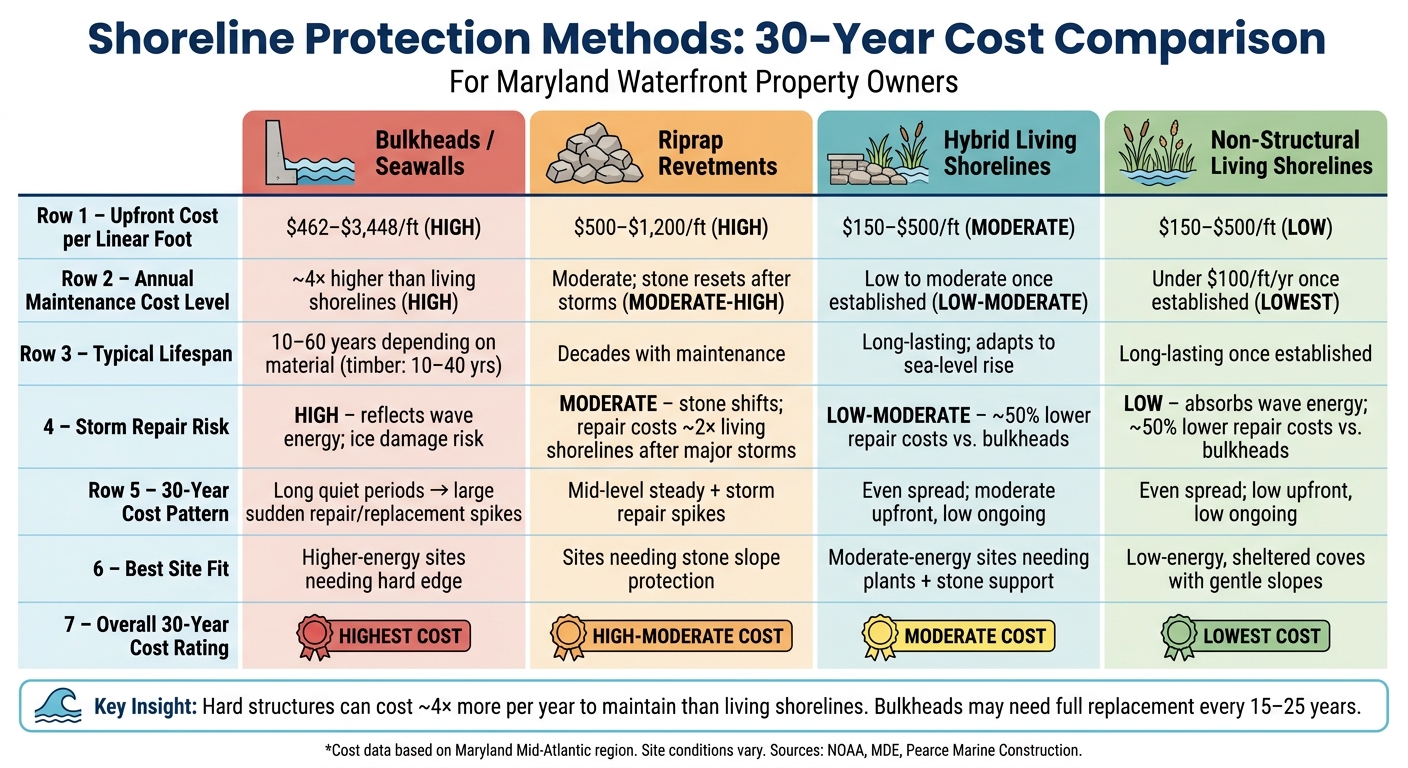
Shoreline Protection Methods: 30-Year Cost Comparison for Maryland Waterfront Owners
Quick Comparison
| Method | Upfront cost | Long-term cost pattern | Main risk | Best fit |
|---|---|---|---|---|
| Bulkheads / Seawalls | High | Low for a while, then large repair or replacement bills | Wave damage, scour, wall failure, drainage pressure | Higher-energy sites where a hard edge is used |
| Riprap | High | Mid-level with repair spikes after storms | Stone movement, scour at the toe | Sites that need stone slope protection |
| Non-Structural Living Shorelines | Low to mid | More even costs after plant establishment | Early plant loss during first 1–3 years | Lower-energy shorelines |
| Hybrid Living Shorelines | Mid | More even than hard structures | Design errors, storm checks for stone parts | Sites that need both plants and stone support |
My takeaway: if you want the lowest long-run cost, I’d usually look first at a living shoreline, then check whether site exposure, slope, and drainage allow it. If not, a hybrid or riprap system may make more sense. Bulkheads can still fit some sites, but they often cost more to own over time.
The rest of the article breaks down where those costs come from and why the pattern matters as much as the first quote.
sbb-itb-843f8be
1. Bulkheads and Seawalls
30-Year Lifecycle Cost
Bulkheads and seawalls come with high lifecycle costs. In the Mid-Atlantic, initial construction usually ranges from $462 to $3,448 per linear foot [3]. The spending pattern is part of the problem. Day-to-day costs may stay low for a while, but when repairs hit, they can hit hard. Then, later on, replacement brings another big bill [3].
Material choice has a big effect on both the upfront price and how long the wall is likely to last:
| Material | Cost per Linear Foot | Lifespan |
|---|---|---|
| Wood | $150 – $500 | 10 – 40 years |
| Vinyl | $200 – $550 | 50 – 60+ years |
| Steel | $200 – $600 | 30 – 50 years |
| Concrete | $200 – $600 | 30 – 50 years |
Source: Pearce Marine Construction [5]
Because replacement may not happen for decades, inspections and early repairs do a lot of the heavy lifting when it comes to keeping costs in check.
Routine Maintenance Needs
Bulkhead maintenance is mostly about catching trouble early. The most common issues are loose tiebacks, joint separation, and base scour at the wall’s toe [4]. You also want to watch for bowing panels, soil loss behind the wall, and seepage through or under the wall [5].
Minor repairs often cost about half a replacement – waiting until the wall fails turns a manageable repair into a full replacement project [5].
That’s the heart of it. A small fix now can save you from a much bigger project later.
Storm Repair Risk
Storm damage is a bigger concern here because bulkheads reflect wave energy instead of absorbing it [4]. That can make storm impacts harsher on the structure itself. In Maryland winters, ice events add another source of damage cost for bulkheads and seawalls [3].
A wall may look fine for long stretches, then one bad storm can change the picture fast.
Drainage and Permit Impact
Drainage behind the wall matters more than many owners expect. If upland drainage is not handled well, water pressure builds up behind the wall. That added pressure can speed up joint failure and put more stress on tiebacks [2][4]. Runoff control helps lower that pressure.
Permitting adds another layer of cost and delay. Engineering and design fees often run $1,500 to $3,500 [5].
That creates a very uneven cost pattern: long quiet periods, then sharp spikes when repairs, storm damage, or replacement show up.
2. Riprap Revetments
30-Year Lifecycle Cost
Riprap usually comes with a mid-range upfront price, but the longer-term bill can grow when scour, storm damage, and regular checks aren’t part of the plan. It’s less rigid than a wall, yet that doesn’t mean it’s cheap to own over time.
In Maryland, installation often falls between $500 and $1,200 per linear foot [6]. At exposed shoreline sites, that number can climb fast. One common issue: the first quote often leaves out the cost of follow-up care.
"Monitoring and maintenance costs are often not accounted for, which may negatively affect the long-term success of shoreline protection efforts." – NOAA National Centers for Coastal Ocean Science [1]
Routine Maintenance Needs
Most of the work is pretty straightforward: look for stones that have shifted, inspect the toe of the slope for scour, and keep the vegetation buffer in good shape. Riprap doesn’t need constant upkeep, but costs tend to hit in chunks, mostly during construction and then again during major repair or replacement periods [3].
Hard structures such as riprap have annual maintenance costs that are about four times higher than living shorelines [6]. Over 30 years, that gap can add up in a big way. And after major storms, it often gets worse.
Storm Repair Risk
Repeated wave action can move stone out of place, which then increases scour at the base [6][4]. That’s where repair risk starts to build. After major storms, repair costs for riprap are about twice those of living shorelines [6].
Sea-level rise adds more pressure over time. It can lead to more frequent overtopping and make height changes or early replacement more likely [4].
Drainage and Permit Impact
Good drainage matters more than many property owners expect. Sending stormwater runoff away from the slope is one of the simplest ways to help protect a riprap revetment. If water collects behind the stone, it can speed up internal erosion and weaken the structure from behind [2].
In Maryland, riprap projects usually need a Joint Permit Application through MDE, along with coordination with the U.S. Army Corps of Engineers [6][4].
3. Non-Structural Living Shorelines
30-Year Lifecycle Cost
Non-structural living shorelines move spending away from big repair bills and toward steady, routine care. They use natural materials such as marsh grasses, native plants, sand, and coir logs to hold the shoreline in place.
In Maryland, installation usually costs $150 to $500 per linear foot [6]. That is often about 50% less upfront than a standard bulkhead [6]. The lower starting price matters, but the bigger story is how costs play out over time. Living shorelines work with sediment movement and plant growth instead of fighting them.
Bulkheads often need full replacement every 15 to 25 years. A well-kept living shoreline can last for decades and adjust as conditions shift [6]. As roots grow deeper and sediment builds up, the shoreline can become more stable over time [2][6].
Put simply, living shoreline costs tend to be spread out more evenly. Conventional shoreline systems often bring long stretches of calm, then a painful repair or replacement bill.
Routine Maintenance Needs
Once the site is established, yearly upkeep is usually under $100 per linear foot. That work mostly includes seasonal plant care, invasive species control, and small fixes after storms [4][7].
The first one to three growing seasons usually need the most attention [4][3]. That early stretch is when plants are taking root and the shoreline is at its most exposed. Because of that, it makes sense to plan for extra planting and more frequent inspections during those first years [4][3].
Storm Repair Risk
Living shorelines absorb wave energy, which helps them take less storm damage than hardened structures in many cases [4][2]. In one comparison, property owners with bulkheads reported about double the repair costs from hurricane damage compared with owners who had living shorelines [6].
A 50-foot buffer of native vegetation can cut shoreline erosion by up to 50% compared with developed shorelines [7]. That same buffer also helps the shoreline adjust to sea-level rise by trapping sediment and gradually moving landward over time [4][2].
That more even damage pattern is a big reason 30-year ownership costs can stay lower.
Drainage and Permit Impact
Runoff from roofs and driveways can wash out new plantings and push replanting costs up [2][6]. One simple fix is grading the site so runoff moves through a vegetated buffer, which can lower that risk [2].
Maryland treats living shorelines as the preferred erosion control method, and that often makes MDE review easier to move through [4][3]. That said, sites with heavier wave exposure may need more support than a non-structural design can offer.
4. Hybrid Living Shorelines
30-Year Lifecycle Cost
Hybrid living shorelines fall between soft and hardened shorelines on cost, so the long-term price tag usually lands in the middle too. They pair stone sills or offshore breakwaters with marsh plants, sand fill, and coir logs.
A NOAA study found that stone-and-vegetation projects at low-exposure sites averaged $1,626 per linear foot, compared with $5,628 per linear foot for bulkheads and seawalls [1]. That gap matters. Over 30 years, hybrid systems can pencil out better because they trap sediment and adjust as sea level rises. Bulkheads, on the other hand, are more likely to need major repairs or even full replacement as they age and take a beating from the water.
Routine Maintenance Needs
Once the shoreline is established, upkeep is fairly straightforward. Most of the work centers on:
- Filling plant gaps
- Checking stone sills
- Doing minor regrading where needed
Adaptive management still needs room in the budget. As the system matures, stone placement may need small adjustments, and some areas may need replanting if vegetation doesn’t take hold [3].
Storm Repair Risk
Owners with living shorelines reported about 50% lower repair costs from hurricane damage than owners with bulkheads [6]. That’s a big difference, especially after a rough storm season.
That said, the hard parts of a hybrid shoreline still need structural checks after major storms. In the Mid-Atlantic, ice damage is another cost to plan for. A good rule of thumb is to expect two ice events in the first 20 years [3].
Drainage and Permit Impact
Upland runoff can cause back-slope erosion, which can weaken the planted parts of a hybrid system. So if stormwater is rushing toward the bank edge, redirecting it is part of keeping long-term costs under control [2].
Permitting matters too. Bulkhead replacement now faces tighter review, while hybrid projects usually move through Maryland permitting with fewer hurdles.
Pros and Cons by Long-Term Cost
The table below shows the main long-term cost tradeoffs for each shoreline method. The biggest difference comes down to how the cost plays out over a 20- to 30-year lifespan.
| Method | Initial Cost | Long-Term Maintenance | Lifespan | Main Cost Risk |
|---|---|---|---|---|
| Bulkheads/Seawalls | High ($500–$1,200/ft) [6] | High; annual maintenance can run about 4× that of living shorelines [6] | 15–25 years for timber structures [6] | Full replacement and wave-scour damage [4][6] |
| Riprap Revetments | High ($500–$1,200/ft) [6] | Moderate; stone may shift after storms and need resetting [4][1] | Decades [4] | Shifting or settling after major storms [4][1] |
| Non-Structural Living Shorelines | Lowest ($50–$100/ft) [2] | Lowest once established, though the first 1–3 growing seasons may require weeding or replanting [4][2] | Long-lasting once established [6] | Vulnerable during the 1–3 year establishment phase [4][2] |
| Hybrid Living Shorelines | Moderate ($150–$500/ft) [6][2] | Low to moderate after establishment [4] | High; adapts to sea-level rise [4] | Requires careful design and engineering [4][6] |
Hard structures tend to bunch costs into a few big moments: a heavy upfront bill, then full replacement within 15 to 25 years for timber systems, plus annual maintenance that runs about four times higher than living shorelines [6]. That can sting. You may not be paying every month, but when the bill comes, it’s often a big one.
Living shorelines work differently. Their costs are spread out over time, with lower installation prices and light upkeep once the plants are established [6][2]. The catch is that they tend to perform best in low-energy settings [6][2]. Riprap falls somewhere in between. It can last for decades, but installation is still expensive, and major storms can shift stones enough to require resets or repairs [4][1].
Upland Drainage
Even a well-built shoreline system can become more expensive if runoff isn’t controlled uphill. Poor upland drainage adds repair risk because it can trigger bank collapse from behind the structure [2][3]. Pro Landscapes MD can help with grading and stormwater management in central Maryland.
Conclusion
For Maryland waterfront owners, living shorelines usually come with the lowest 20- to 30-year cost. The main reason is simple: they tend to cost less to put in and less to care for than hardened structures. A timber bulkhead at $500–$1,200 per linear foot may seem like a simple fix at first, but the math can shift over time. With a 15- to 25-year replacement cycle and annual maintenance costs that can run four times higher than living shorelines, the long-term bill can climb fast [6].
That said, the best option still comes down to your site. In terms of cost, non-structural living shorelines are usually the lowest, hybrids and riprap sit in the middle, and bulkheads and seawalls cost the most over time. High-energy sites often need a hybrid setup, while sheltered coves with gentle slopes are usually a better match for non-structural living shorelines.
There’s also a practical difference in how upkeep is handled. Living shoreline maintenance is usually planned from the start, while conventional projects often treat maintenance as a separate cost that shows up later.
Site fit matters, but drainage can still change the cost picture. Upland drainage plays a part too: redirecting stormwater away from the bank can help cut erosion behind the shoreline and lower future repair costs. Pro Landscapes MD provides grading and stormwater management to address that risk.
A simple inspection routine goes a long way:
- Plan annual visual checks for bare soil, slumping, or plant loss
- Inspect after nor’easters or hurricanes
- Schedule periodic professional evaluations for tiebacks, stone, or sediment buildup
FAQs
Which shoreline option best fits my property?
The best shoreline option comes down to your property’s wave energy, bank slope, and exposure.
Living shorelines are often a good fit for low- to moderate-energy areas, such as tidal creeks and coves. They can bring lower long-term maintenance costs and added habitat value. On more exposed, high-energy sites, tougher structures like bulkheads or stone revetments may be the better choice for stronger protection.
Pro Landscapes MD can assess site conditions and drainage needs to help determine the right approach.
How much does drainage affect long-term repair costs?
Drainage plays a big role in long-term repair costs. When it’s done well, it helps control runoff and cut down erosion before that damage starts to weaken the structure.
Move water away from weak spots, and shoreline stabilization tends to last longer. That also means fewer repeat repairs and lower costs over time. Pro Landscapes MD offers drainage services like installation, pipe placement, grading, and French drains to help protect your landscape.
When should I choose a hybrid instead of a living shoreline?
Choose a hybrid shoreline if your property sits in a high-energy area where a pure living shoreline may not hold up well enough.
A living shoreline uses native plants and natural materials, and it tends to work best on low- to moderate-energy sites. A hybrid shoreline adds stone structures along with vegetation, which gives the shoreline more strength against wave action.
Pro Landscapes MD can help assess your site’s energy level and bank slope.
Chat with Us