









- bhavya gada
- No Comments
If I wanted to keep cost down in a Maryland yard, I’d focus on wall height, drainage, and soil before I picked a material. That’s the short answer.
Here’s the simple breakdown:
- Lowest upfront cost: pressure-treated timber at about $15–$25 per sq. ft.
- Best middle-ground picks: CMU and segmental block
- Best for wet ground: gabion walls and boulder walls
- Longest life: dry-stacked stone and poured concrete
- Big cost trigger: walls at 4 feet or more can add $800–$2,500 for permits and engineering in many Maryland areas
- Drainage matters a lot: gravel, drain pipe, and fabric can add $8–$15 per sq. ft., but poor drainage is one of the main reasons walls fail
- Maryland problem spots: clay soil, freeze-thaw weather, tight access, and steep slopes
If your yard is on a slope, the cheapest wall on paper may not be the cheapest wall over time. A low wall under 3 feet can sometimes be a DIY job. But if the wall is near a driveway, close to a property line, on a steep slope, or over 4 feet tall, I’d expect the job to get more expensive fast.
7 Retaining Wall Types: Cost, Lifespan & Best Use in Maryland
How to Build a Retaining Wall | How To Anything
sbb-itb-843f8be
Quick Comparison
| Wall Type | Cost Range | Life Expectancy | Best Use |
|---|---|---|---|
| Pressure-Treated Timber | $15–$25/sq. ft. | 15–25 years | Short walls, garden beds, light slopes |
| Standard CMU Block | $20–$35/sq. ft. | 30–50 years | Small to mid-size grade changes |
| Segmental Interlocking Block | $12–$20/sq. ft. for DIY materials under 3 ft | 30–50 years | Moderate slopes, terraced yards |
| Natural Boulder | $25–$50/sq. ft. | 40–60 years | Open yards, steeper slopes |
| Dry-Stacked Natural Stone | $82–$165/sq. ft. | 50–100 years | Short garden walls, stone look |
| Gabion Basket | $40–$80/sq. ft. | 30–50 years | Wet areas, runoff-heavy sites |
| Poured Concrete / Urbanite | $30–$60/sq. ft. | 50–75 years | Tall walls, heavy loads, steep grades |
Bottom line: if I were choosing for value, I’d look at timber for the lowest first cost, segmental block for balance, and gabions or boulders for wet sites. No matter which wall type you pick, I would not cut the drainage line item to save money.
What Makes a Retaining Wall Budget-Friendly in Maryland
A lower-cost retaining wall in Maryland usually comes down to a few big things: how much digging the job needs, how easy the site is to reach, what kind of soil you’re dealing with, and whether the wall includes proper drainage.
Excavation alone can add $2–$8 per square foot, and if the crew has to haul away extra dirt or bring in fill, trucking can tack on another $400–$1,500 [3]. Access matters too. If a yard has narrow gates or other limits, labor can jump by 20–40% because workers may need to move materials by hand instead of using a skid steer [3]. That kind of site issue can turn a simple project into a more labor-heavy one fast.
Drainage is another big budget factor. It adds cost at the start, but skipping it can backfire. Water trapped behind a wall builds pressure, and in Maryland winters, frozen water expands and can shove a wall out of line. A proper setup includes clean gravel backfill, a 4-inch perforated pipe, and geotextile fabric. That usually adds about $8–$15 per square foot upfront [3]. Still, that added cost is often what helps a wall last 40+ years instead of failing in about 10 years [3].
Soil can also change the price in a hurry. Clay-heavy soil often needs deeper footings and geogrid reinforcement, which adds about $4–$10 per square foot [3]. And wall height matters more than many homeowners expect. Keeping the wall under 4 feet can help avoid permit and engineering costs that often add $800–$2,500 in many Maryland jurisdictions [3].
Here’s a side-by-side look at the biggest cost drivers:
| Factor | Lower-Cost Condition | Higher-Cost Condition |
|---|---|---|
| Wall Height | Under 4 ft | Over 4 ft (can trigger $800–$2,500 in permit and engineering fees) [3] |
| Soil Type | Sandy or loamy | Heavy clay or rocky |
| Site Access | Open access for machinery | Hand-carry only (can raise labor 20–40%) [3] |
| Drainage | Gravel, pipe, and fabric included | None |
| Design | Straight run | Curves, corners, or built-in steps |
Those cost drivers explain why some wall types are far easier on the budget than others. With that in mind, the seven wall types below show where Maryland homeowners can cut costs without giving up function.
1. Pressure-Treated Timber Retaining Walls
Pressure-treated timber is often the lowest-cost upfront retaining wall pick for Maryland homeowners, but there’s a tradeoff: it usually has the shortest lifespan too [3][1]. That makes it a good fit for raised beds, short terraces, and simple garden borders [3][2].
Best Slope and Height Range
Timber works best when the wall stays fairly low. In most cases, it’s best for heights under 3 to 4 feet [3][1]. If the wall is under 3 feet, it can be a practical DIY job since it uses deadmen anchors instead of the reinforcement you’d see in block walls [3].
There’s a clear limit, though. If the slope is steeper than 3:1, it’s not a safe DIY project [3].
Installed Cost Range
In Baltimore, pressure-treated timber retaining walls usually cost $15 to $25 per square foot of wall face [1]. Most projects use 6×6 pressure-treated timbers, and those often run $30 to $55 each [3].
One thing to skip: reclaimed railroad ties. Many Maryland municipalities restrict them [3].
That lower starting price is the main draw, but it comes with a shorter service life.
Expected Lifespan
Timber walls usually last 15 to 25 years before they need replacement [3][1]. In Maryland, wet conditions and freeze-thaw cycles can be tough on wood, so moisture control plays a big role in how long the wall holds up [1].
Maintenance and Drainage Needs
Because timber sits right against moist soil, drainage matters even more than it does with block. A proper setup should include:
- gravel backfill
- a perforated drain pipe
- geotextile fabric behind the wall [3]
That drainage package usually adds $8 to $15 per square foot, but it helps the wall reach its full service life [3]. It’s also smart to inspect the wall once a year for rot, splitting, and movement [3].
2. Standard Concrete Block (CMU) Retaining Walls
If timber is the low-cost pick, CMU is the next rung up for homeowners who want more strength without jumping to stone-level pricing. Standard concrete block retaining walls give you a durable, budget-aware upgrade from timber [2].
In many Maryland yards, especially ones with clay soil or moderate slopes, CMU hits a practical middle ground. It can handle more load than timber, which makes it a better fit for small to mid-size grade changes. For cost control, it usually makes sense to keep most CMU walls under 4 feet. Once you go taller, permit and engineering costs can climb fast. On steeper sites, terraced walls often pencil out better. If you’re thinking DIY, straight runs under 3 feet are the simplest jobs. Slopes steeper than 3:1 are better left to a pro [1][3].
Installed Cost Range
In the Baltimore market, CMU walls usually cost $20 to $35 per square foot of wall surface area [1][2]:
| Wall Height | Installed Cost (Baltimore Market) |
|---|---|
| 2–3 feet | $20–$30 per sq. ft. [1] |
| 4–6 feet | $30–$50 per sq. ft. [1] |
| Over 6 feet | $40–$75 per sq. ft. (engineering required) [1] |
If your yard has heavy clay soil, which is common in parts of Maryland, expect to add 15% to 25% to the budget for deeper footings and stronger drainage work [3].
Expected Lifespan
With proper drainage and reinforcement, a CMU wall can last 30 to 50 years [3]. In Maryland, moisture is the make-or-break issue, so water control matters a lot [1].
Maintenance and Drainage Needs
Once installed, CMU walls don’t ask for much. A yearly check is usually enough. Look at drainage outlets for clogs, and watch for fresh cracks or joints starting to separate.
Drainage is not optional here. Gravel backfill, a 4-inch perforated pipe, and geotextile fabric help stop water pressure from building up behind the wall and causing early failure [3]. That full drainage stack adds about $8 to $15 per square foot upfront, but that’s also what helps a CMU wall reach its full service life [3].
3. Segmental Interlocking Concrete Block Walls
For homeowners who want a cleaner look than CMU, but don’t want to make the jump to stone, segmental block is the next move. These walls are common in Maryland yards because they hold up well and give a more finished appearance. The blocks stack with a built-in setback, or slight backward lean, and use locking lips or pins instead of mortar.
Best Slope and Height Range
This wall type works best for residential projects under 6 feet in Maryland [3]. On lots with moderate to steep grade changes, a terraced setup can save money. For example, two 3-foot walls with a planting bench between them can cut total project costs by 25% to 35% compared with one engineered wall [3].
That can make segmental block a smart choice for small terraces and moderate slopes where a full engineered wall would be overkill. One thing to watch: in many Maryland jurisdictions, walls over 4 feet usually need a building permit and a structural engineer’s stamp. That can add $800 to $2,500 to the budget [3].
Installed Cost Range
Price climbs as wall height, reinforcement, drainage needs, and soil conditions get tougher. So these walls tend to stay most budget-friendly on lower, simpler runs.
For DIY projects under 3 feet, material costs alone usually land between $12 and $20 per square foot [3]. Labor in Maryland often runs higher than the national average, and heavy clay soil can push costs up another 15% to 25% because it needs more base prep and drainage work [3].
Expected Lifespan
With proper drainage, segmental interlocking walls usually last 30 to 50 years [3].
Maintenance and Drainage Needs
Upkeep is fairly light. After heavy rain or a winter thaw, check for settling, bulging, and blocked drains. Maryland’s freeze-thaw cycles put extra stress on retaining walls, so drainage and setback design matter a lot.
A good rule of thumb is to inspect the wall every 6 months and book a professional check every 24 months to catch movement early [3]. Drainage is essential – skipping it is a leading cause of wall failure [3].
For homeowners who want a more decorative finish, the next wall types trade some simplicity for a more natural look.
4. Natural Boulder Retaining Walls
If you want a more natural finish than segmental block, boulder walls are the next step. They work well in open yards, rural lots, and rustic designs. But there’s a catch: they tend to stay budget-friendly only when access is easy and the wall stays short [2][3].
Best Slope and Height Range
Boulder walls work well on tough slopes because each stone is heavy, and its uneven shape helps it lock into place [2]. That built-in mass does a lot of the work.
For simpler, lower-cost jobs, keep the wall under 4 feet. That helps you stay below Maryland’s permit and engineering threshold. If you’re dealing with a 5- to 6-foot drop, it often makes more sense to terrace the slope into shorter walls instead of building one tall wall.
Access matters here more than many people expect. These stones are heavy, so machine access is a big deal if you want to control labor costs. If a crew has to move boulders by hand, the price can climb fast [3].
Installed Cost Range
In the Baltimore market, natural boulder walls usually cost $25 to $50 per square foot installed, while more complex or taller jobs can land in the $40 to $90 per square foot range [1][3].
Costs tend to jump when the wall gets taller, the site gets tighter, or the soil gets tougher. For example:
- Heavy clay soil can add 15% to 25% because the job may need deeper footings and more drainage work [3].
- Sites that require hand-carrying boulders instead of machine placement can drive labor costs up by 20% to 40% [3].
Expected Lifespan
With proper installation, you can expect a lifespan of 40 to 60 years [3].
Maintenance and Drainage Needs
Once installed, boulder walls are very low maintenance. The gaps between stones let water move through more easily, which helps reduce pressure behind the wall. Even so, drainage still matters. Use gravel backfill, a drain pipe, and geotextile fabric behind the wall [3].
Maryland’s freeze-thaw cycles are also less likely to crack boulder walls than mortared stone walls. Why? Because the boulders can shift a bit without damage [1].
For a more refined stone look, the next option uses smaller, stacked units.
5. Dry-Stacked Natural Stone Garden Walls
Dry-stacked stone walls use no mortar, which is part of their appeal. They work best for short garden walls when you want that natural stone look without a poured or glued-together feel. They’re a smart fit for defining garden beds, edging patios, or terracing a sloped backyard.
Compared with boulder walls, dry-stacked stone gives you a tighter, more polished finish. The tradeoff is labor. It takes more hands-on work, so the price tends to climb.
Best Slope and Height Range
This type of wall makes the most sense when the height stays low enough to avoid major engineering costs. Keep structural walls under 3 feet. Once a wall goes over 4 feet, Maryland usually brings permit and engineering costs into the picture.
On steeper slopes, short terraced stone walls help keep the job easier to build and easier to budget.
Installed Cost Range
Dry-stacked natural stone is labor-heavy, so it stays cost-effective mainly on shorter walls. In the Baltimore market, installed cost usually falls between $82 and $165 per square foot of wall face [1][3].
Labor alone makes up about 45% to 60% of the total cost [3]. If access to the site is tight, or the yard has heavy clay soil, expect the price to go up [3].
Expected Lifespan
Dry-stacked stone walls have an expected lifespan of 50 to 100 years [3].
Maintenance and Drainage Needs
One upside of the higher labor cost is long service life with low upkeep. Check the wall once a year and reset any loose stones as needed. Because the joints don’t use mortar, the wall can move a bit with Maryland freeze-thaw cycles instead of cracking the way rigid materials often do [3][1].
Drainage still matters. Use gravel backfill and a drainage pipe behind the wall [3].
6. Gabion Basket Retaining Walls
Gabion walls use wire baskets filled with stone or recycled fill. They’re a solid middle-ground pick if you want a wall that drains on its own and relies on simple materials. In Maryland yards, they can look right at home in both modern and rustic settings. They also tend to stay budget-friendly when the fill comes from local sources and the wall remains short.
One of the big upsides is drainage. Water moves freely through the stone fill, which helps cut down pressure behind the wall. It still makes sense to add drain pipe and geotextile behind the baskets so soil doesn’t clog the openings.
Best Slope and Height Range
Gabion walls work well on mild to moderate slopes and are best for short to mid-height walls where drainage matters more than a polished finish [2][3]. In steeper Maryland yards that need more than 4 feet of retention, a two-tier terraced setup can help trim costs. For example, two separate 3-foot walls may stay below common engineering and permitting thresholds [3]. Shorter terraced runs also make gabions easier to install and less expensive.
Installed Cost Range
Installed gabion walls usually cost $40 to $80 per square foot across the U.S. In Maryland, prices often run 10% to 25% higher. If the site has heavy clay soil, plan for another 15% to 25% on top of that, since deeper footings and added drainage may be needed [1][3].
Expected Lifespan
Gabion walls usually last 30 to 50 years [3]. That gives them a longer service life than pressure-treated timber.
Maintenance and Drainage Needs
Maintenance is light. In most cases, you’ll just need to rinse off debris and check for settling [4].
For a more rigid, finished look, the next option moves from open baskets to concrete-based construction.
7. Poured Concrete and Urbanite Retaining Walls
Poured concrete is a good pick when a wall needs to hold heavy loads or deal with a steep grade. It’s often used for larger amounts of soil and tougher slopes [2]. Urbanite, on the other hand, is salvaged concrete broken into uneven slabs. It can cut material cost and gives the wall a rough, stone-like look. In simple terms: use poured concrete for harder slopes, and urbanite for shorter garden walls when budget matters.
Best Slope and Height Range
Poured concrete works best for taller walls, heavy loads, and other structural jobs [3]. In Maryland, walls with an exposed height of 4 feet or more usually trigger permit and engineering rules [1][3]. Slopes steeper than 3:1 often need professional design and installation [3].
This wall type also needs engineered footings. In parts of Maryland with heavier clay soil, those footings usually have to go deeper [3]. If you’re dealing with a 6-foot drop, splitting it into two 3-foot walls can cut cost and may help you avoid building one larger engineered wall.
Installed Cost Range
In the Baltimore area, poured concrete retaining walls usually cost $30 to $60 per square foot installed, which is about 10% above the national average [1]. For engineered walls, pricing can jump to $60 to $140 per square foot [3].
There are a few extra costs that can move the total up:
- Permits and engineering for walls between 4 and 6 feet tall usually add $800 to $2,500 [3]
- Drainage adds about $8 to $15 per square foot and is a must in Maryland [3]
- Urbanite can lower material cost since it uses salvaged concrete
Expected Lifespan
When built and drained the right way, poured concrete retaining walls can last 50 to 75 years [3].
Maintenance and Drainage Needs
Maintenance is pretty light. Check drainage outlets from time to time, and keep an eye out for cracks or any movement.
Those differences in height, cost, and upkeep are much easier to compare side by side.
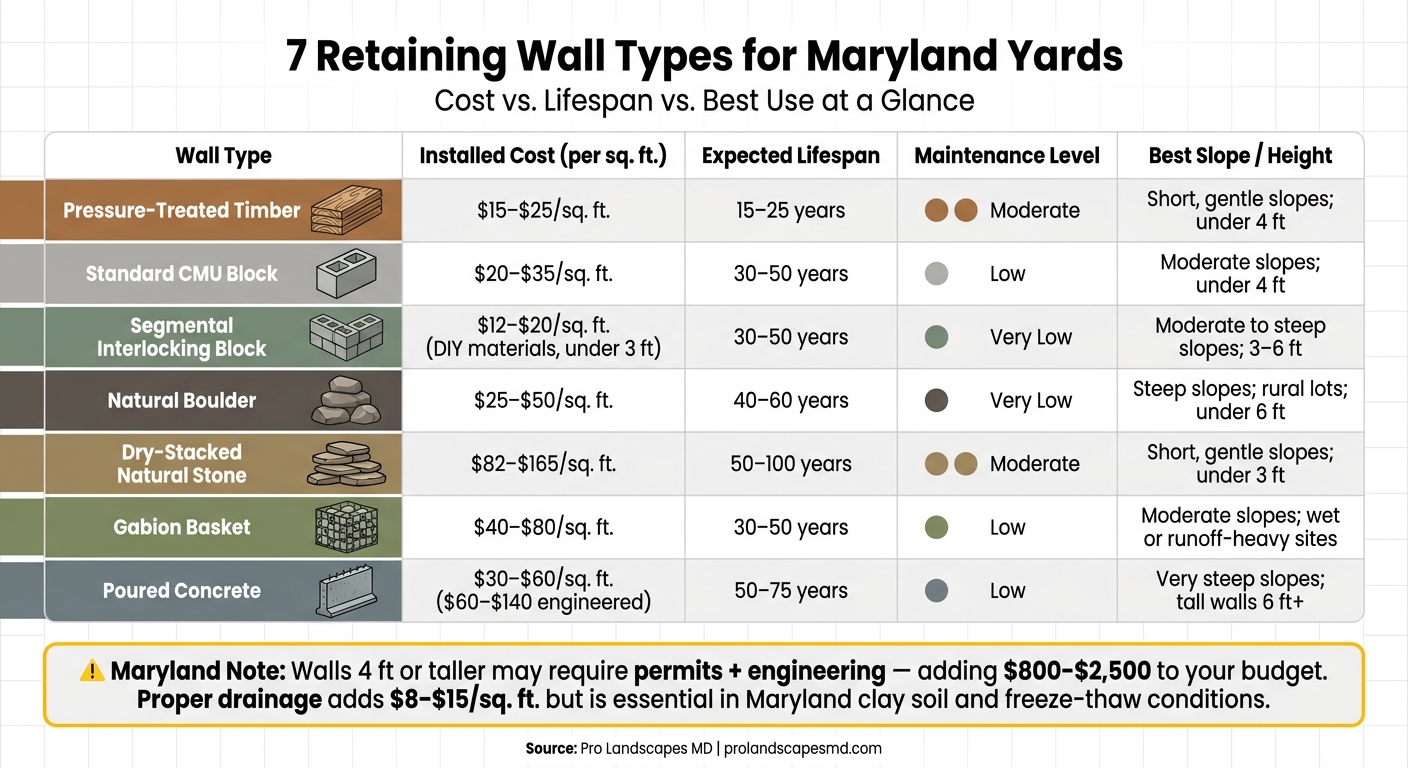
Side-by-Side Comparison of All 7 Wall Types
Here’s the quick comparison of all seven wall types. In Maryland, drainage and freeze-thaw resistance matter just as much as price, so it helps to look at cost, lifespan, and slope fit all in one place.
| Wall Type | Installed Cost (per sq. ft.) | Expected Lifespan | Maintenance Level | Best Slope / Height |
|---|---|---|---|---|
| Pressure-Treated Timber | $15–$25 | 15–25 years | Moderate (rot, termite checks) | Short, gentle slopes; under 4 ft |
| Standard CMU Block | $20–$35 | 30–50 years | Low (check joints) | Moderate slopes; under 4 ft |
| Segmental Interlocking Block | $12–$20 in materials for DIY under 3 ft; installed cost rises with height and reinforcement | 30–50 years | Very low | Moderate to steep slopes; 3–6 ft |
| Natural Boulder | $25–$50 (tighter sites and taller builds cost more) | 40–60 years | Very low | Steep slopes; rural lots; under 6 ft |
| Dry-Stacked Natural Stone | $82–$165 | 50–100 years | Moderate (resetting stones) | Short, gentle slopes; under 3 ft |
| Gabion Basket | $40–$80 | 30–50 years | Low | Moderate slopes; wet yards or runoff-heavy sites |
| Poured Concrete | $30–$60 (engineered builds: $60–$140) | 50–75 years | Low | Very steep slopes; tall walls 6 ft+ |
One thing stands out in Maryland: clay soil and repeated freeze-thaw cycles put extra pressure on retaining walls. That means the wall itself is only part of the job. Water control and a system that can deal with soil movement often make the difference between a wall that lasts and one that starts leaning, cracking, or shifting too soon.
That’s why flexible systems, like gabion baskets and dry-stacked stone, often perform better on wet or shifting sites than rigid wall types. They can move a bit without failing, which matters when the ground expands and contracts through the seasons.
DIY can still make sense for smaller projects. But once you’re dealing with tall walls, steep slopes, or tight access, the project usually moves out of DIY territory fast.
When to Hire a Maryland Retaining Wall Contractor
Hire a Maryland retaining wall contractor when the wall hits 4 feet, supports a load, or sits on a steep or tight site. That’s usually the point where DIY savings dry up and risk starts to pile up. An unpermitted wall can also lead to expensive fixes during a home sale [3].
Height isn’t the only thing that matters. Site conditions can turn a simple wall into a much tougher job fast. It makes sense to bring in a pro for slopes steeper than 3:1, heavy clay soil, visible erosion, major drainage issues, or walls close to property lines [3].
Drainage is often the make-or-break issue, and this is where a contractor’s judgment matters most. Most wall failures start with bad drainage. A proper build should include gravel backfill, perforated pipe, and geotextile – not native soil. If someone plans to backfill with native soil, that’s a red flag. On taller slopes, terracing can also help cut costs [3].
Pro Landscapes MD installs retaining walls, grading, French drains, and stormwater solutions across central Maryland and Washington, DC.
Conclusion
The table points to one simple takeaway: price matters, but fit matters more. The lowest-cost retaining wall isn’t always the smartest pick. The right wall is the one that matches your slope, soil, and timeline.
A timber wall can work well on a mild slope, especially if you expect to sell in 5 to 10 years. But on steeper sites with heavy clay soil, segmental interlocking block often gives you better long-term value.
That long-term value can disappear fast if drainage is done poorly. In Maryland, wet seasons and freeze-thaw weather put a lot of stress on retaining walls. If you’re trying to cut costs, trim extras like caps or veneer, not drainage.
For timing, late August through early October is often the easiest window for a build.
If you want help with wall design and drainage, Pro Landscapes MD serves central Maryland with retaining walls, drainage, grading, and yard leveling.
FAQs
Which retaining wall lasts longest?
For a permanent fix, natural stone and poured concrete tend to last the longest. People often pick them when they want a wall that can stay put for decades, even for the life of the property.
Interlocking concrete blocks are also a long-lasting option. With proper drainage, they can hold up for 30 to 50 years.
No matter which material you choose, the life of the wall depends a lot on how well it’s installed. Two details matter most: gravel backfill and a perforated drain pipe. Without them, hydrostatic pressure can build up behind the wall and shorten its life fast.
What is the cheapest retaining wall for a Maryland yard?
In Maryland, timber and railroad tie walls are usually the lowest-cost option at about $15 to $35 per square foot installed. They’re easier on the budget at the start, but they usually last only 15 to 25 years. That’s a shorter lifespan than concrete or stone.
Gabion walls can also make sense if you’re trying to keep costs down, at around $10 to $40 per square foot. No matter which material you pick, proper drainage is what helps a wall last longer in Maryland’s silt- and clay-heavy soils.
When do I need a permit or contractor?
In Maryland, you’ll generally need a permit for a retaining wall that’s more than 3 to 4 feet tall.
That said, height isn’t the only trigger. A permit may also be needed if the wall:
- Supports a surcharge load
- Crosses a property line
- Sits in problem soils
- Is part of a tiered system
County rules can vary, which is where things get a little tricky. Working with a pro like Pro Landscapes MD can make the permit process easier and help you stay in line with local code.
Chat with Us