









- bhavya gada
- No Comments
If your yard keeps washing out, the fix is usually simple: match plants to sun, shade, and moisture, then plant thick enough to cover bare soil fast. In Maryland, erosion often shows up on slopes, swales, bare banks, and below downspouts. And because 95% of Maryland drains to the Chesapeake Bay, soil loss in one yard can affect water far beyond the property line.
Here’s the short version:
- Roots hold soil together
- Dense plant cover softens rainfall
- Foliage slows runoff so more water sinks in
- Site checks come first: slope, sunlight, drainage, runoff paths, and compacted soil
- Dry sun areas need drought-tolerant spreaders
- Shade areas do better with groundcovers, sedges, and ferns than thin turf
- Wet zones need plants that can handle periodic saturation
- Planting style matters: mix groundcovers, perennials, and shrubs for root depth at more than one level
- Mulch should stay under 3 inches
- The first 12 months matter most for watering, gap repair, and weed control
A few numbers stand out. Maryland has more than 675 native plant species sold for landscaping. A good target is at least 70% native plants on an erosion-control slope. And if runoff is strong or the slope is near a structure, plants alone may not be enough – you may also need grading, drainage work, or a wall.
So if I had to sum up the whole guide in one line, it would be this: pick the right plants for each zone, layer them by root depth, protect bare soil early, and fix drainage problems before planting if the site keeps failing.
The Secret to Erosion Control? Plants That Belong There ft. Heidi Ferrs
sbb-itb-843f8be
Assess Your Site Before Choosing Plants
Before you pick a single plant, take a close look at the site. A quick audit now can save a lot of trouble later and help you cut down the plant list fast.
Slope, sunlight, and runoff patterns
Walk the slope after a heavy rain. You’re looking for runoff paths, washed-out spots, and small erosion channels. Those trouble areas tell you where water is moving and where the ground is losing soil.
At the same time, note how much sun each part of the slope gets:
- Full sun: 6+ hours
- Full shade: 3 hours or fewer
- Areas with reflected heat from pavement or walls
That last one matters more than people think. A spot next to a driveway or wall can feel much hotter and drier than the rest of the yard.
Soil drainage and problem areas to identify
A soil test can help confirm drainage issues and sort the site into dry (D), medium (M), and wet (W) zones.
Also watch for compacted soil, especially near foundations and paths. When soil is packed tight, roots struggle to grow, and water has a harder time soaking in. Mixing organic matter into the full planting area before you plant helps with drainage and gives roots a better shot at getting established.
When planting alone is not enough
Plants can do a lot, but they can’t fix every slope problem on their own.
If erosion keeps coming back because the site doesn’t fit the plants, or if compacted soil and poor drainage are stopping roots from taking hold, vegetation alone won’t solve it. In those cases, you may need regrading, French drains, dry riverbeds, or retaining walls before planting starts – or at the same time.
Pro Landscapes MD handles grading, drainage, restoration, and planting across central Maryland. Deal with structural problems first so plants can get established and help hold the slope in place.
Use these site notes to match each zone with plants that fit its sun and moisture conditions.
Best Low-Maintenance Plants by Sun, Shade, and Moisture
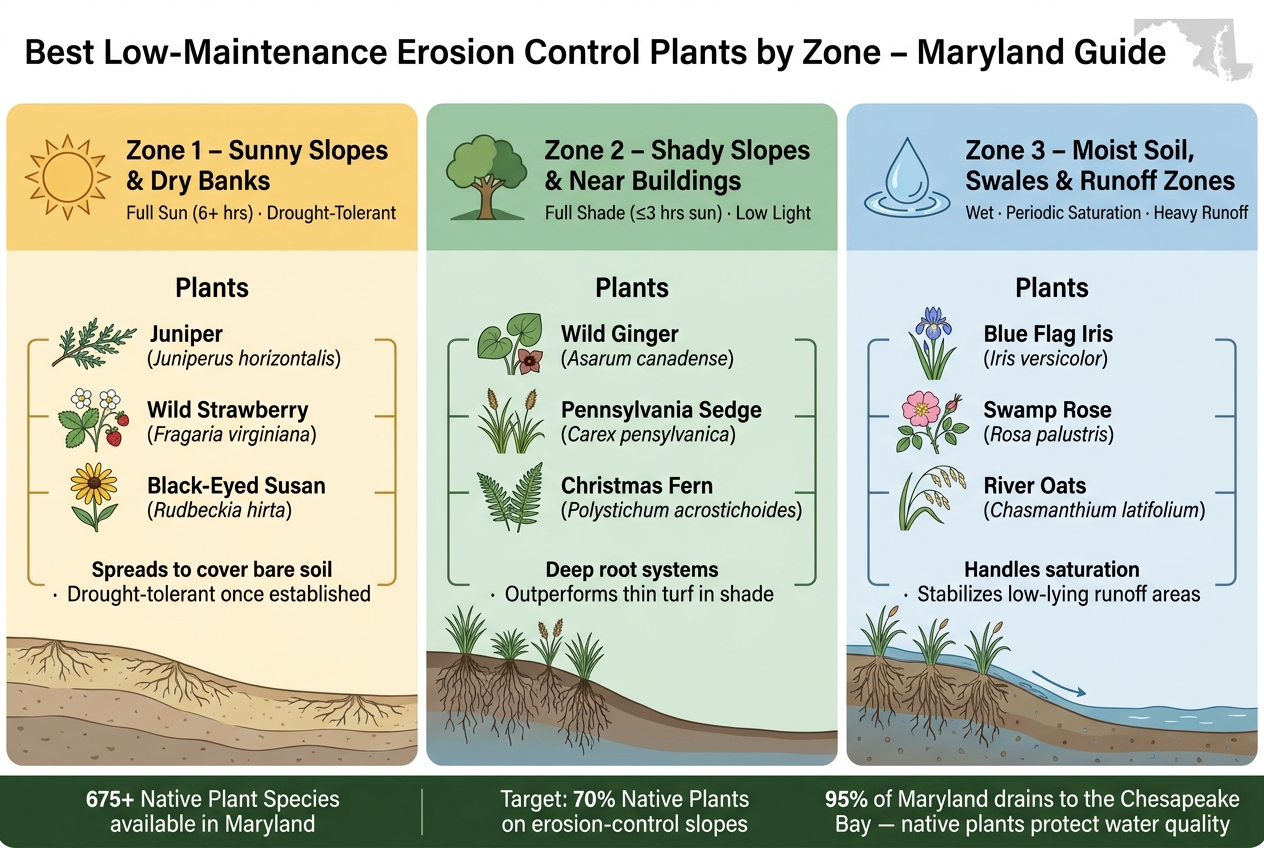
Best Erosion Control Plants by Sun, Shade & Moisture in Maryland
After you map sun and moisture, pick plants that match each zone. Use the sun and moisture map from the last section to narrow down what belongs in each planting area.
Plants for sunny slopes and dry banks
Sunny, dry slopes need plants that can take full sun, handle dry spells, and spread enough to cover bare soil. On exposed banks, low groundcovers do a lot of the heavy lifting. They shade the soil, help slow weed growth, and cut down on upkeep.
Good choices for central Maryland include juniper (Juniperus horizontalis), native wild strawberry (Fragaria virginiana), and black-eyed Susan (Rudbeckia hirta). Once these plants get established, they tolerate drought well and usually need little attention after the first season.
Plants for shady slopes under trees and near buildings
Grass tends to thin out in shady spots, which is why groundcovers and woodland natives often work better for erosion control there. Where turf struggles, these plants can step in and do the job.
Native options like wild ginger (Asarum canadense), Pennsylvania sedge (Carex pensylvanica), and Christmas fern (Polystichum acrostichoides) spread over time, handle low light, and grow root systems deep enough to help steady shaded slopes. In deep shade, use shade-tolerant native groundcovers that also match the site’s moisture level.
Plants for moist soil, swales, and runoff zones
Wet areas call for plants that can handle periodic saturation and heavy runoff without falling apart. In Maryland swales and low-lying runoff zones, blue flag iris (Iris versicolor), swamp rose (Rosa palustris), and river oats (Chasmanthium latifolium) are solid fits.
The big idea is simple: match the plant to the moisture. When you do that, plants settle in faster and you’re less likely to deal with replanting.
Once you choose the right plants, spacing, mulch, and first-year watering decide whether they can hold the slope.
How to Plant for Lasting Slope Stability
Choosing the right plants is only half the job. How you plant them is what decides whether the slope stays put during heavy rain or starts to slip before roots take hold.
Use the site assessment results to amend compacted planting areas before planting [2].
Layer plants so roots cover the slope at multiple depths
After you match each zone with the right plant type, build the slope in layers based on root depth.
Planting one groundcover across the whole slope may look simple, but it leaves the soil less protected below the surface. A better setup mixes plant types so roots are holding soil at shallow, mid-level, and deeper layers all at once. Groundcovers, perennials, and shrubs work together to form a thicker root network than any single plant type can on its own [2].
| Plant Category | Recommended Spacing | Root/Stability Role |
|---|---|---|
| Groundcover | Varies by species | Shallow, spreading surface protection |
| Perennial | Varies by species | Medium-depth fibrous roots |
| Small Shrub | ~3 ft. apart [2] | Medium-depth structural stability |
| Medium Shrub | ~4 ft. apart [2] | Deep-reaching root systems |
| Large Shrub | ~5 ft. apart [2] | Deep-reaching root systems |
| Small Tree | ~20 ft. apart [2] | Deepest structural soil anchoring |
Install in sections so you don’t trample loose soil or damage new plantings [2].
Use mulch and temporary erosion-control materials correctly
Once the planting layout is in place, protect any exposed soil until the roots spread.
Bare soil between young plants is often the weak spot during establishment. Shredded mulch, applied no deeper than 3 inches, helps protect roots and keep moisture in the soil. If you go past 3 inches, you can smother the plants [2].
On steeper slopes, biodegradable erosion-control blankets or jute netting placed directly over the soil can help hold it in place while plants root in. Coir logs set along the contour of the slope can also slow runoff and help new plantings settle in [2].
Spacing, watering, and the first 12 months
Tighter spacing usually leads to faster coverage and fewer weeds competing with new plants. When plants fill in sooner, they shade the soil earlier and cut down on how much mulch you need [2].
The first year after planting is the key window. Check soil moisture on a regular basis during those first 12 months so roots can establish the way they should [2].
Maintenance, Common Mistakes, and Key Takeaways
### Yard maintenance and landscape projects after establishment
After the first growing season, the job changes. At that point, you’re not trying to help plants settle in anymore. You’re trying to keep the slope covered.
Most of the upkeep comes down to gap control. That matters because open spots can weaken the root system that formed during planting and give runoff a place to start cutting into the slope. Watch for stray weeds, and scale back mulch little by little as the plants fill in [2]. If one plant dies, replace it fast so that small opening doesn’t turn into a new erosion point.
Mistakes that make erosion worse
Most slope-planting failures trace back to two things: poor plant-site matching and slow establishment. In plain English, the plants either weren’t right for the spot, or they took too long to fill in.
The biggest mistakes include:
- Skipping the site check
- Planting too sparsely
- Using too much mulch
Plants that don’t fit the site tend to fail fast, which leaves bare soil behind. And bare soil on a slope is asking for trouble. Avoid invasive species such as Japanese barberry [2].
Big gaps also invite weeds and runoff, so don’t let mulch pile up too deep. Keep mulch under 3 inches [2].
Key points to remember for Maryland landscapes
Long-term slope stability usually comes back to the same decisions that made the planting work at the start. Match plants to the sun, moisture, and slope angle. Then combine groundcovers, perennials, and shrubs so roots hold the soil at different depths [2].
During the first 12 months, check soil moisture and keep mulch at 3 inches or less [2]. Try to make at least 70% of the slope native plants [2]. Maryland has more than 675 native species sold for landscaping [1], so you have a lot to work with. And since 95% of Maryland’s land drains into the Chesapeake Bay [1], native plantings can also help protect regional water quality.
Sometimes planting alone won’t fix the problem. If erosion is severe, or the slope sits near a structure, you may need to pair plants with grading, drainage work, or retaining walls to deal with the root cause. For severe erosion in central Maryland, Pro Landscapes MD can combine planting with grading and drainage solutions.
FAQs
How do I know if plants alone will stop erosion?
Plants can do a lot for erosion control. Deep, fibrous roots help hold soil in place, and they soak up runoff before it can wash that soil away. Native plants often work especially well because they’re already suited to local rain, soil, and weather.
That said, plants aren’t always enough on their own. If you’re dealing with severe erosion – like a steep slope, heavy runoff, or hard, compacted soil – you may need more than root systems can handle. In those cases, grading, French drains, or retaining walls may need to be part of the fix.
What should I plant on a shady slope instead of grass?
For a shady slope in Maryland, sedges are a smart, low-maintenance swap for grass. They grow well in shade and damp soil, and their dense, fibrous roots help keep soil in place and cut down on erosion.
For stronger slope support, it helps to plant in layers. A mix of groundcovers, native shrubs, and trees gives the slope better cover and root hold. Pro Landscapes MD can help you choose and install the right plants and structural fixes for your site.
How long does it take erosion-control plants to fill in?
It depends on the plant species, site conditions, and how well the plants are installed. Timelines can vary, but steady watering during the first growing season helps plants take root and start doing their job.
On steeper or more difficult slopes, plants with strong root systems that establish fast can help stabilize soil sooner. Pro Landscapes MD can design layered plantings that hold soil in place and help manage runoff as the plants fill in.
Chat with Us