









- bhavya gada
- No Comments
If your Maryland project disturbs 5,000 square feet or more, or moves 100 cubic yards or more of earth, you will usually need a certified person on site. In 2026, that usually means the MDE Responsible Personnel Certification (RPC), also called the Green Card. For State Highway Administration work, the SHA Yellow Card may also apply.
Here’s the short version:
- I see two main certification paths:
- MDE RPC for most grading and construction sites
- SHA Yellow Card for highway-related state projects
- I note that both cards last 3 years
- I see that certification usually involves:
- an approved course
- an exam
- card issuance after passing
- I’d also watch local rules, because counties and cities often handle site checks, notices, and recordkeeping
A few facts stand out:
- 5,000 sq. ft. disturbed area can trigger E&S oversight
- 100 cu. yd. of earth movement can also trigger it
- 3-year renewal cycles apply to both main cards
- On many private projects, RPC is the default
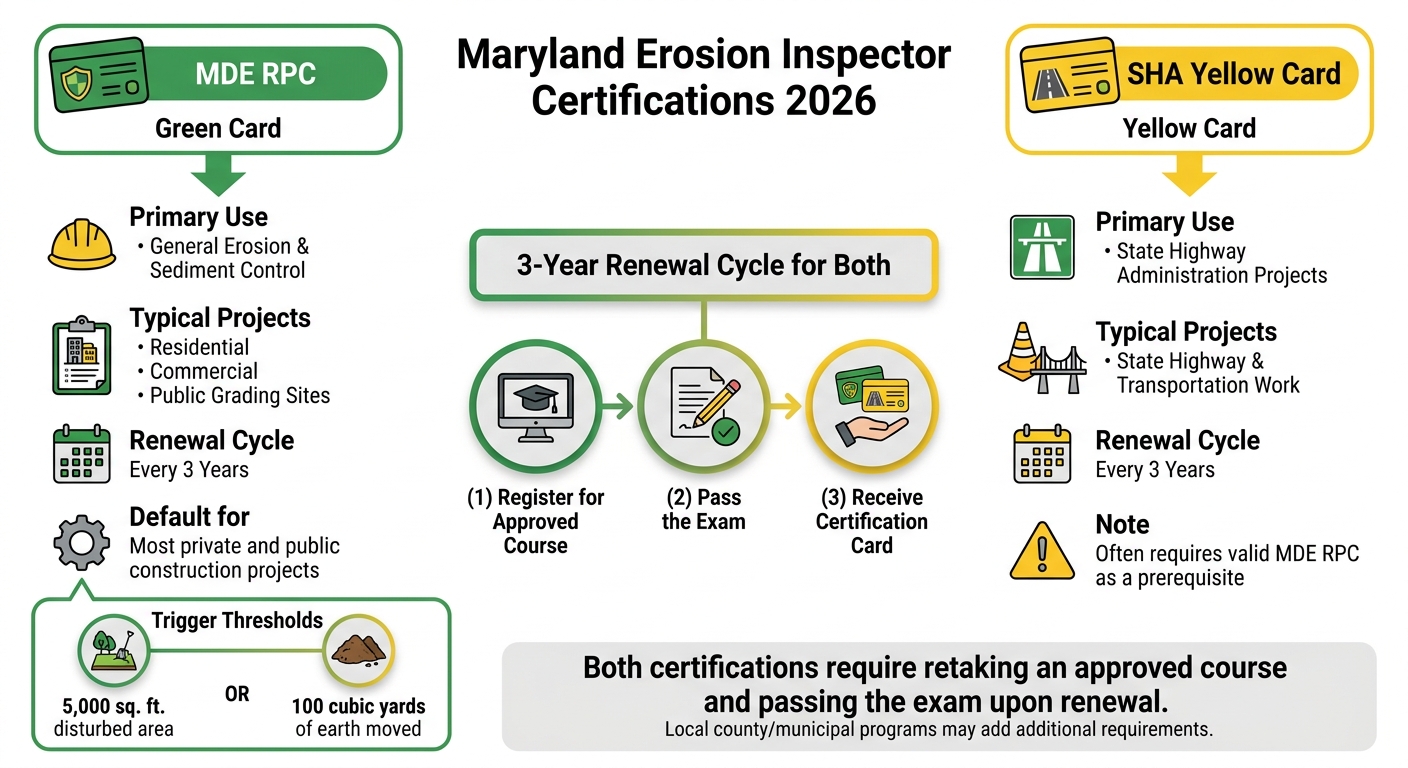
Maryland Erosion Inspector Certifications: MDE RPC vs SHA Yellow Card (2026)
2026 Designated Erosion Control Inspector 101 Webinar
Quick comparison
| Certification | Main use | Typical projects | Renewal |
|---|---|---|---|
| MDE RPC (Green Card) | General E&S duty | Residential, commercial, public grading sites | Every 3 years |
| SHA Yellow Card | SHA project duty | State highway and transportation work | Every 3 years |
To me, the core point is simple: this guide explains who needs training, which card fits the project, how renewal works, and what certified inspectors check in the field.
Maryland Rules That Shape Erosion Inspector Training
Maryland’s erosion and sediment control rules come from Environment Article Title 4, Subtitle 1 and COMAR 26. Section 4-104 sets the training requirement for responsible personnel on regulated projects.
State Agencies, Local Programs, and Delegated Enforcement Roles
The Maryland Department of the Environment (MDE) sets statewide erosion and sediment control standards. In practice, local governments often handle enforcement through county and municipal programs. That usually includes site inspections, correction notices, and follow-up on problems found in the field.
Project teams need to meet both state rules and local requirements. That matters because local programs also affect how inspectors are trained and how compliance records are kept.
When Inspections Are Required During Grading and Construction
During grading and construction, local programs inspect sites, document what they find, and require fixes when controls fail. Those rules also shape who needs training and which certification path applies.
sbb-itb-843f8be
Training Paths for Maryland Erosion Control Inspectors
Maryland uses two main training paths: MDE RPC for most regulated sites and agency-specific training for some public projects. Those inspection rules aren’t just paperwork. They depend on trained people in the field, so Maryland links compliance to set certification paths.
MDE Responsible Personnel Certification (RPC)
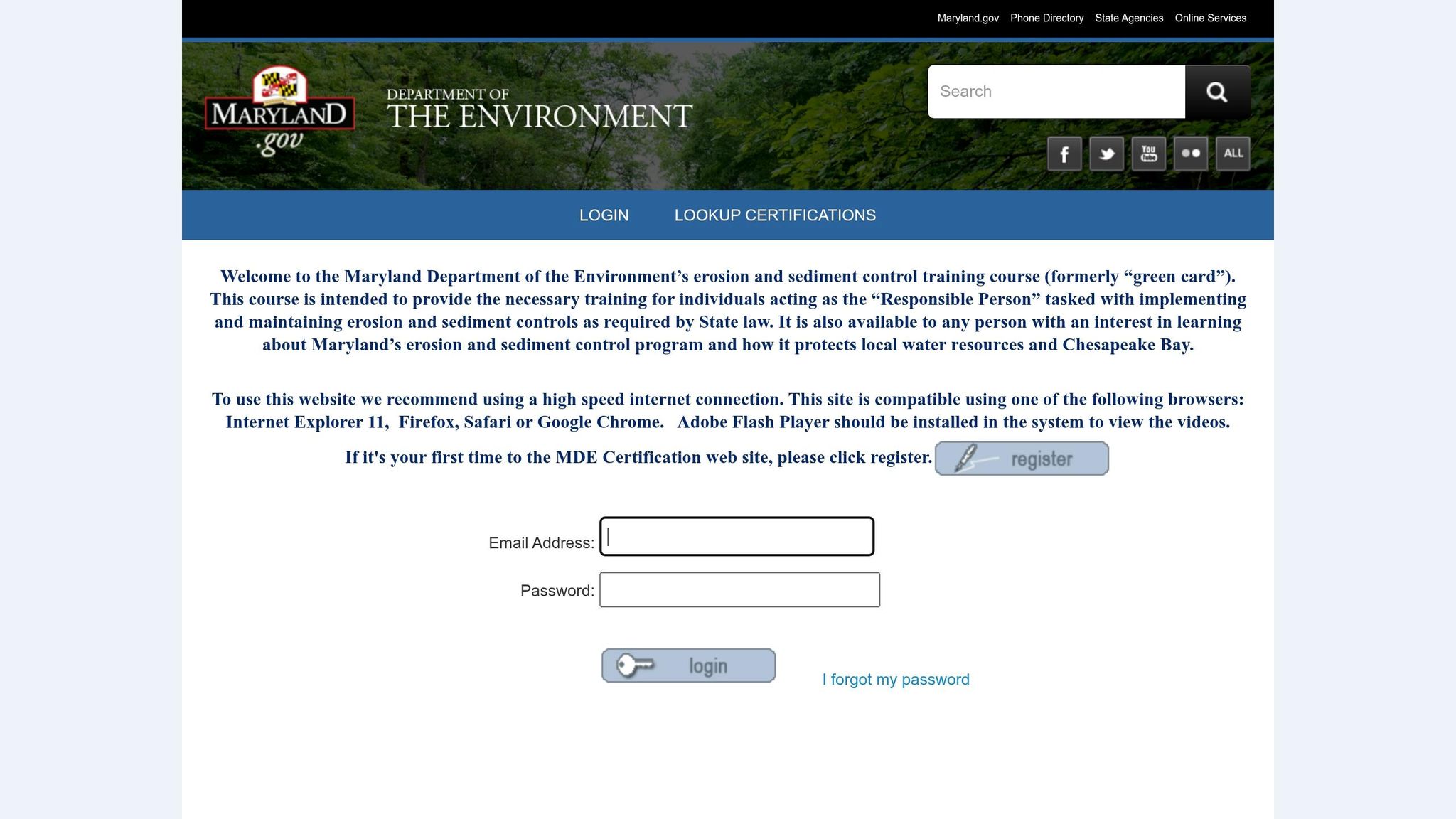
MDE’s Responsible Personnel Certification (RPC) is the statewide baseline for people who install, maintain, or inspect erosion and sediment controls on a regulated site.
RPC coursework centers on day-to-day compliance work, including Maryland law, approved erosion and sediment control plans, stabilization deadlines, and accurate field documentation. The goal is simple: help the people in charge of site controls understand what inspectors look for during field visits.
SHA Yellow Card and Other Specialized Training Programs
The SHA Erosion and Sediment Control Yellow Card is a certification for State Highway Administration highway and transportation projects. In most cases, a valid MDE RPC comes first, which makes the Yellow Card more of a state-project add-on than a separate statewide system.
On most residential and commercial jobs, RPC is still the default requirement.
Who Needs Training on Real Maryland Projects
Anyone directly responsible for E&S controls on a regulated site should expect to need RPC training. In plain English, if you’re the person expected to keep controls in place and working, you should be trained to spot problems before inspectors do.
How Certification, Renewal, and Field Inspection Work Together
Once the training path is clear, the next piece is how certification connects to field compliance.
Certification Steps: Training, Exam, and Card Issuance
RPC begins with registration in an approved course. After that, the person takes the exam and, if they pass, receives the card. Courses may be classroom-based or self-paced online. SHA training uses the same certification-and-exam setup for highway work. The RPC is often called the "Green Card."
But the card by itself doesn’t do the job. It matters when inspectors use that training on active job sites to check whether controls are in place and working as intended.
Renewal Timing and Three-Year Certification Cycles
RPC is valid for three years. Both RPC and SHA cards renew on a three-year cycle. To renew, the cardholder must retake an approved course and pass the exam again. If a credential lapses, it can disrupt inspection responsibility during active grading or construction.
What Trained Inspectors Do on Site to Support Compliance
This is where certification turns into day-to-day site work. On site, certified personnel verify controls, document deficiencies, and track corrections so the project stays compliant.
In practical terms, that means inspectors are out in the field checking installed controls, noting problems, and making sure fixes are recorded and followed through.
Key Takeaways for Maryland Projects in 2026
Now that the training paths and renewal rules are covered, the main points are pretty simple.
For Maryland projects in 2026, erosion inspector training comes down to two certifications: MDE RPC for most grading and construction work, and the SHA Yellow Card for State Highway Administration projects. Both follow a three-year renewal cycle.
Training applies to the person responsible for on-site erosion and sediment control. On top of that, local programs may add project-specific requirements.
Here’s the quick view:
| Certification | Primary Use | Valid For |
|---|---|---|
| MDE RPC | General grading and construction | 3 years |
| SHA Yellow Card | State highway projects | 3 years |
Why does this matter? Because current certification helps keep inspections and corrections moving without delays. If a certification lapses in the middle of a job, compliance can get messy fast.
For responsible personnel, these rules set the baseline for compliant grading and construction. Trained inspectors check controls, document corrections, and help keep the site compliant.
FAQs
Do I need the Green Card or Yellow Card?
You do not need a Green Card. That was the old name for the Maryland Department of the Environment’s Responsible Personnel Certification.
If you’re the designated Responsible Person on a construction or landscaping project in Maryland, you must complete the erosion and sediment control training course and pass the exam.
Who on a job site must be certified?
In Maryland, Responsible Personnel Certification (RPC) is required for supervisors on construction or landscaping jobs that involve land disturbance and need an approved erosion and sediment control plan.
That usually means foremen, superintendents, and project engineers who oversee clearing, grading, or sediment control on sites that disturb more than 5,000 square feet or move more than 100 cubic yards of earth.
What happens if my certification expires mid-project?
Maryland Responsible Personnel Certification stays valid for three years and, in most cases, renews automatically.
If the Maryland Department of the Environment (MDE) says you need extra training, it will send you a notice with the steps to follow and the deadline to meet.
Make sure your contact details on file with MDE stay up to date. If you miss required training, your certification status can change. And that can affect compliance with Maryland’s erosion and sediment control rules during the project.
Chat with Us