









- bhavya gada
- No Comments
If your project disturbs 5,000 square feet or moves 100 cubic yards of soil, I’d assume permit review may be in play. That same starting point shows up across Howard, Montgomery, Carroll, Frederick, Prince George’s, and Baltimore Counties, but the process changes fast after that.
Here’s the short version:
- Howard County: Soil district review first, then grading permit, then county inspections. Surety may apply.
- Montgomery County: DPS runs the process, fees can start at $815 or $1,910, and pre-start steps are strict.
- Carroll County: A size-based system. Many single-lot jobs use a standard plan from 5,000 to 30,000 sq. ft.
- Frederick County: Minor vs. major grading split at 30,000 sq. ft. or 500 cu. yds.
- Prince George’s County: Plan review can involve PGSCD, DPIE, and sometimes woodland review too.
- Baltimore County: Centralized permit path, standard plans for some smaller jobs, and strong inspection follow-up.
A few points matter most if you’re planning grading, a patio, drainage work, or a retaining wall:
- The same job can face a very different review path depending on the county.
- Some counties want soil district approval first.
- Some require financial security or bonding before permit release.
- Most counties require a pre-construction meeting, 48-hour notice, or both.
- Inspection timing differs, from about every 2 weeks to after major rain events.
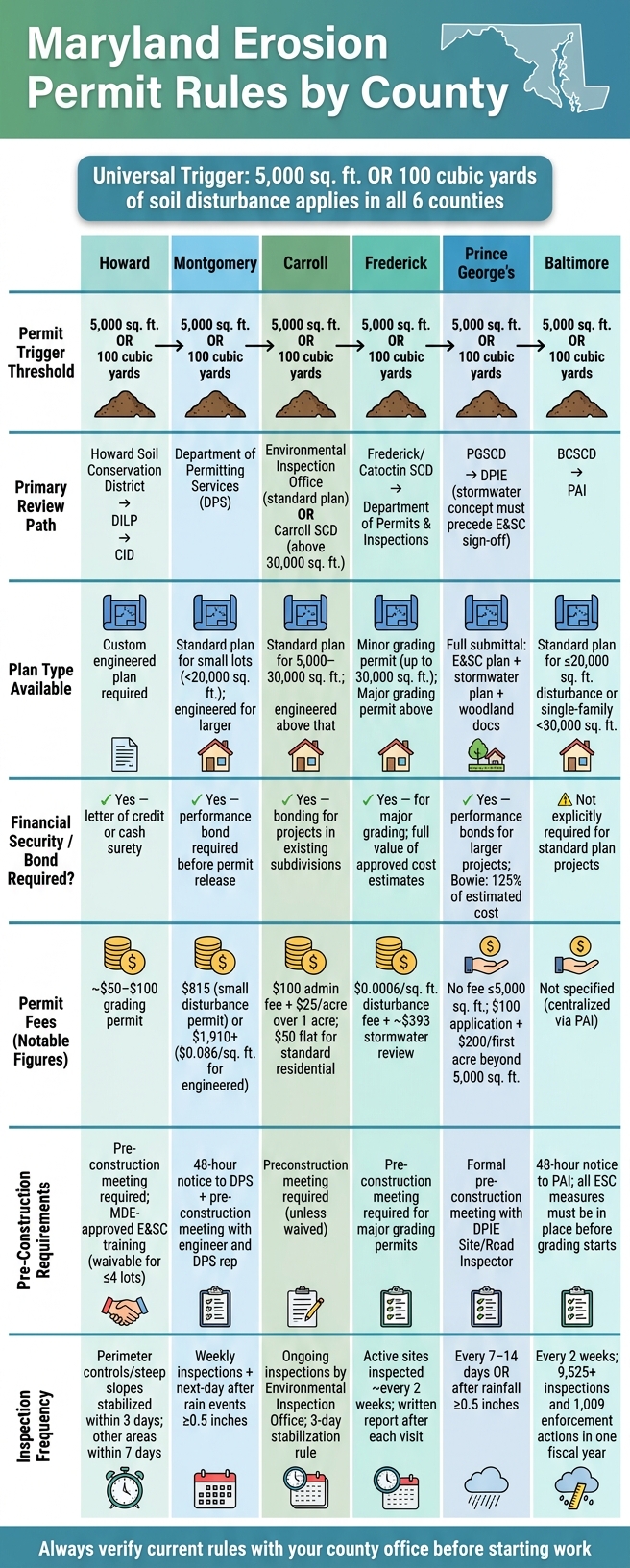
Maryland Erosion Permit Rules by County: Side-by-Side Comparison
Quick Comparison
| County | Main Trigger | Main Review Path | Common Extra Step |
|---|---|---|---|
| Howard | 5,000 sq. ft. / 100 cu. yds. | Soil district → DILP → CID | Surety + pre-construction meeting |
| Montgomery | 5,000 sq. ft. / 100 cu. yds. | DPS | Bond/security + 48-hour notice |
| Carroll | 5,000 sq. ft. / 100 cu. yds. | County review or soil district by size | Stormwater review at 5,000 sq. ft. |
| Frederick | 5,000 sq. ft. / 100 cu. yds. | SCD → Permits & Inspections | Minor/major grading split |
| Prince George’s | 5,000 sq. ft. / 100 cu. yds. | Stormwater concept + PGSCD + DPIE | Rain-event inspections |
| Baltimore | Over 5,000 sq. ft. / 100 cu. yds. | BCSCD → PAI | 48-hour notice + strong enforcement |
Bottom line: I’d treat the 5,000-square-foot / 100-cubic-yard mark as the first checkpoint, not the full answer. You still need to check the county’s office, plan type, fees, bonding, and inspection rules before work starts.
sbb-itb-843f8be
1. Howard County
Permit trigger thresholds
Projects that stay under both of these limits – 5,000 square feet of land disturbance and 100 cubic yards of earth moved – may qualify for an exemption.[17] That sounds simple on paper, but many common home projects can cross the line fast. A large patio, a retaining wall, or major regrading often trips at least one of those limits.
Review offices and approvals
In Howard County, three offices are part of the process: the Howard Soil Conservation District, the Department of Inspections, Licenses and Permits (DILP), and the Construction Inspection Division (CID).[5][14]
Once a project crosses the threshold, the county uses a two-step review path. First, the Soil Conservation District must approve the erosion and sediment control plan. Then the homeowner applies for a grading permit through DILP.[5][14] During construction, CID handles field inspections, and DILP accepts electronic submissions for both residential and commercial permits.[8][19]
Forms, plans, and surety
The plan needs to show the full limit of disturbance (LOD), which is the area where soil will be cleared, graded, or filled.[13][15] It also has to include temporary sediment controls and a permanent stabilization plan.[13][15]
The grading permit itself is often estimated at $50 to $100.[2] Howard County also requires financial surety – either a letter of credit or cash – to guarantee soil stabilization and the installation, maintenance, and removal of erosion and sediment controls.[2]
Inspections and pre-construction steps
Before any work starts, the owner must certify compliance with the approved plan.[5][18] The county also requires responsible personnel to complete MDE-approved erosion and sediment control training, though that training can be waived for projects involving four or fewer residential lots.[5][18]
CID requires a pre-construction meeting before work begins.[8][21] During construction, perimeter controls and slopes steeper than 3:1 must be stabilized within three calendar days of disturbance. All other disturbed areas must be stabilized within seven days.[16] If work starts too early, the county can issue stop-work orders or take other enforcement action.
Montgomery County follows a different review path, with its own submission and inspection sequence.
2. Montgomery County
Permit trigger thresholds
Montgomery County uses a tiered system based on how much land you disturb. For new homes and additions, you need an engineered sediment control permit once the disturbed area hits 5,000 square feet or more.[6][9]
If you’re working on a single-family lot under 20,000 square feet, you may be able to use a Small Land Disturbance Activity Permit.[24] And for smaller jobs, the county may allow a standard erosion and sediment control plan. That option can apply to minor residential grading, a single-family home, or small utility work.[7]
Once you know the disturbed area, the next move is simple: figure out whether your project goes through DPS or a municipal review path.
Review offices and approvals
The Montgomery County Department of Permitting Services (DPS), Land Development Division, handles residential sediment control permits.[26]
There are a few city-level exceptions. New homes in Gaithersburg and Rockville are reviewed by the municipality. In Takoma Park, DPS issues the sediment control permit, while the city reviews stormwater management.[6]
Forms, plans, and surety
For an engineered single-family lot permit, homeowners submit through the county’s ePlans system.[25]
A typical package includes:
- An engineered sediment control plan showing existing and proposed grading, limits of disturbance, and erosion control measures[25]
- A stormwater management report and computations[25]
- A cost estimate[25]
- Proof of property ownership[25]
The county also requires financial security, such as a bond or surety, before it issues the permit. That surety is released only after the final inspection confirms the site is stabilized.[6][27]
Fees depend on the permit type. A Small Land Disturbance Activity Permit costs $815. Engineered permits start at $1,910, with $0.086 per square foot added for some projects.[24] For single-family lots, plan reviews usually take about 2 to 3 weeks from submission.[6]
Inspections and pre-construction steps
Once the permit is approved, Montgomery County moves into a tight pre-construction and inspection process. Before any work starts, the permit holder must notify DPS at least 48 hours in advance and hold a pre-construction meeting with the engineer and a DPS representative.[26]
Bring the approved plans to the site. If those plans are missing, construction gets delayed.[23]
During construction, weekly inspections must be documented, along with next-day inspections after rain events. Those records should cover weather, site status, discharges, and any missing controls.[28] After that, a final inspection closes out the permit and starts the bond release process.[6]
3. Carroll County
Permit trigger thresholds
Carroll County uses a pretty clear size-based system for residential work. The main trigger is 5,000 square feet of disturbance.[35] If a project stays below that mark – and involves less than 100 cubic yards of cut or fill – it’s usually exempt from formal review.[9]
| Disturbed area | Required plan |
|---|---|
| Under 5,000 sq. ft. / under 100 cu. yds. | Usually exempt from formal review |
| 5,000–30,000 sq. ft. | Standard Erosion and Sediment Control Plan |
| Over 30,000 sq. ft. or 500 cu. yds. | Carroll Soil Conservation District-approved sediment control plan |
Once a residential project goes over 5,000 square feet, it also triggers stormwater review.[34]
If disturbance goes above 30,000 square feet – or 500 cubic yards – the county requires a Carroll Soil Conservation District-approved sediment control plan.[32][35] For more routine single-lot residential jobs, the county uses the Standard Erosion and Sediment Control Plan instead of a full engineered submittal.[32][33] That standard plan applies to work like:
- New homes
- Additions
- Driveways
- Yard regrading
This applies when the project is not part of a larger multi-lot development by the same owner or builder.[32][33]
Carroll’s setup is more modular than the counties discussed earlier. As the disturbed area gets bigger, the plan type changes with it.
Compared with Howard and Montgomery, Carroll’s process is easier to sort out because the review path follows clear size tiers.
Review offices and approvals
The Resource Management Division’s Environmental Inspection Office handles residential erosion permit review and works with Planning and Land Management and the Carroll Soil Conservation District under Chapter 152.[30][38] County forms and applications are available through the Environmental Inspection Office and the county’s Permits/Forms page.[30][37] The office is located at 225 North Center Street, Westminster, MD 21157.[44]
For projects that qualify for the standard plan, county staff review the submission directly. If disturbance exceeds 30,000 square feet, the Carroll Soil Conservation District must approve the sediment control plan before the county can issue the grading permit.[32][35]
Forms, plans, and surety
The Environmental Inspection Office leads this part of the process. A submission must include a plot plan that shows the limit of disturbance, drainage areas, and hydrologic soil groups, along with impervious area and Environmental Site Design volume calculations.[31][34][40]
If the project includes a detailed stormwater system, the package also needs stormwater design computations and construction drawings.[31][34][40]
Some single-lot residential projects can use the Standard Stormwater Management Plan for Single Lot Residential Construction.[36][39] That option is available when the project is not contiguous with other development by the same builder, the impervious cover is typically 15% or less of the lot, and the disturbed area is under 20,000 square feet.[36][39]
If a project doesn’t fit those limits, the county requires site-specific engineered erosion, sediment control, and stormwater plans with full calculations and drawings.[32][34][40] For projects in existing subdivisions, the applicant must reference the subdivision’s approved stormwater plan and get bonding forms from the Bureau of Resource Management.[34]
Permit fees include a $100 administrative fee for a land-disturbing permit, plus $25 per acre for land over one acre. Single-family residence agreements in lieu of a plan carry a flat $50 fee.[42]
Inspections and pre-construction steps
Before any work begins, the applicant must notify the Bureau of Resource Management – Environmental Inspection Services Division and attend a preconstruction meeting, unless the county waives that step.[41]
After that, the Environmental Inspection Office handles sediment control, stormwater, and final grading inspections.[38] Inspectors check whether erosion controls are installed the right way, whether slopes stay within permitted limits, and whether stormwater practices match the approved plan.[33][38]
There’s also a tight stabilization rule here: perimeter controls and slopes steeper than 3:1 must be stabilized within three calendar days of initial disturbance.[33]
The owner/contractor affidavit signed when the permit is issued gives county staff permission to enter the property for inspection.[45] Once construction is done, the design engineer must submit certified as-built plans. The county releases any bond only after confirming that the facilities are working as approved.[34]
Frederick County uses a different review structure, with its own permit trigger and approval path.
4. Frederick County
Permit trigger thresholds
Frederick County uses a three-tier permit setup based on how much land a project disturbs. If clearing or grading stays under 5,000 sq. ft. and under 100 cu. yds., the work is exempt from grading and erosion permit requirements.[56][54] Go over either limit, and a permit is required.
| Disturbance level | Permit type |
|---|---|
| Under 5,000 sq. ft. and under 100 cu. yds. | Exempt |
| Over 5,000 sq. ft. or 100 cu. yds. (up to 30,000 sq. ft. / 500 cu. yds.) | Minor grading permit |
| Over 30,000 sq. ft. or 500 cu. yds. | Major grading permit |
Stormwater review starts at 5,000 sq. ft. too. That can mean a separate stormwater management permit, along with a review fee of about $393.[50]
Review offices and approvals
Frederick County works through two Soil Conservation Districts: the Frederick SCD and the Catoctin SCD. These offices approve erosion and sediment control plans.[48][53] After that, the Frederick County Department of Permits and Inspections can issue grading and building permits.[46][54] Stormwater review goes through Environmental Compliance & Stormwater Engineering, which also decides whether a Standard Plan Agreement can be used.[51]
That sequence matters because it shapes the full submission package.
Forms, plans, and surety
For a minor grading permit, applicants file through the county’s online Application Portal. The submittal must include a plot plan that shows the limit of disturbance, existing impervious areas, contours, and other site details.[47] The disturbance fee is $0.0006 per square foot.[47]
A major grading permit takes more paperwork. Applicants must provide a cost estimate for sediment and erosion control and, when structural stormwater practices are part of the job, a separate stormwater management cost estimate.[52] The county sets the financial guarantee at the full value of the approved cost estimates. The original performance agreement must also be signed and notarized before agency review and permit issuance.[52][54]
Some smaller residential lots can use a Residential Stand-Alone Lot Standard Plan Agreement instead of full custom stormwater engineering. To qualify, the project must stay under 30,000 sq. ft. of disturbance, under 15% impervious cover, and clear of sensitive features.[51] Approved erosion and sediment control plans remain valid for two years. Grading permits last one year, and renewal requests tied to surety must be filed at least 60 days before expiration.[48][54]
Inspections and pre-construction steps
After permit issuance, the process moves into field oversight and pre-construction coordination. Major grading permits require a pre-construction meeting with county staff before any earthwork starts.[52] From there, the construction sequence moves from perimeter control installation to final grading and stabilization, and county staff must approve the site before sediment controls can be removed.[12]
County staff inspect active approved sites about every two weeks and issue a written report after each visit.[12] Final stormwater approval, including ESD as-built plan sign-off, is required before use and occupancy.[51]
Prince George’s County uses a different approval setup, especially for residential grading and stormwater review.
5. Prince George’s County
Permit trigger thresholds
Prince George’s County requires a grading permit once land disturbance goes over 5,000 sq. ft. or 100 cubic yards. And if a project tops 5,000 sq. ft., it also needs a PGSCD-approved E&SC plan before the permit can be issued.[11][68]
Smaller jobs aren’t always off the hook. They may still need sediment controls, though they often fit under simplified or model plans.[49][9]
That matters for homeowners because pretty standard residential work can cross those limits fast.[10]
Review offices and approvals
The review path in Prince George’s County has a few moving parts. PGSCD approves the E&SC plan first. After that, DPIE issues the grading permit and handles stormwater review and inspection enforcement.[11][61][62] Compared with the counties above, Prince George’s uses a more layered approval sequence.
If the work touches woodland areas, M–NCPPC may also need to approve a tree conservation or woodland conservation plan before DPIE releases permits.[57] And in Bowie, the City adds one more step: it requires its own sediment control permit, backed by a PGSCD-approved plan and the County grading permit.[63]
Forms, plans, and surety
A full submittal includes:
- The grading permit application
- A PGSCD-standard E&SC plan
- A stormwater plan
- Any needed woodland conservation documents[57][61]
There is one catch here: DPIE must approve the stormwater management concept before PGSCD will sign off on the E&SC plan. So those two reviews need to move together, not one after the other.[60]
For larger grading or stormwater work, the County may require performance bonds tied to the estimated cost of installing and maintaining E&SC and stormwater measures.[11] In Bowie, the bond is set at 125% of the total estimated cost of erosion and sediment control construction and maintenance.[63]
PGSCD’s fee setup is pretty direct. There is no plan review fee for disturbance of 5,000 sq. ft. or less. For larger projects, the charge is a $100.00 initial application fee plus a $200.00 certification fee for the first acre, or portion of an acre, beyond 5,000 sq. ft.[66]
Inspections and pre-construction steps
Before any clearing or grading begins, the applicant must hold a pre-construction meeting with the DPIE Site/Road Inspector. The first inspection checks that sediment controls are already in place.[57][58][59]
After that, routine inspections take place at least every 7–14 days or after any rainfall event of 0.5 inches or more.[64]
A few field rules are easy to miss but matter a lot:
- Keep the PGSCD-approved, green-stamped E&SC plan on-site at all times
- Stabilize disturbed areas that are not actively being worked within seven days[64][65][67]
The process ends with a final inspection. Use and occupancy can’t be issued until all grading and stormwater requirements have been fully met.[11]
Baltimore County follows a different review path, with its own office structure and inspection sequence.
6. Baltimore County
Baltimore County uses the same state trigger thresholds, but the review process is more centralized.
Permit trigger thresholds
In most cases, Baltimore County requires a grading permit when work disturbs more than 5,000 sq. ft. or 100 cubic yards. That often covers projects like patios, retaining walls, drainage work, and site grading.
Smaller jobs can still need review if they fall in protected areas. That includes watercourses, floodplains, wetlands, buffers, habitat protection areas, forest buffer areas, historic districts, and the Chesapeake Bay Critical Area.[4][1][49] County code also bars changes to the natural ground level that redirect surface water onto a neighboring property without a valid grading permit.[3][73]
Once a project crosses the threshold, review shifts from the soil district to PAI.
Review offices and approvals
The Baltimore County Soil Conservation District (BCSCD) reviews and approves the erosion and sediment control plan first. Then PAI issues the permit and manages inspections.[4][1][69]
Forms and plans
For smaller residential projects, Baltimore County lets applicants use a Sediment and Erosion Control Standard Plan instead of custom engineering. This standard plan can be used when land disturbance is ≤20,000 sq. ft. and cut/fill is ≤1,000 cubic yards. For individual single-family dwellings, it may be used when the limit of disturbance stays under 30,000 sq. ft.[71][72]
There’s an important catch: every control measure has to be installed exactly as shown before grading starts.[71]
Inspections and pre-construction steps
If you’re using the Standard Plan, you must notify PAI Sediment Control at least 48 hours before work begins. Before that start date, all ESC measures must already be in place, except for the ones being installed during that phase of work.[71]
That pre-construction notice is part of PAI’s inspection process. It gives the county a chance to verify site conditions before earthwork starts. After that, active sites are inspected every two weeks.[70] Approved grading and ESC plans must remain on-site, and inspectors must be given access to the property.[3][73]
Baltimore County also enforces these rules closely. In one recent fiscal year, inspectors completed 9,525+ inspections and issued 1,009 enforcement actions, including 743 correction notices and 266 stop-work orders.[70]
How County Permit Processes Differ
Maryland uses the same baseline trigger across these counties. But the process after that? It can feel like six different playbooks.
What changes from county to county is the review path, the type of plan you can submit, whether you need a bond, and when work can begin. In plain English: two jobs that look almost the same on paper can move at very different speeds depending on where the property sits.
The table below compares trigger thresholds, review offices, plan types, and inspection steps.
| County | Typical Permit Trigger | Primary Review Office(s) | Plan Type / Notable Requirements | Pre-Construction / Inspection Step |
|---|---|---|---|---|
| Howard County | 5,000 sq. ft. or 100 cubic yards | Howard Soil Conservation District first; DILP grading permit second; CID handles inspections[20][75] | Grading approval integrated with site development review; financial surety required[75] | Pre-construction meeting required; perimeter controls and steep slopes stabilized within three calendar days[8][21] |
| Montgomery County | 5,000 sq. ft. disturbed or 100 cubic yards or more[6][74] | Department of Permitting Services (DPS)[6] | Engineered plans for new homes and larger additions; performance bond or financial security required[13][76] | Pre-construction coordination with DPS; staged inspections through final stabilization[6] |
| Carroll County | 5,000 sq. ft. or 100 cubic yards[35] | Environmental Inspection Office review; standard plan for smaller jobs; Soil Conservation District approval above 30,000 sq. ft. or 500 cubic yards[32][35] | Standard Erosion and Sediment Control Plan for routine single-lot residential work; engineered plans required above thresholds[32][33] | Preconstruction meeting required unless waived; perimeter controls stabilized within three calendar days[41] |
| Frederick County | 5,000 sq. ft. or 100 cubic yards; minor and major grading split at 30,000 sq. ft. or 500 cubic yards[56][54] | Frederick or Catoctin Soil Conservation District approval before grading permit; Department of Permits and Inspections issues permit[48][53] | Minor grading permit for smaller projects; major grading permit requires cost estimates and notarized performance agreement[52][54] | Major grading permits require pre-construction meeting; county staff inspect active sites approximately every two weeks[12][52] |
| Prince George’s County | 5,000 sq. ft. or 100 cubic yards; multiple approvals required[11][68] | PGSCD plan approval first; DPIE grading permit second; stormwater concept approval must come before E&SC sign-off[60][61][62] | Full submittal includes E&SC plan, stormwater plan, and woodland conservation documents where applicable[57][61] | Formal pre-construction meeting with DPIE Site/Road Inspector; routine inspections every 7–14 days or after 0.5-inch rainfall[57][58][64] |
| Baltimore County | More than 5,000 sq. ft. or 100 cubic yards, plus work in watercourses, floodplains, wetlands, buffers, habitat protection areas, or forest buffers[4][1] | BCSCD plan approval first; PAI issues the permit and runs inspections[4][1] | Standard plans allowed for smaller residential sites: ≤20,000 sq. ft. disturbance or single-family lots under 30,000 sq. ft.[71][72] | ESC measures must be in place before grading begins; 48-hour notice to PAI required; active sites inspected every two weeks[70][71] |
For most homeowners, small patios and short walls often stay under the review threshold. Once the job shifts into regrading, driveways, drains, or retaining walls, though, the permit risk goes up fast.
A few county-specific details stand out right away:
- Montgomery County requires financial security as part of the permit application.[13][76]
- Frederick County splits jobs into minor and major grading, and Soil Conservation District review can take up to 30 working days.[10]
That’s the stuff that separates the simpler counties from the tougher ones. Same state trigger, different level of friction.
These county-by-county changes shape cost, timing, and paperwork, which is why the next section looks at the tradeoffs by county.
Pros and Cons by County
Once a project crosses the 5,000 sq. ft. / 100 cubic yard mark, county rules start to feel very different from one place to the next. On paper, the threshold is the same. In practice, the day-to-day experience can change a lot based on the plan path, the order of review, permit costs, and how closely the county watches the job site.
For homeowners, that means the issue usually isn’t just whether approval is needed. It’s how much paperwork, waiting, and site oversight comes with it.
| County | Pros | Cons |
|---|---|---|
| Howard County | Clear published prerequisites. The county requires an approved E&SC plan before the grading permit, so the sequence is easier to follow.[2][22] | Surety items, such as a letter of credit or cash, add another admin step. Stormwater maintenance agreements may also apply.[2][22] |
| Montgomery County | ePlans submission and a published permit checklist help spell out the process. Pre-construction and inspection steps are also defined, and single-family projects use a set ePlans path.[6][26][25] | The permit setup is more layered. Certain permits have a minimum fee of $1,910 plus $0.086 per sq. ft. of disturbed area, and a performance bond may be required.[24][27][29] |
| Carroll County | A standard plan is available for disturbances from 5,000 to 30,000 sq. ft., which can cut down on engineering work for many single-lot jobs.[30][33][32] | Approved plans stay valid for only 2 years. If a project stalls, resubmittal may be needed, and notice and inspection steps still apply.[41][43] |
| Frederick County | A standard plan is available for minor earth disturbances, including single-family residences.[12][55] | County approval still has to come before any work starts.[12][55] |
| Prince George’s County | The review sequence is clearly laid out, so it’s easier to see what must be approved before work begins.[57][61] | E&SC, stormwater, and in some cases woodland approvals may all be required. That adds paperwork and can slow the start date.[10][11][57] |
| Baltimore County | Review is centralized through PAI, and standard plans are available for smaller residential sites.[4][1][71][72] | Pre-start notice rules are strict, inspections are frequent, and enforcement is strong.[70][71] |
The pattern is pretty simple: some counties make the process easier to predict, while others make it easier to spend more time and money before a shovel hits the ground.
Conclusion
This county-by-county comparison points to one simple takeaway: the trigger may look similar, but the process can change a lot from one county to the next.
All six counties operate under Maryland’s statewide erosion and sediment control rules. But once you get into the details, each county has its own trigger points, review process, and inspection steps.
Before you start any project, check the local rules first. Verify the trigger threshold, approval path, required submittals, and any pre-start notice or inspection steps before work begins.
For grading, drainage, patios, retaining walls, and other land-disturbing projects, Pro Landscapes MD offers landscaping, hardscaping, drainage, stormwater management, grading, and retaining wall services across central Maryland. That local know-how can help keep a project moving.
FAQs
How do I calculate disturbed area?
Measure the total land area that will be exposed, cleared, graded, or filled during the project. That means every square foot where the existing ground surface will change.
In many Maryland counties, permits are triggered at 5,000 square feet or when more than 100 cubic yards of material are moved. Always confirm county-specific boundary rules, especially for sensitive areas.
Which county office do I contact first?
It depends on the county, because permit rules vary across central Maryland.
- Howard County: Department of Inspections, Licenses, and Permits
- Prince George’s County: Prince George’s Soil Conservation District
- Harford County: Bonding and Permit Administration
Check the right reviewing agency for your project site before work starts.
What permits might I need besides erosion control?
Besides an erosion control permit, you may also need stormwater management approval. For many larger projects, that means sending in a stormwater plan along with your sediment and erosion control measures.
In Howard County, land clearing or grading often calls for a grading permit. You may also need an approved stormwater plan and related agreements for private systems. In Baltimore County, grading permits can apply based on how much land you disturb or how much soil you move, especially near sensitive areas.
Chat with Us