









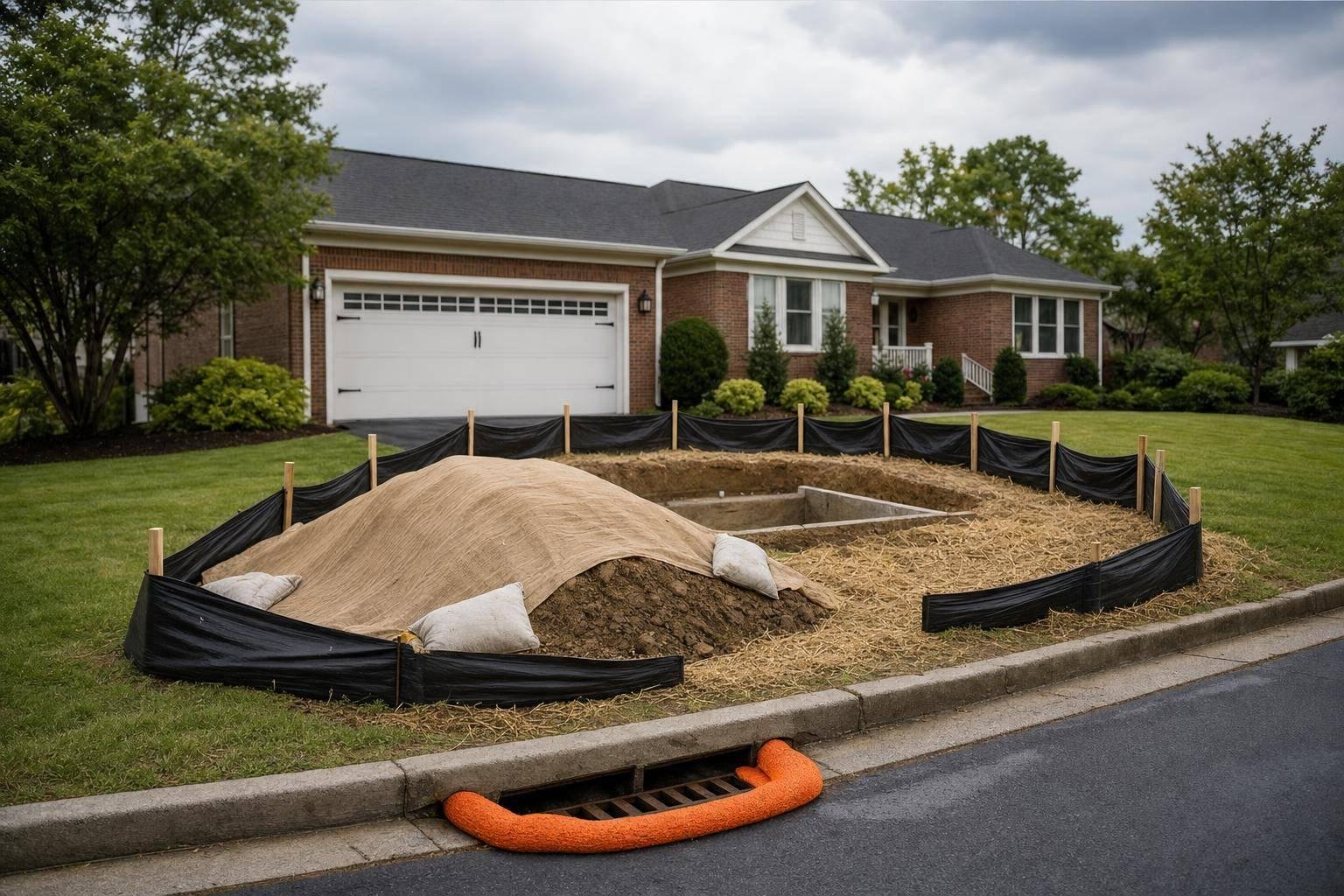
- bhavya gada
- No Comments
If your project disturbs 5,000 square feet or more, or moves 100 cubic yards or more of soil, you may need an approved E&S plan before work starts. If not, you still need to keep soil on your lot, protect storm drains, and stabilize bare ground within 3 or 7 days, depending on the area.
Here’s the short version:
- E&S means erosion and sediment control. It’s about stopping soil from washing into streets, drains, streams, and nearby properties.
- Common home projects can trigger review. Patios, driveways, retaining walls, grading, drainage work, and big landscaping jobs are common examples.
- The homeowner often remains responsible. A contractor may file papers and install controls, but the permit is often tied to the property owner.
- Inspections don’t stop after approval. Sites are checked before grading, during work, after storms, and at closeout.
- Storm checks matter. On some jobs, inspections are required every 7 days and within 24 hours after a storm of 0.5 inches or more.
- Controls stay up until the site is stable. You usually can’t remove silt fence or inlet protection just because construction is done.
- Final stabilization means the soil is covered for good. That may be sod, established grass, plantings, stone, pavers, or concrete.
| Topic | What you should know |
|---|---|
| Plan threshold | 5,000 sq. ft. disturbed or 100 cu. yd. moved |
| Fast stabilization | 3 days for perimeter areas, ditches, swales, and steep slopes |
| Other disturbed areas | 7 days if not under active grading |
| Storm follow-up | Check after rain; some sites need review within 24 hours after 0.5 in. storms |
| Closeout | Keep controls in place until disturbed soil is permanently stabilized and removal is approved |
I’d treat this as a simple rule: if you expose soil, change drainage, or move a lot of dirt, check county rules before the first shovel hits the ground.
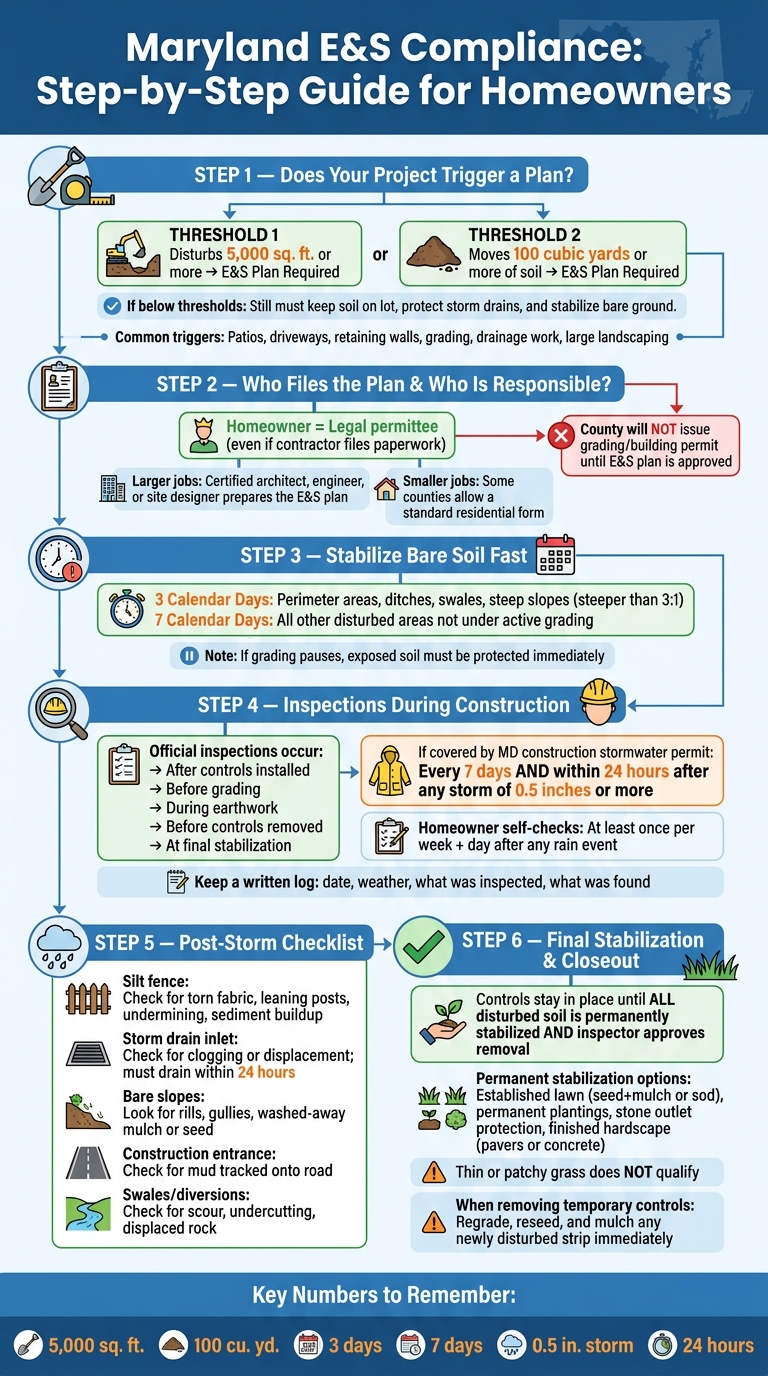
Maryland E&S Compliance: Step-by-Step Guide for Homeowners
Plans and permits: who files and who is responsible
Once a project crosses the review threshold, the next step is figuring out who draws the plan and who carries the permit.
When a plan is required for home projects
A plan may be needed for additions, patios, driveways, retaining walls, drainage changes, and yard regrading. Even smaller jobs can trigger review if they change how water drains off your property. County rules differ, so check with the county permitting office or local Soil Conservation District before work starts.
Who prepares and submits the plan
For larger residential jobs, a certified architect, engineer, or site designer usually prepares the E&S plan and includes it with the permit application. Some counties let homeowners use a standard residential form for smaller jobs.[9][12][10][16]
The homeowner is usually the legal permittee, even if a contractor handles the paperwork and installs the controls.[11][9] In plain English: the contractor may do the legwork, but the permit usually still sits in the owner’s name.
The county also usually will not issue the grading or building permit until the approved E&S plan is on file.[14][13]
Responsibility table: homeowner, contractor, county, and MDE

| Task | Homeowner | Contractor | County Permitting Office | Soil Conservation District or delegated local office; MDE sets statewide standards |
|---|---|---|---|---|
| Plan preparation | Uses the standard form or hires a professional for larger jobs | Prepares detailed plans for larger or more complex jobs | – | SCD or a delegated local office reviews the plan; MDE sets statewide standards |
| Plan submission & permit application | Submits or authorizes submission | Often files on the owner’s behalf | Receives and processes the application | – |
| Permit approval | – | – | Issues permits after the E&S plan is approved | Approves the technical plan |
| Permit display at site | Makes sure the permit is posted at the site entrance | – | May check posting during inspection | – |
| E&S control installation | Ensures controls are in place before disturbance starts | Installs controls per the approved plan | – | – |
| Day-to-day maintenance | Checks for damage and repairs controls during work | Maintains and repairs controls during work | May inspect or coordinate follow-up | – |
| Final sign-off | Keeps the site stabilized until closeout is approved | Completes final stabilization work | Confirms the site meets closeout requirements | – |
In most counties, the permitting office and the technical reviewer are not the same office. The county handles the permit, while the Soil Conservation District or a delegated local office reviews the E&S plan. MDE sets statewide standards and oversees delegation.
After approval, the site still needs inspections and storm checks while work is underway.
sbb-itb-843f8be
Inspections and storm response during the job
After the plan is approved, E&S compliance comes down to active upkeep and routine inspection. Once permits are issued, the work shifts from planning to making sure the controls keep doing their job through construction.
Who inspects E&S controls and when
Most residential E&S inspections are handled by county or municipal staff, not MDE [19][23]. As a condition of your grading or building permit, the inspection agency can enter the property from time to time to inspect the site [5].
Official inspections usually take place after controls are installed, before grading starts, during earthwork, before controls are removed, and at final stabilization [7][22]. If the site is covered by Maryland’s construction stormwater permit, inspections must also happen every 7 days and within 24 hours after any storm that drops 0.5 inches or more of rain [20].
Those official visits don’t replace your own checks between inspections. Maryland guidance expects site checks at least once a week and again the day after any rain event [8][27]. A simple written log is enough. Note the date, weather, what you inspected, and what you found.
What to check after heavy rain
Inspect the site after heavy rain. Start at the perimeter controls, especially the silt fence. Check for torn fabric, leaning posts, undermining, and sediment buildup. If the fence has failed, remove the trapped sediment and repair or replace the damaged section.
Next, look at storm drain inlet protection. If it’s clogged, out of place, or still not draining within 24 hours after the storm, clean it or replace it [26][27]. Then walk the bare slopes and disturbed areas. Look for rills, small gullies, and spots where mulch or seed washed away. Also check the construction entrance for mud tracked onto the road [24][25].
Post-storm action table for residential sites
| Control to inspect | Common storm-related failure | Corrective action |
|---|---|---|
| Silt fence | Torn fabric, undermining, leaning posts, or sediment buildup | Repair or replace fabric, re-anchor posts, remove accumulated sediment |
| Storm drain inlet protection | Clogging or displacement by flow; poor drainage | Remove sediment after each storm; clean or replace fabric or stone if drainage is blocked |
| Bare slopes and disturbed soil | Rills, gullies, or washed-away mulch and seed | Regrade, reseed, and apply fresh mulch or erosion control blankets |
| Construction entrance | Mud tracking onto public road or driveway | Remove tracked sediment promptly; add or refresh stone at the entrance |
| Swales and diversions | Scour, undercutting, or displaced rock | Restore grade, replace rock, and redirect concentrated flow back toward controls |
Make fixes promptly. Write down what you found, what you repaired, the date, and the estimated rainfall [18]. Keep that log available for county review.
How long controls stay in place and what final stabilization means
Once storm repairs are done, the next step is figuring out how long the controls need to stay put. A lot of people want to pull the silt fence as soon as the main construction work ends and move on. That’s usually where trouble starts. Temporary E&S controls must remain in place until all disturbed soil is permanently stabilized.[2][29][1]
When temporary controls can be removed
Maryland requires prompt stabilization during the job, not just at the very end. Perimeter controls, dikes, swales, ditches, perimeter slopes, and slopes steeper than 3-to-1 must be stabilized within 3 calendar days of disturbance.[2][28][29][30] All other disturbed areas that are not under active grading must be stabilized within 7 calendar days.[2][31][32][29][6][21][35]
That means if grading stops for a bit, exposed soil can’t just sit there. It needs protection fast. Silt fence, inlet protection, and similar barriers should stay in place until the areas draining to them have permanent stabilization installed and the inspector approves removal.[33][7][36]
What final stabilization looks like on a home site
Final stabilization means the earthwork is done and all exposed soil has a stable, long-term surface that prevents erosion.[2][15][4][6][1] On a typical Maryland home site, that often means:
- An established lawn from seed and mulch or sod
- Permanent plantings
- Stone outlet protection
- Finished hardscape like pavers or concrete
Permanent stabilization means the site is finished and covered by established vegetation or another long-term erosion-resistant surface. Put simply, a thin, patchy lawn doesn’t cut it. The vegetation needs to be established and actually holding the soil in place.
Temporary vs. permanent stabilization table
| Measure | Typical use on a home site | Temporary or permanent |
|---|---|---|
| Straw or wood mulch | Cover newly graded soil; protect seed on slopes and flat areas | Temporary (can be part of permanent bed cover depending on design) |
| Temporary seeding | Fast-germinating grasses applied quickly to meet 3- and 7-day requirements | Temporary; replaced by permanent turf or landscaping |
| Sod | Instant lawn cover on disturbed areas, especially around the house | Permanent once rooted; also satisfies 3- and 7-day standards |
| Erosion control matting | Protects bare slopes and channels while vegetation establishes | Temporary until vegetation is established; supports permanent vegetation and may remain as part of the final protection |
| Riprap or stone protection | At downspouts, outlets, or in dry swales | Permanent structural stabilization for long-term stormwater control |
| Completed pavement or pavers | Driveways, patios, walkways | Permanent hard surface covering soil |
Removal work can create new bare soil, so closeout still needs one last stabilization pass. When temporary controls come out, regrade, seed, and mulch any disturbed strip right away.[8][1]
Landscaping, drainage, and project closeout in central Maryland
How drainage and hardscaping affect E&S compliance
Grading, patios, driveways, and retaining walls can trigger E&S review FAST because they change runoff and disturb soil. Many homeowners hit review thresholds sooner than they expect. And once water starts moving in a new direction, drainage details matter just as much as the grading work.
French drains and dry riverbeds can move runoff to a stabilized outlet and help keep water off bare soil.[3][38] That can make a big difference on a site that’s already at risk of washing out. On the flip side, a poorly placed retaining wall can block drainage or push water into a new path, which can lead to erosion problems and violations.[3][17]
Permeable pavers help cut runoff by letting water soak in through joints or open cells.[37][3][38] On smaller urban and suburban lots, permeable patios and walkways can keep more rainfall on-site and reduce concentrated flow that can damage slopes or neighboring properties.[3][38] When grading, drainage, and hardscaping overlap, even a small design mistake can turn into a much bigger compliance problem.
When professional site work helps
Projects that combine grading, drainage, and hardscaping make E&S compliance more complicated. Professional design and installation help is often needed when runoff, grading, and retaining wall rules all come into play at the same time.
Key points homeowners should remember
For closeout, the goal is simple: leave the site stable and make sure the drainage still works.
Before starting any major grading or hardscaping project, check whether your disturbance area or soil volume hits the thresholds that trigger a plan and permit requirement.[8][39] Be clear on who files the plan, who maintains the controls, and when inspections take place.[34][7]
Keep silt fences, sediment traps, and other controls in place until the enforcement authority approves removal – not just until the last day of construction.[8][2] After storms, inspect the site for clogged drains, settled pavers, or erosion at outlets.[34][7][38] At closeout, confirm that drains, swales, and paved areas send water to a stable outlet and that all disturbed soil is fully stabilized.[34][7]
FAQs
Do I need an E&S plan for my project?
In Maryland, you’ll usually need an approved erosion and sediment control plan if your project disturbs 5,000 square feet or more or moves more than 100 cubic yards of soil.
You may also need permits if the work takes place in sensitive areas, including the Chesapeake Bay Critical Area, floodplains, wetlands, or designated historic districts.
Local rules can change from one area to another, so it’s smart to check with your local permitting office or a professional landscaper before you start.
Who is responsible if my contractor handles the work?
Even if your contractor does the hands-on work, you still share responsibility for following erosion and sediment control rules. In Maryland, property owners, developers, and contractors all have to comply with sediment control laws.
Before any work starts, hold a preconstruction meeting to go over the approved plans and make sure everyone is clear on maintenance and inspection procedures.
When can I remove silt fence and other controls?
You can remove silt fence and other sediment controls once the site has 70% to 80% vegetative cover, the soil is stable, and there are no visible signs of erosion, such as rills or gullies. Drainage features also need to be fully functional.
For permitted Maryland construction projects, wait for your local inspector’s approval as part of the final erosion and sediment control sign-off. It’s best to remove controls on a dry day, then backfill and reseed those areas.
Chat with Us