









- bhavya gada
- No Comments
If I need Maryland E&SC training, I’d start with one question: is the course approved by MDE? After that, the choice is simple. Online training saves time and travel, while in-person or blended training gives more field practice.
Here’s the short version:
- MDE approval comes first for responsible personnel training
- Online courses fit tighter schedules and cut travel costs
- In-person classes give live feedback and job-site practice
- Webinar-only options often cost $25 to $35
- Hybrid certificate programs often cost $250 to $275
- Some in-person programs offer a $25 early sign-up discount
- Short webinars can run about 3 hours
- Field sessions may run from 10:00 AM to 2:00 PM or 9:00 AM to 5:00 PM
If I were choosing by role, I’d keep it simple:
- Contractors and superintendents: in-person or blended
- Crew leads and field supervisors: blended
- Property managers, HOAs, and owners: online
Bottom line: online works best when I want less schedule disruption; in-person works best when I need hands-on BMP setup, maintenance, and site review practice.
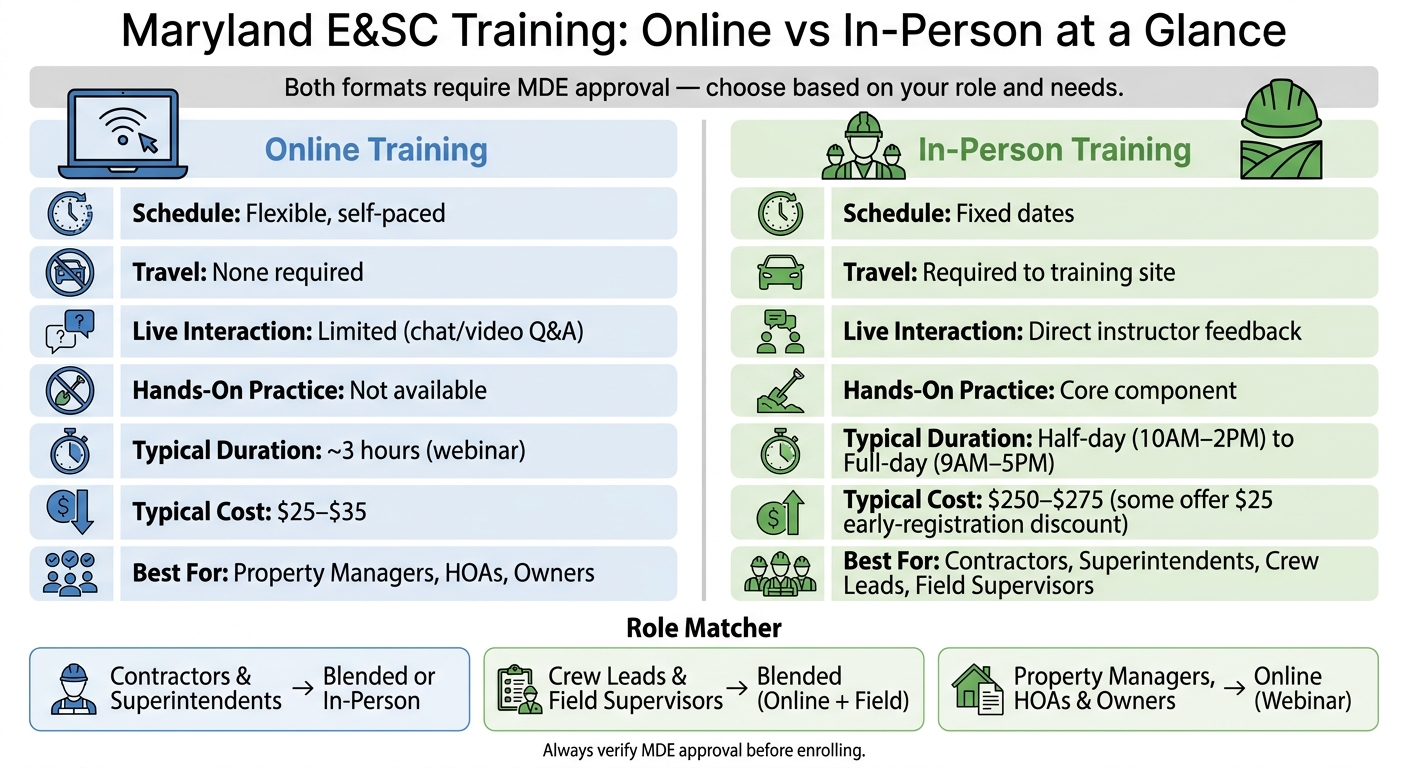
Maryland E&SC Training: Online vs In-Person at a Glance
Quick Comparison
| Criteria | Online | In Person |
|---|---|---|
| MDE approval needed | Yes | Yes |
| Schedule | More flexible | Fixed dates |
| Travel | None | Required |
| Live instruction | Limited | Direct |
| Hands-on practice | No | Yes |
| Typical price | $25 to $35 | $250 to $275 |
| Best fit | Owners, managers, oversight roles | Site leaders, field staff |
So if I just need rule and oversight knowledge, I’d lean online. If I’m making field calls or managing controls on site, I’d pick the format that includes face-to-face field training.
sbb-itb-843f8be
Maryland E&SC Training Requirements and State Approval
In Maryland, only courses approved by MDE count for erosion and sediment control training.
Who Needs Responsible Personnel Training
Maryland’s “responsible personnel” usually include foremen, superintendents, and project engineers who oversee clearing, grading, and sediment control work. Who needs training can vary based on project size and local permit rules.
What Counts as an Approved Course
For responsible personnel, the key factor isn’t whether the course is online or in person. It’s whether MDE has approved it.
Approved courses cover the same core topics in either format, including:
- erosion processes and how sediment acts as a pollutant
- installation and maintenance of Best Management Practices (BMPs)
- procedures for correcting deficiencies
- the regulatory duties of site personnel
Some approved programs also mix online lessons with required in-person field training.
Once you’ve confirmed approval, the next step is simpler: pick the format that works best for your schedule, budget, and job on site.
Online vs. In-Person Maryland E&SC Training: A Direct Comparison
Once you’ve confirmed MDE approval, the next step is picking the format that fits your schedule, travel limits, and day-to-day work. At that point, the comparison gets pretty simple: look at time, travel, cost, and how much hands-on learning you need.
| Feature | Online Training | In-Person Training |
|---|---|---|
| State Approval | MDE-approved provider | MDE-approved provider |
| Format | Self-paced modules, Zoom webinars, and recorded sessions | Instructor-led workshops and field-based learning |
| Scheduling | Flexible; complete on your own time | Fixed dates and longer time blocks |
| Travel | None required | Travel to a training site |
| Cost | Online courses usually cost less than in-person certificate courses | Higher upfront cost; full certificate programs run $250 to $275 [1] |
| Assessment | Online portal or proctored exam | Proctored exam or field assessment |
| Live Interaction | Limited to chat or video Q&A | Direct instructor feedback and peer discussion |
| Hands-On Practice | Not available | Core component |
Online Training: Flexible Scheduling, No Travel Required
Online courses make sense for people who need to work training into a busy job schedule. They’re often shorter, with webinars around 3 hours [1], and you can complete them anywhere you have a solid internet connection.
That convenience comes with tradeoffs. Discussion usually happens through chat or video, so it can feel a bit limited. And there’s no way to practice physical installation or walk a site with an instructor, which can be a big gap if your work depends on what happens in the field.
In-Person Training: Live Instruction and Field-Based Learning
In-person sessions take more time and usually run on a fixed schedule. Some field days stretch from 9:00 AM to 5:00 PM, while shorter workshops run about 10:00 AM to 2:00 PM [1] [2].
What you get for that extra time is direct, hands-on instruction. An instructor can show you how to spot installation issues and maintenance problems on an active site. That’s hard to match through a screen. If the course connects closely to daily site oversight, this kind of training often has more day-to-day use.
Which Format Costs Less in Time and Money
The gap in price can be pretty big, but the listed course fee is only part of the picture.
| Cost Factor | Online | In-Person |
|---|---|---|
| Course fee | Lower; webinar-only options run $25 to $35 [1] | Higher; full certificate programs run $250 to $275 [1] |
| Travel costs | None | Mileage to a Maryland training site |
| Time off work | Minimal; short sessions fit around schedules | Longer blocks, often a half-day or full-day commitment |
| Scheduling disruption | Low | Higher; fixed dates, limited availability |
| Early registration savings | Varies | Some programs offer a $25 discount for registering at least two months in advance [1] |
If you’re training several crew members, the indirect costs can pile up fast. Lost work hours, fuel, and schedule gaps all hit the budget. Online training keeps those costs down. In-person training asks for more money upfront, but it gives people the kind of field practice that’s tough to get any other way.
Choosing a Format by Role: Contractors, Crew Leads, and Property Managers
Job-site roles don’t all need the same kind of training. The best format depends on what someone does on the site, not just what’s easiest to schedule.
Use the chart below to match the training format to the job.
| Role | Recommended Format | Primary Reason |
|---|---|---|
| Contractors / Superintendents | Blended or In-Person | Hands-on work fits active site oversight |
| Crew Leads / Field Supervisors | Blended (Online + Field) | Connects rules with field practice |
| Property Managers / HOAs / Owners | Online (Webinar) | Covers oversight basics fast |
Contractors and Superintendents
For people making field decisions, hands-on training matters more than convenience. Site managers who deal with sequencing and control decisions need training that happens in the field, where those calls actually get made.
Blended programs like the CBLP-Buffers certificate do exactly that. They pair an online "Basics" webinar with an in-person "Implementation and Maintenance" field workshop, so attendees get both the rule background and the field judgment needed for complex grading and control sequencing [1].
Crew Leads and Field Supervisors
Blended training works well for crew leads because it ties rule knowledge to day-to-day maintenance tasks. That matters when someone’s not just reading requirements, but applying them in the middle of field work.
Maryland also offers the Sustainable Stormwater BMP Management for Crews certificate, available in both English and Spanish, for crews that need focused training on BMP management in the field [1].
Property Managers, HOAs, and Owners Overseeing Site Work
Oversight roles usually need less field practice and more general compliance knowledge. If your job is to oversee site work rather than direct it day to day, an online webinar is often enough.
A short webinar can cover the basics owners need to coordinate with contractors and keep up with site oversight, without asking for a full field-day commitment.
Conclusion: Picking the Right Maryland E&SC Training Format
Once MDE approval is confirmed, the choice mostly comes down to your role, your schedule, and how much field practice you need.
Cost is the next practical filter. Webinar-only options usually run $25 to $35. Hybrid certificate courses tend to cost $250 to $275, and some include a $25 early-registration discount [1].
For contractors, crew leads, and property managers, the best format is the one that fits the actual job. Go with online training if you want speed and convenience. Pick hybrid or in-person training if you need hands-on skill.
FAQs
How do I verify MDE approval?
Check your submitted plan status in the Maryland OneStop portal.
For state-level permits, contact MDE at 410-537-3551. If your project is handled at the county level, contact your local permitting agency, since some erosion and sediment control approvals are managed by county offices.
After approval, schedule an on-site pre-construction meeting with your assigned inspector before any land disturbance begins.
Will online training meet permit requirements?
No. Online training on its own does not meet Maryland permit rules for land-disturbing projects.
To get an erosion and sediment control permit, you need to submit a detailed sediment control plan to the proper local Soil Conservation District or the Maryland Department of the Environment for review and approval.
Training can help you learn the process and avoid mistakes. But it does not take the place of the project-specific plans and permits Maryland requires.
Do I need hands-on training for my role?
It depends on your certification and career goals. Programs like NGICP put a lot of weight on hands-on, field-based training, so you can use what you learn on actual infrastructure projects.
The CBLP program also includes formats like field workshops that give you practical experience in sustainable design and installation. For many landscape professionals in Maryland, that kind of training matters for compliance and the quality of the finished project.
Chat with Us