









- bhavya gada
- No Comments
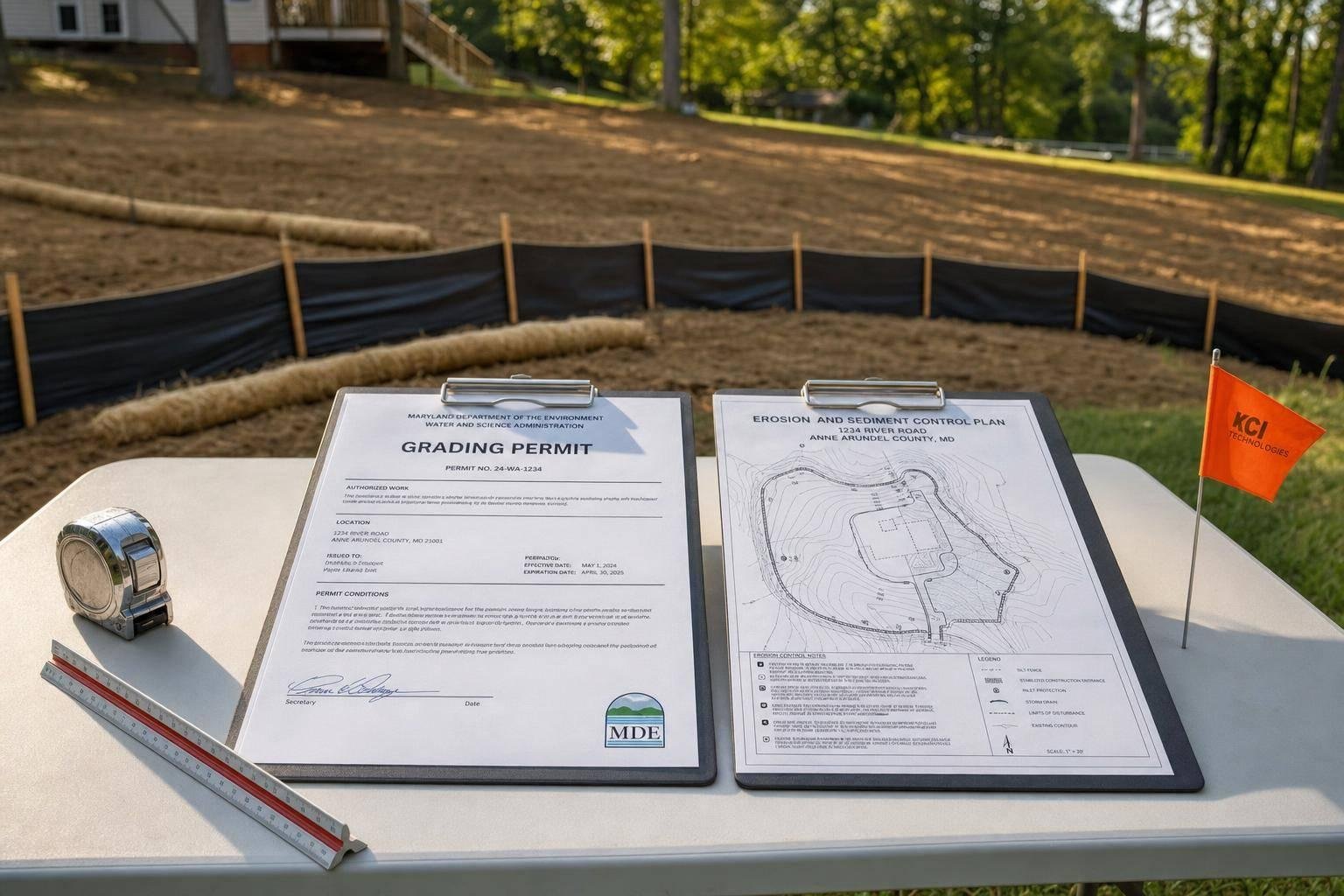
If you’re moving soil in Maryland, you may need two different approvals before work starts. One covers the grading work itself. The other shows how you’ll keep soil and runoff under control during the job.
Here’s the short version:
- A grading permit lets you excavate, fill, or regrade land
- An erosion and sediment control plan shows how soil will stay on site
- Many Maryland jobs trigger review at 5,000 sq. ft. of disturbance or 100 cubic yards of earthwork
- Counties such as Howard, Montgomery, Frederick, Carroll, Prince George’s, and Baltimore may add their own rules
- A patio, driveway, addition, or yard regrade can need grading review, erosion control review, and sometimes stormwater review
- In many cases, the erosion control plan must be approved first
That last point trips people up. A lot of homeowners think a small backyard project won’t need much review. But once you count access paths, stockpile areas, utility trenches, and tie-in grading, the disturbed area can climb past 5,000 sq. ft. faster than expected.
MDE Guidance For Protecting Stormwater Best Management Practices During Construction November 2023
sbb-itb-843f8be
Quick Comparison
| Item | Grading Permit | Erosion Control Plan |
|---|---|---|
| Main job | Approves soil movement | Shows how to control sediment and runoff |
| Covers | Cut, fill, excavation, regrading | Silt fence, inlet protection, seeding, matting, stabilization |
| Reviewed by | County permit office | Soil Conservation District or local review agency |
| Usual order | After plan review | Usually first |
| Trigger | Earth disturbance and grade change | Disturbed area, soil volume, and site conditions |
If I had to boil the whole article down to one rule, it would be this: measure the disturbed area, estimate the cut-and-fill volume, and check county rules before anyone starts digging. That one step can help you avoid delays, redesigns, drainage problems, and stop-work orders.
Grading Permit vs Erosion Control Plan: The Core Difference
A grading permit gives you permission to disturb soil. That includes excavating, adding fill, regrading, or otherwise changing the land. An erosion and sediment control (ESC) plan is the document that shows how erosion and sediment will be managed during and after that work.[1][4]
Put simply: the permit allows the earthwork. The plan lays out how the site will be kept from washing soil and sediment where it shouldn’t go.
What a Maryland Grading Permit Covers
A grading permit covers the physical act of moving soil. That can mean cutting into a slope, bringing in fill, regrading a yard, or reshaping land so a structure can be built.
Projects that often trigger a grading permit include:
- major yard regrading
- large home additions
- long or relocated driveways
- retaining wall work tied to earthmoving
- larger hardscape installations such as patios or site terraces
Some Maryland counties go a step further. Baltimore County, for example, also requires a grading permit for disturbance in sensitive areas no matter the size.[3][11]
In many cases, permit review moves forward at the same time as ESC review for the same job.
What an Erosion Control Plan Covers
The ESC plan shows the erosion controls required for the site. It spells out what measures will be installed and maintained so soil stays on the property during construction instead of washing away.
Common measures include silt fence, a stabilized construction entrance, inlet protection, temporary seeding, erosion control matting, check dams, and final stabilization after grading is done.[4][7][10]
In Maryland, ESC plans must meet the Maryland Standards and Specifications for Soil Erosion and Sediment Control. They’re also usually reviewed and approved by the local Soil Conservation District (SCD) before a county permit is issued.[12][5][15] Under state rules, a grading or building permit generally cannot be issued until the ESC plan has been reviewed and approved. So the plan comes first – it’s not something you tack on later.[4][15]
Comparison Table: Grading Permit vs Erosion Control Plan
The table below separates their roles at a glance.
| Grading Permit | Erosion Control Plan | |
|---|---|---|
| Definition | Authorization to excavate, fill, or regrade land | Document showing how erosion and sediment will be controlled |
| Purpose | Approves the earthwork itself | Protects the site and surrounding areas during and after construction |
| Who reviews it | County permitting office | Local Soil Conservation District (SCD) or designated approval authority |
| When it applies | For projects that involve qualifying earth disturbance | Usually required before grading permit approval |
| Documents involved | Permit application, site plan, grading plan | ESC plan with control measures and a site map |
| Homeowner responsibility | Get the permit before work starts; install, maintain, and repair controls; stabilize disturbed soil at completion. |
On residential projects, these two approvals usually move together, not as separate tracks.
How They Work Together on Maryland Residential Jobs
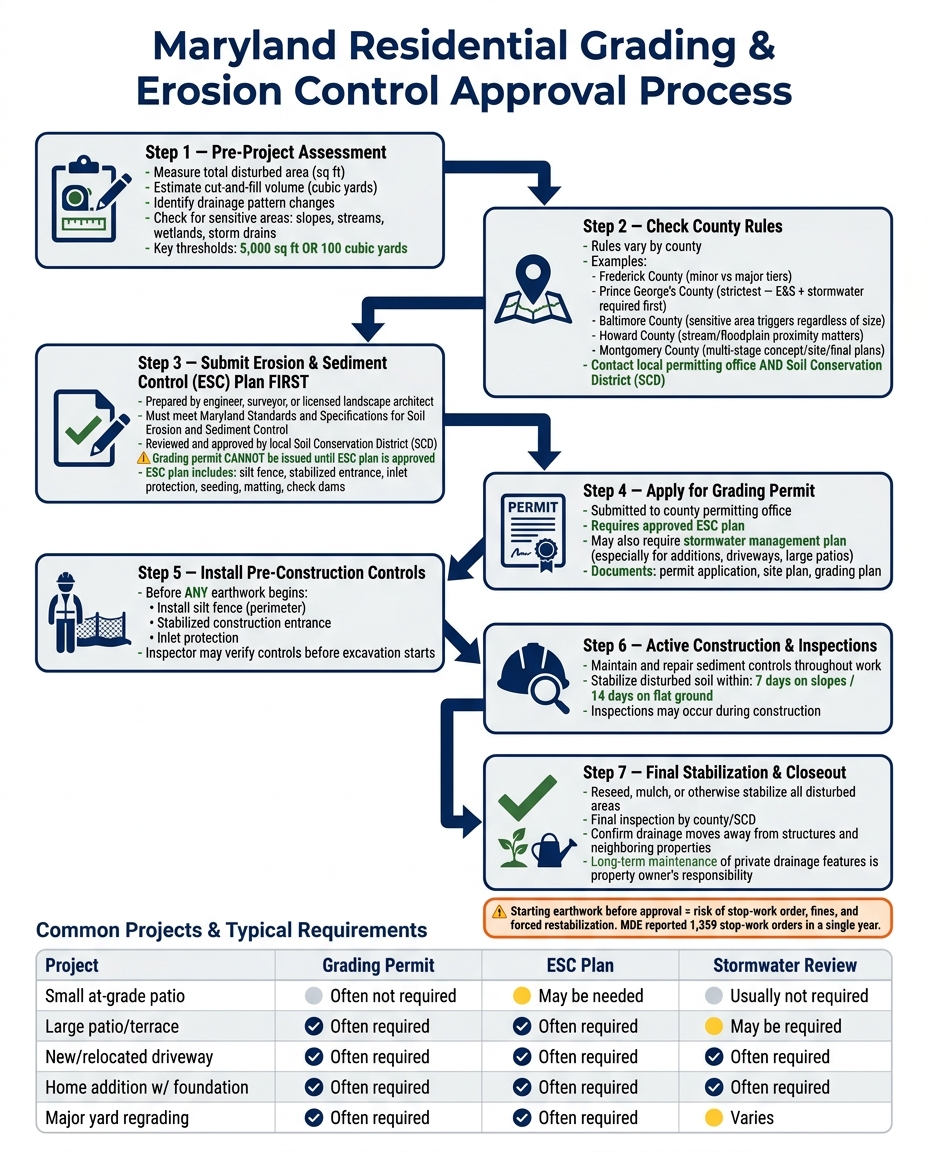
Maryland Grading Permit vs Erosion Control Plan: Approval Process Flow
On Maryland residential jobs, these two approvals usually happen one after the other. The E&S plan is reviewed first, and the grading permit comes next once that approval is in place.[24][25] Counties such as Prince George’s County spell out that order directly.[21][22]
Typical Approval Steps for Additions, Patios, Driveways, and Yard Regrading
Before any digging starts, the contractor or designer looks at the site and measures a few key things: the disturbed area, cut-and-fill volume, access routes, and space for stockpiles. Those numbers shape the next step. Some jobs stay fairly simple. Others move into a formal review process.
The grading permit is tied to how much earth is being moved. The E&S plan is tied to how the site will be protected while that work happens. The team also checks whether the project changes drainage patterns or pushes runoff off site.[19] After that, plans are usually submitted in sequence, and stormwater review may also come into play.[12][17][25]
Before earthwork begins, perimeter sediment controls need to be installed, including:
Inspectors may visit the site to check those controls before excavation starts. During construction, the controls need to be maintained and fixed when needed. Final approval comes after the site is stabilized and inspected.
Where the Requirements Overlap
Some projects don’t go through two separate tracks. Instead, they need one combined review set. A patio, addition, or regrading job can trigger both approvals because it changes the land itself and the way runoff moves across the site.[23][24]
A rear addition with a patio and regrading is a good example. That kind of project can trigger all three reviews, and each part needs approval before work can move ahead.
Even small jobs still need basic site protection. Staying below a review threshold doesn’t mean runoff stops mattering. Basic sediment controls help avoid runoff problems, neighbor complaints, and fines.[24][26]
When Homeowners Need One, Both, or Neither
It depends on the project, the site, and the county. Start with the local permitting office. County rules decide what applies, and small changes in local thresholds can change the answer even for a modest job.
Small Yard Work and Minor Hardscaping
Projects that disturb less than 5,000 sq. ft. and move less than 100 cubic yards of soil may not need ESC plan review. A small paver patio or short walkway often falls under those limits, especially if runoff stays about the same.
That said, small jobs don’t always stay off the county’s radar. Review can still be triggered on steep slopes, near swales, storm drains, drainage easements, or property lines. The same goes for sites where earlier disturbance already pushed the lot over a local threshold.
Even if a grading permit isn’t required, basic sediment controls still matter. A few simple steps can go a long way:
- Put temporary silt fence or straw wattles downslope of disturbed soil
- Keep stockpiled soil covered with a tarp
- Backfill, compact, and reseed or mulch as soon as possible
Once the slope gets steeper or the drainage pattern changes, the project can shift into permit review.
Larger Projects That Often Trigger Review
Bigger projects often need both approvals. In many cases, they may also need stormwater review.
Common examples include large rear patios with steps and yard regrading, new or relocated driveways, home additions with foundation excavation, and major terracing with retaining walls. These are the kinds of projects that often push a job past county review thresholds or trigger formal review for other reasons.
Driveway work tends to get extra attention when it changes slope, redirects runoff toward the street, or adds impervious area.[28][1] A home addition can also add new roof area and more runoff, which means stormwater review may be required along with grading and erosion control submissions.[27][9] It’s smart to confirm where your project fits before locking in the design.
Comparison Table: Common Residential Projects and Likely Requirements
| Project Type | Grading Permit | Erosion/Sediment Control Plan | Stormwater Review |
|---|---|---|---|
| Small at-grade patio on relatively flat ground | Often not required if disturbance stays below local thresholds | May be needed if soil is disturbed | Usually not required |
| Large patio or terrace | Often required if thresholds are exceeded | Often required | May be required depending on impervious area |
| New or relocated driveway | Often required | Often required | Often required if drainage or impervious area changes |
| Home addition with foundation | Often required | Often required | Often required |
| Major yard regrading with retaining walls | Often required | Often required | Varies by county and drainage impact |
County rules can change these outcomes, which is why local review comes next.
County Review and Local Differences in Maryland
Maryland sets the baseline rules in COMAR. But grading permits and erosion and sediment control (E&S) plans are checked at the local level by counties and Soil Conservation Districts (SCDs). So the forms, thresholds, review path, and approval steps can change based on where the property is located.[4][31]
That local review affects more than whether a permit applies. It also shapes how the grading permit and E&S plan fit together. In practice, the biggest differences show up in county thresholds and review paths.
Why County Thresholds and Review Paths Can Differ
Under the state baseline, many projects don’t need formal E&S review. Once a project goes above that line, though, the process can split in very different ways from county to county. For patios, driveways, additions, and regrading, local thresholds often decide whether the review stays simple or turns into a multi-step process.
Here are some of the clearest examples.
Frederick County uses two grading tiers: a minor grading permit for disturbance over 5,000 sq. ft. or 100 cubic yards, and a major grading permit when a project goes over 30,000 sq. ft. or 500 cubic yards.[15] The county also requires SCD approval before the permit can be issued.[31]
Prince George’s County is stricter. No grading permit or building permit is issued until both a final E&S plan, approved by the county SCD, and a final stormwater management plan are approved.[20] Its exemption only covers very small projects that stay within tight limits for disturbance, grade change, and drainage.[21]
Baltimore County requires a grading permit for any disturbance over 5,000 sq. ft. or more than 100 cubic yards of fill. It also triggers review for grading near watercourses, floodplains, wetlands, habitat protection areas, or forest buffers, no matter the project size.[3][32]
Howard County has a simpler standard E&S plan path for disturbances up to 30,000 sq. ft. and 1,000 cubic yards. But that option goes away if the site is within 100 feet of a stream, inside the 100-year floodplain, or includes slopes steeper than 3:1.[2]
Montgomery County may require concept, site development, and final E&S plans. That review can include mapping for slopes, highly erodible soils, and natural resources.[14][16]
What to Confirm Before You Apply
Before you call the county permitting office or SCD, pull together the basic project numbers. The two big ones are:
- Total disturbed square footage
- Estimated cubic yards of cut and fill
You can estimate cubic yards from the disturbed area and the average cut or fill depth.
Then look at the site itself. Will the project change where runoff goes? Are there streams, wetlands, or storm drains nearby? Does the lot have steep slopes or other sensitive areas? And in places like Frederick County and Prince George’s County, will the building permit be held up until grading or E&S approval is done first?[31][20]
If the project is anywhere near the state baseline thresholds, it’s smart to assume county review may apply and confirm before work starts.[11][30][8][3]
That’s where many homeowners get tripped up: they start too soon or underestimate the disturbed area.
Common Mistakes That Delay Residential Projects
Once you know which approvals apply, most delays come from a few mistakes that are easy to avoid. Even careful homeowners can hit problems when grading and erosion control rules aren’t followed closely. In most cases, the holdup comes down to three things.
Starting Earthwork Before Approval
The biggest mistake is also the simplest: starting work before the permit or erosion and sediment control plan is approved. Sometimes a contractor begins grading, excavation, or fill work before the needed approvals are in place. In counties that use the 5,000-square-foot or 100-cubic-yard threshold, going past those limits without approval can trigger violations and stop-work orders.[32][33]
That can snowball fast. Inspectors may require disturbed areas to be restabilized, ask for extra engineering to show what has already been graded, and require plan resubmission.[33] MDE reported thousands of sediment-control and grading violations, along with 1,359 stop-work orders, in one reporting year. For a homeowner, that can turn into weeks of delay and added costs.
Underestimating Disturbed Area or Soil Volume
A lot of homeowners look only at the finished feature – the patio slab, driveway, or addition footprint – and miss everything else that gets disturbed during the work. But the total disturbed area also includes access paths for equipment, staging areas, spoil piles, utility trenches, and any regrading needed to tie new grades back into the existing yard.[13][9][29]
A simple site walk can save a lot of trouble here. Before work begins, walk the property with your contractor and mark every spot where soil or turf will be disturbed. That same review should also catch drainage changes before they become a problem.
Overlooking Drainage Changes on Small Projects
Small projects can still cause big headaches. A patio near a property line, a filled low spot in the yard, or a new driveway apron may look minor, but each can change where rainwater flows. Redirecting runoff onto a neighboring property can violate Maryland and county rules no matter how small the project is.[18][34][35] Baltimore County’s regulations also prohibit changing the natural ground level in a way that alters the direction, volume, distribution, or velocity of surface water onto adjoining property without a valid grading permit.[18]
Plan drainage early. Keep existing swales in place, send runoff to stable vegetated areas, and stabilize disturbed soil within 7 days on slopes and 14 days on level ground. Small jobs still need drainage control and fast stabilization.
Working With a Contractor on Permits, Drainage, and Site Protection
If you want to avoid permit delays, get drainage and compliance duties in writing before work begins.
Questions to Ask Before Construction Starts
Begin with one plain question: who is the permittee? That person is legally on the hook for the grading permit and ESC compliance. Don’t leave that to guesswork. Put it in the contract.
You should also have the contractor calculate the disturbed area and soil volume so you can tell whether agency review applies. The contractor should also handle approval timing and site protection, not treat them like afterthoughts.
Before any work starts, confirm:
- Who prepares the ESC plan and whether the job calls for an engineer, surveyor, or licensed landscape architect
- Who coordinates inspections – before disturbance, after controls are installed, and at final stabilization [36][6]
- Who installs controls before digging starts – perimeter controls must go in before grading begins [36][7]
- Who is the certified responsible person on site – Maryland requires the person overseeing clearing and grading to complete MDE-approved ESC training [7]
It also helps to ask the contractor to walk you through both the current and final drainage paths. A simple flow sketch is usually enough. The point is to confirm that runoff won’t be pushed toward a foundation, a neighbor’s property, or a low area where water will sit.
Permits are only one part of the job. The finished grade still needs to move water the right way.
Why Drainage Planning Matters After the Project Is Done
Once the roles are clear, the next thing to pin down is how the site will drain when the work is finished.
Final approval doesn’t end drainage responsibility. It gets the project moving, but the grading details decide whether the site actually works after construction.
Poor final grading can lead to ponding, runoff onto neighboring property, and pressure against retaining walls [3][37]. That can turn into structural damage, expensive fixes, and friction with neighbors.
Maryland’s model stormwater rules put long-term maintenance of private drainage features on the property owner [38]. So if your project includes a swale, dry well, or rain garden, you’re the one responsible for keeping it clear and working. Ask the contractor to point out anything that will need upkeep later.
After the first heavy rains, take a look around. Check that water is moving away from structures, swales are still open, and stabilized areas are holding in place.
Conclusion: The Practical Rule for Maryland Properties
A grading permit covers earthwork. An erosion control plan is there to limit sediment runoff during construction.
For many residential projects in Maryland, you may need both once site disturbance goes past 5,000 sq ft or 100 cubic yards. That threshold can sneak up on people. A large patio with cut-and-fill work, a driveway replacement that changes slope or adds impervious surface, an attached addition with foundation excavation, or retaining-wall work that calls for regrading can all get there faster than expected. That’s why it makes sense to check local rules before the design is locked in.
County review steps still differ. Start with local approval rules, then measure the project.
Use these checks before scheduling excavation:
- Measure disturbed area and soil volume – will the work go over 5,000 sq ft or 100 cubic yards?
- Assess drainage changes – will runoff patterns shift?
- Confirm county approvals – your county may have extra steps.
Spotting these issues early can save a lot of pain later. A stop-work order or a forced redesign in the middle of construction usually costs far more in time and money than a permit review before the job starts.
For patio, driveway, grading, or drainage projects in central Maryland, Pro Landscapes MD can help assess site conditions, drainage, and permit needs.
FAQs
How do I calculate disturbed area?
Measure the full area where you plan to remove vegetation, clear the ground, or move soil. That includes any part of the site affected by excavation, grading, or construction.
A site map can help you set your Limits of Disturbance (LOD) and mark those boundaries on-site. Projects that disturb 5,000 square feet or more need a grading permit.
Can one project need grading, ESC, and stormwater review?
Yes. One project may need a grading permit, an erosion and sediment control (ESC) plan, and stormwater management (SWM) review.
In Maryland, projects that disturb 5,000 square feet or more often need all three. Here’s the simple breakdown:
- ESC deals with runoff during construction
- SWM deals with runoff after the project is finished
In many cases, these approvals can be reviewed together, which helps keep the process more streamlined.
Who files the permit and plan?
Property owners, developers, or authorized contractors usually file the required grading permit and erosion control plan. Even so, the property owner is still the one ultimately responsible.
In many cases, licensed professionals prepare and submit the paperwork to make sure it lines up with local Soil Conservation District or municipal rules. Filing usually happens through a county online portal or the Maryland OneStop portal, depending on the project location and jurisdiction.
Chat with Us