









- bhavya gada
- No Comments
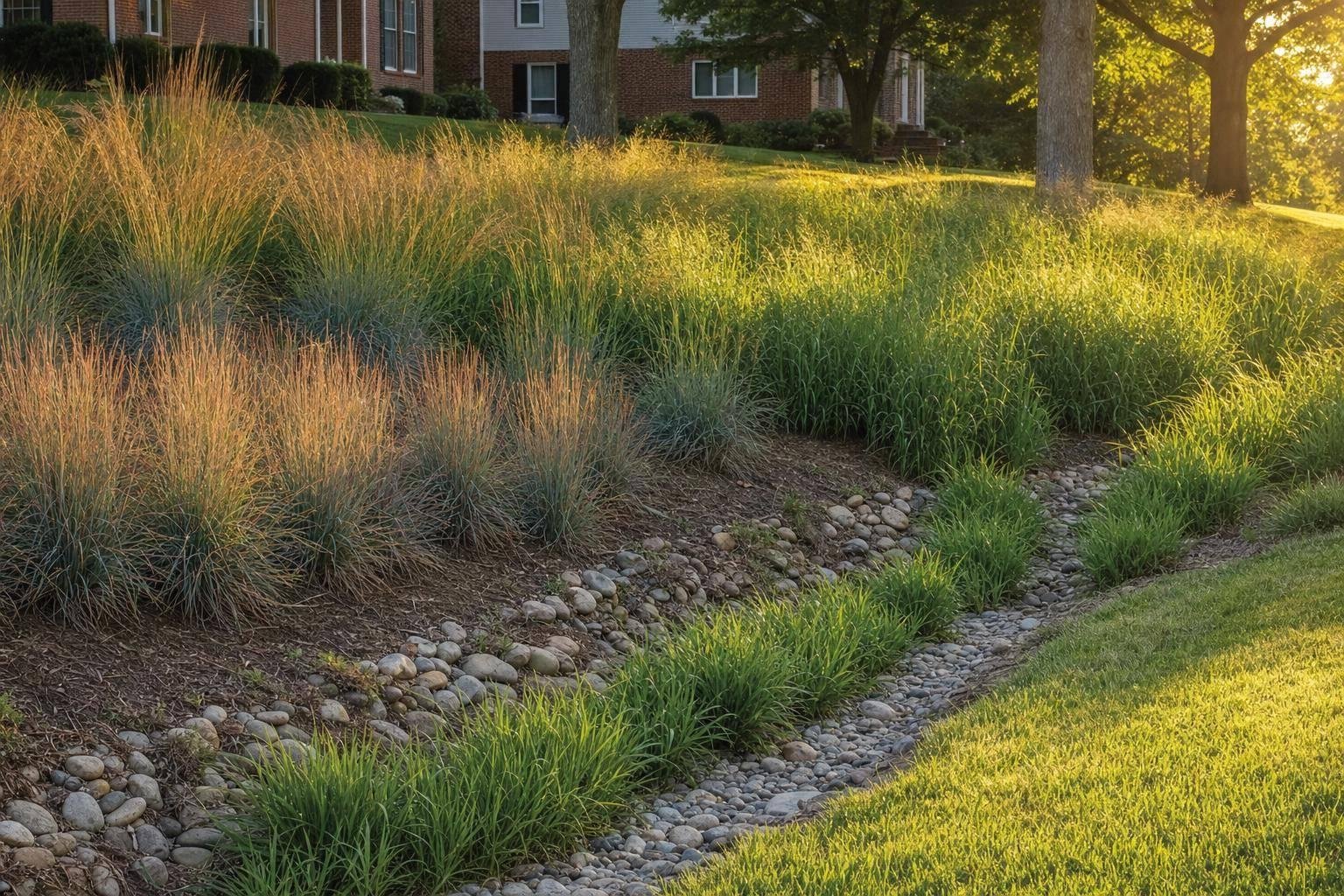
If you want the short answer: match the plant to the site. In this roundup, I’d use switchgrass for sunny slopes with some moisture, little bluestem for hot dry banks, indiangrass for large sunny embankments, bottlebrush grass for shaded slopes, and Pennsylvania sedge for dry shade under trees.
Here’s the part that matters most: roots help, but plants are not a fix for every erosion problem. Switchgrass roots can reach 5 to 6 feet, little bluestem about 4.5 to 5.5 feet, and indiangrass up to 9 feet. Research cited here also shows runoff and soil loss can drop hard in the right planting, with switchgrass cutting soil loss by 43.7% to 95.5% in some tests.
If I had to boil the whole article down, it’s this:
- Full sun + slope + mixed moisture: go with switchgrass
- Full sun + dry, lean soil: pick little bluestem
- Full sun + lots of room: use indiangrass
- Part shade to shade + decent drainage: choose bottlebrush grass
- Dry shade + low groundcover: plant Pennsylvania sedge
- Active washout or drainage trouble: fix grading and runoff first
Quick Comparison
| Plant | Best Light | Moisture | Best Use | Erosion Role |
|---|---|---|---|---|
| Switchgrass | Full sun | Dry to moist | Sunny slopes, banks, swales | Strong root hold |
| Little Bluestem | Full sun | Dry to medium-dry | Dry slopes, small sunny beds | Good on dry banks |
| Indiangrass | Full sun | Dry to moist, well-drained | Large open slopes | Strong in mixed plantings |
| Bottlebrush Grass | Part shade to shade | Moist to medium-dry, well-drained | Shaded banks, woodland edges | Surface soil hold |
| Pennsylvania Sedge | Part shade to full shade | Dry to moist, well-drained | Dry shade groundcover | Light soil cover |
So if you’re picking for a Maryland yard, I’d focus on sun, moisture, drainage, and slope position first – then choose the plant that fits.
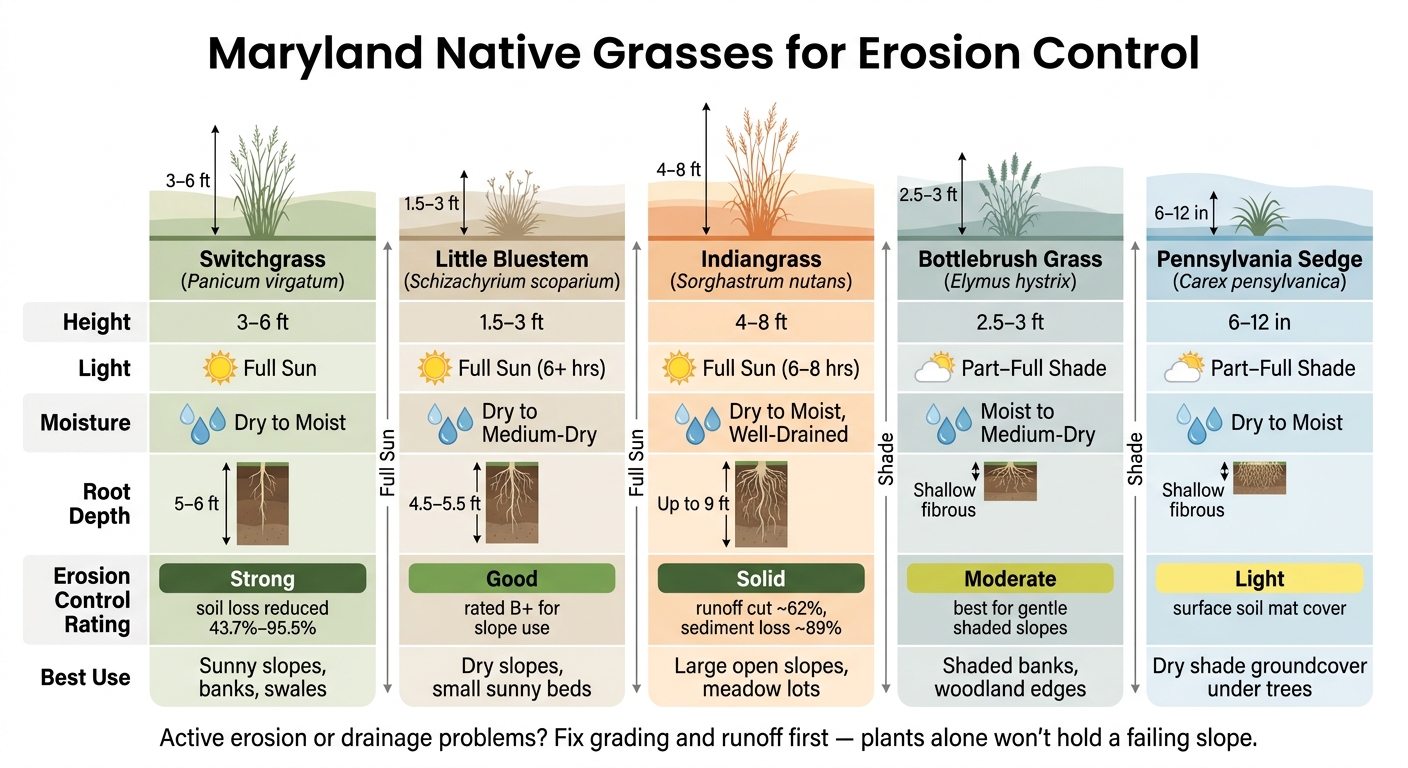
Maryland Native Grasses for Erosion Control: Side-by-Side Comparison
1. Switchgrass (Panicum virgatum)
Sun Exposure
Switchgrass does best in full sun and handles only light part shade. University of Maryland Extension says it can tolerate part shade, but there’s a catch: in lower light, plants tend to grow looser and may flop. [1][5][7] If you’re planting a slope or bank to hold soil in place, a sunny spot is the better call.
Soil Moisture and Drainage
This grass is pretty forgiving about soil. It can grow in dry or moist ground, and it handles sandy or clay soils. It also tolerates some salt on Maryland’s Coastal Plain. That range makes it useful on dry uplands as well as lower areas that stay wet for a bit but drain after rain. [1][5][6][7]
Slope Placement
Maryland Extension recommends switchgrass for slopes, banks, and disturbed ground. For gentle slopes, space plants 18 to 24 inches apart. On steeper ground, tighten that to 12 to 18 inches, and stagger the rows where runoff hits hardest. [1][6][7][8]
That spacing matters more than it may seem at first glance. Wider spacing saves money up front, but tighter planting helps switchgrass fill in faster and start gripping the soil sooner. On spots that are too steep to mow, it can be a strong long-term pick. [1][6][7][8]
Erosion-Control Performance
For home landscapes, the main point is simple: switchgrass grows deep roots that help anchor soil and improve water infiltration. [6] In plain English, more water soaks in, and less of it rushes downhill carrying dirt with it.
Research that compared switchgrass with row crops on sloped land found that water runoff dropped by 3.2% to 12.1%, while soil loss fell by 43.7% to 95.5%, depending on slope and rainfall conditions. [9] That can mean less sediment washing onto driveways, sidewalks, or into storm drains after a hard rain.
During establishment, mulch or temporary erosion-control fabric can help shield bare soil. By year two, roots are deeper, top growth is thicker, and irrigation often isn’t needed anymore. [7][8]
sbb-itb-843f8be
Native Grasses for Use in Home Gardens and Native Meadows with Sara Tangren
2. Little Bluestem (Schizachyrium scoparium)
If switchgrass does better in wetter, easier sites, little bluestem is the better pick for dry, thin slopes.
Sun Exposure
Little bluestem grows best with at least 6 hours of direct sun each day. It brings blue foliage in summer and red-orange color in fall.[1] It does best on south- or west-facing slopes and other open, sunny spots.
Soil Moisture and Drainage
It likes dry to medium-dry, well-drained soil and struggles in places that stay soggy.[11][17][18] On suburban lots, it’s a smart choice where construction has left behind poor soil.
Slope Placement
Little bluestem fits dry upland areas well, including ridges, hilltops, and steep slopes.[13] It also works on Maryland side yards and along roadway edges that are too awkward to mow. Because it grows in clumps, it looks good planted in drifts on south- or west-facing slopes. At about 1.5 to 3 feet tall at maturity, it stays easy to handle on home landscapes.[1]
Erosion-Control Performance
Little bluestem has roots that can reach about 4.5 to 5.5 feet deep, which helps it hold soil on slopes.[15] A Rhode Island roadside study ranked it among the best survivors on exposed slopes, and the University of Maryland Center for Environmental Science gives it a Good to Excellent (grade B+) rating for slope use.[12][16]
It tends to work best in mass plantings or as part of a mixed native grass meadow. Once it’s established, it handles drought well and needs little upkeep.
Its strong point is dry slopes, though on deeper, richer soils, taller warm-season grasses usually take over.
3. Indiangrass (Sorghastrum nutans)
If little bluestem is the lean, tough one for thinner slopes, indiangrass is the taller, flashier grass for open sites with more room to shine. It’s a tall native grass that does best in sunny, better-drained spots, with golden-bronze seed heads and yellow-orange fall color that stand out in late season.[19][2][20][23]
Sun Exposure
Indiangrass needs full sun – about 6 to 8 hours of direct light each day.[19][23][25] When it gets too much shade, flowering drops off, plants flop more, and disease pressure goes up. That’s why it’s smart to keep it away from large shade trees and north-facing walls. In smaller yards, south- or west-facing spots are usually the better match.[23][25]
Soil Moisture and Drainage
This grass grows in dry to moist, well-drained soil and handles sand, loam, and some clay. It also tolerates slight salinity.[19][10] Brief flooding is usually fine, but wet soil that stays soggy is another story.[10] During the first growing season, water weekly if rainfall is under 1 inch.[25] Steer clear of compacted low areas and any site that drains poorly.
Slope Placement
Indiangrass fits best on upper and middle slope areas like sunny embankments, road banks, and dry upland berms and hardscaping.[3][21][22] At the bottom of a slope, where water tends to collect, it often starts to thin out. In those spots, a grass or sedge suited to wetter ground usually makes more sense.[21][22][25]
In home landscapes, it works well in small drifts spaced 18 to 24 inches apart within mixed native plantings.[20][22][23] It also has a place in native seed mixes for disturbed slopes.[3][24]
Erosion-Control Performance
Indiangrass brings serious root power. Its roots can reach up to 9 feet deep,[6] which helps it hold soil in place. On slopes steeper than 15%, research found that indiangrass plantings cut runoff volume by about 62% and sediment loss by about 89% compared with bare soil.[25]
Because it grows in clumps instead of spreading by rhizomes, it’s best at slowing water across the soil surface and holding smaller sections of soil together. That makes it a strong part of a mixed native grass planting, rather than a solo fix for every erosion problem.[20][21][24][25] Maryland Extension also lists it for native meadows and erosion control.[19]
Mature clumps reach 4 to 8 feet tall, so this is a grass for larger slopes, not tight little beds. Cut it back to 4 to 6 inches in late winter to keep it tidy and ready for new growth.[19][1][20][21][23][25]
It’s not the right pick for shady sites or ground that stays wet for long periods.
4. Bottlebrush Grass (Elymus hystrix)
Bottlebrush grass plays a different part than indiangrass. Instead of liking open, sunny ground, it’s made for shade. This grass usually grows 2.5 to 3 feet tall and produces 9- to 10-inch seed heads in early to midsummer, which is earlier than many warm-season grasses.[1] That timing makes it handy in spots where shade rules out the warm-season options covered above. University of Maryland Extension also includes it as a native lawn alternative for shady sites.[26]
Sun Exposure
Bottlebrush grass does best in partial shade to open shade. Good spots include woodland edges, areas under high-branched trees, and the north or east side of a building or hardscaped structure.[27][30][33] It can handle full shade, but growth may get looser, and stems can flop in fertile or wet soil.[33]
It tends to do best with a few hours of direct sun.[33] On the flip side, hot south-facing slopes or areas next to reflective pavement can be rough on it. Full summer sun on dry soil may stress this cool-season grass.[29][32][33]
Soil Moisture and Drainage
This grass prefers moist to medium-dry, well-drained soil. It can grow in clay, loam, or sand, and it needs little fertilizer.[28][31][32][34][35][36] Too much nitrogen is a bad trade here. It can lead to weak stems that flop over.[28][31][32][34][35][36]
Slope Placement
UMD recommends bottlebrush grass for shaded slopes because it germinates fast, resists deer, and provides winter cover.[28] It fits best on partially shaded banks with moist to dry soil and good drainage, especially where slope and shade show up together.
Stay away from the toe of a slope where runoff gathers and soil stays wet. In those spots, the plant can struggle. And on steep, fully exposed banks, warm-season grasses such as switchgrass are often the better pick.[28][29][32]
Erosion-Control Performance
Its big edge on slopes comes from that shade tolerance. Bottlebrush grass helps control erosion with a fibrous root system that holds together the upper soil layers and helps resist surface erosion from rain and sheet flow.[32] Its upright stems also stay standing through winter, which helps slow runoff and catch leaf litter.[27][28]
For heavier erosion, though, it works better as part of a mixed planting with other shade-tolerant native plants and groundcovers than as a solo fix.[28][32]
5. Pennsylvania Sedge (Carex pensylvanica)
Where bottlebrush grass brings height to shady spots, Pennsylvania sedge stays low and almost lawn-like. It’s a native sedge, not a grass, and it works as a fine-textured groundcover for dry shade and part shade. That’s the gap it fills: dry shade groundcover, which can be hard to find. It usually reaches just 6 to 12 inches tall.[40][41][43][47] It also spreads slowly by rhizomes.[42][43] Maryland Extension points to it as a solid lawn alternative for shaded, low-traffic areas.[14]
Sun Exposure
Pennsylvania sedge grows best in part shade to full shade.[44][45] It’s a good fit under deciduous trees, along woodland edges, and on the shaded sides of buildings.[44][45] It can take some direct sun, but only when the soil stays fairly moist. In full sun with dry heat, it tends to struggle.[44][46]
Soil Moisture and Drainage
This sedge is more drought-tolerant than many shade plants. It handles dry to moist soils and prefers well-drained ground.[4][38] That’s a big reason people use it in dry shade, where tree roots compete for water and many other plants just can’t keep up.[37][38] On the flip side, heavy clay that stays soggy can make it decline.[4][39]
Slope Placement
On shady or partly shaded slopes, Pennsylvania sedge is a practical option. Its rhizomatous spread helps it knit into a mat over time, which can cover soil that might otherwise stay bare beneath tree canopy.[42][43] It does well on banks with dry to average moisture, especially in places that are annoying to mow. It’s best for gentle to moderate shaded slopes. If the site is steep or already eroding, you’ll need something with stronger holding power.
Erosion-Control Performance
Pennsylvania sedge gives light erosion control through its fibrous, shallow root system.[4][39] That makes it useful for limiting surface soil loss on gentle to moderate wooded slopes and for filling in spaces between larger shrubs and perennials with living cover.[41][48] If a slope gets a lot of runoff or has active erosion, it works better as part of a mixed planting with deeper-rooted natives. So it’s best seen as a finishing layer for shaded banks, not the main fix for heavy washout.
Best Fits, Tradeoffs, and Pros and Cons
These plants mostly fall into two roles: sunny slope stabilizers and shade groundcovers.
For sunny spots, Switchgrass covers the most ground in terms of site use. It grows in full sun, handles periodic wetness, and UMD Extension lists it as a large native grass used for erosion control.[1][6] That makes it a strong option for sunny slopes, drainage swales, and bigger mixed borders. The catch is size. At 3–6 ft tall, it can feel too big for a small front-yard bed.[1]
Little bluestem works better where space is tight. It suits small sunny beds and dry slopes, and its narrow shape is easier to manage. Indiangrass, by contrast, is the biggest statement plant of the three sun grasses. At 6–8 ft, it fits meadow-style lots and open back slopes well, but it can swallow up a tight foundation bed or a narrow side yard.[1]
In shady parts of the yard, bottlebrush grass and Pennsylvania sedge divide the job by height. Bottlebrush grass fills the middle layer at about 2.5–3 ft, and its 9–10 inch seed spikes stand out along woodland edges and shaded side yards.[1] It does best in part shade to shade, but it doesn’t do well in waterlogged soil. Pennsylvania sedge stays much lower, at about 6–12 inches, and spreads into a low, lawn-like groundcover that works well under trees where turf often gives up.[49][50][42]
That said, both shaded options come with tradeoffs. Neither gives you the height or visual weight of the prairie grasses. And while Pennsylvania sedge is useful as a low cover, it is not a high-traffic lawn replacement and it won’t solve a wet low spot that stays soggy.[49][50][51]
Quick comparison:
| Plant | Best Maryland Fit | Main Tradeoff | Erosion Control |
|---|---|---|---|
| Switchgrass | Sunny slopes, swales, larger borders | Too tall/wide for small beds | Strong; deep roots |
| Little bluestem | Small sunny beds, dry slopes | Struggles in rich, wet, or shaded sites | Good on dry, sunny banks |
| Indiangrass | Meadow lots, open slopes | Overpowers suburban yards | Solid on sunny, well-drained slopes |
| Bottlebrush grass | Shady woodland edges | Less sturdy on steep erosion sites | Moderate; best for gentle shaded slopes |
| Pennsylvania sedge | Dry shade groundcover | Not for steep or actively eroding banks | Helpful as soil-covering mat in shade |
For small Maryland lots, little bluestem and Pennsylvania sedge are usually the easiest fit. Switchgrass and Indiangrass need more elbow room. Bottlebrush grass makes sense when a shaded bed needs some mid-height structure without getting too bulky.
One more thing matters here: active erosion needs more than planting. If the problem comes from runoff and grading, not just exposed soil, plants alone won’t hold the slope. In that case, drainage work and regrading need to happen first. Pro Landscapes MD serves central Maryland.[52][53]
Conclusion
The best native grass comes down to three site factors: sun, soil moisture, and slope. So the choice is less about looks and more about putting the right plant in the right place.
Switchgrass is a good fit for sunny slopes with occasional moisture. Little bluestem does well on hot, dry banks. Indiangrass works best on large, open embankments. Bottlebrush grass fits part shade to shade. Pennsylvania sedge fills dry shade under trees. Mixed plantings often work best on sites where sun or moisture shifts from one area to another.
A simple rule of thumb makes this easier: put sun-loving grasses in sunny spots, and keep shade-tolerant plants under trees.
If slope or drainage is the main issue, grading and drainage work should come first. For steep banks or drainage problems, Pro Landscapes MD provides grading, drainage, planting, and landscape services across central Maryland.
FAQs
How do I choose the right native grass for my slope?
Choose native grasses with deep, fibrous roots that help hold soil in place and slow runoff. For dry spots, Little Bluestem is a strong pick. For wetter parts of the slope, Switchgrass tends to work better. The main thing is to match the plant to your slope’s sun exposure and moisture level.
It also helps to plant in layers. Put taller shrubs near the top of the slope and lower-growing groundcovers farther down. That mix helps break up the path of moving water instead of letting it rush straight downhill.
When are plants not enough for erosion control?
Plants alone won’t fix a site if water flow and soil stability are working against them. When drainage, grading, or soil conditions are off, even native grasses can struggle.
In those cases, add site fixes that help manage runoff and hold soil in place. That can include terracing or leveled sections, retaining walls or boulders to slow water, and drainage features like French drains or dry riverbeds.
It also helps to give plants temporary watering during the first two seasons. At the same time, keep an eye on the area for erosion and bare gaps so you can step in before small problems turn into bigger ones.
Can I mix these grasses on one property?
Yes – as long as you use hydrozoning, which means grouping grasses with similar sun, soil, and moisture needs.
For example, plant switchgrass in wetter areas or spots that collect stormwater. Use little bluestem in drier upland areas. When each grass is matched to the right conditions, the landscape tends to stay healthier and needs less upkeep.
Chat with Us