









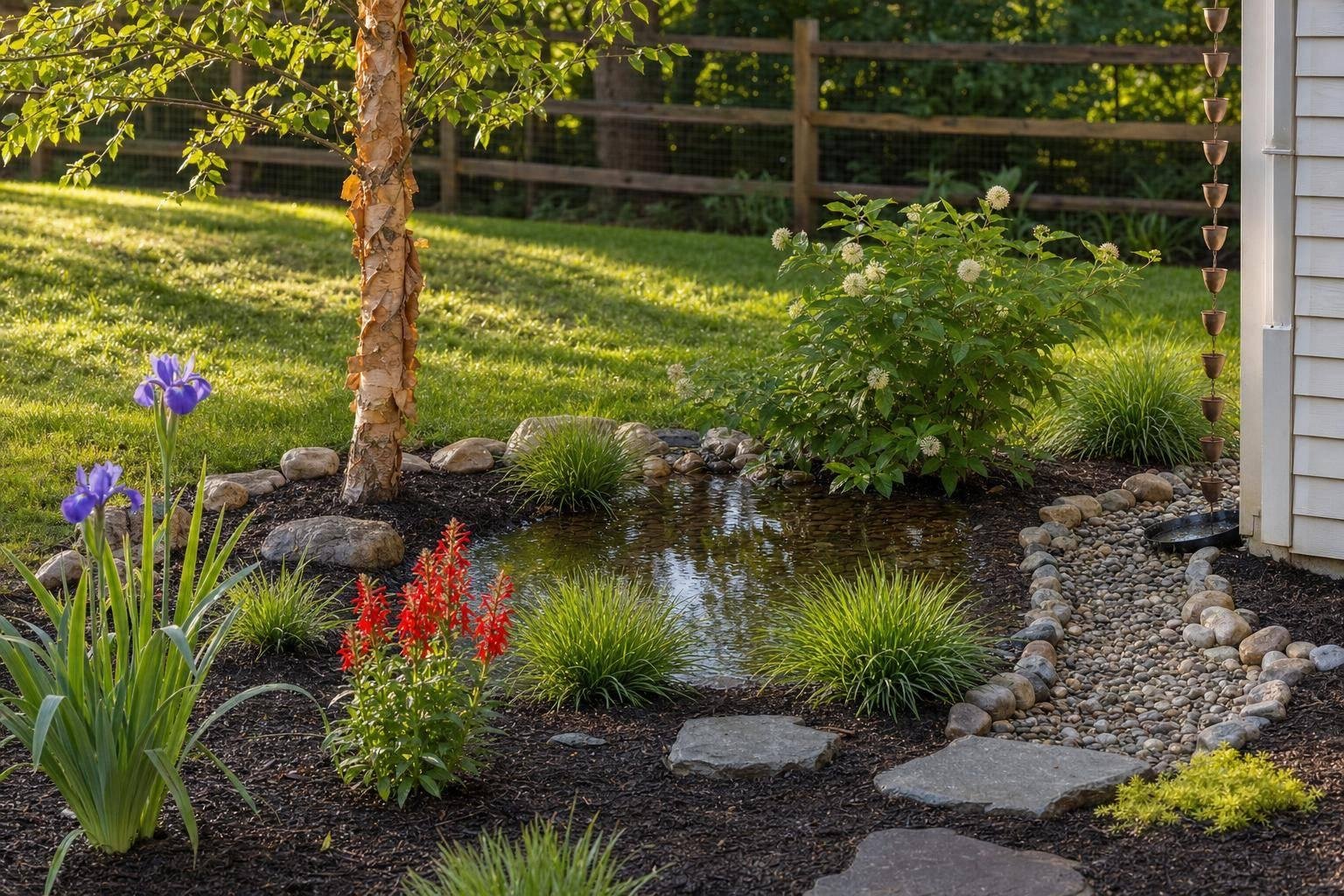
- bhavya gada
- No Comments
If water in your yard drains within 24–48 hours, many Maryland native plants can work. If it sits for more than 48–72 hours or moves toward your house, you may need drainage work first.
I’d sum up this guide like this: check how long the area stays wet, track where runoff comes from, note sun levels, and then match plants to three zones: the wet bottom, the sloped middle, and the moist outer edge. The article covers wet-area perennials like swamp milkweed, cardinal flower, blue flag iris, and white turtlehead; swale plants like tussock sedge, soft rush, switchgrass, Virginia wild rye, and broomsedge; plus shrubs and trees like buttonbush, winterberry, sweetspire, sweet pepperbush, sweetbay magnolia, and river birch.
Here’s the short version:
- Watch the site after rain at 24 hours and 48 hours
- Test drainage with a 12-inch-deep hole
- Measure sun between 9:00 a.m. and 5:00 p.m.
- Map runoff paths from downspouts, driveways, and slopes
- Use flood-tolerant plants in the basin bottom
- Use sedges, rushes, and grasses in swales and flow paths
- Use perennials, shrubs, and small trees on the moist upper edge
- Plant in clumps of 3–7
- Space most perennials 18–24 inches on center
- Give new plants about 1 inch of water per week in the first season
- Mulch 1–2 inches deep
- Cut most plants back to 6–8 inches in late winter or early spring
- Expect up to 10% plant loss in year one and replace weak plants fast
A few details matter most. Rain garden areas should usually drain within about 24–36 hours after an infiltration test. Spots that stay wet longer need plants that can handle steady saturation, such as sedges, rushes, and buttonbush. And if you see erosion, sediment, gullies, exposed roots, or water near a foundation, planting by itself may not solve the problem.
This article is mostly a field guide for picking the right Maryland natives for wet yard spots without guessing.
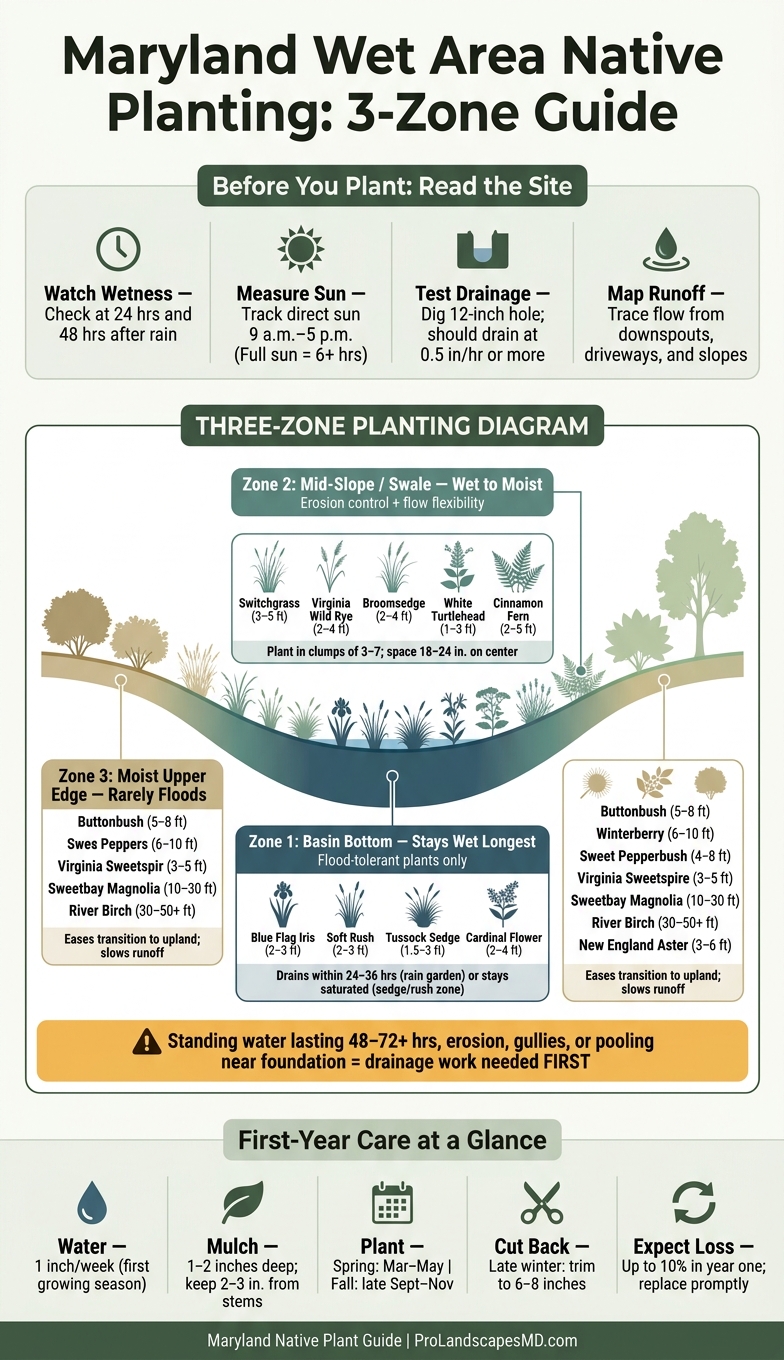
Maryland Wet Area Planting: 3-Zone Native Plant Guide
Best Bets: Native Plants for Wet Conditions
sbb-itb-843f8be
How to Check a Wet Spot Before You Plant
Before you buy plants, take a close look at the site. You want to know how long it stays wet, where the water is coming from, and whether drainage work needs to happen first.
How Long the Area Stays Wet After Rain
Start by watching what the water does after a normal rain. Check the wet spot at 24 hours and again at 48 hours. If the surface is only damp – or already dry – by 24 hours, it’s briefly wet. That kind of area usually works well for rain garden perennials and moisture-tolerant natives. If water is still pooled at 48 hours, you’re dealing with a persistently saturated spot that calls for plants such as sedges, rushes, or buttonbush.[7][6][8]
You can back that up with a simple infiltration test. Dig a hole about 12 inches deep and 6 inches wide, fill it with water, and time how fast the water drops. If it drains at 0.5 inch per hour or more and empties fully within 24–36 hours, the soil can usually support a rain garden or a similar planting.[7][9][10] If it drains more slowly, heavy clay or compacted soil may be the issue. In that case, grading or other drainage work often needs to come first.
Use what you find to divide the area into planting zones:
- The basin bottom stays wet the longest, so it needs the most flood-tolerant plants.
- The side slopes dry faster between storms and can handle plants that deal with wet-to-dry swings.
- The outer edge is only a bit wetter than the rest of the yard, so treat it as a moist but well-drained zone.[6][14][15]
Once you’ve timed how long water sits, look at light and flow. That’s what helps match the planting to the site instead of forcing the site to fit the plants.
Sun, Soil, and Runoff Direction
Track how many hours of direct sun the area gets between 9:00 a.m. and 5:00 p.m. on a clear day during the growing season. Six or more hours counts as full sun. 3–6 hours is part shade. Under 3 hours is shade. A plant that needs sun usually won’t do well in a shaded wet spot.[13][14][15][16][17]
Next, figure out where the water comes from. It may be a downspout, a driveway, or a slope higher than the yard. The easiest way to check is during rain or right after it stops. Follow the flow path and watch for rills, flattened grass, or sediment deposits. Those signs show where water is moving fastest. Keep those paths open. Use low, flexible plants in the middle of the flow channel, then thicker plantings along the sides to help hold the soil in place.[11][12]
If water sits too long or keeps heading toward a house or other structure, plants alone won’t fix the problem.
When a Planting Plan Should Be Paired With Drainage Work
Some warning signs are hard to ignore. Standing water that lasts more than 48–72 hours after a normal storm, visible erosion like gullies or exposed roots, and pooling near a foundation or walkway all point to a drainage problem that needs attention first.[3][6][8]
In those cases, the fix may include:
- grading changes
- French drains
- dry riverbeds
- other stormwater improvements
That work should happen before – or at the same time as – the planting plan. Pro Landscapes MD can help assess and address drainage issues before a planting plan goes in. When drainage is the real issue, fix the water first, then plant.
Maryland Native Plants for Wet Areas by Location
Use the plant groups below by zone: basin bottom, swale, and moist edge.
Perennials for Rain Garden Bottoms and Low Spots
The basin bottom holds water the longest, so it needs the most flood-tolerant plants.[5]
For shady low spots, royal fern (Osmunda regalis) and cinnamon fern (Osmundastrum cinnamomea) bring strong texture without flashy blooms. Cinnamon fern handles sun to shade and wet to moist soil, growing 2 to 5 feet tall, while royal fern reaches 1.5 to 6 feet in similar conditions.[26] Both work well in cooler, shaded bottom areas.
| Plant | Sun | Moisture Range | Seasonal Interest | Height | Wildlife / Function | Best Placement |
|---|---|---|---|---|---|---|
| Swamp milkweed (Asclepias incarnata) | Full sun to part sun | Moist to wet | Pink midsummer blooms | 3–5 ft | Monarch host; nectar for pollinators | Sunny basin bottom |
| Cardinal flower (Lobelia cardinalis) | Full sun to part shade | Wet to moist; brief shallow standing water | Red mid- to late-summer blooms | 2–4 ft | Hummingbirds, butterflies | Part-shade low spots |
| Great blue lobelia (Lobelia siphilitica) | Sun to part shade | Moist to wet | Blue late-summer blooms | 2–3 ft | Pollinators | Low, wet pockets with cardinal flower |
| Blue flag iris (Iris versicolor / I. virginica) | Full sun to part sun | Wet to saturated | Blue late-spring to early-summer blooms | 2–3 ft | Soil stabilization | Downspout outlets, wettest basin |
| White turtlehead (Chelone glabra) | Sun to part shade | Wet to moist | White late-summer blooms | 1–3 ft | Bumblebees; Baltimore checkerspot host | Consistently moist basin bottoms, low swales |
| Boneset (Eupatorium perfoliatum) | Full sun to light shade | Wet to periodically flooded | White late-summer flower clusters | 3–5 ft | Diverse pollinators | Low spots, slow-draining interiors |
| Golden ragwort (Packera / Senecio aureus) | Part shade to sun | Moist to wet | Yellow early-spring blooms; semi-evergreen foliage | 1–2 ft | Groundcover; weed suppression | Shallow basin edges |
| Royal fern (Osmunda regalis) | Sun to shade | Wet to moist | Textural foliage | 1.5–6 ft | Amphibian cover | Shadier low areas |
| Cinnamon fern (Osmundastrum cinnamomea) | Sun to shade | Wet to moist | Textural foliage | 2–5 ft | Amphibian cover | Shadier low areas |
Sedges, Rushes, and Grasses for Swales and Drainage Channels
Swales and drainage channels move water the fastest, so they need plants with roots that grip the soil and stems that can flex with the flow.[6][18][19][22][24] Switchgrass and broomsedge fit full-sun spots best, while Virginia wild rye can take part shade.[6][22][24]
| Plant | Best Position | Moisture Range | Mature Height | Erosion-Control Role |
|---|---|---|---|---|
| Tussock sedge (Carex stricta) | Swale bottom | Often saturated | 1.5–3 ft | Dense tussocks trap sediment and form micro-pools |
| Soft rush (Juncus effusus) | Swale bottom, base of downspouts | Saturated to wet | 2–3 ft | Flexible stems and dense root mat stabilize concentrated flow |
| Switchgrass (Panicum virgatum) | Lower and upper banks | Moist to occasionally dry | 3–5 ft | Deep fibrous roots hold soil and slow sheet flow |
| Virginia wild rye (Elymus virginicus) | Bank, semi-shaded channel | Moist to periodically wet | 2–4 ft | Fibrous roots stabilize slopes and establish quickly |
| Broomsedge (Andropogon virginicus) | Upper bank and shoulder | Moist to dry | 2–4 ft | Holds drier slopes and provides winter cover |
Flowering Edges, Shrubs, and Small Trees for Moist Upper Zones
The outer edge stays moist but does not flood often, which makes it a good fit for flowering perennials, shrubs, and small trees that help slow runoff and ease the shift to upland planting.[6][18][20][21][23][25][2] Winterberry needs both male and female plants for strong fruit set, and river birch is best saved for larger rain gardens.[18][2]
| Plant | Type | Sun | Moisture Range | Mature Size | Seasonal Interest / Function | Best Use |
|---|---|---|---|---|---|---|
| Beebalm (Monarda didyma) | Perennial | Sun to part shade | Moist | 2–4 ft | Red summer blooms; hummingbirds and bees | Outer rain garden ring, swale sides |
| New England aster (Symphyotrichum novae-angliae) | Perennial | Full sun to part sun | Moist to average | 3–6 ft | Purple-pink late-summer to fall blooms; late-season nectar | Sunny upper edges |
| Ironweed (Vernonia noveboracensis) | Perennial | Full sun | Moist to wet | 4–7+ ft | Purple late-summer blooms; butterflies | Back of rain garden, property edges |
| Blazing star (Liatris spicata) | Perennial | Full sun | Moist | 3–5 ft | Purple midsummer flower spikes; pollinators | Moist, sunny upper zones |
| Virginia sweetspire (Itea virginica) | Shrub | Part shade to sun | Moist to occasionally wet | 3–5 ft | Spring bottlebrush flowers; fall color | Upper rain garden slopes |
| Sweet pepperbush (Clethra alnifolia) | Shrub | Part shade to sun | Moist to wet | 4–8 ft | Fragrant white mid- to late-summer blooms | Semi-shaded edges, moist hedges |
| Winterberry (Ilex verticillata) | Shrub | Sun to part shade | Moist to wet | 6–10 ft | Red berries in fall and winter; birds | Property edges, back-of-rain-garden screens |
| Buttonbush (Cephalanthus occidentalis) | Shrub | Sun to part shade | Wet; tolerates periodic standing water | 5–8 ft | Spherical summer flower clusters; pollinators | Transition zone between basin and upland |
| Sweetbay magnolia (Magnolia virginiana) | Small tree | Sun to part shade | Moist to wet; tolerates some flooding | 10–30 ft | Fragrant white late-spring flowers; semi-evergreen in milder areas | Backdrop planting near wet areas |
| River birch (Betula nigra) | Tree | Full sun to part sun | Moist to wet; tolerates periodic flooding | 30–50+ ft | Exfoliating bark; year-round interest | Larger rain gardens and property edges |
Use these zone matches to shape the planting layout by height, spread, and water tolerance.
How to Design and Maintain a Wet-Area Native Planting
Arrange Plants by Height, Spread, and Water Depth
Once you’ve matched plants to the right wet zone, the next step is layout. A simple way to do it is to divide the area into three parts: basin bottom, mid-slope, and upper edge.
Put taller shrubs and small trees at the back of a border or in the middle of an island bed. Place medium-height perennials and grasses on gentle slopes. Use shorter plants, sedges, rushes, and groundcovers along the outer edges so runoff can move in and out without getting blocked. Keep inlets, outlets, and overflow notches open.
Plant each species in clumps of 3–7. That helps roots knit together, cuts erosion during summer storms, and improves water movement and erosion control across the planting.[34]
Planting and First-Year Care in Maryland
After the layout is set, timing and spacing do a lot of the heavy lifting. In Maryland, plant in early to mid-spring, from March through May, or in early to mid-fall, from late September through early November. Spring planting takes advantage of warming soil and steady rain. Fall planting gives roots time to settle in before summer heat hits.
Space plants based on their mature spread, not the size of the nursery pot. Most wet-area perennials and grasses, like blue flag iris or soft rush, do well at 18–24 inches on center and usually fill in within 2–3 seasons. Shrubs such as winterberry holly or red chokeberry usually need 4–8 feet between plants, depending on their full width. Stagger rows instead of planting in straight lines so roots interlock and the bed looks more natural.[34]
Even in a spot that stays moist, new plants still need extra water while their roots are stuck in the original potting soil. Aim for about 1 inch of water per week, including rainfall and irrigation, during the first growing season. Pay close attention during the first 6–8 weeks after planting.[29][30] Check soil moisture by probing 2–3 inches down near the roots. If the soil feels dry at that depth, water slowly at the base of each plant.
Use 1–2 inches of shredded hardwood mulch between plants. Keep the mulch 2–3 inches away from stems, and don’t let it block inlets or outlets.[27][28][31]
Long-Term Upkeep and Adjustments
After the first season, the focus shifts. Watering becomes less important, and weed control and seasonal cutback take center stage. The first 1–3 years usually need the most weeding, often every 2–4 weeks during the growing season, so aggressive nonnative plants don’t crowd out young natives before they settle in.
Do the main cutback in late winter to very early spring, while plants are still dormant. Cut most herbaceous perennials and grasses back to 6–8 inches, but leave some upright stems and seed heads standing through winter for birds and beneficial insects.[32][33] Do not fertilize a rain garden or wet swale.[32]
As the planting fills in, storms will show you how well the drainage plan is working. After major storms, check for:
- Ponding that lasts more than 24–48 hours in spots that are supposed to drain
- New erosion scars
- Sediment buildup near inlets
If ponding keeps lasting beyond 48 hours, replace the top few inches of soil to improve infiltration.[31][13]
It’s normal to lose up to 10% of plants in the first year. Replace weak or failing plants right away instead of waiting to see if they bounce back.[4]
If ponding, erosion, or foundation runoff keeps happening after replanting, Pro Landscapes MD can assess the drainage and revise the planting plan.
Conclusion: Match Your Plants to the Water
After you check wetness, sun, and drainage, the last step is picking plants that fit the site. Start by reading the area before you plant anything. Look at how long water sits after rain, where runoff comes in, where it leaves, and how moisture changes from the low center up to the higher edge. Those details tell you which Maryland natives are most likely to do well.
The goal is simple: match plants to each moisture zone. Put the right plants in the wettest bottom, the transition slope, and the moist upper edge. Root type, mature size, and moisture tolerance all need to line up with the conditions in each part of the bed. That’s what makes the planting hold up over time.
Once those zones are mapped out, water still needs a clear path through the bed. Keep inlets and outlets free of mulch, debris, and overgrowth. Sedges, rushes, and native grasses help hold swales in place without blocking flow.[1]
That’s also why sizing and upkeep matter. If grading or runoff keeps creating wet spots, drainage work and planting should be planned together. Pro Landscapes MD handles drainage installation, French drains, grading, yard leveling, and planting across central Maryland when drainage and planting need to work together.
FAQs
How do I know if my wet spot needs drainage work first?
If water sits in the same spot for more than 24 hours after rain, that’s usually a sign the area needs drainage work before anything else.
Pay attention to the area during and after heavy rain. Look for signs like:
- Pooling water
- Slow drainage
- Erosion
- Sediment buildup
- Compacted soil
If water gathers near your home’s foundation, or the slope keeps water from flowing away on its own, you may need grading, French drains, or dry riverbeds.
Which native plants handle standing water best?
Choose native plants that handle saturated soil well. Pickerelweed, soft rush, and blueflag iris are good picks for spots that stay wet all the time, like the lowest parts of rain gardens and pond edges. They can grow in up to 6 inches of standing water.
For areas that stay moist or flood from time to time, swamp milkweed, New York ironweed, and Eastern narrow-leaved sedge are also good options. These plants can help slow runoff, filter pollutants, and support the local ecosystem.
How should I plant and space natives in a wet area?
First, figure out the moisture zone. Permanently wet spots, like the bottom of a rain garden, need plants that can handle saturated soil. Areas that are only wet part of the time, especially at soil grade, can support a broader mix of native plants.
It also helps to space plants based on their mature size, not how they look in the pot. New York Ironweed should go about 3 to 4 feet apart. Milkweed grows best in groups of 3 to 5 plants, with 18 to 24 inches between each one.
Chat with Us